
What is faith?
Most people hear that word and immediately place it in the wrong category. They think faith belongs to religion alone. They think it means believing what cannot be proven. They think it means closing your eyes, accepting dogma, and calling your refusal to question things a virtue.
But that is not faith.
That is belief.
And sometimes it is not even belief in the noble sense. Sometimes it is merely the desire for certainty dressed up in religious language.
Faith, as I am using the word, is something much more powerful. Faith is not the abandonment of logic. It is a method of knowing. It is the mind’s willingness to follow observable effects into the unknown realm of their causes.
It is not the enemy of reason.
It is one of the engines of reason.
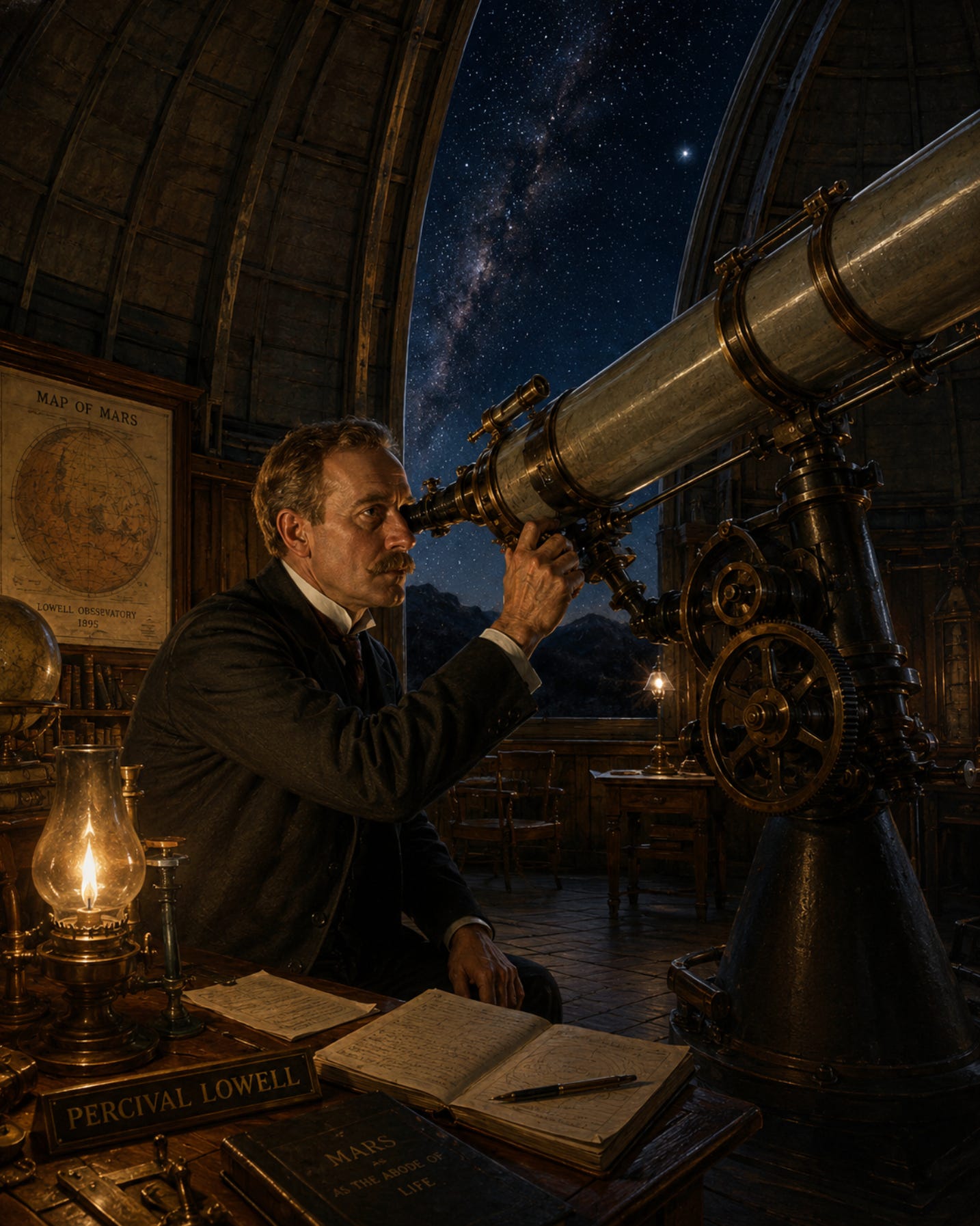
A good example is Percival Lowell and the search for Planet X.
Lowell was an astronomer and mathematician who studied apparent anomalies in the orbits of Uranus and Neptune. Something seemed to be disturbing them. Something unseen appeared to be exerting influence. Lowell concluded that another planet, which he called Planet X, must exist beyond Neptune.
No one had seen it.
No telescope had confirmed it.
No photograph had revealed it.
But Lowell believed the evidence pointed toward it. More than that, he believed the mathematics required it. Something unseen was making itself known through visible effects.
This is important.
Lowell did not simply “believe” in another planet the way a person might believe in a comforting idea. He was not inventing a fantasy to soothe himself. He was working from evidence. He saw an effect and inferred a cause.
That is faith in the sense I mean it.
It is the conviction that what is seen may point to what is not yet seen.
Years later, Clyde Tombaugh discovered Pluto while carrying forward the search for Lowell’s Planet X. For a time, it seemed that Lowell had been vindicated. The unseen planet had been found. The hidden cause had emerged into visibility.
But then the story became more interesting.
Further investigation showed that Pluto did not have enough mass to account for the orbital anomalies Lowell had been studying. Pluto was real, but it was not the cause Lowell had imagined. His theory was wrong, or at least incomplete. The thing he found was not the thing he thought he was looking for.
And yet he still found something.
That is the part we should not miss.
A mistaken theory led to a real discovery.
This happens more often than we realize. Scientific and medical history are full of discoveries that began with incomplete assumptions, faulty models, mistaken explanations, or guesses that did not quite land where their originators expected. But the original movement was still valid: observe an effect, infer a cause, pursue the hidden source, and be willing to correct the theory when reality answers back.
That is not blind belief.
That is disciplined faith.
It is foolish to look at a wall and declare that nothing exists on the other side simply because you cannot see through it. You may not know what is there. You may guess wrongly. You may imagine a room and find a hallway. You may expect a person and find a machine. You may expect one cause and discover another.
But it would be irrational to say that reality itself stops at the wall.
This is why faith, properly understood, belongs less under the heading of theology and more under the heading of epistemology. Epistemology is the study of how we know what we know. And faith, in its deepest sense, is one of the ways knowledge begins.
It begins when we encounter an effect whose cause is hidden.
Science does this constantly. It does not limit itself to what is already visible. If it did, science would never have come into existence. Science looks at the visible world and asks what invisible causes might explain it. It infers fields, forces, particles, structures, relationships, and laws from their effects.
Science does not say, “We cannot see it, therefore it is not there.”
Science says, “Something is happening. What could be causing it?”
That is the movement of faith.
The problem is that the word faith has been so badly handled that many intelligent people now recoil from it. They have seen faith used as a shield against inquiry. They have seen people use faith to avoid questions, protect dogmas, defend inherited beliefs, or pretend to know what they have never honestly investigated.
That is not faith.
That is the misuse of faith.
Real faith does not thwart discovery. It makes discovery possible.
The person who says, “I already know the answer, and no evidence can change my mind,” is not practicing faith. He is practicing fear. He has built a wall of belief and then proudly announced that nothing exists beyond it.
Religious people do this.
But so do secular people.
The religious person may say, “My doctrine explains everything, so I do not need to look any further.”
The secular materialist may say, “Matter explains everything, so I do not need to look any further.”
Both have stopped inquiring.
Both have replaced discovery with certainty.
Both have parked an explanation in front of the mystery and called the matter settled.
But reality is not settled by our explanations.
Reality is what our explanations are trying to reach.
This brings us to the greatest observable effect of all: existence itself.
We are here.
The world is here.
The universe is here.
Consciousness is here.
Order is here.
Beauty is here.
Moral awareness is here.
The question is not whether these things exist. The question is: What are they effects of?
What is the cause of existence?
What is the source of consciousness?
What is the ground of order?
What is the origin of the intelligibility that makes science possible in the first place?
This is where the word “God” enters the conversation. For many people, God is the name given to the First Cause, the ultimate source from which everything else proceeds.
But here again, we must be careful.
What if our theory of God is wrong?
Not wrong in the sense that there is no ultimate source, no divine reality, no First Cause. But wrong in the sense that what we have called “God” may be much greater, stranger, deeper, and less anthropomorphic than our inherited images suggest.
What if God is not the white-haired elder on a throne?
What if that image is not faith at all, but fantasy?
What if it is a symbolic placeholder that some people have mistaken for the Reality itself?
This is where real faith must remain open.
Faith does not mean clinging to a picture of God that makes us comfortable. Faith means following the evidence of existence into the mystery of its cause. It means refusing to confuse the symbol with the source, the doctrine with the reality, the image with the living truth.
Lowell thought he was looking for one thing and found another.
That may be a better model for theology than many theologians would like to admit.
Humanity has always looked at the world and sensed that something is causing it, sustaining it, informing it, or expressing itself through it. We have given that something names. We have made images. We have built doctrines. We have told stories. Some of those stories are profound. Some are crude. Some are luminous. Some are childish.
But the deeper question remains.
What is actually there?
What is the real source behind the observable effect of existence?
Modern science is not finished with this question. Far from it. Some theories now suggest that physical reality may be far less solid than it appears. The holographic principle, for example, raises the possibility that the three-dimensional world we experience may be related in some deep way to information encoded at a more fundamental level.
Whether that theory proves correct or not, it points to something important: the world may not be what it appears to be.
The “solid” universe may not be solid in the way common sense assumes.
Matter may not be ultimate.
Space itself may not be ultimate.
What we call physical reality may be the surface expression of something more fundamental.
A mystic hears this and does not feel threatened.
A mystic says, “Yes. Keep going.”
Because faith, real faith, is not afraid of discovery. It is not afraid if our images break. It is not afraid if our theories have to be revised. It is not afraid if the old man on the throne gives way to something more radiant, more subtle, more intelligent, more intimate, and more real.
What faith cannot tolerate is the substitution of fantasy for inquiry.
Fantasy says, “I have imagined something, therefore it is true.”
Faith says, “I see something real, and I am willing to follow it into the unknown.”
Fantasy begins with an image and protects it.
Faith begins with reality and investigates it.
Fantasy fills the mystery with projections.
Faith allows the mystery to reveal itself.
That is the difference.
Faith is not dreaming up a hypothetical version of what we already know. It is not taking human authority, human kingship, human personality, and human architecture, then projecting them into the sky and calling the result God.
That may have symbolic value. It may serve the religious imagination. But if we mistake the symbol for the Reality, we stop discovering.
And when discovery stops, faith dies.
Real faith starts with what can be known.
It starts with the existence of the world.
It starts with consciousness.
It starts with order.
It starts with beauty.
It starts with moral law.
It starts with the strange fact that reality is intelligible to the human mind.
Then it asks: What must be true for these things to be true?
That is a different kind of question.
It does not begin with fantasy. It begins with evidence.
It does not abandon logic. It extends logic into the unknown.
It does not claim that our first theory must be right. It admits that our theory may need correction. But it refuses to deny that the effect must have a cause.
Whatever the ultimate cause is, it has to be there.
We may name it badly.
We may picture it crudely.
We may theologize it prematurely.
We may mistake Pluto for Planet X.
But none of that removes the deeper fact: something is causing the effect.
The task of faith is not to stop at the first answer.
The task of faith is to keep going.
Faith is not the wall we build to protect our beliefs.
Faith is what tells us there is something beyond the wall.
It is not the refusal to know.
It is the beginning of knowing.
And if we are willing to follow it honestly, it may lead us past our fantasies, past our inherited images, past our premature certainties, and into a reality far greater than anything we first imagined.
No posts
Comments
Nothing yet. Say the first thing.
Sign in to join the conversation.