
Note: I wrote every single goddamn word of this directly into Substack’s editor, so spare me the “you’re not a real writer” rhetoric.
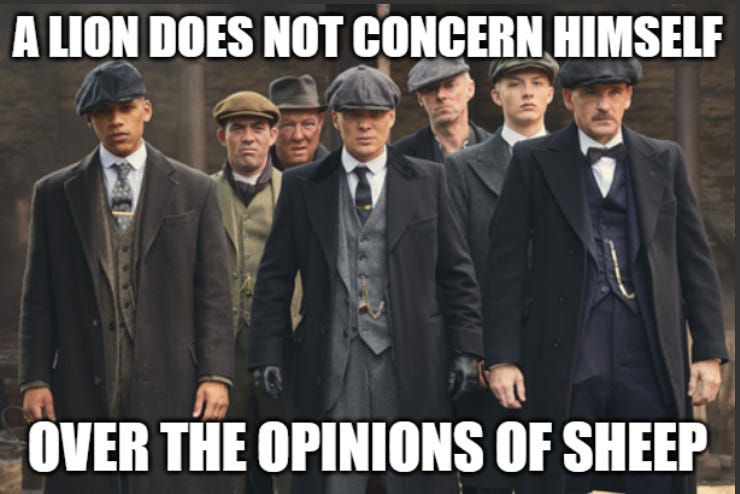
You’ve probably seen them at some point on social media; a meme of some hyper-masculine imagery declaring the poster’s assertion that unlike the weak-minded or weak-bodied out there in the world, THEY are powerful and strong. The image might contain a lion or a wolf or some other animal, but it is quite often paired with some image of Cillian Murphy in his role on “Peaky Blinders”, ironically, given that Thomas Shelby is a man who responds with violence and rage to the overwhelming responsibilities he feels as his life is slowly torn apart piece by piece.
The quote in question, of course, “The lion does not concern himself with the opinions of the sheep”, is not from Peaky Blinders at all. It’s spoken by Tywin Lannister in “Game of Thrones”, where he also drops this bit of wisdom:
Any man who must say, "I am the King", is no true king.
The message is simple: those who hold true authority have no need to broadcast it. It simply is. They don’t have to say they are strong. They are. They don’t have to say they’re a leader. They lead. The propensity to loudly proclaim threat when frightened is so common in the animal kingdom that sayings like “All bark, no bite” are practically truisms. There are a million street fight videos on YouTube showing some loud obnoxious drunk yelling in the face of someone who is calm and ready, and who, in the moment of violence, responds only as much as is needed to end the fight.
“You love to run your mouth on the internet, hope you keep the same energy when it’s crunch time” - Joyner Lucas, “ISIS”
This propensity is often associated with a number of traits considered weak from the perspective of patriarchal masculinity. “Napoleon complex” or “Short guy complex” have been in common parlance ever since Napoleon was smeared about his height, but in modern terms, it’s often referred to as SDE.
SDE (“small dick energy”) is the counterpart to BDE (“big dick energy”). It associates penis size with strength and competence, and quiet demonstrations of confidence are considered signs of BDE. And yes, while penis size has literally nothing at all to do with any of those other traits, that mode of language is deeply pervasive, even among those who consider themselves feminist or otherwise anti-patriarchal. What a big truck, you must be compensating for something. Oh, you like guns? Sorry about your penis.
A thing does not have to be accurate or true to be a commonly used expression about traits of human behavior.
Which brings us, at last, to the vocally anti-AI, and, most especially, a certain class of them: the Dolores Umbridges of the creative world who would give anything to make writers who use AI in their work carve their sins into their flesh, or at the very least, let another AI do it for them.

It’s especially ironic that the Venn diagram of people who lament the “manosphere” and people who clutch their pearls about AI usage is remarkably circular, given that they both radiate SDE. Overwhelmingly lower middle class white males are barking so loudly because they fear that they are low value and weak, and their insecurities drive them to overcompensate. Overwhelmingly mediocre creators with small audiences of limited reach and engagement and little commercial value are barking so loudly because they fear that their work is at risk of being overshadowed with little effort by more imaginative people with less technical creation ability. Both are so rabid because they think they are fighting for their survival, and perhaps rightfully so.
For the manosphere types, the solutions to these problems are internal. Looksmaxxing, leg stretching and other extreme heightening methods, penile injections and other bizarre surgical interventions (one might even call them “gender-affirming healthcare”, but that’s a whole other post). And yes, guns and big trucks that “roll coal” or whatever. Anything that gains them cachet in the eyes of adolescents and similarly maladapted adults.
For the anti-AI crowd, however, that energy is all aimed outwards. They want to label and shun, to close ranks in insular tribalism. “You’re not good enough to be here.” Or “you’re not a writer at all”. Their barking isn’t intended to make their writing look better, it’s to make sure that yours doesn’t get seen at all. Because if it IS seen, then they have to compete on substance, and they are absolutely terrified of that. They think that “100% human written” should grant them special dispensation, should let them be treated as a privileged class, because their deepest darkest fear is that they’re not good enough to stand out when everyone can be a writer.
SDE.
This is also why their arguments only exist in binaries. There is no “I edit with AI” or “I organize bullet points into a draft with AI” or “I revise a very rough draft into a strong first pass with AI”. There are only their own pristine shining examples of artisan hand crafted sentences against the barbarian hordes of mindless AI slop. Never mind that their work is trite, cliche, contrived; that it makes Stephenie Meyer’s writing look like Shakespeare. THEIR formulaic slop is HUMAN formulaic slop, and that should somehow matter to the reader, for reasons.
Pro-tip: the difference between SDE and BDE is not an actual phallic measurement; it’s the calm confidence that comes from knowing who you are, and being good at what you do, something that generally requires commitment and time to hone your skills with practice. If your response to not winning the contest is to try to disqualify other competitors, you’re looking in the wrong direction.
Instead of barking loudly, have you tried writing something interesting?

No posts
Comments
Nothing yet. Say the first thing.
Sign in to join the conversation.