
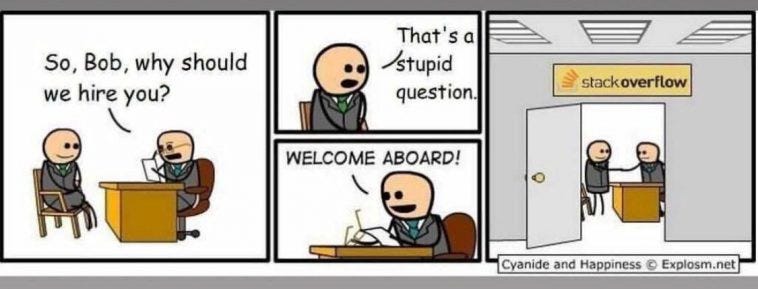
15 years ago, if you were a junior developer trying to learn code, your options were limited. You could rtfm, (and many of us spent countless hours on php.org or the MSN developer sites trying to make sense of the recommendations and guides), or you could go to an emerging developer hub called StackOverflow. It used a community recommendation engine like Reddit, and supported a broad range of questions across a broad range of languages. If you were working in some esoteric language like TCL, you could probably find others there who were as well.
The site became so popular that over time, it became a meme that baby devs would simply go there to copy code for their work projects, and that the internet ran on copy pasted code from SO. However, over time, a different meme formed: that of the gatekeeper. Because of that community engine, scoring and user ranks became weaponized, driving the site towards insularity. Fewer and fewer new users could get any value out of the site, because junior level questions were immediately downvoted to a negative score, limiting their visibility, and the answers they did get were often condescending and unhelpful, either recommending an alternative approach that was more popular, but completely ignored the user’s actual context, or directly insulting, instructing the user to learn to code, or providing links to training as a response.
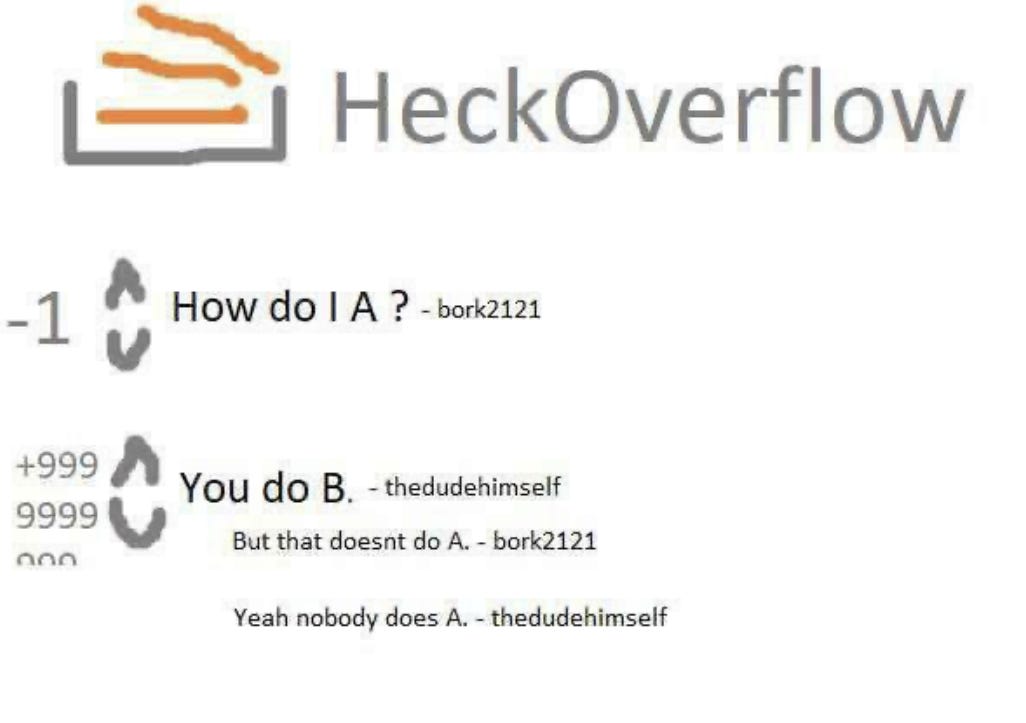
Over time, this second meme became the predominant view of the site and its culture; elite tier neckbeard nerds using their niche influence as power users of a technology site to to rain down condescension on users who didn’t know how to ask a question in a form that they considered worthy. The site became unusable to everyone except the people who didn’t actually need it.
It should surprise absolutely no one that when ChatGPT became capable of answering coding questions, junior developers flocked to it immediately. Its ability to interpret development requests made in natural language, combined with its sycophantic soft touch conversational style, meant that the abuse people learning to code had been expected to endure as a form of industry hazing was no longer a requirement. You don’t have to deal with assholes on the internet trying to debug a piece of code, you can just get an answer with a patient explanation from an encouraging voice. Hell, you don’t even have to look dumb in front of your senior developer supervisor. You’re able to debug the problem, and get your code to work.
And despite all of the various schools of thought and engineering disciplines and essays on technical debt, the industry runs on code that works.
The impact on the gatekeepers of software development has been dramatic:
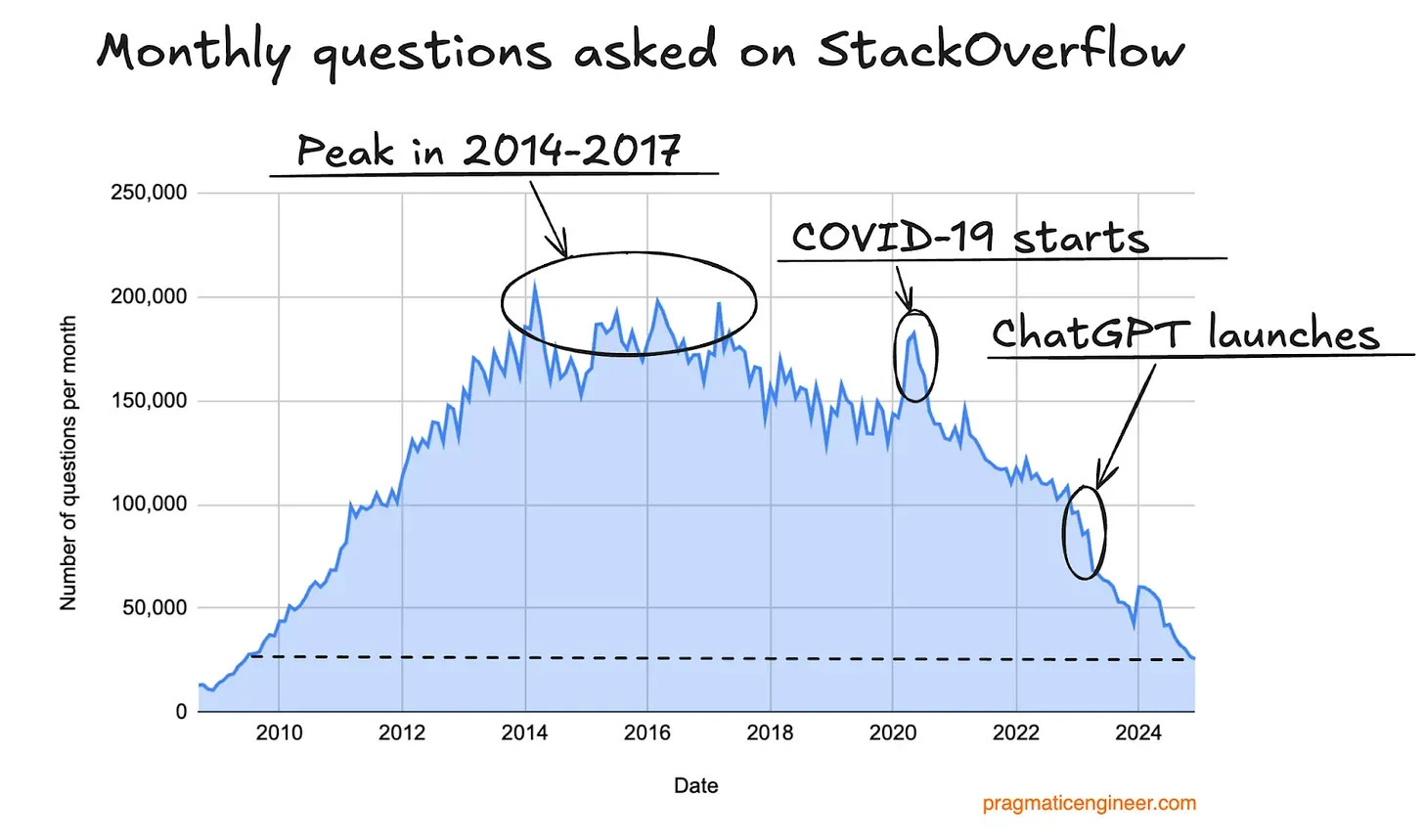
The fall off from the peak of usage beginning in 2017 was a result of developers beginning to use the site less specifically because of how toxic the culture had become there, and how the site was functionally becoming less useful. A brief surge of usage when Covid started, and more people began exploring software development as a career option that could be worked remotely, fell off quickly for the same exact reason: hostility to newcomers.
But the real dramatic decline begins with the launch of ChatGPT. When end users no longer have to deal with shitty gatekeepers, they stop. Of all of the types of work most impacted by the rise of LLMs, technology gatekeeper will be the first to become fully extinct, and deservedly so. And when people DON’T have to deal with pretentious purist assholes to engage with a technology, they’re more likely to do so.
In my 25+ year career as a software developer, I have spent countless hours trying to help people new to the space learn and improve, not because I’m some saint of education, but because I think what I do is cool, and I love it when other people get excited about it too. There is a magic of creation that happens when you run code and see your idea come to life, and I like sharing that with others. And now that LLMs make it possible for people with very little experience or development knowledge to fully create and launch their own software, there is a much broader audience of new creators to share that with. People who would have never even vaguely considered building an application in the past now pause for a moment when offered the option, and think “Well, sure, I guess so. Let’s give it a shot.”
The platforms that are winning from this evolution are the ones who make it easy for new users to engage; Github, Vercel, and other platforms with easy onboarding and automation become the de facto landing pads for users who couldn’t care less about how they work, only that they do. The platforms that are losing are the ones trying desperately to hang on to the old paradigm, and enforce boundaries that no longer exist.
There’s still a lot for vibe coders to learn; the principles of software engineering never go away, and there have been a number of high priority horror stories illustrating how important it is to understand things like software security, scalability, etc. But the current landscape enhances the impact of experts willing to patiently teach those higher level concepts.
For the gatekeepers, however, the story is entirely different: much like printing press opened up a world where information was broadly accessible to the common man, consumer level AI has made technology trivially accessible to non-engineers. The gatekeepers are on the verge of extinction.
The ghost of my baby dev self is celebrating.
No posts
Comments
Nothing yet. Say the first thing.
Sign in to join the conversation.