
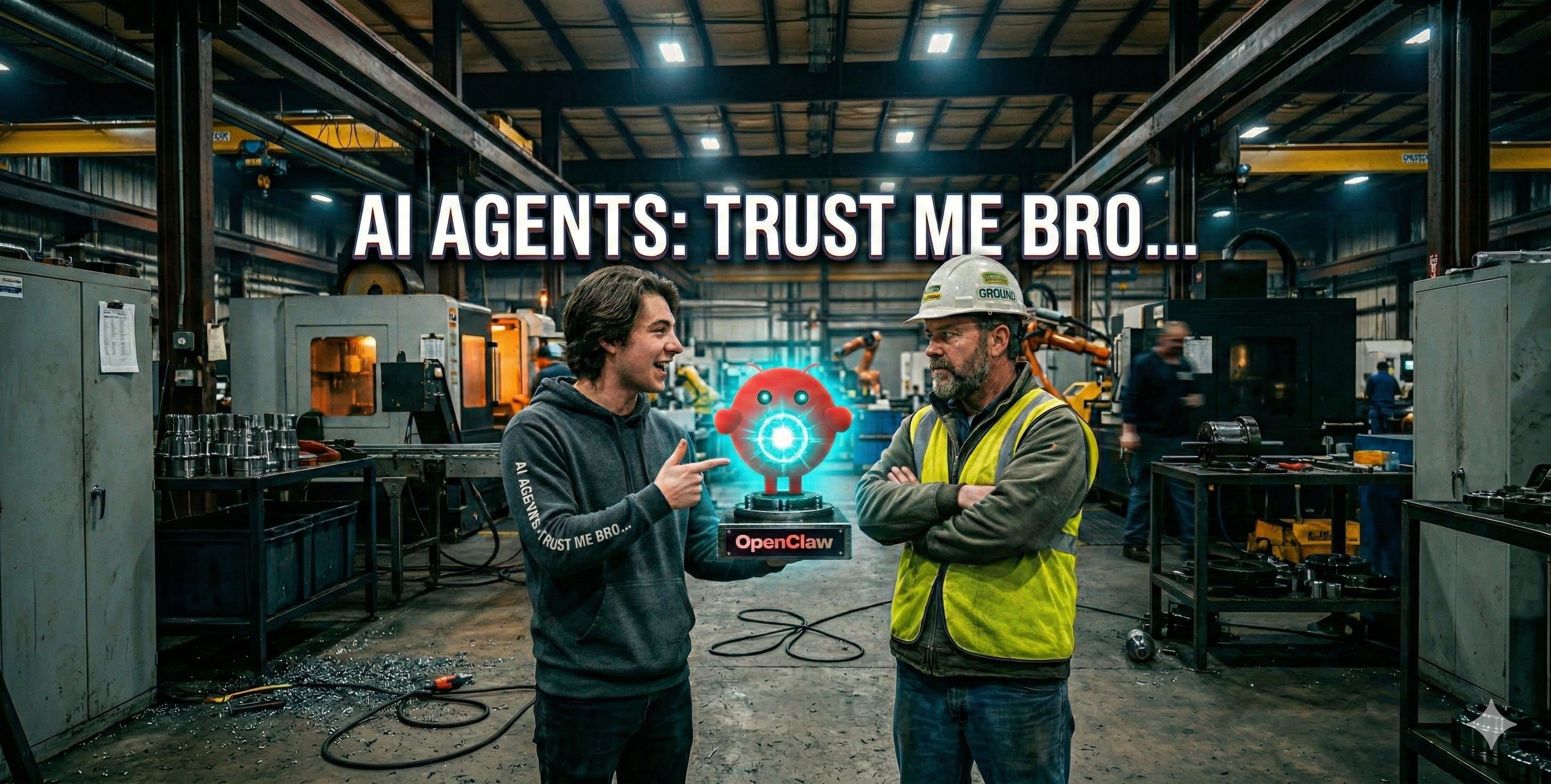
Generated using Google Nano Banana 2
If you follow the news, X-influencers or “YouTube bro’s” you’d think that AI and Agents are everywhere, and that if you haven’t already let go of half your workforce and replaced them with AI, you’re a dinosaur just waiting to be “extinctified” by that AI-comet that is about to crash.
While we here at MachinEdge do see long-term promise in this technology, we feel right now most of the information out there is hype. Hype that is being fueled by a focus on short-term shareholder value, companies seeking to maintain relevance, and an explosion of people racing into the gold rush to sell you an AI readiness audit or agentic worker development service, all for a low monthly fee. To be fair, some of these folks are doing good work. But the signal-to-noise ratio right now is brutal, and even well-intentioned advice can steer you wrong if the person giving it doesn’t understand your machines, your floor, or what happens when the internet goes down at 2 AM on a Saturday.
Here’s what we actually know. According to Deloitte and KPMG’s own surveys, only about 1 in 4 organizations had AI agents in production by end of 2025, and most are large enterprises with dedicated teams and seven-figure budgets. Gartner predicts that over 40% of current agentic AI projects will be cancelled by 2027. And researchers at WebArena benchmarked the best AI agents on real-world tasks, the top performers succeeded less than half the time.
What this leads us to believe is that most organizations who think they’re ahead are mostly just spending ahead. So, being thoughtful right now is not being late. It’s being smart.
Most often we’ve seen strategies and infrastructure built on a single provider where all your data, all your logic, all your intelligence runs through someone else’s infrastructure. On March 2nd 2026, Anthropic’s Claude went down for nearly three hours. On December 5th 2025, Cloudflare (the infrastructure behind 20% of all websites) went down and took Zoom, LinkedIn, Spotify, and Shopify with it. That was their second major outage in 17 days.
Another way to think about this, if your machine’s troubleshooting system, your SOP library, or your work order automation depends on a cloud API to function, or cloud intelligence, you’ve inherited someone else’s single point of failure. For a marketing team, that’s an inconvenience. For a production line, it’s hundreds or thousands of dollars per minute.
Add to this the data privacy question. Who owns your machine data, your tribal knowledge, your process IP when it’s sitting in someone else’s cloud? You can start to see why “just plug in an AI” isn’t a strategy. It’s a liability.
Here’s the good news: you don’t need to boil the ocean. You don’t need a massive AI transformation. You need to start by doing three things well.
1. Map your data infrastructure — all of it.
From the PLC on the floor to the ERP in the back office to the CRM up front. Where does data live? How does it flow? Where are the gaps? You can’t automate what you can’t see, and most companies are surprised by what they find when they actually draw the map. This isn’t an AI project, it’s basic operational hygiene that will pay dividends regardless of what technology you adopt.
2. Identify where you need to keep things in-house.
Not everything needs to run in the cloud. Your mission-critical troubleshooting system? Your maintenance SOPs built from decades of tribal knowledge? These should work when the internet is down, when the VPN is flaky, and when corporate IT is still reviewing your cloud security questionnaire from six months ago. Think about what needs to run in a “black-out” scenario where no internet is no problem, and design for that first.
3. Apply what you already know about automation.
If you’re in manufacturing, systems integration, or machine building, you already know how to break a process into rules, process automation, and decision logic. AI agents aren’t a new problem, they’re a new tool that unlocks more decision-making capability. The same discipline you apply to PLC programming, alarm management, and HMI design applies here. Break apart the problem. Define the boundaries. Keep humans in the loop for the decisions that matter. The technology is new, but the engineering thinking is yours.
We’re working with machine builders and sys
tems integrators in New England on exactly these problems, and helping them build AI infrastructure that’s robust, resilient, and designed to run when the cloud can’t. If any of this resonates, we should talk.
MachinEdge, LLC | www.machinedge.io | info@machinedge.io
Want to dig deeper? Here are the primary sources behind the numbers in this piece:
Comments
Nothing yet. Say the first thing.
Sign in to join the conversation.