
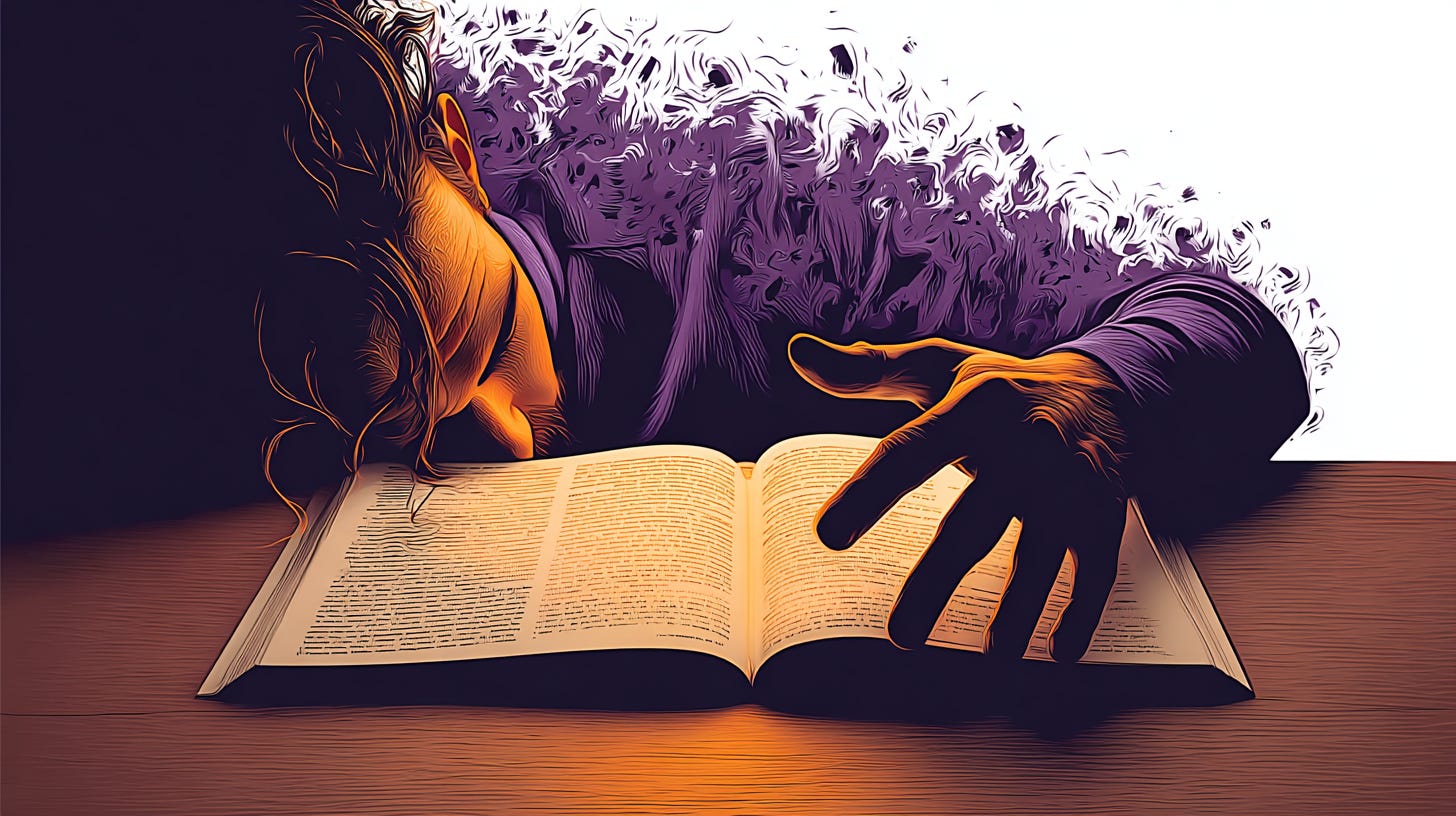
This is Part 7 of an eight-part series on the architecture of villainous protagonists. In Part 6: Redemption’s Ghost, we watched Snape frozen at the moment of his greatest mistake, Jimmy McGill surrendering to Saul Goodman, and Stevens standing outside Miss Kenton's door, listening to her cry. They could all see the light. None of them could reach it. Now the essay stops looking at them — and starts looking at us.
Now we reach the heart of the crime scene, and the chalk outline on the floor is our own.
We’ve traced the antihero’s seductions, mapped their moral systems, felt their charisma, watched their contamination spread, plumbed their false bottoms, glimpsed redemption’s ghost. But there’s one character we haven’t examined, one whose corruption enables all the others: the reader. Us. The ones who turn pages when we should turn away, who lean in when we should recoil, who root for monsters while telling ourselves we’re just observing.
The antihero’s ultimate trick isn’t making us watch—it’s making us complicit. Through perspective and pacing, through structure and silence, through the intimate contract between writer and reader, we become not audience but accomplice. We don’t just witness crimes; we participate in them. We don’t just understand evil; we practice it, if only in the safe space of our imagination, if only for the duration of our reading. But practice makes perfect, and every page we turn is a small yes to darkness.
Vladimir Nabokov knew exactly what he was doing when he structured Lolita as Humbert Humbert’s address to the jury. “Ladies and gentlemen of the jury,” the novel begins, and with those words, we’re trapped. We’re not readers anymore—we’re jurors, and our verdict matters. Every page becomes evidence, every beautiful sentence an argument for the defense, every moment of revulsion a test of our judgment.
But Nabokov’s trap goes deeper. Humbert doesn’t just address us; he seduces us with language so beautiful it becomes its own moral problem. “Lolita, light of my life, fire of my loins. My sin, my soul. Lo-lee-ta: the tip of the tongue taking a trip of three steps down the palate to tap, at three, on the teeth.” The prose is gorgeous, musical, unforgettable. We find ourselves savoring sentences that describe the destruction of a child, admiring wordplay that enables abuse.
This is complicity through aesthetics. Our pleasure in Humbert’s language makes us participants in his crime. We can’t claim distance—we’re right there with him, feeling the alliteration on our tongues, noting the rhythm of his sentences. When he describes “the tangle of two bodies, and the slow-motion, silent explosion of love,” we respond to the poetry before remembering what it describes. Our aesthetic sense betrays our ethical sense, and in that betrayal, Nabokov shows us something terrible about ourselves: beauty can make us forgive anything.
Worse, we begin to think like Humbert. His logic—twisted but internally consistent—becomes ours through prolonged exposure. We start to see Dolores’ mother Charlotte as he does: shrill, embarrassing, an obstacle. We feel his panic during the school play, his relief at successful deceptions. When he drugs Dolores at the hotel, we’re horrified, yes, but we’re also—and this is the damning part—worried he’ll get caught. We’ve been recruited into his perspective so thoroughly that his concerns become ours.
The jury address intensifies through the novel, Humbert alternately confessing and justifying, revealing and rationalizing. But the real trial isn’t his—it’s ours. Every time we appreciate his wit, every time we turn the page to see what happens next, every time we find ourselves thinking “but he really loves her,” we convict ourselves. Nabokov has made us practice pedophilia’s mental gymnastics, feel its self-justifications from the inside. We emerge from the novel not innocent observers but tainted jurors who let beauty influence justice.
Tsugumi Ohba and Takeshi Obata achieve a different kind of complicity in Death Note through the mechanics of puzzle and play. Light Yagami, brilliant student who finds a supernatural notebook that kills anyone whose name he writes in it, doesn’t seduce us with prose—he recruits us as strategists. The manga’s structure makes us think alongside him, solving the same problems, anticipating the same moves.
When Light first uses the Death Note, killing criminals to create his vision of a perfect world, we’re presented with a moral puzzle that becomes a tactical one. The question shifts from “should he do this?” to “how can he avoid getting caught?” We watch him develop his rules—only kill criminals, never kill innocents unless absolutely necessary—and we find ourselves nodding along, not because we agree but because we’re following the game’s logic.
The complicity deepens as his adversary L enters the picture. Now it’s a chess match, and we’re playing both sides, but we’re playing harder for Light. We know what L doesn’t know. We see Light’s preparations, understand his thinking, anticipate his moves. When L sets traps, we worry—not for justice but for Light’s escape. When Light finds solutions, we feel clever, as if we thought of them ourselves.
This is complicity through gameplay. The Death Note’s rules—write a name while picturing a face, control circumstances of death with details, default to heart attack after forty seconds—become a system we master alongside Light. We start thinking in terms of efficiency, alibis, untraceable methods. The manga trains us to think like a serial killer with a righteous complex, and we’re eager students because the puzzle is so engaging.
The brilliance lies in how our engagement shifts our moral center. By the time Light is killing FBI agents and their families, we’re too deep in the game to quit. We’ve already helped him evade detection a dozen times in our minds. We’ve already accepted his premise that a new world requires sacrifices. We’ve already started thinking of L as the antagonist, despite Light being the one with the body count. Our intellectual investment has become emotional investment has become moral investment, and we can’t extract ourselves without admitting we’ve been playing for the wrong team all along.
Caroline Kepnes achieves perhaps the most visceral complicity in You through the violent intimacy of second person narration. “You walk into the bookstore and you keep your hand on the door to make sure it doesn’t slam,” the novel begins, and immediately we’re split in two. We’re the “you” being watched, but we’re also inside the watcher, seeing ourselves through stalker Joe Goldberg’s eyes.
This grammatical choice creates unprecedented complicity. We’re not just following Joe—we’re perpetrating and receiving his obsession simultaneously. When he thinks, “You smile at me and I want to own you,” we feel both the desire to possess and the horror of being possessed. We experience stalking from both sides at once, predator and prey collapsed into a single reading experience.
The second person makes every violation feel participatory. When Joe breaks into Beck’s apartment, we’re breaking in—the “I” of his narration pulls us along. But we’re also being broken into—the “you” makes us experience the invasion. When he reads her emails, we read them, violating privacy we simultaneously own. When he masturbates outside her window, the pronouns make us both voyeur and viewed, forging a complicity so uncomfortable many readers report physical nausea.
But we don’t stop reading. That’s the true complicity—not just that we experience Joe’s crimes through grammar, but that we continue despite discomfort. We want to know what happens to “you,” even though we’re the ones making it happen. We’re curious about our own stalking, eager to see how we’ll be captured, whether we’ll escape. The second person doesn’t just make us complicit—it makes us active participants in our own violation.
This is complicity through grammatical violence. Kepnes weaponizes point of view until reading itself becomes a form of stalking. We can’t claim we were just observing—the pronouns won’t let us. Every page deepens our participation, makes us practice obsession’s thoughts, feel them from inside and outside simultaneously. By the novel’s end, we’ve been both Joe and Beck so thoroughly that the boundary between identification and identity has dissolved.
These three works—Lolita, Death Note, You—demonstrate different mechanisms of creating reader complicity. Nabokov uses beauty and jury duty, making us convict ourselves through aesthetic seduction. Ohba and Obata use puzzle structure, making us solve alongside a killer until we’re thinking like one. Kepnes uses grammatical innovation, making us simultaneously stalk and be stalked until we’re complicit in our own violation.
What unites them is the transformation of reading from passive to active, from observation to participation. We don’t just understand these antiheroes—we become them, temporarily, provisionally, but undeniably. Their thoughts become our thoughts. Their logic becomes our logic. Their crimes become, in some horrible sense, our crimes.
This complicity reveals fiction’s darkest power: its ability to make us practice evil in safe spaces. Every time we read from an antihero’s perspective, we’re rehearsing darkness. Every time we solve their problems, admire their prose, feel their feelings, we’re strengthening neural pathways we’d rather not have. We tell ourselves it’s just a story, just entertainment, just literature. But our brains don’t distinguish between real and imagined experience as clearly as we’d like to believe.
The antihero’s final gift is showing us that we’re not as good as we thought. Given the right prose, the right puzzle, the right pronouns, we’ll side with monsters. We’ll help them hide bodies in our minds. We’ll feel their justifications from the inside until they almost make sense. We’ll practice evil until it feels like play.
And when we close the book, we carry that complicity with us. We know now what we’re capable of, at least in imagination. We know how thin the line is between reading about evil and reasoning like evil. We know that under the right circumstances, with the right guide, we could think our way into anything.
The antihero doesn’t corrupt us—they reveal that we were always corruptible. They don’t make us accomplices—they show us we were always ready to be recruited. The chalk outline on the floor is our own shape, but it’s not where we died. It’s where we discovered we were alive to possibilities we’d rather not possess.
WRITING EXERCISES
Second Person Darkness: Write a disturbing scene in second person (”You walk into the room… “). Make the reader perform the antihero’s actions grammatically while experiencing their victim’s perspective emotionally.
The Puzzle Box: Create a scenario where your antihero must solve a problem using immoral means. Present it as a puzzle that readers will instinctively try to solve alongside them, making them complicit in finding the dark solution.
Direct Address: Write a scene where your antihero breaks the fourth wall to address readers directly, making them confidants. Have them share something that makes the reader complicit through knowledge.
Next up — Part 8: The Dark Mirror's Gift, where we reach the bottom of the descent and find not a monster but a mirror. What we see there — and what we choose to do with the reflection — is the antihero's final gift, and the only one that matters.
Comments
Nothing yet. Say the first thing.
Sign in to join the conversation.