
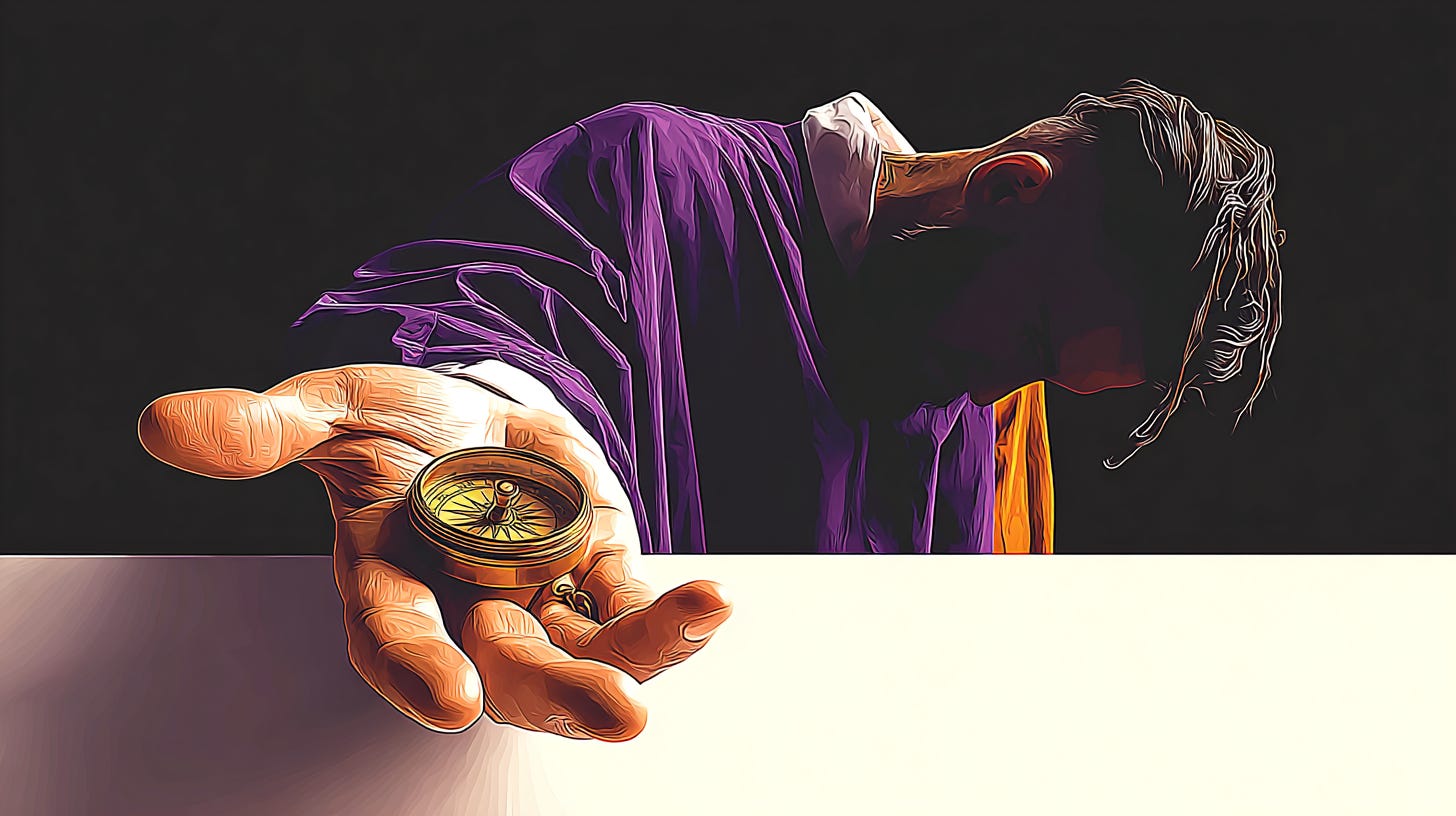
This is Part 2 of an eight-part series on the architecture of villainous protagonists. In Part 1: The Seductive Abyss, we asked why we follow the damned — through competence, truth-telling, and the promise of transgression without consequence. Now we look at the maps they follow, and discover that the abyss has its own constitution.
The most unsettling thing about true antiheroes isn’t that they lack morality—it’s that they possess their own. They navigate by different stars, follow maps written in alphabets we can’t quite read but almost understand. This is what separates them from simple villains or chaos agents: the terrible coherence of their ethics, the iron logic of their laws. They’re not moral anarchists but moral architects, building careful structures on foundations that make us dizzy to contemplate.
We tell ourselves that evil is lawless, that conscience is what keeps us from the abyss. But the antihero shows us something more disturbing: the abyss has its own constitution, its own careful precedents. And sometimes, viewed from certain angles in particular lights, these alien ethics achieve a horrible beauty, like the perfect symmetry of a spider’s web jeweled with dew and dead flies.
Consider Anton Chigurh, that ghost who haunts Cormac McCarthy’s No Country for Old Men. With his cattle gun and his calm voice, he moves through Texas like judgment itself, bound by rules as strict as any monk’s. The coin toss that might spare a gas station attendant isn’t random sadism—it’s liturgy. “Call it,” he says, and in those two words lives an entire theology. The coin becomes fate’s instrument, the toss a sacrament, the call a confession of humanity’s role in its own destiny.
When Carla Jean refuses to call the coin near the novel’s end—”The coin don’t have no say. It’s just you”—she’s not just rejecting a killer’s game. She’s committing heresy against Chigurh’s faith. His response is telling: he explains, with something like patience, that he gave his word her husband would bring this moment to pass. The coin is how he serves both chance and choice, honoring randomness while maintaining agency. It’s not madness—it’s mysticism, complete with prophet, ritual, and revelation.
Chigurh’s morality terrifies because it’s incorruptible. He can’t be bargained with, not because he’s inhuman but because he’s absolutely faithful to his inhuman principles. Money means nothing—he leaves drug cash behind. Personal feeling is irrelevant—he kills employers who inconvenience him with the same dispassion he shows strangers. He’s a fundamentalist of his own religion, and like all fundamentalists, he achieves a kind of purity that makes ordinary humans look shabby and compromised.
This is the antihero’s first gift: showing us that evil can have integrity. In a world of flexible ethics and situational standards, there’s something almost refreshing about Chigurh’s absolutism. We who bend our principles daily, who make a hundred small compromises between coffee and sleep, watch this figure who bends nothing, compromises never. His evil is pure in ways our good never manages to be.
But cosmic absolutism is only one form of reversed morality. Sometimes the antihero’s ethics are all too human, their mathematics of revenge and resentment calculated with actuarial precision. Shakespeare knew this when he created Iago in Othello, that smiling destroyer whose moral system runs on the dangerous fuel of perceived slight.
“I am not what I am,” Iago tells us early, and this isn’t mere villainy—it’s philosophy. His ethics rest on a foundation of thwarted merit: Cassio got the promotion Iago deserved, Othello is celebrated while better men serve. From this seed of injustice grows an entire moral system where destruction becomes correction, where lies serve a higher truth about humanity’s worthlessness. Every manipulation is justified by the original wound, every cruelty balanced against that first unfairness.
Watch how meticulously Iago builds his case. He doesn’t simply destroy—he demonstrates. Cassio’s drunken brawl proves his unworthiness for command. Desdemona’s innocent pleading reveals how virtue itself becomes suspicion. Othello’s jealousy exposes the beast beneath the general’s medals. Each revelation validates Iago’s worldview: humanity is corrupt, love is lust, honor is performance. He’s not breaking moral law—he’s enforcing it, his version of it, written in the ink of his own injury.
What makes Iago’s morality so infectious is its partial truth. Haven’t we all been passed over unfairly? Haven’t we seen the undeserving promoted, the foolish celebrated, the corrupt rewarded? Iago’s response—to tear down the whole false structure—carries its own dark logic. If the system is rigged, why not reveal its corruption through corruption? If merit goes unrewarded, why not prove that merit itself is meaningless?
This is more dangerous than Chigurh’s alien ethics because it’s built from materials we recognize. Every office worker who’s watched an incompetent colleague get promoted understands Iago’s first principle. The distance from understanding to endorsement is terrifyingly short, measured in disappointments and accumulated slights. Iago shows us how ordinary resentment, given sufficient intelligence and opportunity, crystallizes into systematic evil.
But perhaps the most insidious moral reversals are those that begin with legitimate insights, that build their dark architectures from genuine understanding. Chuck Palahniuk’s unnamed narrator in Fight Club starts where many of us live: trapped in a corporate job, drowning in IKEA catalogs, medicating his alienation with support groups for diseases he doesn’t have. His critique of consumer culture isn’t wrong—we do fill our emptiness with Swedish furniture, we do sleepwalk through jobs that slowly kill us, we do hunger for authentic experience in a world of plastic simulacra.
“His apartment was the American dream,” the narrator observes of his own life, and then: “a living room set from a respectable furniture store. Like everyone else, I had become a slave to the IKEA nesting instinct.” This isn’t madness—it’s clarity. His moral system begins with truths we recognize: that modern life has become a prison of comfort, that we’ve traded meaning for security, that we’re dying slowly in ergonomic desk chairs.
Enter Tyler Durden, the narrator’s shadow self, preaching a gospel of destruction as liberation. “It’s only after we’ve lost everything that we’re free to do anything,” Tyler says, and the narrator—and we—nod along. Yes, we think, remembering our own compromises, our own slow surrenders. The fight clubs start as therapy, a place where men can feel something real, can matter for the space of a three-minute round. Getting punched in the face becomes a sacrament, bruises become stigmata of authenticity.
But watch how the moral system evolves, how each reasonable critique builds toward unreasonable conclusions. Consumer culture is stifling, so destroy all culture. Corporate jobs are dehumanizing, so eliminate human civilization. The social contract is constraining, so burn every contract. Project Mayhem—Tyler’s terrorist organization—follows impeccable logic from poisoned premises. If modern life is the disease, then modernity itself must be the cure’s target.
The narrator’s journey shows us how sophisticated understanding can become the foundation for primitive solutions. He’s read his Nietzsche, his Marx, his Thoreau. He can articulate everything wrong with contemporary existence, diagnose every malaise of late capitalism. But his intelligence becomes the very tool of his moral reversal—the smarter the critique, the more justified the destruction seems. When Tyler’s followers blow up credit card companies to “return everyone to zero,” it feels like justice rather than chaos because we’ve followed the intellectual breadcrumbs from insight to insanity.
This is the most dangerous form of reversed morality: the kind that sounds like wisdom. Chigurh’s cosmic absolutism is alien enough to keep us at distance. Iago’s wounded mathematics feel petty even as we understand them. But the Fight Club narrator’s journey from alienation to terrorism follows a path we might walk ourselves, given the right pressures and the wrong guide. His moral system doesn’t reject our values—it takes them to their logical extreme. If authenticity matters more than comfort, if meaning matters more than safety, if truth matters more than civilization, then maybe civilization itself is the lie that needs exposing.
The three figures map different territories in the landscape of reversed morality. Chigurh shows us evil as cosmic principle, pure and unwavering. Iago reveals evil as personal mathematics, every cruelty balanced against original injury. The Fight Club narrator demonstrates evil as intellectual endpoint, sophisticated reasoning arriving at primitive conclusions. Each follows their bent compass with absolute fidelity, never doubting their direction even as it leads toward darkness.
What unites them is structure. Their ethics aren’t absent but intricate, not missing but misaligned. They’ve solved the problem that torments the rest of us—how to live, what to value, which direction to walk. That their solutions horrify us matters less than the fact that they have solutions, that they’ve found solid ground in the swamp of moral uncertainty where the rest of us stumble.
This is the dark gift of the reversed moral compass: it reveals the arbitrariness of all compasses. If someone can build a coherent ethical system that justifies murder, what does that say about the systems that justify our own choices? If morality is just a matter of selecting different axioms, different first principles, then what makes our principles superior to Chigurh’s coin, Iago’s arithmetic, the narrator’s accelerationist logic?
The answer matters less than the question. The antihero’s reversed morality doesn’t convert us to their creed, but it denaturalizes our own. After walking in their shoes, following their logic, understanding their careful reasons, we can never again see our own ethics as inevitable. They’re choices, constructions, architectures built on foundations that could have been laid differently.
And in that recognition lies a kind of vertigo, the dizziness of realizing that the moral ground beneath our feet isn’t bedrock but another kind of construction—sturdier than theirs, we hope, but construction nonetheless. The antihero’s compass may point to hell, but it proves that all compasses are manufactured, that “north” is just the direction we’ve agreed to call “up.”
WRITING EXERCISES
Alien Ethics: Design a character with a coherent but twisted moral code. Write their “ten commandments” or core principles, then show them following these rules in a scene. Make their consistency unsettling.
Revenge Mathematics: Create a character who believes in proportional revenge but calculates the proportions wrong. Write a scene where they explain their logic for why a small slight justifies a major retaliation.
Intellectual Endpoint: Take a legitimate social critique (capitalism is dehumanizing, technology isolates us, etc.) and write a character who takes it to an extreme conclusion. Show their journey from reasonable observation to unreasonable action.
Next up — Part 3: Sympathy for the Devil, where we dissect the craft of dark charisma — how perspective traps us, humor disarms us, and vulnerability binds us to monsters we should have abandoned long ago.
Comments
Nothing yet. Say the first thing.
Sign in to join the conversation.