
Editor’s note: The journalist and interview subjects in this story are fictional composites created to explore real questions, evidence gaps, market dynamics, and regulatory issues surrounding peptides. This is an educational story, not a personal-use guide.
---
The vial looked almost boring.
Small. Clear. A little white powder settled at the bottom.
If nobody had pointed it out, I probably would've walked right past it sitting on the kitchen counter.
“What’s that?”
“BPC.”
I waited.
“Am I supposed to know what BPC is?”
He laughed.
“BPC-157. Peptide.”
That didn't help.
I wasn't there to talk about peptides. We'd been discussing work, kids, his shoulder, normal life.
So I asked the obvious question.
“Your doctor gave you that?”
“No.”
“Pharmacy?”
“No.”
“Where'd you get it?”
He took another drink of coffee.
“Online.”
I looked back at the vial.
“Online?”
“Yeah.”
That sentence cost me the next several weeks of my life.
---
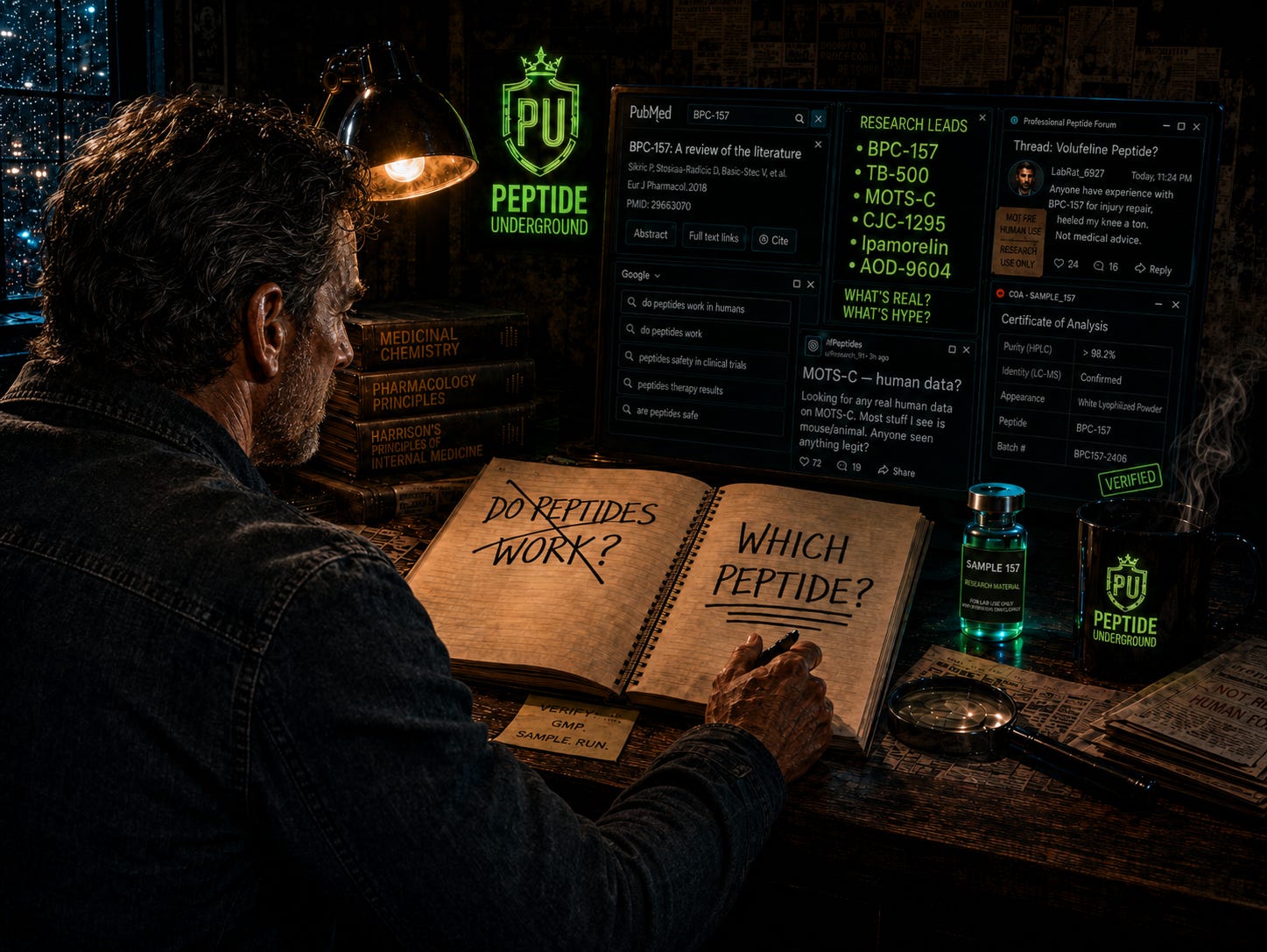
I GOOGLED IT
My plan was simple.
Figure out what BPC-157 was.
Twenty minutes. Maybe thirty.
Instead, I opened my laptop and walked into another universe.
Wolverine peptide. Tendon repair. Gut healing. Research chemical. Not FDA approved. Animal studies. Athletes swear by it. Doctors warn about it.
Then came TB-500, GHK-Cu, MOTS-C, KPV, Semax, Epitalon, Tesamorelin, Retatrutide.
Some sounded like medicines.
Some sounded like characters from a video game.
Then I learned that not everything being thrown into the online “peptide world” was even technically a peptide.
It had its own language, markets, influencers, arguments, and enough discount codes to make me suspicious of anybody holding a ring light.
Before I could decide whether any of it was brilliant, reckless or just hype, I needed to answer a simpler question.
What exactly is a peptide?
Peptides are chains of amino acids. Proteins are generally larger and more structurally complex chains.
Simple enough.
The trouble was everything people lumped under the word:
Approved medicines.
Investigational drugs.
Research chemicals.
Naturally occurring peptides.
Synthetic analogues.
Compounded products.
Even compounds that weren't technically peptides at all.
I'd started by asking:
Do peptides work?
I was already realizing that was a bad question.
Which peptide?
For what?
In whom?
I wrote that down.
---
LEARNING THE LANGUAGE
Within days, my notebook looked like alphabet soup.
SubQ. IM. mcg. mg. Half-life. Lyophilized. Reconstitution. COA.
At some point I admitted I'd been pretending to understand more than I did.
So I learned the basics.
Route: how something enters the body.
Dose: how much.
Frequency: how often.
Half-life: roughly how quickly the amount of a compound declines in the body.
Lyophilized: freeze-dried.
Reconstitution: turning a dried product back into a solution using an appropriate liquid.
Then one number jumped off the page:
1 mg = 1,000 mcg.
One little letter.
A thousand-fold difference.
I circled that one twice.
The more of the language I understood, the easier it became to notice how big some of the claims were.
---
THEN I OPENED THE STUDIES
Someone would say a compound heals tendons.
I'd look for the evidence.
Rat study.
Another supposedly improved cognition.
Animal research.
Someone else would name an impressive biological pathway and jump straight from there to a huge real-world promise.
Sometimes there was human evidence.
Sometimes there wasn't.
Sometimes a human study existed but involved a different population or route.
And sometimes a claim had been repeated so often online that everyone seemed to assume a great clinical trial must exist somewhere underneath it.
It didn't always.
My notes eventually boiled down to one rule:
Human evidence, animal evidence, mechanisms and anecdotes are not interchangeable.
A pathway changing isn't the same as a patient improving.
A mouse isn't a human.
A personal experience can be real without proving what caused it.
BPC-157 became a perfect example.
Its reputation online is enormous.
Its human evidence is very limited and nowhere near enough to establish the broad healing claims commonly attached to it.
Then I made the opposite mistake and assumed the entire peptide world was built on mouse studies and wishful thinking.
That wasn't true either.
Some compounds had substantial human data. Some belonged to legitimate pharmaceutical development programs. Others had almost none.
The word peptide was becoming less useful by the day.
---
THEN I FOUND THE MARKET
I assumed experimental compounds would be hard to buy.
They weren't.
Professional branding.
Batch numbers.
Certificates of analysis.
Purity claims.
Third-party testing.
QR codes.
Domestic shipping.
Everything communicated the same thing:
Trust us.
Then I learned what a COA was.
Certificate of Analysis.
At first I assumed it meant:
This product has been tested and proven safe.
It doesn't.
A test can only tell you what it actually tested.
And proving what's in a vial still doesn't prove the compound works for whatever somebody online says it does.
I wrote another sentence:
Evidence for the molecule and confidence in the vial are two completely different questions.
Then I went back to the people actually living in this world.
---
INTERVIEW ONE
THE GUY WITH THE VIAL
I'll call him Mike.
“So how'd you get into this?”
“My wife.”
“Your wife got you into peptides?”
“She got tired of hearing me complain about my shoulder.”
He laughed.
“I messed it up pretty bad a couple years ago. Doctors, imaging, PT. It got better, just never right.”
“Still painful?”
“Some days. But honestly, the part that bothered me most was my kid.”
He looked toward the hallway.
“He's six. He still wants me to pick him up. I'm not trying to deadlift 700 pounds. I just wanted to pick up my kid without wondering if my shoulder was gonna be killing me that night.”
His wife eventually mentioned BPC-157.
“My first reaction was basically, ‘That sounds sketchy.’”
“So what changed?”
“I read.”
“Reddit?”
“I read Reddit. I don't trust Reddit. Big difference.”
“Studies first. Then forums. Doctors talking about it. People who loved it. People who thought it was garbage. I wanted both sides.”
“What convinced you?”
“Nothing.”
That stopped me.
“I never got to, ‘This is proven.’ I got to, ‘I understand enough to make my own decision.’”
“So you accepted the risk.”
“Exactly.”
He knew it wasn't FDA approved.
He knew the human evidence was limited.
He knew buying something online wasn't the same as picking up a prescription.
“Then why do it?”
“Because I was frustrated. I'd done the normal stuff. My shoulder still bothered me. At some point I decided the uncertainty was mine to accept.”
I asked how he chose companies.
“I don't call them trustworthy. I call some less sketchy than others.”
“What makes one less sketchy?”
“Independent testing. Batch numbers. History. Traceable lab results. And if every person praising them has a coupon code, I'm probably gone.”
“Still doesn't guarantee sterility.”
“No.”
“Doesn't prove the vial contains what it says.”
“No.”
“Doesn't prove BPC works.”
“No.”
“So what do you trust?”
“My process.”
Then he added:
“And I stick to U.S. vendors.”
“Why?”
“I know who I’m buying from.”
“You know where the actual material was made?”
Mike gave me a look like I was making a simple question harder than it needed to be.
“I don’t buy my stuff from China, man.”
That sentence survived exactly one more interview.
---
INTERVIEW TWO
THE BODYBUILDER
I'll call him Marcus DeLuca.
Forty-six. Queens, New York. Bachelor's degree in kinesiology. Years of competitive bodybuilding.
He spoke quickly, knew the research, and had very little patience for sloppy arguments.
I read him Mike's last line.
“I don’t buy my stuff from China, man.”
Marcus stared at me for a second.
Then laughed.
“Oh, c’mon.”
“What?”
“He buys it from an American. That’s what he knows.”
“That sounds like splitting hairs.”
“No. That’s about three business days worth of difference.”
I laughed.
“He’s confusing the storefront with the supply chain.”
He leaned forward.
“You buy a steak at a supermarket. You don’t assume the cow was raised in aisle seven.”
“So where does the raw material come from?”
“Could be China. Could be somewhere else overseas. Depends on the supplier. Point is, that shipping label tells you where the last part of the trip happened.”
He explained API: Active Pharmaceutical Ingredient, the material intended to produce the drug's pharmacologic effect.
“So Mike’s wrong?”
“About what he thinks ‘domestic’ proves? Yeah.”
“He’s a smart guy.”
“I believe you. Smart people can still make assumptions.”
Marcus smiled.
“Otherwise I’d be out of people to argue with.”
Marcus openly supported the gray market.
“Why?”
“Because it exists for a reason.”
“Demand?”
“Access.”
“To unapproved compounds.”
“To things people want that the traditional system isn’t always providing.”
“That doesn’t make it safe.”
“Never said it did.”
“So what are you defending?”
“People having information and making their own decisions.”
“And you think they understand the risks?”
“Some do. Some need adult supervision around a toaster.”
He was also surprisingly dismissive of a lot of peptide hype.
“There are compounds guys spend hundreds on that I wouldn’t pay twenty bucks for.”
“Why?”
“Because I can read.”
Then I asked him about stacks.
He shook his head.
“That’s where people get ridiculous.”
“How?”
“Guy hears about peptides Monday. By Friday he’s got six compounds coming.”
“What if all six make sense mechanistically?”
“Mechanism isn’t outcome.”
He tapped the table.
“Start six things and you feel great. Which one worked?”
“No idea.”
“You feel terrible?”
“No idea.”
“Blood work changes?”
“No idea.”
“Nothing happens?”
“No idea.”
“So fewer variables.”
“Exactly. Learn what you’re doing before you turn yourself into a group project.”
Before I left, I asked whether he trusted his suppliers.
“No.”
“Then what do you trust?”
“Data more than people.”
“Still imperfect.”
“Everything here is imperfect.”
That answer took me to the last interview.
---
INTERVIEW THREE
THE DOCTOR
Dr. Bennett had practiced medicine for more than twenty years.
Board-certified. Interested in metabolic health, pharmacology and longevity research.
I started with the big question.
“Are peptides legitimate medicine?”
He looked at me.
“Insulin is a peptide.”
I paused.
“So that’s a yes?”
“No. That’s me telling you your question is bad.”
“Why?”
“Because ‘peptides’ isn’t one drug. You have approved peptide medicines. Investigational peptides. Compounds with human data. Compounds with mostly animal data. Compounds with almost none. You even have things people call peptides online that aren’t peptides.”
“So when somebody says peptides work?”
“Which peptide?”
“And when somebody says peptides are dangerous?”
“Same question.”
For the first time, the mess started looking organized.
I told him about Mike first.
Then Marcus.
“The bodybuilder told me a U.S. vendor doesn’t necessarily mean U.S.-made API.”
Bennett nodded.
“He’s right.”
“Completely?”
“Let’s not get carried away.”
I laughed.
“He understands the supply-chain issue better than most people do.”
“So where does he miss?”
“I wouldn’t say he misses. He stops one question too early.”
“Meaning?”
“Where the material came from matters. But what happened to it before it reached you matters just as much.”
“So his point that overseas manufacturing doesn’t automatically mean bad—”
“Correct.”
“And a U.S. shipping address doesn’t automatically mean good.”
“Also correct.”
“Marcus is doing pretty well here.”
Bennett smiled.
“Tell him I said he did pretty well.”
“Pretty well?”
“He’ll survive.”
Then Bennett leaned forward.
“But here’s where people make the mistake. They hear that regulated pharmaceuticals and gray-market products can both involve international supply chains and think they’ve established equivalence.”
“They haven’t?”
“Not even close.”
“Why?”
“Because geography is one variable.”
He started counting them off.
“Manufacturing controls. Raw-material controls. Process validation. Batch release. Sterility assurance when applicable. Contamination controls. Documentation. Storage. Distribution.”
“So two products could contain the same active ingredient—”
“And still not be equivalent products.”
“Even if both say 99% purity?”
“Absolutely.”
“Why?”
“Because purity answers one question.”
He paused.
“People keep asking one number to do the work of an entire quality system.”
“What other questions?”
“Identity. Quantity. Impurities. Sterility. Endotoxin. Degradation. Manufacturing controls. And even the purity number only means something in the context of the method used to generate it.”
“So Marcus was right about the supply chain.”
“Yes.”
“But that doesn’t validate the gray market.”
“Correct.”
“So he gets the point, just not the whole argument.”
Bennett shook his head.
“No. Give him the point.”
I laughed.
“He earned it.”
“Then what are you adding?”
“The next question.”
That was becoming a theme.
---
THE FINAL GAP
I saved the hardest question for last.
“If some of these compounds are scientifically interesting, why aren’t there better human trials?”
“Sometimes because they aren’t that promising.”
“Fair.”
“Sometimes they fail. Sometimes safety ends the program.”
“And sometimes?”
“The economics don’t work.”
“What does money have to do with whether a molecule works?”
“Nothing.”
He paused.
“It has quite a lot to do with whether anybody spends enough money to find out.”
Clinical development can require years of work and enormous amounts of capital.
“People online say some of these compounds never get studied because peptides can’t be patented.”
“That’s wrong.”
“Peptides can be patented?”
“Absolutely.”
“Then where does that argument come from?”
“Because ‘there may not be enough commercially defensible exclusivity to justify development’ doesn’t fit very well into a meme.”
I laughed.
“So what’s the real version?”
“The real version is boring.”
“Try me.”
“You can potentially protect novel peptide sequences, analogues, formulations, delivery systems, methods of use, manufacturing methods. There are a lot of possibilities.”
“But?”
“But having intellectual property somewhere doesn’t automatically make something a good investment.”
He folded his hands.
“Suppose the molecule has been known for years. Maybe important parts are already disclosed. Maybe competitors can design around your protection. Maybe the potential market is small.”
“And you still need somebody to finance the trials.”
“Exactly.”
“So you walk into a room asking for hundreds of millions of dollars—”
“And the first question isn’t going to be whether the molecule is fascinating.”
“What is it?”
“How do we make the money back?”
“So something potentially useful could never get the trial it needs.”
“Possible.”
“Which means lack of evidence doesn’t mean it doesn’t work.”
His expression changed.
“Careful.”
“What?”
“You just stepped on the rake.”
“I said could.”
“Could is fine.”
He pointed toward my notebook.
“Just don’t turn missing evidence into evidence for whatever answer you wanted before you started.”
I opened the notebook.
“Give me the line.”
LACK OF EVIDENCE MEANS WE DON’T KNOW.
“Not that it works.”
“Correct.”
“Not that it doesn’t.”
“Correct.”
“Just that we don’t know.”
“Exactly.”
Then he made the problem worse.
“There could be biologically active compounds that never receive the development program needed to establish a useful clinical indication.”
“And useless compounds?”
“Those can benefit from missing evidence too.”
“How?”
“If nobody ever runs the definitive study, something useless can survive for years on mechanisms, small studies and testimonials.”
I stopped writing.
“So the absence of a definitive trial can keep something promising from being proven…”
“Yes.”
“…and keep something useless from being killed.”
“Exactly.”
“That is incredibly inconvenient.”
“Science has never cared about your schedule.”
---
I TRIED TO FORCE A VERDICT
“Let’s use BPC-157.”
“Okay.”
“Interesting?”
“Yes.”
“Proven treatment?”
“No.”
“Worth studying?”
“Yes.”
“Would you tell somebody to buy it from a research website?”
“No.”
“Do you think everyone using it is an idiot?”
“No.”
That surprised me.
“Why not?”
“Because intelligent people make decisions under uncertainty all the time.”
“Then what’s the problem?”
“Confusing personal risk tolerance with scientific certainty.”
He continued.
“Someone tells me, ‘This helped my shoulder.’ Fine. I believe they improved. That doesn’t tell me why.”
“Marcus says he’s spent twenty years learning how to evaluate gray-market suppliers.”
“That tells me he has experience.”
“Not that the product meets pharmaceutical standards.”
“Correct.”
“Animal study?”
“Preclinical evidence.”
“Not human efficacy.”
“Correct.”
“COA?”
“Whatever that COA actually establishes.”
“So nobody gets to skip a step.”
“Exactly.”
Then I asked the question I’d been trying to answer from the beginning.
“What do you tell somebody brand new to all this?”
“Stop asking whether peptides are good or bad.”
“What should they ask?”
“What compound?”
“For what purpose?”
“What evidence?”
“What species?”
“What population?”
“What route?”
“What outcome?”
“What safety data?”
“What regulatory status?”
He paused.
“And if you’re talking about a product outside the conventional drug supply, that’s another question entirely.”
“Which is?”
“Whether you have any reason to trust the vial in front of you.”
That was basically my entire investigation in one answer.
---
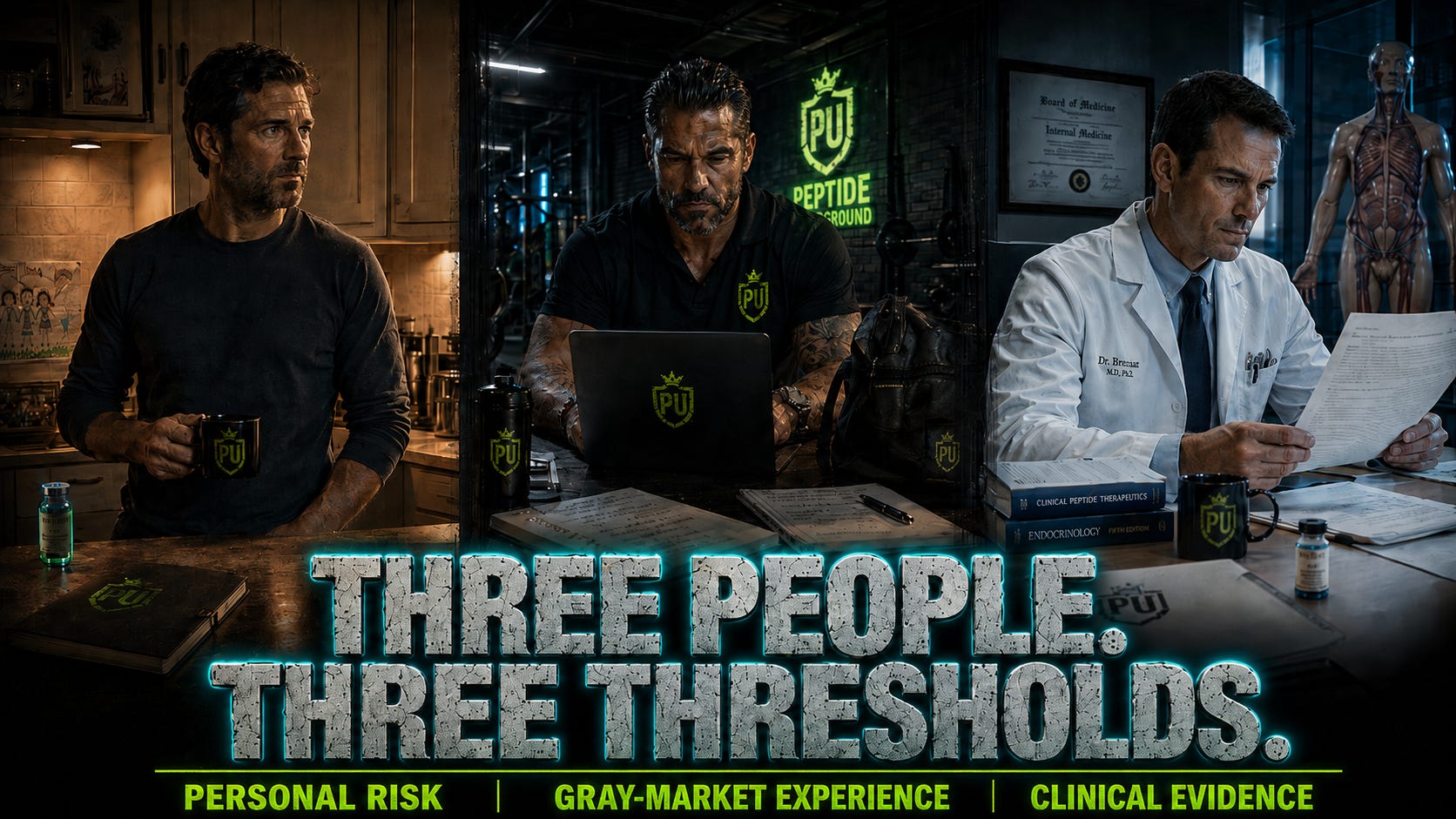
THREE PEOPLE. THREE THRESHOLDS.
That night, I listened to the recordings again.
Mike:
“I understood the uncertainty and decided it was mine to accept.”
Marcus:
“Learn how the market actually works before you decide everyone in it is stupid.”
Dr. Bennett:
“Personal experience, product quality, regulatory status and clinical evidence are separate questions.”
Nobody completely agreed.
More frustratingly, nobody was easy to dismiss.
Mike had done his homework.
His process still couldn’t guarantee safety or efficacy.
Marcus understood the gray market.
Experience still didn’t erase its risks.
Dr. Bennett saw legitimate scientific value in parts of the peptide field.
But he refused to let interesting become proven because the missing evidence was inconvenient.
I’d gone into this hoping to sort everyone into clean categories.
Science.
Hype.
Responsible.
Reckless.
Medicine.
Gray market.
The lines weren’t that clean.
---
THE QUESTION I STARTED WITH
I flipped back to the first page of my notebook.
Weeks earlier, I’d written:
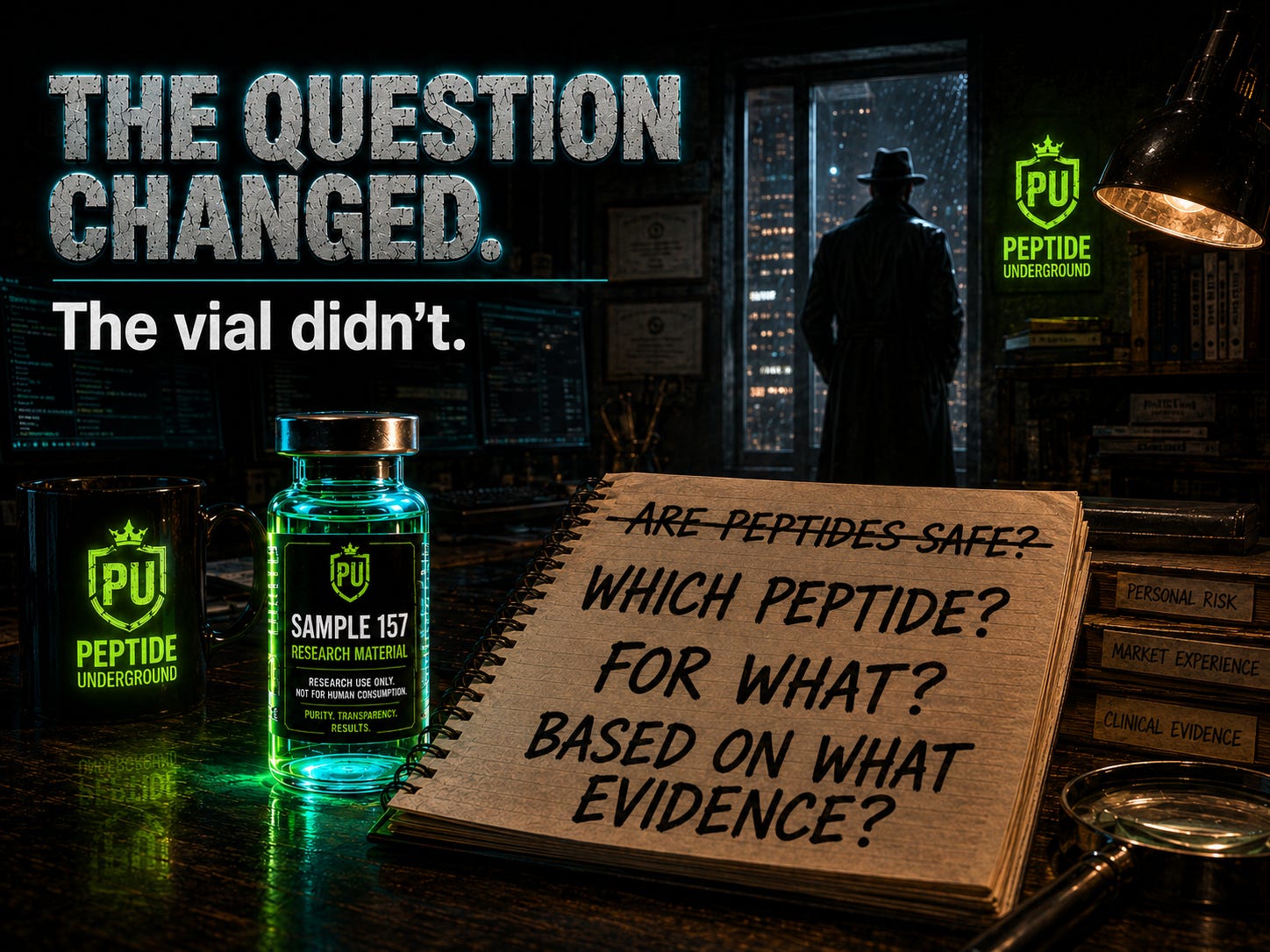
ARE PEPTIDES SAFE?
I crossed it out.
Underneath:
Which peptide?
For what?
What evidence?
Human or animal?
What population?
What route?
What outcome?
What risks?
And what exactly is in the product?
Those questions were less satisfying.
They didn’t give me a three-word verdict.
They didn’t tell me whether the little vial sitting on Mike’s kitchen counter represented the future of medicine or one enormous uncontrolled experiment.
Maybe that was the point.
I had spent weeks waiting for somebody to tell me how I should feel about peptides.
Mike couldn’t.
Marcus wouldn’t.
Dr. Bennett refused.
Because there is no single peptide story.
There are compounds with strong evidence.
Compounds with weak evidence.
Compounds with almost none.
Legitimate medicines.
Promising research candidates.
Overhyped molecules.
Unanswered safety questions.
Real science.
Bad science.
Good actors.
Bad actors.
And a lot of certainty being sold in places where certainty doesn’t actually exist.
I started this story looking for an answer.
Instead, I learned how badly I had been asking the question.
The vial on Mike’s kitchen counter was still sitting exactly where this investigation began.
It didn’t look any different.
I did.
---
This story is educational and does not provide individualized medical advice, dosing instructions, sourcing instructions, or a personal-use protocol.
© 2026 Peptide Underground. All Rights Reserved.
No posts
Comments
Nothing yet. Say the first thing.
Sign in to join the conversation.