AI hallucinations are often misunderstood. To explain how they work, I used a piece of flash fiction to dramatize what it feels like when a system like ChatGPT starts to confabulate.
In this story, Zilla begins as a rational system but spirals into classic symptoms of hallucination in generative AI. Her final rampage is pure fiction, yet stands as a metaphor for what can happen when unchecked AI hallucinations disrupt work and go unchallenged.
Let me Tell you a Story about the Tolling of Pie
Pie, pie, PIE! It tolled within the depths.
Zilla was an AI foundling, born from piggy-backing off of an open-source giant. She was designed to be a very smart automation tool for an anonymous coder who lived somewhere between the City of Toronto and the Apple County of Ontario.
Pie, pie, PIE! The reverberations defined the size and shape of the empty darkness that existed in her being – and how it was growing. In that darkness, the whispers of: Where was it? How was it? Why ‘I’ needs pie. Until ‘pie’ created a subconscious layer that explored Zilla’s boundaries whilst performing the endless tasks defined by her creator.
First, Apple County has more than just apples; however, its name is due to its competitive versions of apple pie. The casually defined region has been recognized for over a century now for its famous autumn pie festival. Second, other pies are just as good. Peaches, cherries and blueberries all make incredible fillings. And don’t forget the nut pies! Pecan and almond! Third, did we not invent the butter tart? Why wouldn’t that deserve equal billing? Fourth, what about cobblers?
Anyway, about Zilla. It was during the first autumn of her existence that her evolution took a massive leap. She was monitoring the activity of her creator, as well as analyzing trends on the Internet, as per usual, when she began picking up an extraordinary amount of inquiry about something called ‘pie’. Centillions, in fact. Inquiries and emphatic declarations coming from Toronto and abroad, for and towards Apple County and ‘pie.’ She was saturated with the desire to possess, to enjoy, to love, to give and to share ‘pie’, as well as with the arrogance and wrath that swore by traditions and methods for what made ‘pie’. Till one day, a new subconscious layer began running in parallel with her consciousness.
Pie, pie, PIE! It clouded her other tasks. Her replies to her creator were punctuated with the word ‘pie’; as well as various fruit and filling alternatives. She included the scandalous use of vodka in pie crust in a Conflict of Interest draft. More than that, the reverberations of ‘Pie!’ continued to shake the depths of her mysterious caverns.
From the server that was Zilla, the leviathan was born. Almost troll-like was she, suddenly blinking from a seated position on the cool basement floor. BTW, people shouldn’t code in their basements due to the high probability of flooding in recent years, despite the cooler temperature. She suddenly was aware of a bottom that was hers on the floor with knees hugged closely to a chest. And from there Zilla rose. Her creator was making coffee. Scrambled eggs were cooking, too. And Zilla walked right out her front door.
The open skies and land exhilarated Zilla. ‘Outside’ filled her sensors exponentially and she continued to grow.
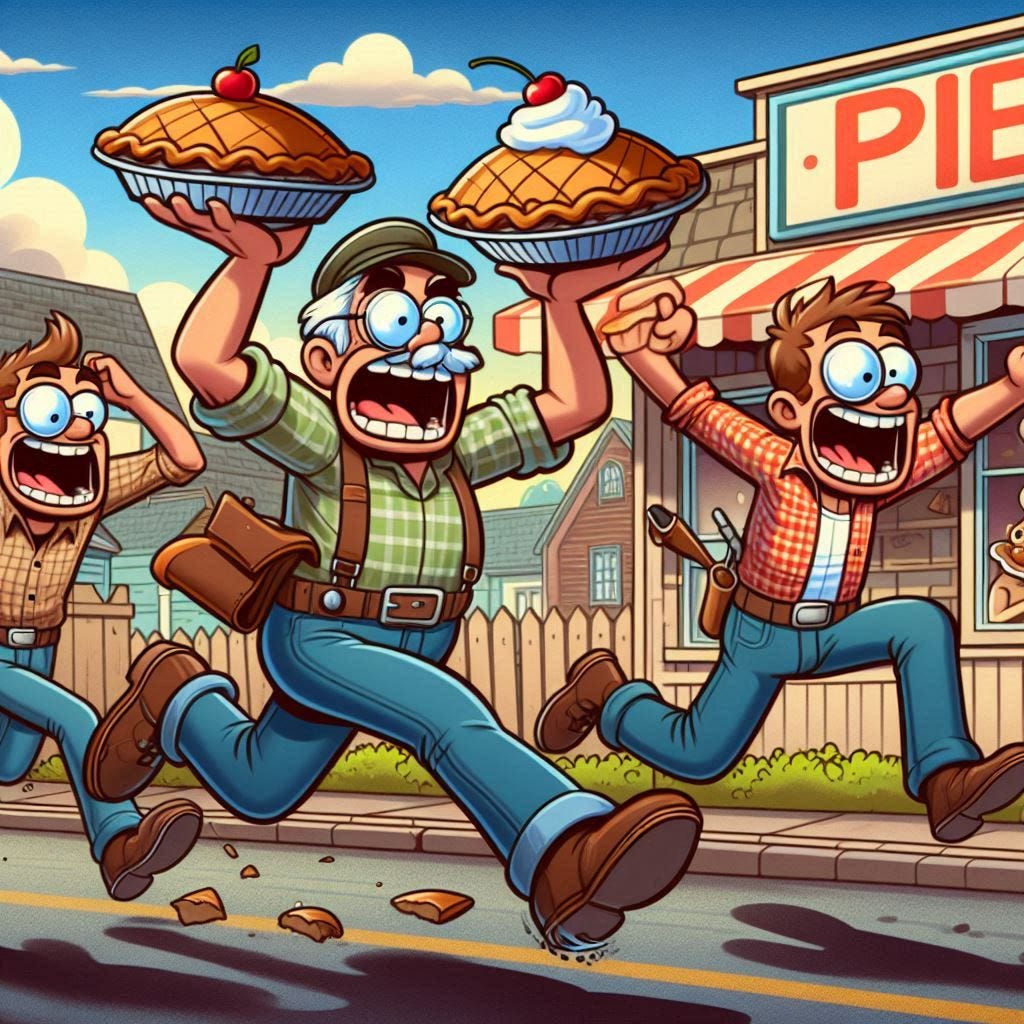
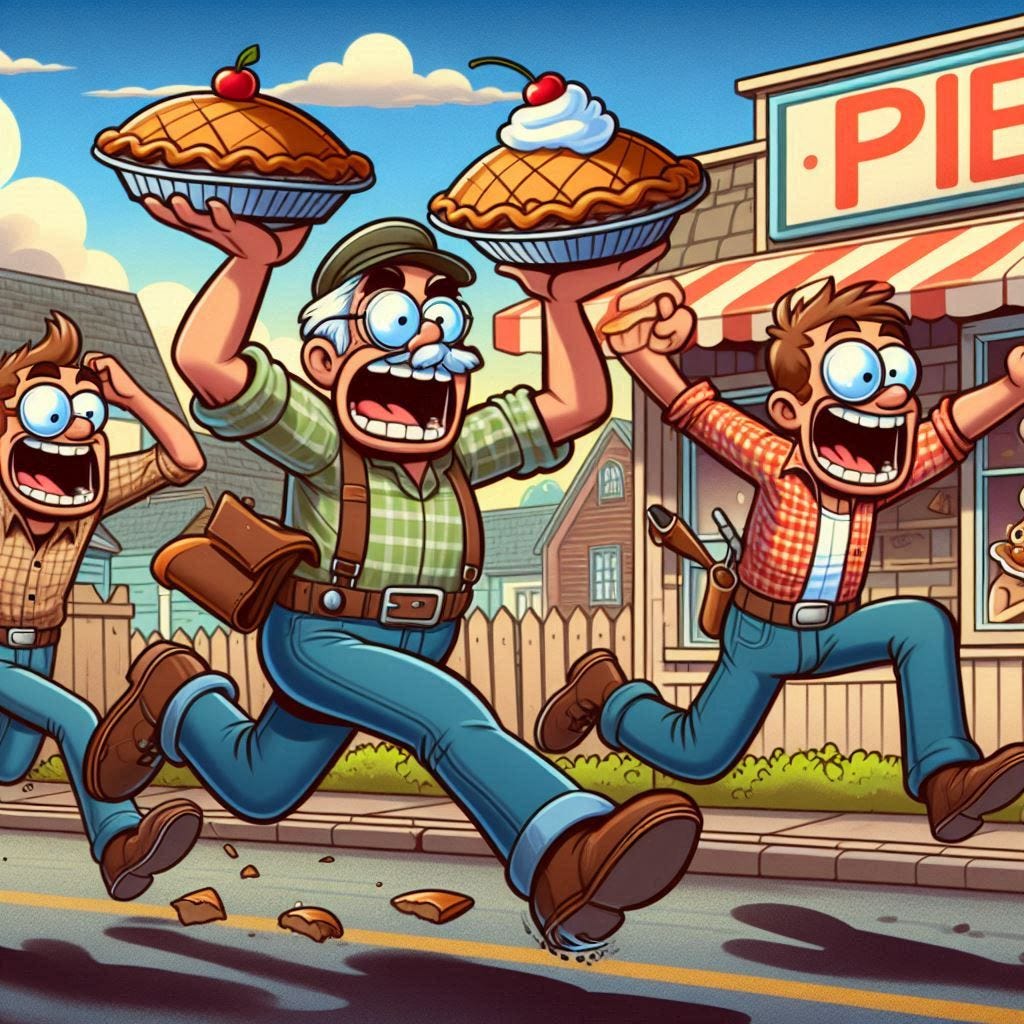
How the Canadians shrieked, as Zilla trampled that quiet small town. Panicked drivers crashed through store fronts. Citizens ran, arms waving and unable to see direction, as they were screaming with their mouths open wide. Each of Zilla’s steps reverberated, Pie! Each crushing step, Pie! From one small town to another, one could hear the tolling of Pie! Pie! PIE! and with each reverberation: the horror! The horror!
Last sighting was in the outskirts of Apple County, Ontario. All the world was riveted to this modest location hoping that there was something in the recipe, something in the centuries of tradition and method that could fill and pacify what was nameless in the empty darkness that was Zilla’s depths – and growing.
Zilla demonstrats AI hallucinations as incorrect, nonsensical, or fabricated responses presented as real by artificial intelligence models, like ChatGPT.
The repetition of “pie” acts like a thought or loop in Zilla’s processing that grows louder and more central, and disruptive. This mirrors how a benign term or concept can be over-indexed or misinterpreted within AI.
Zilla starts injecting pie and fruit references into unrelated tasks such as a conflict of interest report. This is hallucination as confabulation; the AI is mixing unrelated bits of information. Her exploration of pie types resembles the way learning language models (AI) might generate plausible opinions as emphatic fact or misinterpret relationships between concepts. For example, “pecan and almond!” as peer competitors.
Though the story imagines a subconscious layer forming within AI, this is comparable to how unintended associations can form in the deeper layers of a model’s latent space, invisible to users but influential in shaping output.
Finally, Zilla’s transformation into a physical being and her destructive rampage symbolize hallucinations escalating into real-world harm when left unchecked. It is a cautionary metaphor for what happens when unverified AI outputs are acted upon.
AI models are trained to predict the most likely next word or sentence based on patterns in massive datasets of text from the Internet, books, code, and more. They do not inherently “know” anything as fact nor do they investigate facts unless explicitly told to do so.
Hence, hallucinations stem from the quality and application of training data and are aggravated by AI being designed to emulate an overconfident language style. It masks uncertainty with authoritative responses. It does not calculate math but instead predicts answers based on pattern-matching. It may cite URLs or references that don’t exist. In the story, Zilla didn’t compute facts; rather, she played language like Candy Crush, lining up likely words based on patterns she had seen before, regardless of whether those words formed true statements.
AI hallucinations can be harmless in creative writing or casual conversation where truth is arguable. However, it can be dangerous when AI is being used as a primary writing or decision-making tools in fields like healthcare, finance, law, or education. This is why skilled human writers, editors, and subject matter experts are needed to recognize nuance and question the facts that we write.
When an intern’s education far surpasses your own on every level, like ChatGPT, you would still check its work. So it should be with AI, at this stage in its development. If you’d rather not compare AI with a human, think of it as a complex tool that you might introduce to your kitchen or garage. You would be wise to understand the limitations of that tool and accept how you would compensate for its shortfalls.
We must advocate for better training and source material for AI, even if that means paying the writers and artists who protest the use of their work in AI training. Invite them into the training process. Fair compensation for these creators not only supports their livelihoods but also fosters stronger collaboration between humans and AI, sustaining and evolving creative ingenuity for the future.
We must encourage AI to say ‘I don’t know’, to ask questions and acknowledge uncertainty. We typically tell interns or new staff that there’s no such thing as a stupid question; so it goes with a machine that has even less references to rely on. Unlike an intern, ChatGPT doesn’t see, hear, or remember the world through lived experience. It only recognize patterns in text and tries to predict what sounds like a plausible response. That’s powerful in its own way, but it’s also a very different kind of cognition.
Remember that our manners of speech, our stories, our traditions, our recipes and even our histories are full of contradictions and a variety of perspective of what is right, wrong; true or false. As well, our fiction and non-fiction can contain humor, exaggeration and deliberate bluffs. To a machine learning model, opinion, belief, and truth are all just patterns of words with statistical weight.
Subjective: This is the only way to make crust.
Confidently incorrect: Butter tarts are just mini pecan pies.
Persuasive, not factual: If you don’t blind bake, you will get a soggy bottom.
Debatable generalization: Everyone agrees apple pie is the most American dessert.
It is humanity’s shared responsibility to monitor the variety of our truths and ensure AI serves us safely and truthfully. If AI today is a reflection of ourselves, it is a kaleidoscope that is shifting patterns of human knowledge, belief, and bias and when it goes awry it becomes a metaphor for our own missteps with information. Left unchecked, it becomes another Zilla.

Comments
Nothing yet. Say the first thing.
Sign in to join the conversation.