
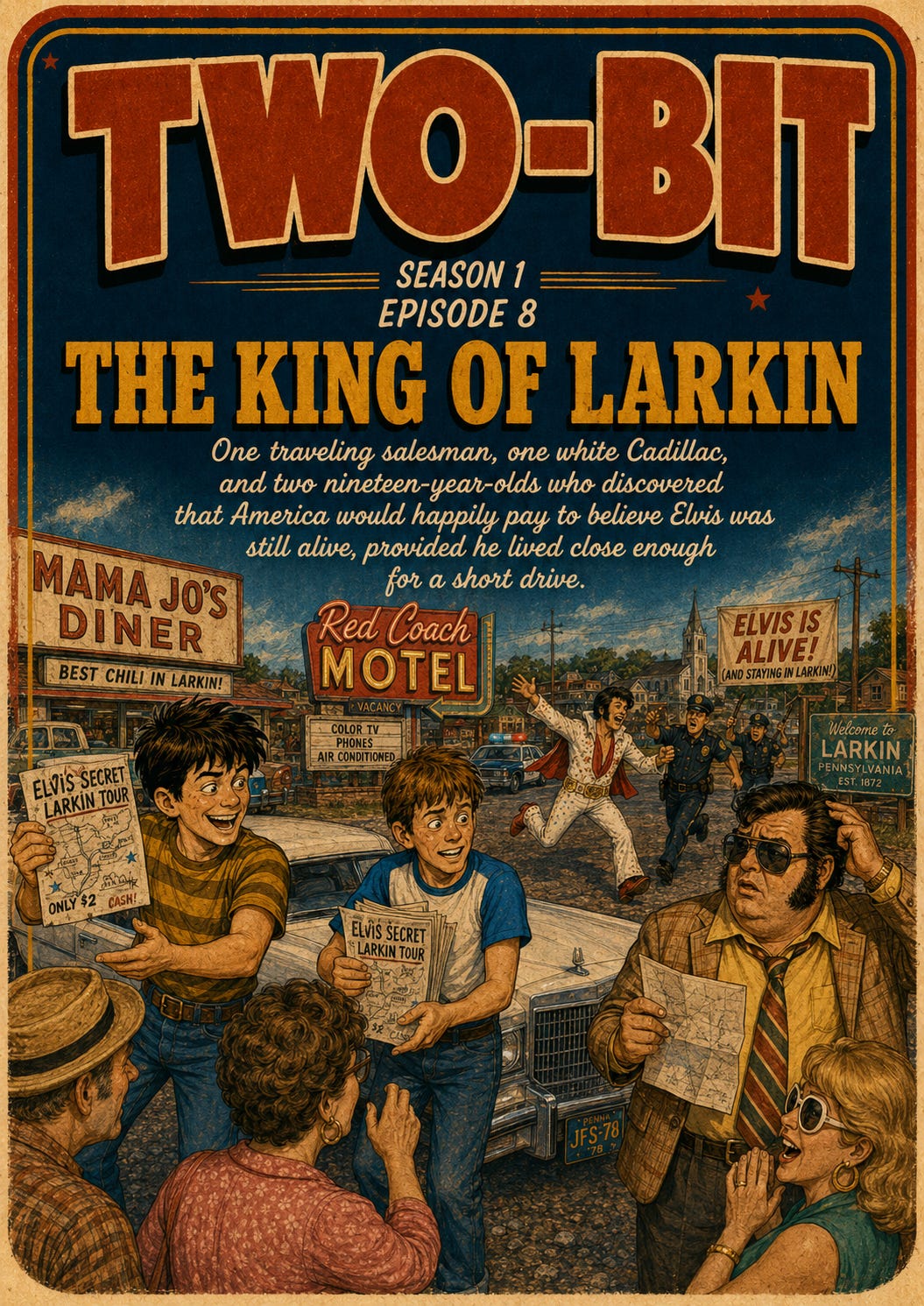
Two friends. Fifty years. Not one good idea. Two-Bit follows Eddie Doyle and Ray Brooks, childhood friends from Larkin, Pennsylvania, who grow older without ever outgrowing small scams and spectacular failures. Each season covers a decade, as the two men try to get lucky and always escape arrest thanks to police blunders.
In the summer of 1978, Eddie Doyle discovered that the easiest way to make money from Elvis was to let people believe he had never died. The idea was born on a hot afternoon at Mama Jo’s Diner, when an overweight traveling vacuum-cleaner salesman stepped out of a white Cadillac, put on oversized black sunglasses, and said “thank you very much” to the waitress purely as a joke.
The man’s name was Ronnie Vale. He came from Harrisburg and did not particularly resemble Elvis except in two respects: his sideburns defied reason, and he possessed an extraordinary commitment to the color white. For Eddie, that was more than enough. For Ray, it was nowhere near enough.
Ray told him that no reasonable person would believe anything so stupid. Eddie replied that this was precisely the most encouraging part of the plan.
By that evening, they had used an old mimeograph machine to produce a crude map titled ELVIS SECRET LARKIN TOUR — $1. It contained four stops: the diner where Elvis had supposedly ordered a fried peanut-butter sandwich, the Red Coach Motel where he was allegedly staying under another name, a telephone booth where he had “spoken to the Colonel,” and a dirt road outside town where he supposedly took nighttime drives to clear his head.
Ray watched Eddie fold the maps and insisted that they should at least feel slightly ashamed. Eddie explained that they were not selling lies but “possibilities of local interest.”
To lend the whole thing greater authority, Eddie added NOT ENDORSED BY COLONEL PARKER at the bottom of the page. He thought the disclaimer made the story more believable. Ray thought it made the story more prosecutable.
They sold seven maps on the first day, mostly to two teenage girls from Beaver Falls and a truck driver who swore he had seen Elvis alive in 1977 and saw no reason why he could not see him again in Larkin.
Things escaped their control on the second day when a local radio host in Johnstown heard the rumor, mentioned it on air as a “strange but charming possibility,” and invited listeners to make up their own minds.
By Saturday, a line had formed outside Mama Jo’s. Eddie and Ray were selling maps, handwritten VIP SIGHTINGS, and buttons reading THE KING WAS HERE. Eddie had also raised the price to two dollars because, as he explained, Elvis became more valuable the longer he remained dead.
Ray began to worry when three women started photographing the telephone booth and a retired man from Altoona knelt in the motel parking lot as though waiting for a religious apparition.
The worst part was that Ronnie Vale had no idea what was happening.
When he returned to the motel and found twelve strangers waiting outside his room, he initially assumed he had forgotten to pack away one of his vacuum demonstrations. Then a woman shouted that “the world always knew you were alive,” and Ronnie threw his suitcase into the room, slammed the door, and called reception.
The desk clerk advised him that, if he intended to come outside, “something with rhinestones might help.”
Officer Dugan was the first policeman to take the rumor seriously. He told Malloy that, if nothing else, they had a duty to rule out the possibility that Elvis Presley really was hiding in Larkin.
Malloy stared at him for a long time before asking whether Dugan could hear himself speaking. Dugan replied that his mother had collected newspaper clippings for months after Elvis died and that there were “a lot of unanswered questions.”
Malloy said the only unanswered question was why they were still partners.
Even so, when the crowd outside the motel grew and traffic on Market Street began to jam, they had to respond. Dugan arrived first and decided to keep a low profile.
To avoid attracting attention, he approached one of the map sellers, who happened to be Eddie, and bought one.
In less than three minutes, a Larkin police officer had paid Eddie two dollars to discover where Elvis Presley was supposedly hiding.
Malloy found Dugan studying the map as though it were an FBI document and snatched it from his hands. At exactly that moment, three local Elvis impersonators arrived on their own initiative.
One wore a white cape, another a black leather jacket, while the third had used so much hair dye that his head resembled a wet crow. The crowd began shouting and photographers started running toward them.
Dugan, instead of arresting Eddie and Ray, who were standing ten yards away with the money in their pockets, grabbed the impersonator in the cape and ordered him to stop resisting the truth.
From his motel window, Ronnie Vale watched the chaos and decided it was time to leave town. He ran downstairs, put on his sunglasses, climbed into the white Cadillac, and tried to pull out of the parking lot.
At that exact moment, a girl in the crowd spotted him and screamed that “the King is getting away.”
Within seconds, thirty people were running after the Cadillac. Dugan released one fake Elvis so he could chase another, while Malloy tried to explain over the radio that they were not literally pursuing Elvis Presley, although under the circumstances he could not completely rule it out.
The chase lasted only four blocks. Ronnie turned sharply into an alley, encountered a soft-drink truck unloading bottles, and came to a stop without anyone being hurt, apart from several bottles of root beer.
Dugan reached the Cadillac first. He opened the door with the expression of a man expecting to make history and found a terrified, sweating vacuum-cleaner salesman from Harrisburg who was nearly in tears and repeatedly insisted that he could not sing even half a verse.
By then Malloy had detained the wrong Elvis for the second time, while a third impersonator had begun singing spontaneously in an attempt to calm the crowd.
It had the opposite effect.
The small pursuit turned into an improvised concert. The crowd forgot about Ronnie Vale entirely, and the two people actually responsible for everything simply walked away through a sea of people carrying maps, buttons, and memories of an encounter that had never happened.
Eddie and Ray eventually ended up behind Ray’s garage, counting their earnings on an overturned wooden crate. They had made forty-eight dollars, collected three burger coupons, and somehow acquired an autograph one of the fake Elvises had accidentally given Eddie.
Ray told him they had finally crossed every reasonable line. Eddie disagreed and explained that they had merely helped local tourism during a difficult economic period.
That evening, the local newspaper appeared with the headline ELVIS NOT FOUND IN LARKIN and a blurry photograph of Dugan holding an impersonator by the shoulder as though he had personally saved the nation.
According to the article, Malloy was “considering all possibilities,” which Eddie took as proof that the police had understood absolutely nothing.
As Ray gathered the remaining maps to burn them, he found one unsold copy in the corner. On the back, Eddie had already written another idea in pencil: HAUNTED HOUSES OF LARKIN — NIGHT TOUR.
Ray closed his eyes for several seconds and told him that if the next scheme involved ghosts, he at least wanted to be paid in advance. Eddie smiled, gathered the papers, and slipped them into his pocket.
“See? That’s what I like about you. You always get straight to the business side.”
Comments
Nothing yet. Say the first thing.
Sign in to join the conversation.