
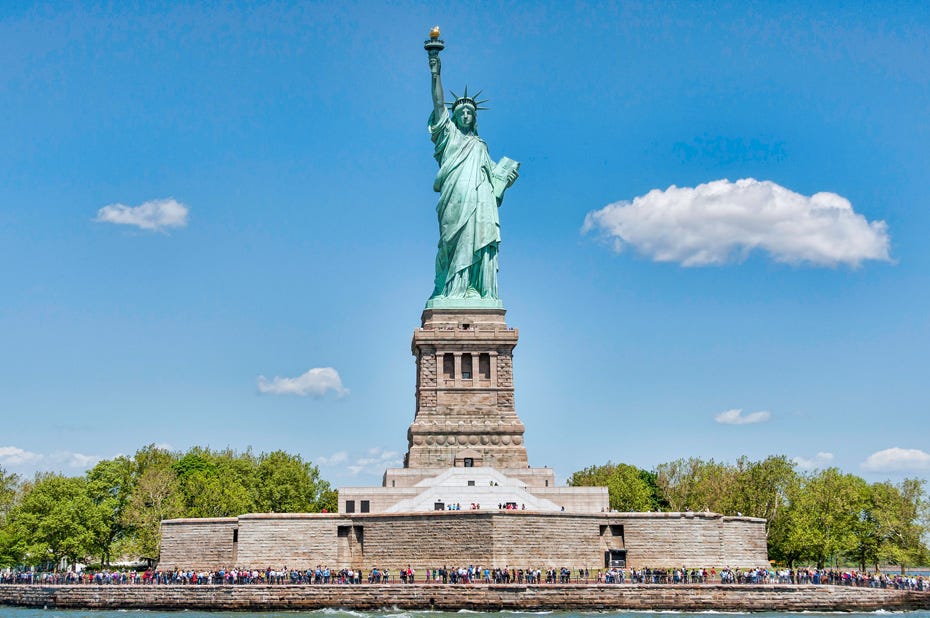
On June 17, 1885, a French ship entered New York Harbor carrying 214 wooden crates, and no one looking at them could yet know that inside lay one of the most recognizable faces the modern world would ever create. Packed into those crates were 350 pieces of copper, iron and engineering ingenuity. Once assembled, they would become Liberty Enlightening the World, the monument the world would simply come to know as the Statue of Liberty.
Its story had begun in France, linked to the centennial of American independence and to the idea of a gift that would symbolize friendship between two nations, but also something larger: freedom and democracy as values supposedly belonging to everyone.
The sculptor Frédéric Auguste Bartholdi designed a colossal female figure wearing robes and a radiating crown. In her raised right hand she held a torch, and in her left a tablet bearing the date July 4, 1776. The statue itself stood about 46.5 metres high, rising to 93 metres with its pedestal, and weighed roughly 225 tons.
It was not always green. Its outer surface was made of copper sheets, and when completed it had the reddish-brown colour of the metal itself. Over time, oxidation produced the blue-green patina that now seems so natural that it is difficult to imagine Lady Liberty looking any other way.
The scale of the project created an obvious engineering problem. A copper structure of such size had to support its own weight while surviving the powerful winds of New York Harbor.
That was where Gustave Eiffel entered the story, before the Paris tower bearing his name made him synonymous with engineering audacity. Eiffel and his collaborators designed the internal metal framework that supported the copper skin while allowing enough flexibility for the monument to move slightly with the wind.
France had taken responsibility for building the statue. The American side was supposed to pay for the pedestal, and that was where things became complicated.
Money was not arriving quickly enough, and for a time there was a real possibility that the statue would reach New York before there was anywhere ready to put it. The man who changed the situation was newspaper publisher Joseph Pulitzer. Through the New York World, he launched a major fundraising campaign that appealed not only to wealthy donors but to ordinary people as well.
Small contributions began to accumulate until the necessary money was finally raised. When the 214 crates arrived from France, the statue remained dismantled for months while the pedestal was completed.
Assembly was finished in 1886, and on October 28, in rain and fog, President Grover Cleveland officially dedicated the Statue of Liberty.
An image that now appears eternal had only just taken its place on the New York skyline.
The statue’s original meaning was not exclusively tied to immigration. Geography, however, gradually rewrote its symbolism.
The monument stood at the entrance to a harbor through which millions of people arrived in the United States searching for another life. For passengers aboard ocean liners approaching Ellis Island, the woman holding the torch was often among the first things they saw after weeks at sea.
Over the decades, around thirty million immigrants passed through this broader gateway to America. Their experiences were not all the same, and certainly not everyone found the freedom promised by the myth. Many encountered poverty, exploitation, racism and exclusion.
The image nevertheless remained powerful.
For someone who had left behind a village in Italy, a family in Eastern Europe or a life with few prospects somewhere else, that raised torch could mean something very specific: I have arrived.
The Statue of Liberty became something its creators may never have fully anticipated. It became a visual shorthand for the idea of America itself.
And once an image becomes that powerful, someone eventually tries to sell it.
The commercialization of the statue began almost before the monument itself was finished. By the 1870s, its image was already appearing on miniature reproductions and in advertising.
From there, there was no turning back.
Lady Liberty appeared on posters selling soap, oil, pencils and lawn mowers. Over time she was used to sell almost everything. Beer, sausages, chocolates, lighters, towels, drinking glasses and T-shirts all acquired the woman with the torch.
During the First World War, her image was used to sell government bonds. Later, she appeared even on garbage bags.
The irony was difficult to miss. A monument dedicated to freedom had become one of capitalism’s most efficient logos.
And the more recognizable the image became, the more products it could help sell.
In 1986, New York prepared to celebrate one hundred years since the statue’s dedication in an unmistakably American fashion: a huge celebration, television coverage, corporate sponsorships, restoration work and millions of dollars.
The four-day event was promoted as the “party of the century.”
The statue underwent extensive restoration. Its torch was replaced and the flame covered with 24-karat gold leaf. At the same time, work began to restore Ellis Island, which had remained neglected for years.
The total cost of the projects reached roughly $265 million, with much of the money coming from donations and corporate sponsorship. Coca-Cola, American Airlines, Kodak and other major companies attached their names to the anniversary.
Liberty now had sponsors.
There were criticisms as well. Questions were raised about the management of the restoration funds, and Lee Iacocca, chairman of the responsible foundation and head of Chrysler, was called to explain matters before Congress.
Meanwhile, the market flooded with even more versions of Lady Liberty. Foam crowns, masks, glasses with radiating spikes, watches using the torch as a hand, and souvenirs in every possible size and level of taste appeared everywhere.
One of the most powerful political symbols of modern history could now be bought next to a keychain.
It would be easy to assume that this level of commercialization would eventually empty the Statue of Liberty of meaning.
That did not quite happen.
Perhaps great symbols behave in a strange way. They can become products without ceasing entirely to be symbols. You can buy a cheap plastic Statue of Liberty in a tourist shop and then, minutes later, look at the real one from the deck of a ferry and feel something completely different.
The market can reproduce the image.
It cannot always control what the image means.
The same monument that was used to sell bonds, soap and sausages remains connected to people who arrived in America carrying one suitcase and the hope that somewhere beyond that harbor there might be a life slightly better than the one they had left behind.
That does not mean the promise was fulfilled for everyone. Nor does it mean America has always lived up to the symbol standing at its entrance.
Perhaps that is precisely where the statue’s power lies.
It is not only a monument to what a country is. It is also a permanent reminder of what that country claims it wants to be.
In 1885, it arrived in New York packed inside 214 wooden crates. Since then, it has become a beacon for immigrants, a national symbol, a tourist attraction, a cinematic image, an advertising tool and a commercial product.
And yet, more than a century later, when we look at that woman holding her torch above the harbor, we do not think first of sausages, Coca-Cola or plastic crowns.
We still think of freedom.
And perhaps that is the most remarkable thing the statue ever managed to achieve.
Comments
Nothing yet. Say the first thing.
Sign in to join the conversation.