
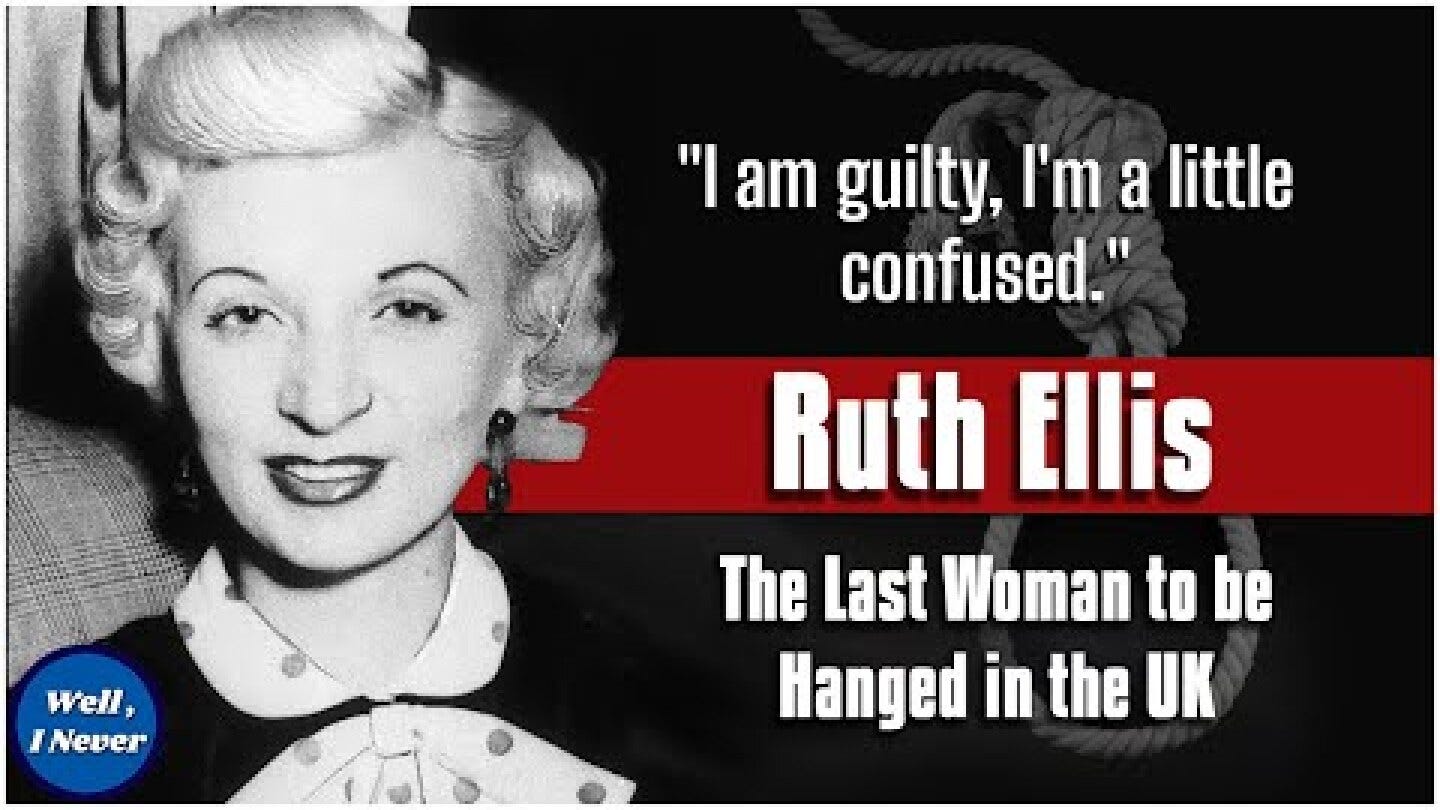
On the morning of July 12, 1955, Ruth Ellis was led to the gallows at Holloway Prison knowing that within minutes she would become the last woman executed in Britain. She was 28 years old, the mother of two children, and had been convicted of murdering her lover, David Blakely. Her responsibility for the shooting was never in doubt. What would be questioned for the next seven decades was something very different: whether a justice system that understood almost nothing about domestic abuse, coercive control and the consequences of sustained violence had truly understood the woman it was sending to her death.
The answer came dramatically late. More than seventy years after her execution, King Charles granted Ellis a posthumous conditional pardon following a recommendation from the British government and a long campaign by her family.
The pardon does not mean that Ruth Ellis did not kill David Blakely. She shot him outside a pub in north London on April 10, 1955, and remained at the scene until she was arrested. What it means is perhaps more important to the way we understand her case today: the woman tried in 1955 was judged without the court seriously considering what we now know about the violence that had come before.
Ruth Ellis did not fit comfortably into the image of womanhood that postwar Britain considered respectable and safe.
She was working class, an unmarried mother of two children by different fathers, worked in London nightlife, and became one of the youngest nightclub managers in the capital. She had ambition, financial independence and a public presence that sat uneasily within a society that, after the war, was pushing women back toward domestic life and traditional roles.
The clubs where she worked were filled with the human debris of the postwar world. Men returned from military service carrying experiences for which there was often neither language nor understanding, spending their nights drinking, talking and trying to recover some sense of normality.
Ruth knew how to move through that world. She had the looks that drew attention, but also the intelligence and warmth required to manage people and situations. She was not simply the glamorous blonde later presented by the newspapers. She was a woman who had learned to read a room quickly because survival had demanded it long before she entered the clubs.
Ruth was born in North Wales in 1928. Her father, Arthur Hornby, worked as a musician accompanying silent films. Her mother, Elisaberta Goethals, was a Belgian refugee working as a domestic servant when they met.
The arrival of talking pictures gradually destroyed her father’s profession. As financial pressure tightened around the family, later accounts described his behaviour inside the home as increasingly violent.
Ruth’s sister, Muriel Jakubait, later alleged that their father had raped her and had also sexually abused Ruth. Those claims were never established in court, but they became part of the family history that emerged after Ruth’s death.
Whether every detail can now be proven or not, one fact remains clear: Ruth grew up in an atmosphere of instability and violence and entered adulthood having already learned that affection and fear could exist much closer together than they ever should.
She would spend much of her adult life trying to escape the social position into which she had been born. She worked, changed environments, entered a world of glamour and wealth, and tried to construct a different life.
Then she met David Blakely.
Blakely was a racing driver, handsome, charming and socially more privileged than Ruth. Their relationship began in 1953 and quickly became destructive.
He was unfaithful, unstable and often financially dependent on her. Ruth spent heavily trying to keep him close, while their relationship became marked by fierce arguments, separations, reconciliations and physical violence.
At the same time, another man was present in her life: Desmond Cussen, a former RAF pilot who was deeply in love with her. The result was a complicated triangle in which Ruth struggled to maintain control over a life that was becoming increasingly chaotic.
The relationship with Blakely had already taken a serious physical toll. According to later accounts, during one particularly violent attack he struck her in the abdomen while she was pregnant, causing her to miscarry.
Soon afterwards, he left her again.
Today, such a history would be understood through concepts that either did not exist or rarely reached a courtroom in 1955: cycles of abuse, coercive control, trauma and psychological dependency.
But the society of 1955 had a very different vocabulary.
And very different expectations of women.
That day, Ruth had consumed a large amount of alcohol. Desmond Cussen had given her a loaded Smith & Wesson revolver and driven her to the Magdala pub in north London.
Blakely was there.
Ruth waited for him and, when he appeared, shot him repeatedly. She did not flee. She remained at the scene and was arrested immediately before the case moved to the Old Bailey.
There was never any serious question about who had killed David Blakely.
The question was why.
And that was where the case began to fail her.
For a case that would end with the state taking a human life, the trial was extraordinarily brief.
The defence did little to develop the history of abuse. Her barrister, Melford Stevenson, conducted only limited cross-examination of prosecution witnesses and did not present a full account of the violence that had preceded the killing.
The jury took around twenty minutes to reach its verdict.
Guilty of murder.
At the time, that verdict carried a mandatory sentence of death by hanging.
The court of 1955 did not have the legal concepts that would later allow a much fuller examination of diminished responsibility, loss of control and the effects of prolonged abuse. What it did understand very well was how to judge Ruth herself.
She was an unmarried mother. Her children had different fathers. She worked in nightclubs. She had lovers. She drank. She did not behave as respectable Britain believed a woman should behave.
So alongside the woman who had killed a man, another woman was placed on trial: the woman who had broken an entire social code.
The violence committed against her remained at the edges.
Her life became the centre.
The press found in Ruth Ellis an almost perfect story: sex, jealousy, violence, crime, nightlife and a glamorous blonde woman.
The image of the “cold-blooded murderess” was easier to sell than the image of a woman who could be both perpetrator and victim at the same time.
That is precisely what makes the case difficult.
Ruth was not innocent.
David Blakely was dead because she shot him. Recognising the abuse she endured does not erase his death or transform the killing into something other than what it was.
The question is whether a civilised justice system should examine the whole story before deciding that a human being must die.
In Ruth Ellis’s case, the system of 1955 did not.
On July 12, she was hanged at Holloway Prison.
She was 28 years old.
Her death triggered an enormous public debate over capital punishment. The image of a young mother sent to the gallows in a case filled with evidence of abuse and emotional collapse became one of the most powerful arguments used by those demanding reform.
Only two years later, diminished responsibility entered English criminal law. In 1965, the death penalty for murder was suspended and effectively abolished in Great Britain.
Ruth did not live long enough to see any of those changes.
She had already become part of the argument.
Her family never stopped seeking a reconsideration of the case. Her grandchildren, Laura Enston and Stephen Beard, continued the campaign for the state to recognise that the execution could no longer be regarded as just in light of what is now understood about domestic abuse and coercive control.
The recognition came more than seventy years later.
Following a recommendation from Justice Secretary David Lammy, King Charles granted Ruth Ellis a posthumous conditional pardon.
Her granddaughter described it in the only way such delayed justice can really be described. The pardon could not restore Ruth’s life, repair the families damaged by the case or return the lost years.
But it could acknowledge one thing.
She should not have been hanged.
There is always a temptation, when looking back at old criminal cases, to judge the past with the comfort of knowledge acquired later and assume that we would have understood better.
Perhaps we would have.
Perhaps we would not.
Ruth Ellis’s story matters precisely because it forces us to confront something more uncomfortable. Justice never operates outside its own time. Courts are made of people who carry the prejudices, knowledge and blind spots of the society in which they live.
In 1955, a woman could be held responsible for her crime without the court considering it equally important to understand what had happened inside the relationship that preceded it.
Today, we know more.
That does not change the crime. But it changes the way we understand responsibility, punishment and the right of a state to take a life.
Ruth Ellis spent much of her life trying to escape the class, violence and roles other people had chosen for her. In the end, a court placed her inside one final role: the cold-blooded murderess.
It took more than seventy years for the picture to become a little more complete.
Not to say that she did not kill.
But to acknowledge that the justice system that condemned her had not understood enough before deciding to kill her.
Comments
Nothing yet. Say the first thing.
Sign in to join the conversation.