
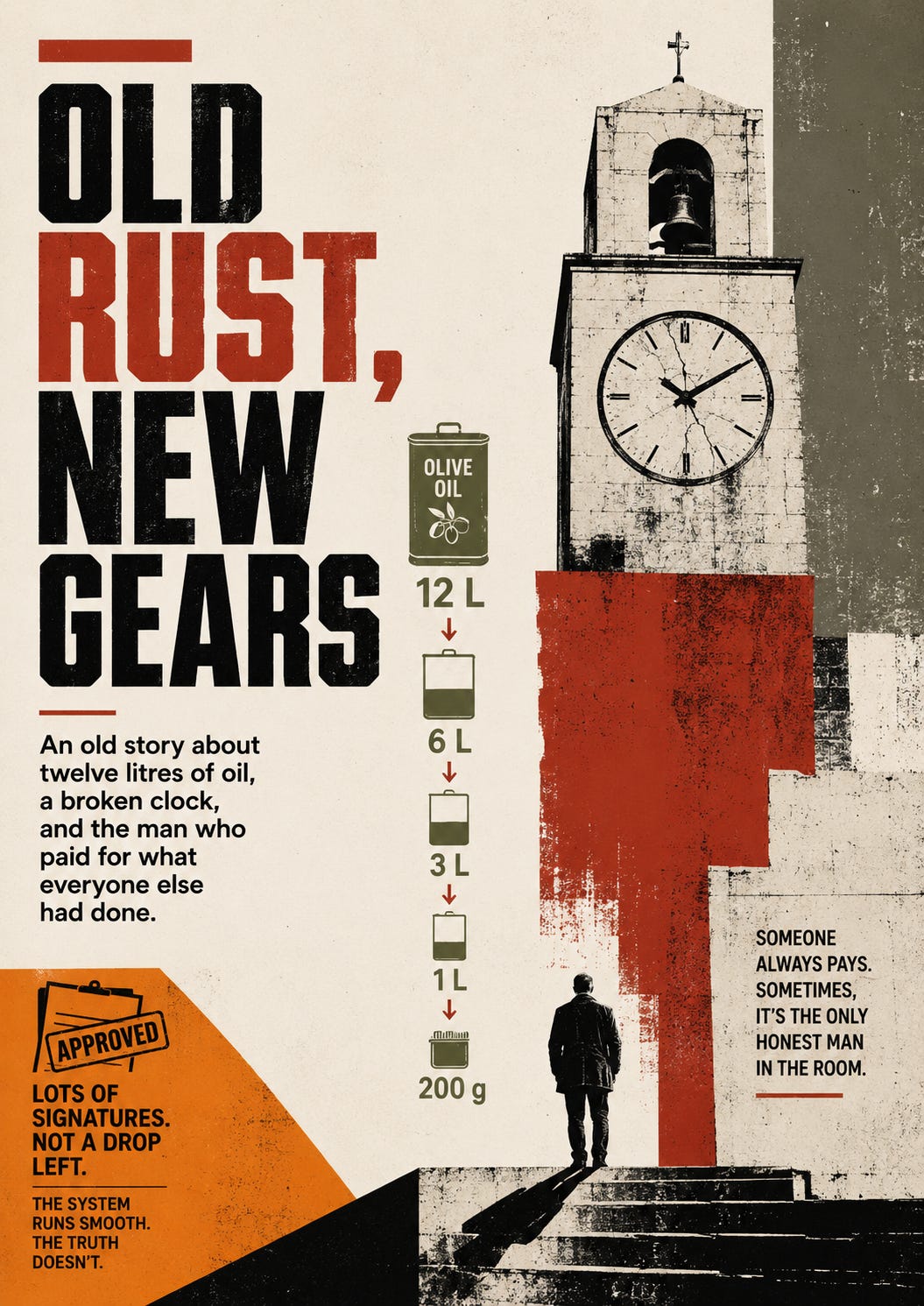
During the Italian occupation of a small Ionian island, a broken clock needed twelve litres of oil to work again and ultimately cost the life of the only man who did not steal a single drop. The Italians had requisitioned the Town Hall in the main square and turned it into their headquarters. The commanding officer had installed himself in the mayor’s office, from whose large window he could see almost the entire square.
Opposite stood the island church and, beside it, a tall bell tower. Halfway up was an ornate clock that had once regulated the rhythm of the town. People knew when to open their shops, when to head down to the harbour, when to return home, without needing to look at anything else.
Now the clock had stopped.
The Italian officer noticed it every day and waited in vain to hear its bell. One morning he called in the mayor and asked why it no longer worked. The mayor explained that the clock had developed a fault and that, among other things, its gears needed oiling. But there was no oil. It was wartime. People cooked with whatever they could find, and there were families who had almost forgotten what olive oil looked like on a table.
The officer decided that this had to be corrected. Perhaps the silence of the clock annoyed him. Perhaps he liked the idea of showing that even under occupation he could be the man who put things back in order. He gave the mayor a tin containing twelve litres of fine Italian olive oil and instructed him to make sure the clock was repaired immediately.
The mayor took the tin home. That same evening, he invited the municipal treasurer over and explained how important it was to satisfy the Italian officer’s wishes. He handed him a demijohn containing six litres of fine Italian olive oil and told him to make sure it reached the man responsible for repairing the clock as quickly as possible.
The remaining six litres were never mentioned in the conversation.
The following morning, the treasurer went to the church and asked to see the priest. In his hands he carried a bottle containing three litres of oil. He explained that the Italian officer had taken a personal interest in the clock and that, since the bell tower belonged to the church, it seemed only natural that the priest should take responsibility for what happened next.
The priest accepted the bottle, thanked the treasurer and agreed that the officer’s wishes should certainly be respected. The other three litres did not appear to trouble anyone very much.
That same afternoon, the priest called the sexton into his office. He spoke about the Italian officer, the importance of maintaining good relations with the occupation authorities and, naturally, the need to get the clock working again. He handed the sexton one litre of fine Italian olive oil and asked him to take it immediately to the clockmaker.
The sexton left with the oil. A little while later, he knocked on the clockmaker’s door and explained that the matter had begun with the Italian officer himself and that the instruction was clear: the clock had to be working again as soon as possible.
Then he took a small bottle from his pocket.
Inside were about two hundred grams of oil.
The clockmaker held it in his hands and stared at it for a long time without saying anything. He knew nothing about the Italian officer’s twelve litres. He knew nothing about the mayor’s six, the treasurer’s three or the priest’s one. For him, the story had begun only seconds earlier, when the sexton handed him a tiny bottle and told him that this was the oil the officer had provided for the clock.
Two hundred grams of oil was not an insignificant amount in those days. At home, his children had spent months eating corn bread, greens and whatever else could be found. He looked at the bottle and imagined how different the boiled vegetables would taste with a few spoonfuls. He thought of his children, who had almost forgotten the flavour of oil, and of how a few drops on their food would be a luxury beyond anything that had entered the house for months.
Then he thought of the Italian officer. He knew nothing about the chain above him and could not imagine that twelve litres had once existed. All he knew was that an officer of the occupying army expected to hear the clock and that, if he did not, somebody would have to explain why.
So he pushed the thought of the vegetables and his children aside as best he could, took the little bottle and climbed the bell tower.
That same afternoon, the clock struck again.
Six times.
The islanders, who had almost forgotten the sound, stopped what they were doing. Some assumed someone had died and crossed themselves, murmuring the traditional words offered after news of a death. Then they realised the six strokes were not a funeral bell. The old clock had come back to life.
At evening prayers, the priest thought it proper to explain what had happened. He told the congregation about the good Italian officer who had taken an interest in the island and had generously provided fine Italian olive oil so that their clock could work again. In such difficult times, he said, even a gesture like this deserved gratitude. Despite the war and occupation, the Lord had allowed a kind-hearted man to appear among them.
The mayor was there listening. So was the treasurer, and the sexton stood a little farther back. None of them felt that the priest’s account required any additional detail.
For several days the clock continued to work. Every hour the bell sounded over the square, and from his office window the Italian officer could feel satisfied. He had provided twelve litres of oil, and the problem had been solved. From where he sat, matters looked remarkably simple.
A week later, the clock stopped again.
The officer was furious. As far as he was concerned, there was no reason for such a thing to happen. He had supplied more than enough oil and given clear instructions. Someone, therefore, had failed to do his job.
This time, the chain began moving in the opposite direction.
The officer demanded an explanation from the mayor. The mayor assured him that he had passed the oil to the treasurer. The treasurer said he had delivered it to the church. The priest confirmed that he had entrusted the matter to the sexton. The sexton said he had handed the oil to the clockmaker.
And at the end of the chain stood one man.
The only one with nobody beneath him.
One morning, the Italians brought the clockmaker into the main square and placed him against the wall of the bell tower. The mayor, the treasurer, the priest, the sexton and the other islanders were made to watch. The officer wanted the punishment to serve as an example.
The clockmaker was executed for the failure of a clock he had tried to maintain with two hundred grams of the twelve litres that had begun their journey at the Town Hall.
The clock stopped again.
The others continued with their lives.
I do not know whether the story happened exactly this way, whether there were truly twelve litres, whether they became six, then three, then one and finally two hundred grams. Stories passed from mouth to mouth often acquire the shape of parables. Perhaps, though, that does not matter very much.
Because the mechanism is recognisable.
Somewhere at the top, something is allocated for a specific purpose. As it travels from office to office, official to official and hand to hand, it becomes smaller. Everyone keeps something and passes the remainder down to the next person with exactly the same instruction: make sure the job gets done.
At the end of the chain is usually the person who must actually do it, with the equivalent of two hundred grams in his hands. And when the clock stops, everyone above him already has proof that they did their duty.
Times change, uniforms change, documents become digital, and oil tins take on different forms. Old rust, however, has a remarkable talent for surviving inside new machinery.
And when the gears finally stop turning, we still have a habit of looking for the person holding the last small bottle.
Comments
Nothing yet. Say the first thing.
Sign in to join the conversation.