
My grandfather was a physicist and 96 years old, and whenever someone asked how old he was, he usually answered, “Roughly speaking, not long before I die.” The best part was that he smiled when he said it. Not with that strained little smile people use when they are joking about something that secretly terrifies them. He smiled properly, as if he were discussing a perfectly natural fact that had no reason to ruin his day.
He had divorced my grandmother when he was 75. There was no other woman, no other man, none of the drama we tend to think necessary to justify the end of a marriage after so many decades. My grandfather simply did not want to go on excursions to monasteries with her.
He also couldn’t stand her friends. After spending their lives with husbands and lovers, Mykonos holidays and European casinos, they had suddenly decided that Easter ought to be spent at the Holy Sepulchre. My grandfather had his own explanation.
“These women, my boy, are used to arranging everything by asking their politicians for favours,” he once told me. “I can’t stand watching them turn God into another politician. They light candles, make vows, bake offerings, kiss bones and saints’ skulls because this time they’re asking for the biggest favour of all: a penthouse in Heaven. I’d rather be alone.”
And he was. For another twenty years, he lived better alone.
God, if He exists and bothers with such details, gave him remarkably good health. Perhaps because my grandfather never asked for it while randomly kissing the skull of Saint Minas. He repaired his mother’s old house in a village of ten houses somewhere in the southern Pindus mountains and retired there without ever behaving as though he had been exiled.
Every morning he took a long walk in the mountains. Then he came home, read, cooked his lunch and slept for a while. In the afternoon he went to the village’s only café-grocery-tavern-emergency-clinic, where he met the other sixteen residents.
He usually supplied the wine. He had accumulated almost strategic reserves of Savatiano, his particular weakness. They ate omelettes made with eggs from Mrs Magda’s chickens and mushrooms collected by Thomas’s nephew, and after the third glass somebody brought out the cards for biriba or set up the backgammon board.
When my grandfather was in particularly good spirits, he explained the laws governing the universe through examples from everyday life. Material fatigue, for instance, had once been demonstrated through his divorce.
“You argue for years and think it doesn’t matter,” he told them. “Then you make up and carry on. But the relationship has been getting tired. One day you suddenly separate and wonder why, because nothing especially dramatic happened. But nothing dramatic needs to happen. Years of stress eventually produce a fracture. It’s the same with a piece of cloth left in the sun every day. One day, without warning, it simply falls apart.”
Then he went home, read a little more and went to sleep. He was calm and, as far as I could tell, genuinely happy.
Out of the entire family, I was the one he still spoke to regularly.
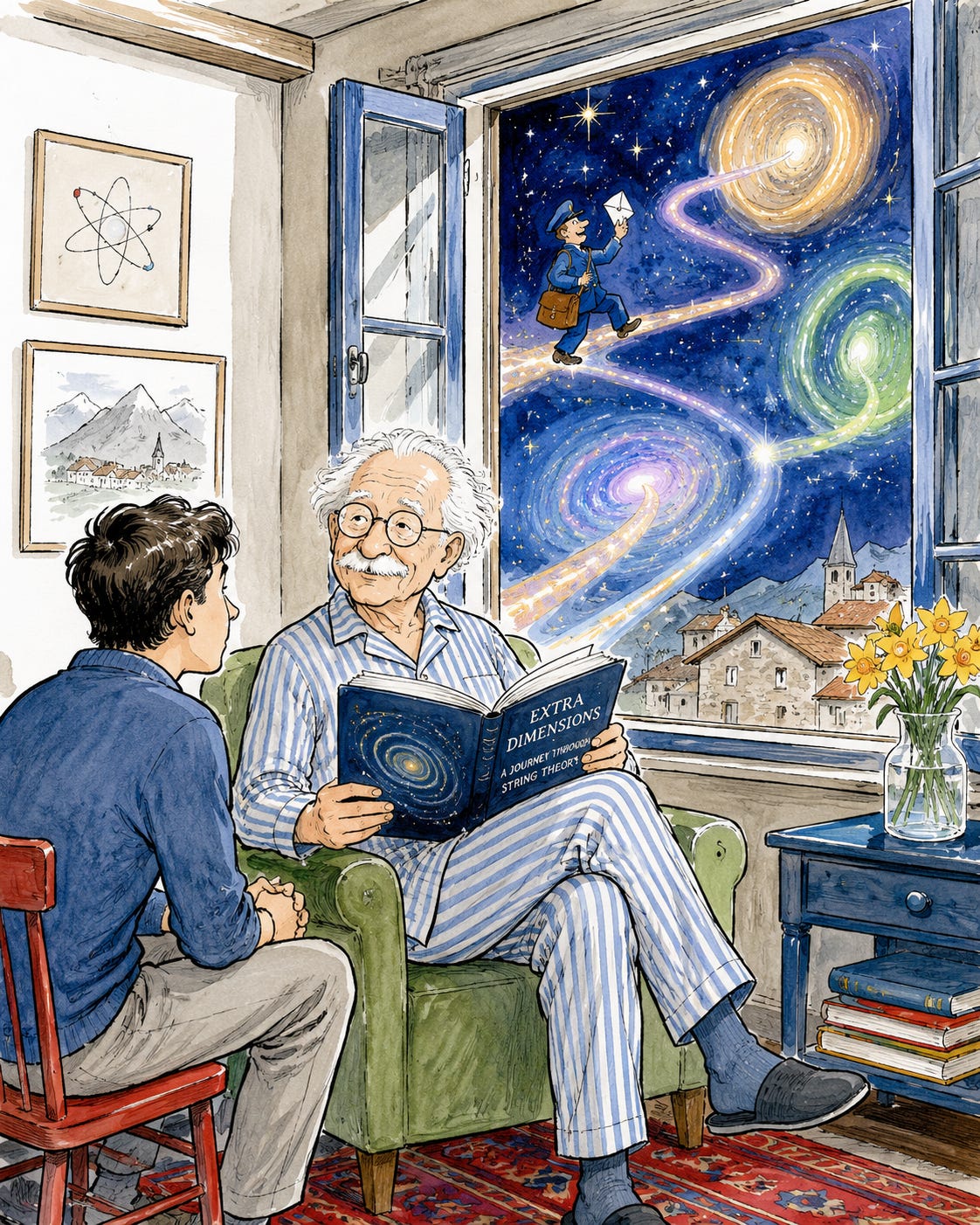
Yesterday, Mrs Magda called me and said he wasn’t well. I caught a flight and within half a day I was at the village. When I entered his house, I found him in bed looking terrible, but wearing clean striped pyjamas, lying between crisp sheets, with a cup of chamomile beside him and a book in his hands.
The moment he saw me, his entire face lit up. Immediately afterward, he told me off for abandoning my work just to come and see him.
“How are you doing, Grandpa?” I asked, making a fairly poor attempt to hide how worried I was.
“I’m trying to work out which of the eight unknown dimensions of the universe would be the nicest one to relocate to,” he said, waving the book at me.
I took it from his hands. It was about string theory. He started explaining that, according to some theoretical models, the universe may contain more dimensions than those we can perceive, and that realities might exist which we, trapped inside our everyday experience of space, are simply incapable of seeing.
“Seriously, Grandpa, do you think it could be true?” I asked him. “Do you think we’re trapped inside a bowl like fish, believing this is everything, while outside there’s the house, the city, the world, the galaxy? Maybe we’re just short-sighted goldfish.”
He looked at me and gave me that teasing laugh of his.
“I’ll tell you very soon, and then I’ll know what I’m talking about. You know what I’m like when I start investigating something. I’ll find a way. I’ll find a mailman with a licence to travel between universes and I’ll send you word. Promise.”
We both burst out laughing and hugged.
That same night, he died peacefully in his sleep.
And for the first time I understood what the phrase “trampling down death by death” might actually mean. Not as a religious slogan, and not as consolation repeated because we are frightened, but as the strange victory of a man who reached his final day without allowing death to take away his curiosity, his humour or his desire to discover what might be waiting beyond what he could see.
And, if I’m telling the truth, I envied him a little for that.
Have a good journey, Grandpa. I’ll be keeping an eye out for your mailman.
Comments
Nothing yet. Say the first thing.
Sign in to join the conversation.