
At the beginning of last year I released an essay called Projecting 2025. Today I am revisiting that essay and sharing new observations as we move deeper into 2026.
The title of that essay, Projecting 2025, was of course a nod to Project 2025, a blueprint for reshaping the federal government to advance White Christian Nationalism. For those who don’t know about it yet, here is a tracker keeping tabs on the progress of Project 2025. According to the tracker, 51% of the policy initiatives outlined in Project 2025 have been implemented. For some people, this has turned into the shorthand, “Project 2025 is halfway done.” While this may be technically correct if you look at the checklist of policy changes, Project 2025 is not just a checklist. It is a world-building project. It has vision and ambition beyond bureaucratic minutia, which is a lot of what has been checked-off. Don’t get me wrong, I am not trying to minimize the danger of some of what has been implemented so far. “Bureaucratic minutia” might sound dismissive, but as the saying goes, “the devil is in the details,” and some of the quiet, detailed work this administration has done is the most devastating. For example, with a single stroke of a pen, the Department of Energy cancelled $13 billion of funding for green energy projects and revoked tax credits for wind and solar infrastructure - a goal listed on pg. 401 of Project 2025. The impact may be felt for decades (this article helps explain why).
But reshaping the federal government only goes so far in reshaping an entire culture. Project 2025 is really about Project 2045 - when the U.S. population is projected to be majority non-white. The proponents of Project 2025 are trying to build an alternative to that world, or at least guarantee their power within it. So when we say Project 2025 is about 50% complete…is their world half-way built? I’m not sure. It’s possible. But I think it requires deeper examination than just counting the policy changes. I say this not to criticize the work of the tracker, which is doing what it is supposed to do, but rather to contextualize our emotional responses to it. Thinking “it’s already more than half-way over” might demoralize people who don’t realize how much good fight there is left to fight. What the world will be like in 2045 is not yet set in stone.
Bad Bunny’s Superbowl Half-Time Show pulled 135 million views. Turning Point USA’s right-wing alternative, the so-called “All American Half-Time Show,” pulled 6.1 million views. Who is really winning the culture war? Whose world-building project is going to win out 5, 10, 20 years from now? To my eyes, that bigger question is still unanswered. I don’t know that the White Christian Nationalist agenda as a whole is more than halfway complete.
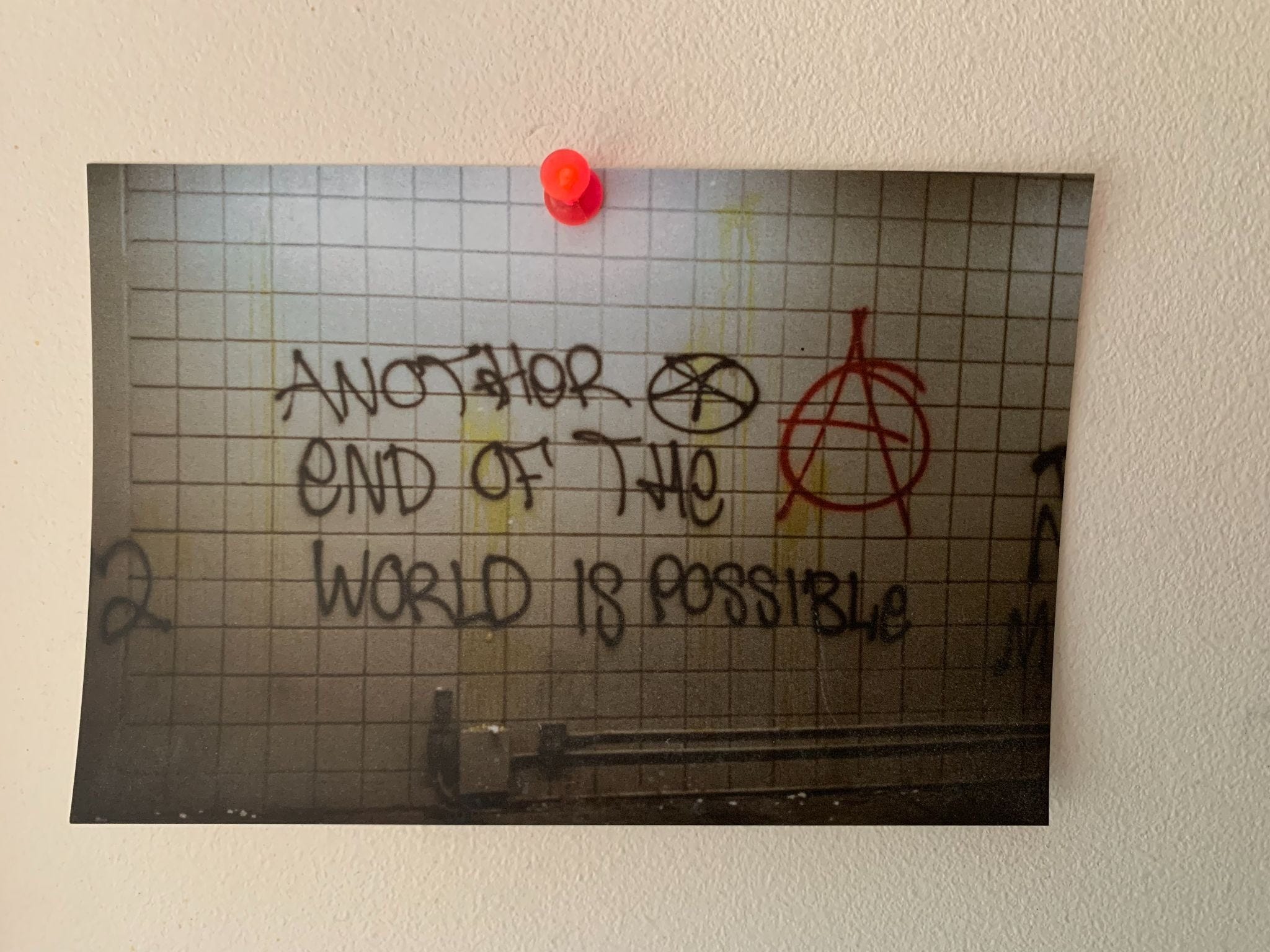
A chipper reminder I keep pinned on my bedroom wall
That being said, I don’t have a whole lot more chipperness to share as we stare down the barrel of 2026. I mostly have warning.
I trained in conflict mediation at Corrymeela, Northern Ireland’s oldest peace and reconciliation organization, studying with teachers who mediated paramilitaries during The Troubles. One of the concepts that my teachers discussed was the conflict “iceberg.” The part of the iceberg above the water is the visible conflict: where violence erupts, the people or institutions who become flashpoints of controversy, the frontline of struggle, the direct actors involved whether victim or perpetrator or both, etc. etc. The part of the iceberg that is above the water usually involves a much smaller number of people directly, but it is what all the rest of us see on the news or social media or discuss around our kitchen tables.
That brings us to the bottom of the iceberg, the part that is below the water, the part that is not so visible. This is the vicarious and indirect part of the conflict. It is all the people who may not be directly involved, but observe and build narrative about what is happening. The part of the iceberg below the water is the stories we tell about whatever is happening above the water. Not only that, it is also how we see ourselves and others within the story. It is the reasoning we adopt to explain why the conflict is going on. Even if we are not directly involved yet, we situate ourselves in the story one way or another and we shape our identity through doing so. We explain it to ourselves and those around us. We align ourselves as bystanders, as witnesses, as “us” and “them.” And then, we pass those stories on. Sometimes for generations.
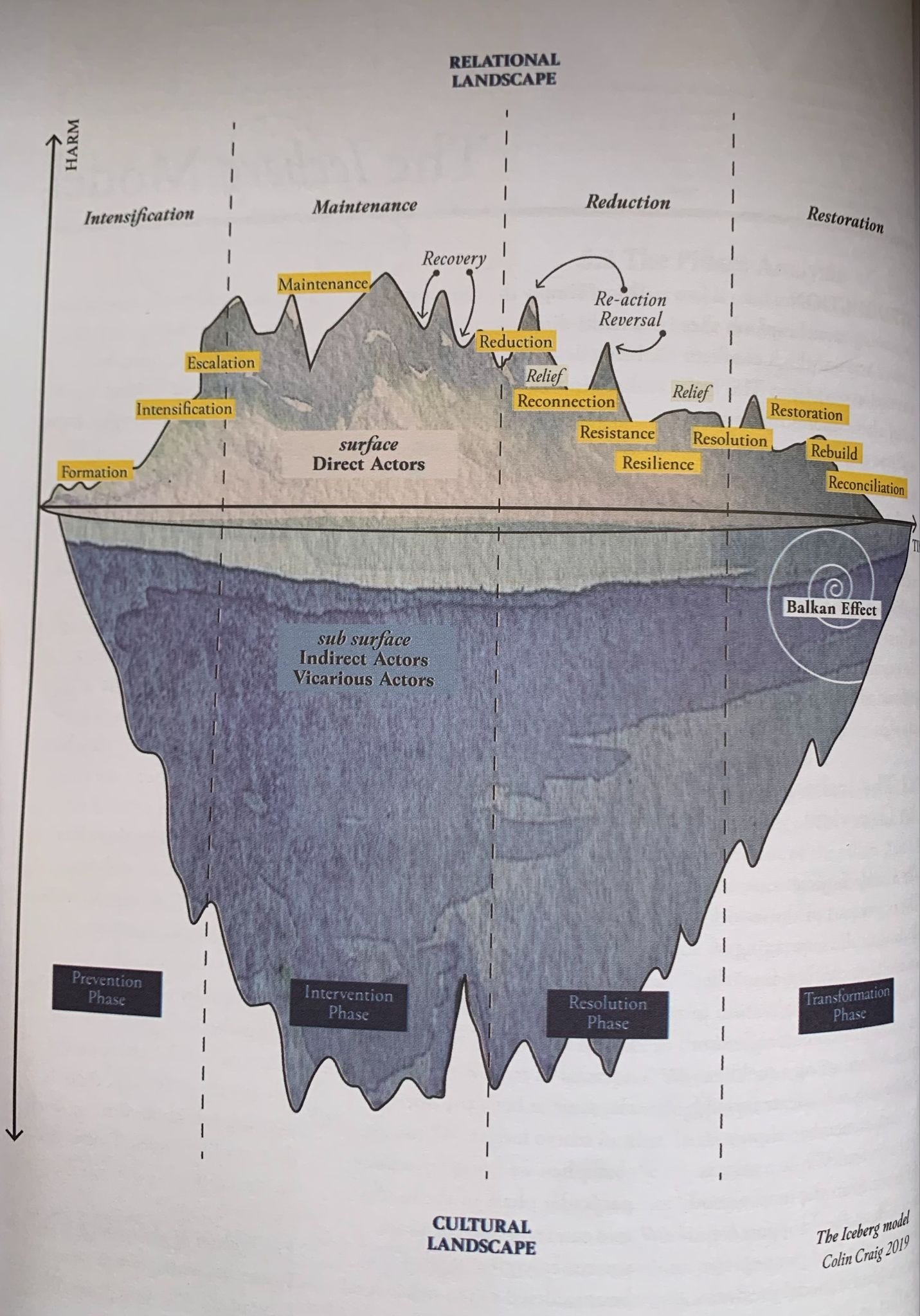
The Iceberg Model as depicted by my teacher at Corrymeela, Colin Craig
“Official” or “formal” truth & reconciliation processes usually involve people who were directly harmed giving testimony about what happened to them and some kind of attempt to reconcile that injustice. They also involve people who were perpetrators testifying about what they did and facing reckoning. And, of course, as is the way of such things, some people are both victims and perpetrators. But some of the longer, harder, deeper work is unpacking the stories people learned about “the other side,” the stories that still hold sway when faced with the reality of having to live with each other in whatever the hell the politicians are calling “peace.” If the rest of the iceberg isn’t dealt with, it is floating there, ready to collide with the right provocation and kick off another cycle of destruction. It’s a type of cultural work that lasts for years, sometimes decades after the fact, and may or may not be part of the “formal” or “official” process. [Al-Jazeera just released a short documentary about this work in Rwanda that is worth watching.] The truth & reconciliation efforts I witnessed in the Balkans, Colombia, and Northern Ireland were this exact type of cultural work - addressing the bottom of the iceberg for years to come.
Maybe you were a child in Bosnia and witnessed Serbian soldiers brutalize your neighbors. What are the stories you learned about Serbs to help explain what happened? What narratives are you carrying into any interaction with any and every Serb for the rest of your life? Were the soldiers prosecuted, or are they roaming free, and how does that change the story for you? Maybe you were a child in Serbia who was bombed during the U.S.’s intervention in the genocide against Bosnia and (like many children who live through war) developed childhood cancer after the fact. What stories are you carrying about who is to blame for your suffering, especially when there is no face and no name that you can submit to a tribunal? How did the adults in your life explain it all to you? These were all questions that came up in the project I was part of in the Balkans.
In Northern Ireland I witnessed a public art work: a large chalkboard that challenged people to write down the stories they heard about “the other side” growing up, everything from “Protestants think we’re all alcoholics” to “Protestants love soup and gardening,” everything from “Catholics won’t use contraception” to “Catholics love incense and JFK.”
For people who were directly involved, especially victims, it’s also not just one time of telling your story to an official somewhere and then it’s done. There’s no real finish line about when that process is “done.” The reality of living with what happened is far more complicated. The who-what-when-where-how of survivors sharing what happened to them, over time, to the people in their daily lives, very much becomes part of this iceberg below the surface. Over time those stories sink from above the water to below and continue to hold tremendous power. Trauma transforms, for better or for worse. In Colombia, the project I was involved in worked with children whose families had been killed or displaced by paramilitaries to share some of their stories through music.
These are all examples of working with the bottom of the iceberg.
Most of my experience with “conflict icebergs” is after the fact - after the war is over, after the genocide has stopped, after the treaties and the tribunals and the laying down of arms. This was true in Colombia, in the Balkans, in Northern Ireland. The stuff above the water had (largely) stopped, and some formal process had been set up to bring justice to those directly involved. Then there was the whole rest of the iceberg to deal with.
For what it’s worth, the only reason I participated in the projects in the Balkans and Colombia was because the U.S. was involved in both of these conflicts and therefore the ongoing cultural work included - or rather, demanded - people from the U.S. Demands to reckon with the U.S. government have been less successful.
Here in the U.S., we’ve never had much stamina for truth & reconciliation. And now, in 2026, I feel like I can see our own icebergs grow in real time. Not just the stuff above the water - the stuff below the surface too. I’m watching as the narratives solidify and harden in real time. It is chilling to watch.
Yes, the U.S. has been living with giant icebergs for a long time. I am not claiming that any of this is truly new. But I’m seeing them grow, I’m seeing new mass take form. I think it’s okay to recognize that the icebergs in the U.S. are evidence of its original sins and have been here the whole time, but do also go through cycles of change. And so as we are watching violence unfold above the water, I can hear the ice underneath cracking and groaning with the weight of all the narratives piling on.
The justifications for fascism are the most horrifying. In case that needed to be said. The Department of Homeland Security claiming that Alex Pretti was an armed terrorist intending to “massacre” law enforcement is sinister. The extra-judicial killings of at least 144 people on boats in the Caribbean Sea in the name of “drug enforcement” is vicious political theatre. Trump’s plans for Venezuela, Greenland, and Gaza are brazen.
This is not the first time within my lifetime that the American government has told the public that violence was good, pure, and needed. My lifetime has included the War on Drugs, the War on Terror, the Iraq and Afghanistan Wars, the entire post-9/11 era, really (RIP Dick Cheney)…These decades built our modern infrastructure of mass incarceration, highly-militarized police forces, the creation of ICE, digital surveillance, new waves of voter and protestor suppression, and a whole different apparatus of tools available to the government when something is labeled as “terrorism” (thanks, Patriot Act). During my lifetime the government built these tools and tested them on certain populations - most often, scapegoats. And they built narratives to justify each step of the way, narratives that shifted to fit the moment, narratives sold expertly to the American public.
Now, what I’m seeing is the justification: “Because we can.” We are no longer in the testing phase of developing new tools. We are in the testing phase of the government using the whole toolbox however they like, whenever they like, and to whomever they like, and seeing what sticks. We are in the testing phase of the government asserting unmitigated power and trying to see what it can get away with. Remember, the real project here is Project 2045. This is about consolidating power. And the stories being told to justify this stockpiling of authority are becoming more fascist. The Bush administration really tried to convince the American public to support the Iraq War. Getting buy-in was part of the plan. They wanted Americans to believe the war was in good faith. I’m not sure the Trump administration cares whether the American public is convinced or not, and I think that might be even more dangerous. Plenty of experts on authoritarian regimes are raising the alarm bells - be they academics or survivors of dictatorships. “This is the playbook,” we are being warned.
But everyone is part of the iceberg. No one is exempt. And I think people who are opposed to Trump may struggle to see or admit this.
The left gets accused of misusing grievance and moral superiority, like caring more about PC language than about people. Some of this criticism is deserved. But it also gets used to delegitimize resistance. Communities who have been targeted for centuries and whose basic message is “stop killing us” get accused of being “woke leftists” for having genuine grievances. This is a very effective way of demonizing social movements, a phenomenon I sometimes think of as “left-jacketing.” Think about it - is survival really a “woke leftist” issue? People of so many different faiths, philosophies, worldviews, and lifestyles are struggling to survive white supremacy, gendered violence, and poverty. As we discussed in the Projecting 2025 essay - the lowest castes of society include some of everyone, there is no majority identity “at the bottom.” And this “voice from below” speaks valid grievance and asserts moral clarity in the face of existential threats. We should be aggrieved at fascism. We should view authoritarianism of any kind as unacceptable and choose to be better.
However, grievance and moral superiority don’t automatically make you an expert about people you have never met, communities you have never been to, and experiences that you have never thought about. And this is where I think caution about the bottom of the iceberg is genuinely warranted even if we know we’re on the “right side of history.” Being “in the right” compared to Stephen Miller does not make you an expert on the lives of millions of other Americans who you view as “other” - or simply don’t think about at all. And what I see happening in liberal, urban places is that narratives are hardening too: more and more, everyone outside the bubble is the enemy, and curiosity about “the other side” is seen as threat, as betrayal. Part of my hope in writing these essays is to address this part of the iceberg.
I want to encourage more people to listen to silence. Some people overestimate the MAGA-ness of the country because they forget to listen to everyone who is politically silent. The majority of Americans did not cast a vote for Trump. Not even the majority of white people in America cast a vote for Trump. This is because of the sheer number of people who simply don’t vote. Let’s revisit this paragraph from Projecting 2025:
About 342 million people live in the U.S. In total, 156 million people voted in the 2024 election, with 77 million voting for Trump (Council on Foreign Relations, 2024). Remember, any statistics that you’re seeing about “such and such percentage of such and such demographic voted for Trump” - that’s only the percentage of the pool who actually voted. The 56% of white voters who supported Trump is 33% of the total white population. Meanwhile, 37% of the white population (66 million) can’t afford basic necessities. The 43% of Latino voters who supported Trump is 9% of the total Latino population. Meanwhile, 66% of the Latino population (42 million) can’t afford basic necessities. The 16% of Black voters who supported Trump is 5% of the total Black population. Meanwhile, 59% of the Black population (24 million) can’t afford basic necessities. (PBS, CFR, USA Facts, Furher).
Even when this silence does get acknowledged it is often to blame people for not voting, instead of getting curious about why certain groups of people are so consistently silent. The loudest and most outrageous voices get the most attention, and this can skew our perception of the quiet and the common. We forget to ask, “Who is not in the room?” and, “Why are they not here?” The answer is: poverty, poverty, poverty, poverty, and poverty. We forget time and time again how truly underrepresented the voices of poverty are in the U.S.
Look at that paragraph again. Did you do the math? Did you figure out that there are more white people in the U.S. who cannot afford basic necessities than there are white people who voted for Trump? Did you catch the fact that the majority of the Black and Latino populations in this country cannot afford basic necessities? Did you catch that the number of white people who cannot afford basic necessities (66 million) is equal to the number of Black and Latino people combined who cannot afford basic necessities (24 + 42 million)?
Once again, “the voice from below” includes some of everyone, there is no majority identity at the bottom. Whenever we stop talking about our own lived experience and start to make statements about someone else’s, how often do we ask ourselves: am I really an expert on all of these people that I’m speaking for, without ever listening to them directly?
I think there is a time and place for listening to uncomfortable stories from “the other side of the tracks,” so to speak. An essay I released in November tried to do exactly that. It talked about how over half of the drug overdoses in the 21st century have happened just in the last 5 years. That’s 500,000 people dead in the last five years alone - more American lives lost than the combat deaths of the Civil War and WWII combined. Overdose deaths reached an all-time-historic-peak in 2022. Unprecedented swathes of rural America have been labeled High Intensity Drug Trafficking Areas. Cartel power grows and hides in the forgotten, invisible corners of the country - like how two of the most-wanted, high-ranking officials in MS-13 were recently arrested in rural Nebraska, where they had been operating for the past two years. And yet I have not heard a single person within liberal, urban settings, not even the wokest leftist, be able to speak lucidly about any of these catastrophes. I have not heard anyone make the connection between what has been happening over the past 5 years and the fact that Trump won the cohort of voters making less than $50K a year in 2024 when he lost it before in both 2016 and 2020. Go check out my essay Teargas in Chicago, Cartels in Nebraska if you want to get into it.
But I don’t say that to be salty or holier-than-thou. You can’t talk about something you don’t even know is happening. I don’t think most people in the big cities know what is going on or have any real means of knowing what is going on. Genuinely. The only reason I know about this stuff is because I grew up in Indiana and have family in Nebraska. Otherwise I’d have no idea either. And I have learned so much from living in Chicago that people in Indiana or Nebraska don’t know either. And Lord knows, there is still so much I don’t know. Isn’t it liberating to admit that we all have limits to our knowledge? Isn’t it liberating not to have to be an expert on places and people you have no direct connection with?
But people in big cities and small towns alike can be resistant to the idea that there’s a ton of stuff they don’t know. And that they don’t know that they don’t know it. And no matter where we come from, we too often think that because we are plugged into our screens, we must have a good idea of what is going on. We forget to question the limits of our algorithm and our traditional news media alike. We think we know who “us” and “them” are. And surely if something so catastrophic was happening to our fellow Americans, we would know about it, right? Right? And this is how the iceberg grows. We become lured into thinking that we are experts in our enemies. But sometimes we’re confused about who our enemies even are. Most of us are still not even experts in our own neighbors. One person who was raised in Chicago who read my zine called Understanding Rural America: A Guide for Chicagoans commented: “I’m realizing for the first time in my life that I too am a target for propaganda.” Isn’t it freeing to admit that? Even just an ounce of curiosity can be the first step to addressing the bottom of the iceberg.
I hope an ounce of curiosity would lead you to ask some very important questions: why have I not heard a single Democratic politician address the growing power of cartels in rural America or raise absolute hell about the fact that more Americans have died of drug overdoses in the last five years than died fighting in the Civil War and WWII combined? Why aren’t the Democrats proposing any solutions?
Interesting, right?
I will leave you with one final thought about icebergs.
The bottom of the iceberg also impacts how we end up treating those who are on the same side as us. This is where grievance and moral superiority can turn especially ugly. There are so many ways that trauma can go wrong. A person who believes in a just cause can still go from being his brother’s keeper to his brother’s killer. Anything that can divide and conquer can and will be used against us. The U.S. federal government has done it many times, from the 1910s against the IWW to the 1960s against the Black Panthers, and they will do it again. In Northern Ireland when Republicans turned on Republicans and Loyalists turned on Loyalists, this was called “the bullet from behind,” and was certainly related to trauma getting stuck in the bottom of the iceberg. Some stories can turn dangerous very quickly. Are we immune to that?
So as we look down the barrel of 2026, I want to leave you with some questions: Could we prevent the worst if we try to work with the bottom of the iceberg now? Not after everything’s gone to hell? Would we need to work with the bottom of the iceberg anyway in order to stop authoritarianism here? If we are actually going to fight back, isn’t that going to require collaboration across some pretty huge and historical divides? Is truth & reconciliation optional anymore amongst those fighting back?
Remember - this is a world-building project we’re fighting. What if we actually have to build the world we want instead?
Comments
Nothing yet. Say the first thing.
Sign in to join the conversation.