

Fentanyl is deadly. But reducing its supply cannot end an overdose crisis rooted in human suffering.
In a recent KevinMD essay, “Fentanyl interdiction will not end the overdose crisis,” I argue that America continues to confuse an important drug-control strategy with a solution to the overdose epidemic.
President Trump has repeatedly pointed to dramatic reductions in maritime drug seizures as evidence that his administration has nearly stopped drugs from entering the United States. Even setting aside questions about what those statistics actually measure, there is a more fundamental problem with the claim.
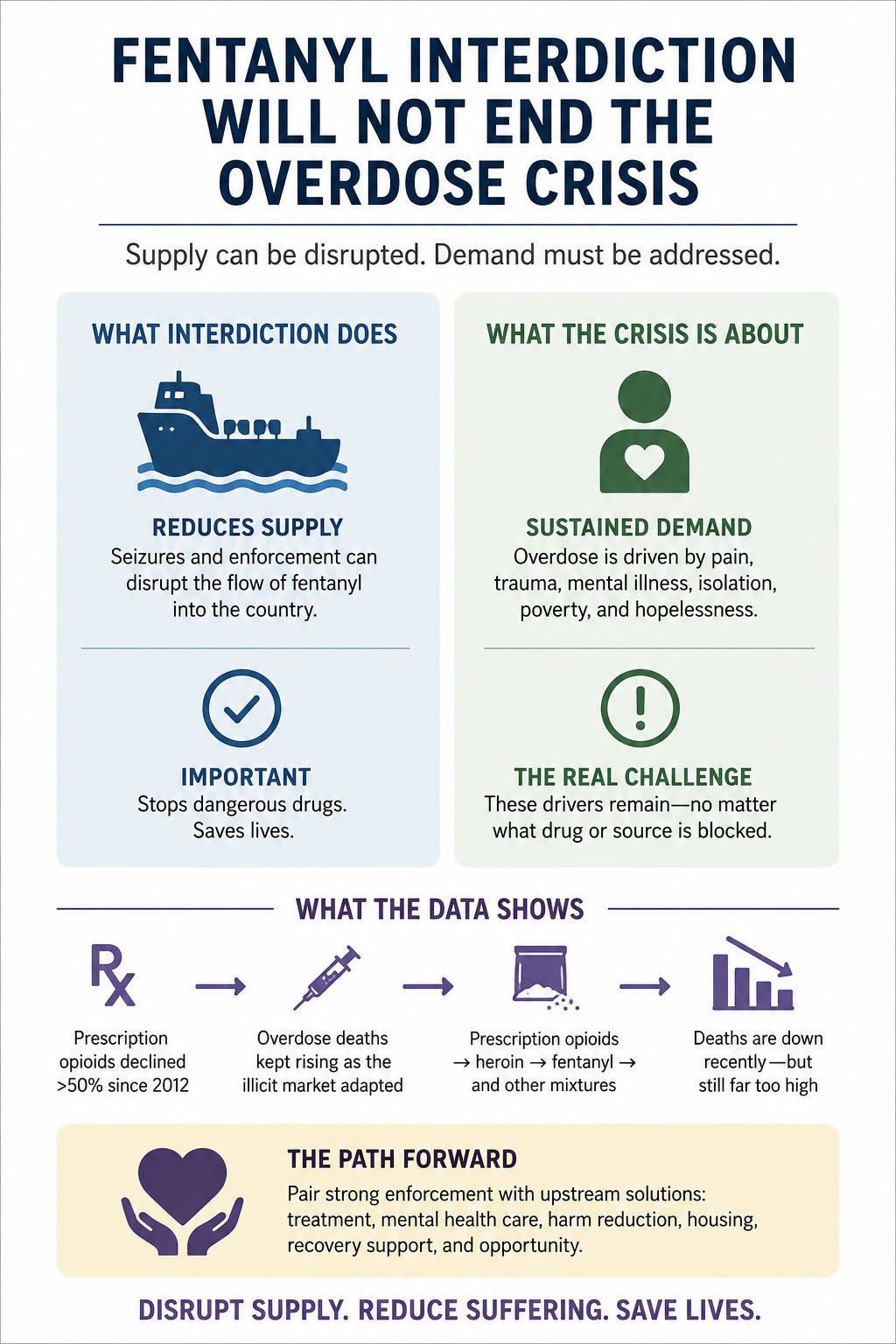
Interdiction addresses supply. It does not address demand.
Fentanyl is extraordinarily dangerous, and disrupting cartels, trafficking networks, precursor suppliers, and distribution routes can save lives. Supply matters enormously when a substance can be lethal in milligrams.
But removing fentanyl does not remove the reasons people seek drugs.
Those reasons include trauma, mental illness, chronic pain, loneliness, housing instability, economic displacement, and despair. Fentanyl did not create these conditions, and eliminating fentanyl will not make them disappear. (KevinMD.com)
We have already seen what happens when policy concentrates primarily on supply. Prescription opioid dispensing in the United States fell by more than half from its 2012 peak. Yet overdose deaths continued to rise for years as the illicit market evolved—from prescription opioids to heroin, then fentanyl, and increasingly to mixtures involving stimulants and other drugs.
The product changed. The source changed. The route changed. Demand remained.
That history should inform what we do next.
America needs vigorous efforts to reduce the lethality of the illicit drug supply. But those efforts must be matched by policies that reduce vulnerability: accessible addiction treatment, naloxone, behavioral health care, stable housing, recovery support, treatment for chronic pain and mental illness, employment opportunities, and stronger communities.
Overdose deaths have recently declined, which is welcome progress. But tens of thousands of Americans are still dying each year. A declining catastrophe remains a catastrophe. (KevinMD.com)
The question we should be asking is not only how fentanyl gets into America, but why so many Americans remain vulnerable to an illicit market they know can kill them.
Until drug policy gives equal attention to that question, the substances will continue to change as markets adapt.
We should disrupt dangerous drugs wherever we can. But we cannot interdict our way out of an epidemic rooted in human suffering.
Fentanyl may change. Demand for relief will persist until we address what creates it.
Read my full argument in KevinMD: “Fentanyl interdiction will not end the overdose crisis.” (KevinMD.com)
Comments
Nothing yet. Say the first thing.
Sign in to join the conversation.