

“Socialism” has become one of the most effective and elastic words in American politics. It is invoked often, defined rarely, and used either to brand very different policies as a common threat or to signal aspirations for greater fairness, security, and shared responsibility. The resulting hysteria is less of a debate over policy than a tribal call. Because the term appears so routinely, especially in arguments over healthcare, it is worth asking what it actually means before judging any policy placed under that label.
The recent growth of the Democratic Socialists of America (DSA) has intensified the controversy. The DSA describes itself as the country’s largest socialist organization, with more than 120,000 members. It argues that working people should democratically control the economy and society and explicitly calls for replacing capitalism with democratic socialism.
A recent Washington Post poll found that roughly three-quarters of Democrats said they would be open to a democratic-socialist presidential candidate. That sounds important, but it does not tell us what respondents understood “democratic socialist” to mean or which policies they would support.
Some voters may hear abolition of capitalism or government control of industry. Others may hear universal healthcare, stronger worker protections, affordable housing, less inequality, or reduced corporate power. Supporting a candidate because one favors part of that agenda is not the same as endorsing the entire DSA platform.
Healthcare provides perhaps the clearest example of this confusion. Proposals ranging from modest expansions of public insurance to comprehensive single-payer plans are routinely branded “socialized medicine,” even though they differ enormously in financing, ownership, delivery, and patient choice.
At its core, socialism involves government rather than exclusively private ownership or control of the means of production. That can include state ownership, worker cooperatives, community ownership, or democratic management. But public ownership of a particular service does not by itself make an economy socialist.
The United States illustrates the point. Americans rarely describe publicly owned highways, dams, water systems, or fire departments as socialism, even though they are collectively financed and managed by government. Public provision of goods and services can coexist with a predominantly capitalist economy.
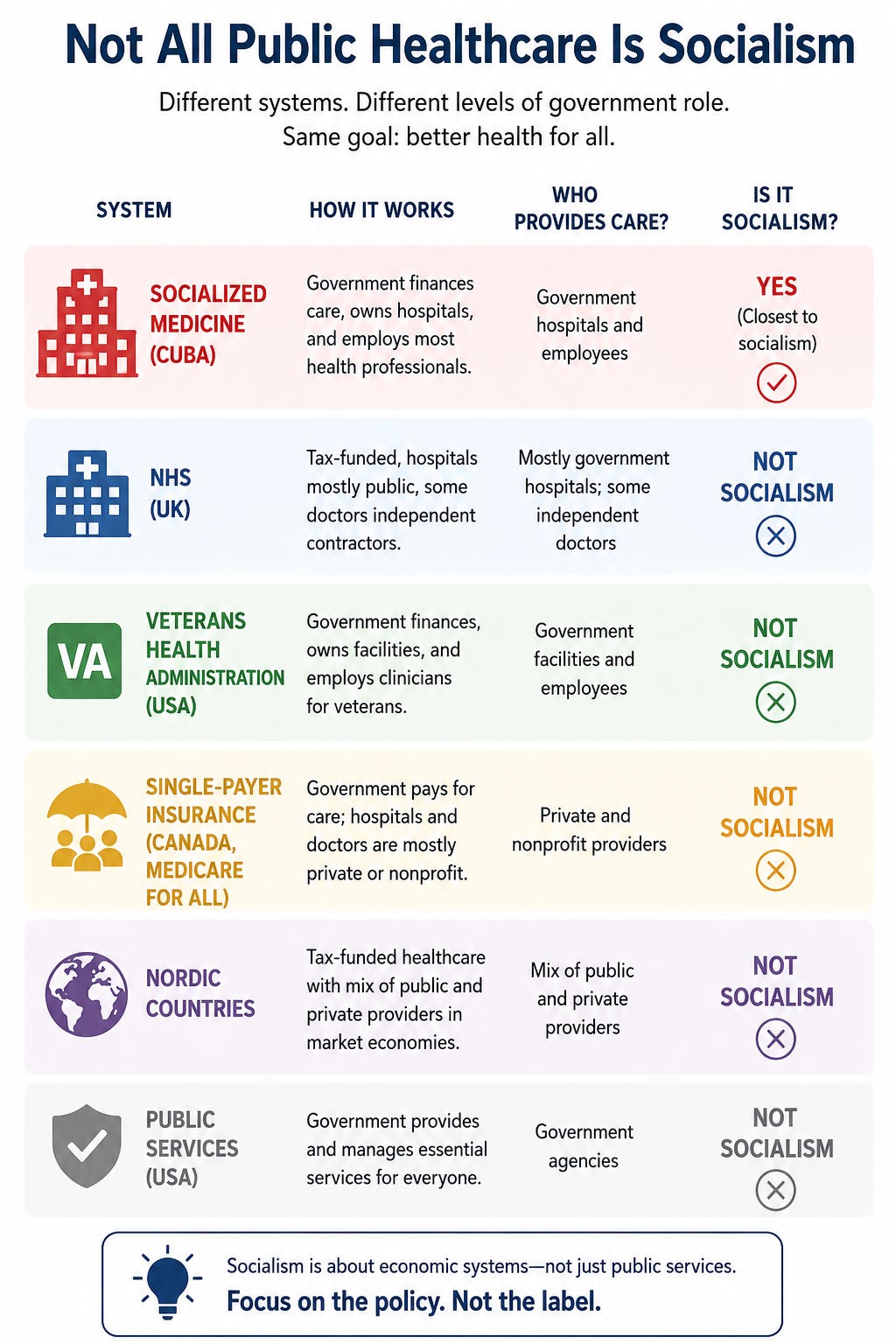
In its narrowest sense, socialized medicine describes a system in which government finances care, owns much of the infrastructure, and employs many healthcare professionals. Cuba is one example, where nearly the entire system is owned and managed by the government.
The British National Health Service also contains important elements of socialized medicine. It is financed largely through taxation, most hospitals are publicly controlled, and many hospital physicians are salaried employees, although many general practitioners work as independent contractors.
The United States already operates a similar integrated model through the Veterans Health Administration (VA). The federal government finances care, owns the facilities, and employs the clinicians. That does not mean the VA model should be extended to everyone. But sweeping denunciations of “government-run healthcare” should acknowledge that such a model already exists in the United States and serves millions of veterans.
Single-payer insurance is different. A public agency finances most covered care while hospitals and physicians remain largely outside direct government ownership. Canada follows this model: provincial governments administer public insurance, while much care is delivered by private or nonprofit providers. American “Medicare for All” proposals generally resemble this approach. They would create a national public insurance program without necessarily nationalizing hospitals or turning physicians into federal employees. That is collective financing, not government ownership of delivery.
The Nordic countries illustrate another arrangement: the social-democratic welfare state. They provide universal healthcare through substantial public financing, with care delivered through combinations of public and private organizations. Yet their broader economies remain predominantly capitalist and market-based.
Other wealthy democracies, including Germany, the Netherlands, Switzerland, Australia, and the United Kingdom, achieve universal or near-universal coverage through varying combinations of public and private financing. What they share is broad risk-pooling and access, not abolition of private enterprise.
Of the healthcare systems commonly invoked in this debate, only Cuba operates within a political-economic system derived from Marxist socialism. The British NHS, the U.S. Veterans Health Administration, Canadian single-payer insurance, and Nordic universal healthcare all operate within predominantly capitalist economies. Universal coverage, collective financing, and even public ownership of healthcare facilities do not, by themselves, constitute Marxist socialism.
The hysteria begins when these distinctions are not acknowledged. Critics may treat a public option or single-payer insurance as equivalent to Cuban central planning. Defenders may point to Nordic outcomes as proof that “socialism works,” overlooking that Nordic countries combine heavily publicly financed healthcare with market-based, privately owned economies. Both sides substitute labels for analysis.
Actual performance deserves more attention than ideological shorthand. Many Americans have been told that the United States has the best healthcare system in the world. Yet the Commonwealth Fund’s 2024 comparison ranked the United States last overall among 10 high-income countries, citing weaknesses in access, equity, administrative efficiency, and health outcomes.
Comments
Nothing yet. Say the first thing.
Sign in to join the conversation.