
Most author interviews are designed to make the author comfortable. This one is not.
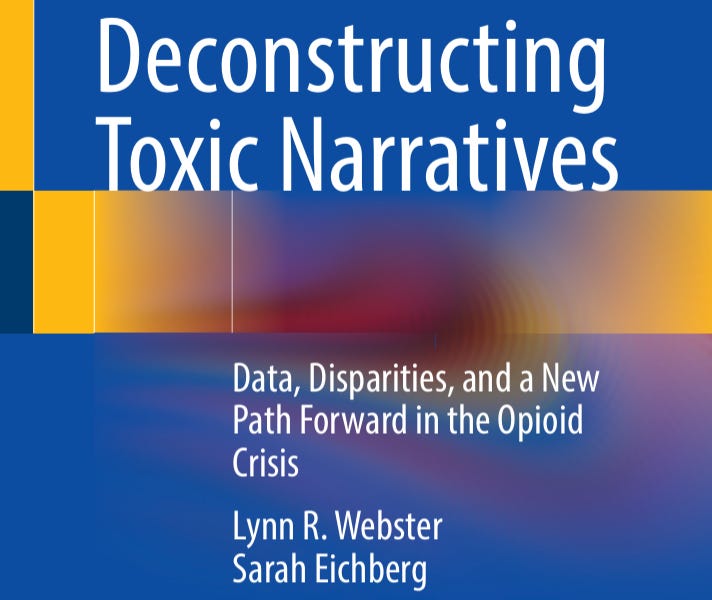
The questions below challenge the central argument of my book, Deconstructing Toxic Narratives—Data, Disparities, and a New Path Forward in the Opioid Crisis. They ask whether I am merely replacing one narrative with another, whether skepticism can become corrosive, and whether questioning dominant explanations might weaken trust in legitimate evidence.
These are fair questions. A book that asks readers to scrutinize familiar explanations should be willing to subject its own argument to the same examination.
My purpose is not to argue that every accepted belief is false or that expertise should be dismissed. It is to show how incomplete explanations can harden into conventional wisdom—and how those explanations have shaped opioid policy, clinical care, public attitudes, and the lives of people with pain and addiction.
“The test of a narrative is not how emotionally satisfying it is, but how accurately it explains the evidence—and what happens when policy is built around it.”
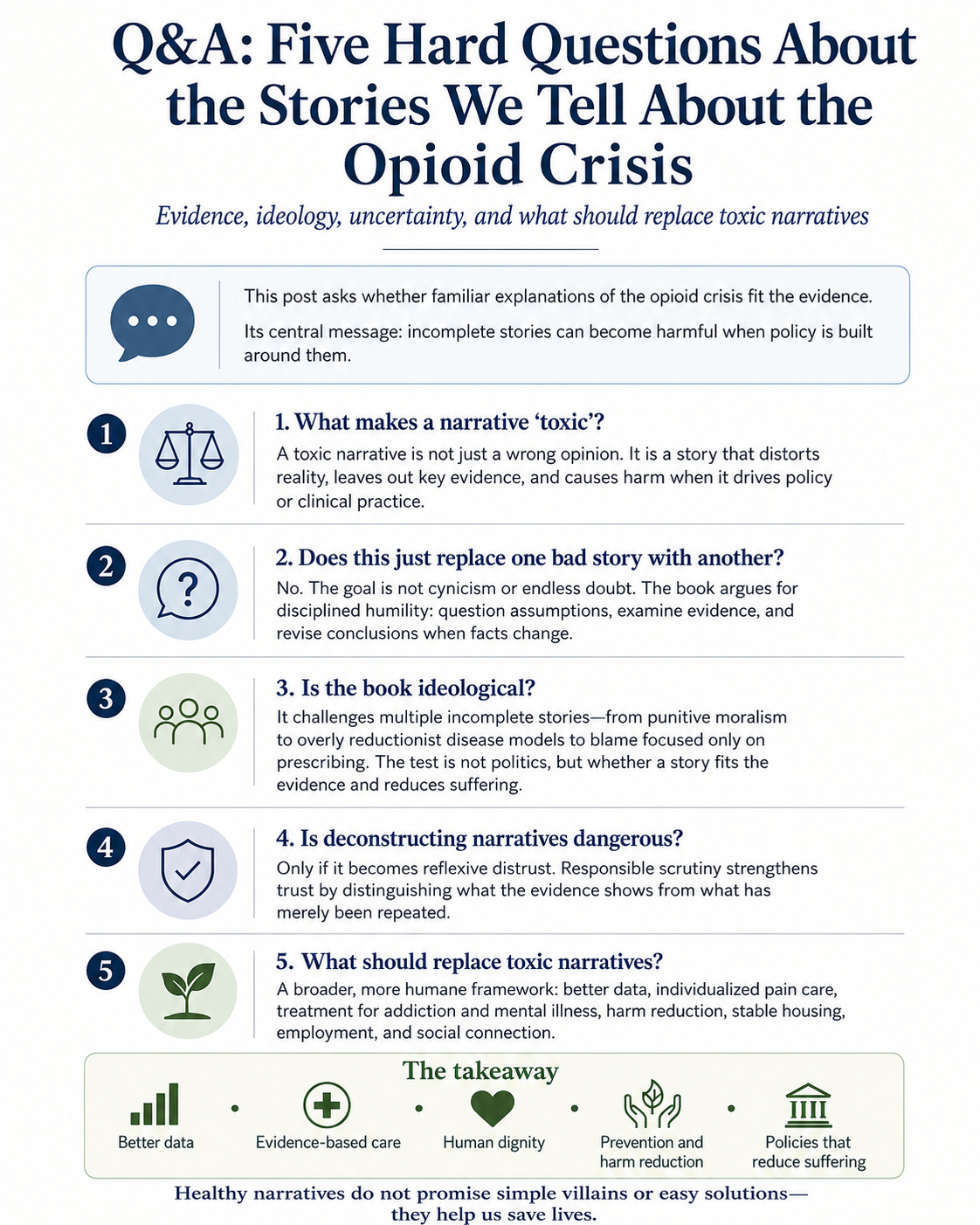
That criticism would be justified if I used “toxic” merely as a synonym for “wrong” or “objectionable.” I do not. A toxic narrative is an explanation that repeatedly distorts a complex reality, excludes important counter-evidence, and produces harmful consequences when it becomes the basis for public policy or clinical practice.
The opioid crisis offers a clear example. The dominant account held that aggressive medical prescribing was the principal cause of the crisis and that sharply reducing access to prescribed opioids would therefore reduce deaths. Prescribing practices did contribute to opioid-related harm, and accountability was necessary. But the explanation became toxic when it was treated as complete. It obscured the growing role of illicit fentanyl, polysubstance use, economic dislocation, trauma, social isolation, inadequate mental-health care, and the absence of comprehensive pain treatment.
The standard is not whether a narrative agrees with me. The standard is whether it represents the evidence accurately, accommodates contradictory findings, changes when the facts change, and improves rather than harms the people affected. My own arguments should be held to exactly the same test.
Deconstruction without reconstruction can become nihilistic. That is not the purpose of this book. I am not asking readers to distrust every institution, reject expertise, or assume that all explanations are equally unreliable. I am asking them to recognize that confidence should be proportional to the quality of the evidence.
The book therefore moves from criticism to reconstruction. It offers a social-ecological framework for understanding addiction and overdose, one that considers the interaction of the drug supply with economic conditions, trauma, mental illness, physical pain, housing instability, stigma, social connection, access to treatment, and public policy. It also uses a multilevel prevention framework—from preventing the conditions that create vulnerability to reducing harm and supporting long-term recovery.
The goal is not endless doubt. It is disciplined humility: examining definitions, asking what the data can and cannot prove, and updating conclusions when better evidence appears. That approach does not leave us unmoored. It gives us a sturdier foundation than certainty built on an incomplete story.
The opioid crisis does not fit neatly within a left-right framework, and neither does the book. Different institutions and political traditions have promoted different parts of the incomplete story.
I challenge the punitive narrative that treats substance use as evidence of moral failure and assumes that arrest, incarceration, or forced abstinence will correct it. I also challenge the reductionist claim that addiction is only a chronic brain disease, because biology matters but does not erase agency, environment, meaning, or the possibility of recovery.
At the same time, I question the politically powerful account that attributes the overdose crisis almost entirely to pharmaceutical misconduct and medical prescribing. That narrative can minimize the role of illicit-market transformation and the structural conditions that sustain demand. I also challenge public-health claims that present lower prescribing rates as proof of success when deaths, untreated pain, and illicit-drug exposure may move in the opposite direction.
The book does not ask which political tribe owns the better story. It asks which explanation best accounts for the evidence and leads to fewer deaths, less suffering, and more effective care.
It could—if “deconstruction” meant reflexively rejecting expertise or assuming that every consensus is fraudulent. That is not the method I advocate. Responsible scrutiny begins with evidence, not suspicion.
In the overdose debate, this means examining primary data, definitions, coding practices, denominators, time periods, and the limits of causal inference. For example, death-certificate and ICD-10 data can identify the involvement of fentanyl or other synthetic opioids, but they often cannot determine whether the substance was an illicitly manufactured product or a medically prescribed formulation. Treating those categories as interchangeable can create a misleading picture of causation.
Similarly, the familiar description of three discrete “waves” of opioid deaths is useful as a teaching device but can imply cleaner transitions than actually occurred. The crisis has been a continuous and changing flow in which different drugs, combinations, and populations have become more prominent over time.
Careful deconstruction strengthens trust because it distinguishes what the evidence establishes from what has merely been repeated. Institutions preserve credibility not by discouraging questions, but by answering them transparently and correcting their claims when the evidence changes.
The answer is not a single new slogan. The opioid crisis is too complex for one. What we need is a more accurate and humane framework—one that recognizes both the lethality of the drug supply and the conditions that create vulnerability to addiction, despair, and overdose.
That framework begins with better data. We should distinguish prescribed medications from illicitly manufactured drugs whenever the evidence allows, acknowledge uncertainty when it does not, and measure success by health outcomes rather than by a single policy metric such as the number of prescriptions written.
It also requires a broader response: accessible treatment for substance use disorders and mental illness; comprehensive and individualized pain care; harm-reduction services; stable housing and employment; support after incarceration or treatment; and stronger social connection. Prevention must begin before a person develops a substance use disorder and continue through treatment, recovery, and protection from avoidable medical harm.
Healthy narratives do not promise simple villains or painless solutions. They acknowledge trade-offs, preserve human dignity, and remain open to revision. Most importantly, they direct attention toward the question that should have guided opioid policy from the beginning: Which actions actually reduce suffering and save lives?
Every public crisis is shaped not only by events, but by the stories used to explain them. Those stories determine whom we blame, which evidence we notice, which interventions we fund, and whose suffering we are willing to overlook.
I do not expect every reader to agree with every conclusion in this book. I do hope readers will ask a harder question of every confident explanation—including mine: What evidence would cause me to change my mind?
That question is not a sign of weakness. It is where better science, better policy, and more humane public debate begin.
Comments
Nothing yet. Say the first thing.
Sign in to join the conversation.