
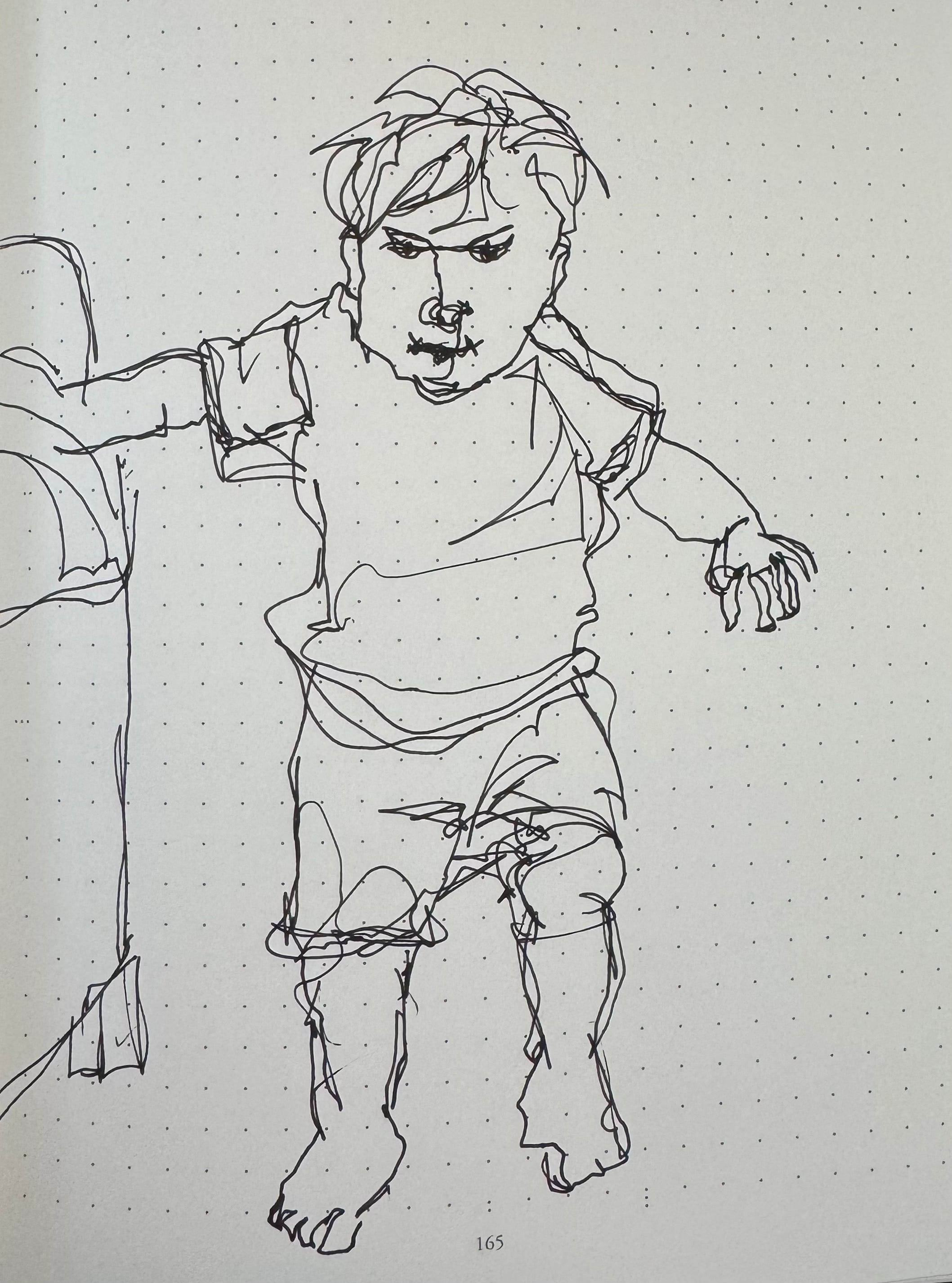
Confidence Comes Later- Contour Sketch 2021
When one of my grandsons was in his first year I watched him learn how to walk.
First, he would stand up holding onto the couch and then crash and burn.
Once he mastered that he let go of the couch and tried to take a step and then would land on his bottom.
Then when he was able to stand without falling, take a step the second and third steps followed. Now, he runs around like a wild man.
He was learning how to walk.
I do not remember seeing him treat falling as failure or that he would never learn how to walk. He was learning.
None of the family members bought him a T-shirt that said, “Be Confident.” We did not read him books about believing in yourself or to fake it to you make it.
Confidence did not appear to be a prerequisite for taking action.
Falling and failed walks was information for him not his identity.
Now he is six
Recently, I watched him hesitate as we were transitioning into a new place.
It may have been walking into music class.
This time I could see something different. There was hesitation.
There seemed to be a question about whether he could do it.
At one year, an unsuccessful attempt did not appear to mean anything about him.
By six, he had become aware that there is such a thing as doing something well or badly.
He could compare himself with other children.
He knew other people could see him. He wanted to please me, his instructor, his parents.
He could imagine failing.
At 12 months: What happens if I try?
At 72 months: What if I cannot do it, and what will that mean about me?
Maybe this is where our relationship with confidence changes.
We begin to want confidence because we think it will protect us from failure, embarrassment, uncertainty, disappointment or being seen struggling.
Maybe we attach failure to our sense of worth and being loved.
I am just thinking out loud but what if confidence is not what fuels action.
What if confidence is a product of action? T
hen you get the T-shirt or new book.
Well, if it is not confidence that we need to get up and do it, take action, make it, create it, say it, do it then what is it?
We need willingness.
The Solution: Our Thoughts
1. I can be unsure and still take the next step.
2. I don’t have to know I can do something before I try.
3. Every attempt gives me information.
4. My results do not define my ability, talent, or potential.
5. I can be willing to try something new, even when I feel uncertain.
Confidence grows through experience.
Every attempt gives me more evidence that I can figure things out because we are learning.
Here is my favorite acronym for this process to build confidence in anything.
Launch — Do it.
Examine — Notice what happened.
Absorb — Learn from it.
Revise — Adjust.
Next — Do it again.
My grandson did not have to know, “I will successfully stand this time.”
He only had to be willing to stand again.
I do not need to know this painting will work. I need to be willing to make the next mark.
Pick up the brush. Make a mark. Do not like it? Make another one. Try the color. Paint over it. Leave the strange thing there. Make the ugly painting. Make another painting.
I do not need to know that the thing I try will work. I need to be willing to try it, learn from what happens and make the next decision.
· What would I try if I did not need to feel confident first?
· What am I afraid failure would mean about me?
· What if failure did not mean anything about me?
· Where have I confused uncertainty with a reason to stop?
· What would it look like to treat the result as information instead of identity?
The confidence I want is not: “I know I will succeed.”
It is: “I trust myself even if I do not.”
You do not have to feel confident before you make the mark.
You can make the mark, see what happens, and make another choice.
That is what we are going to practice in Feeling Art, my 90-minute live masterclass.
We’ll look at how your thoughts create feelings, how those feelings show up when you make art, and how to use line, shape, color, pressure, space, and repetition to make choices that feel more like you.
You do not need to be more confident.
You just need to be willing to try.
Lynn xo
Comments
Nothing yet. Say the first thing.
Sign in to join the conversation.