
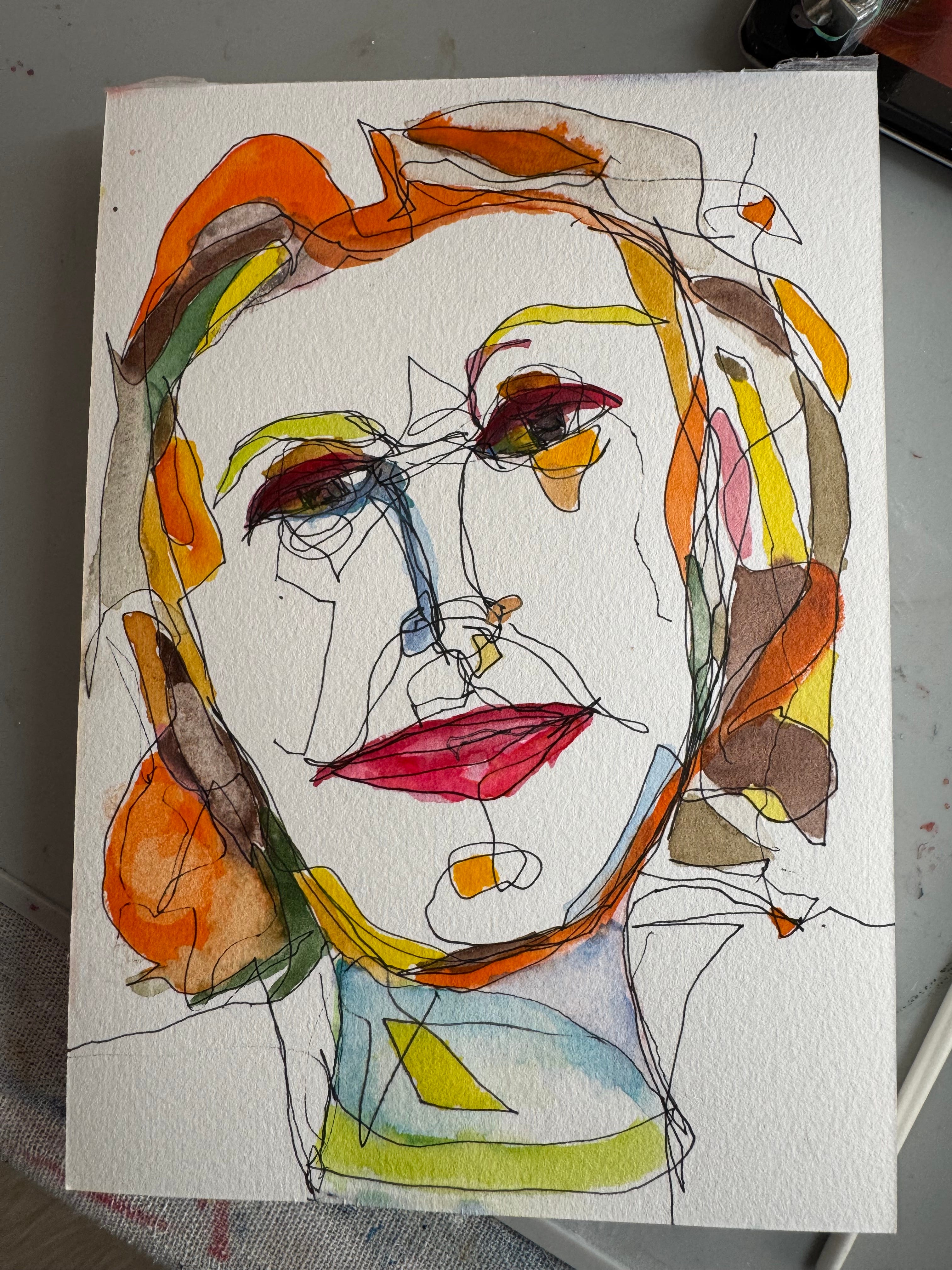
The day after we put Belle to sleep, I went into my studio.
Not because I felt inspired.
Not because I had something important to say.
I went in because I did not know what else to do with myself.
For years, Belle had been part of my art practice. She would settle near my feet while I drew and painted. I rarely thought about her being there.
She simply was.
Then she wasn’t.
The studio looked the same. My brushes were in their jars. My paper was where I had left it. My watercolor palette was still open on the table.
But the room felt different.
I felt different.
I chose a photograph of a woman I had met in Idaho and began drawing her face with a contour line.
I was not drawing Belle.
I was not trying to make art about grief.
But the line moved differently that day.
It slowed down.
It hesitated.
It pressed harder in some places and nearly disappeared in others.
When I added watercolor, I left more of the paper untouched. I let the paint move beyond the lines. I resisted the urge to fix what looked unfinished.
The subject was a woman’s face.
But grief was in the way I made it.
We are taught to begin with what we can see.
Study the object.
Notice the proportions.
Find the shadows.
Mix the right color.
Make the pear look like a pear. Make the flower look like a flower. Make the face look like a face.
These are useful things to learn.
But making something recognizable is not the same as making something felt.
You can create a technically good piece and still feel absent from it.
You can finish a painting that other people admire and quietly wonder why it does not move you.
Nothing may be wrong with the work.
It may simply be showing the subject without showing enough of you.
I do not mean that every painting needs a dramatic message.
I do not mean that you need to reveal your private life through your art.
I mean that what you feel can influence how you make.
A feeling can change the pressure of your line.
It can change the speed of your hand.
It can change the colors you choose, the marks you repeat, the space you leave open, and the places you refuse to correct.
The subject may remain the same.
The feeling changes how you make it.
Quiet might create pale color and open space.
Restlessness might repeat itself across the page.
Tenderness might soften an edge.
Grief might appear in a line that hesitates.
There is no single visual language for any feeling.
Sadness does not always have to be blue.
Anger does not always have to be red.
Joy does not always have to be bright.
Instead of asking, “What color is this feeling?” we can ask better questions.
How does it move?
Does it push or pull?
Does it expand or contract?
Does it rush?
Does it hover?
Does it need room?
Does it disappear and return?
The answers begin to shape the work.
Artists often talk about finding their voice as though it is hidden somewhere.
We search for it in classes, styles, techniques, and other people’s work.
But your voice is already present in the choices you make.
It is in the lines you trust.
The colors you return to.
The shapes you exaggerate.
The edges you leave unfinished.
The marks you make before you have time to judge them.
Your voice becomes easier to hear when you stop asking only:
Does this look right?
And begin asking:
Does this feel true?
No one looking at the drawing I made that day would necessarily know I was grieving.
The piece did not tell the story of Belle.
It did not need to.
The feeling had entered the work without becoming a confession.
It was present in the making.
That was enough.
Your art does not have to explain your life.
It can simply carry evidence that a real person was there.
Sometimes the hand knows before the mind has words.
Sometimes the line tells the truth first.
Sometimes what is underneath us finds its way onto the page before we understand what we are trying to say.
Lynn
P.S. When you look at the last piece you made, what feeling is showing, even if you did not put it there on purpose?
Comments
Nothing yet. Say the first thing.
Sign in to join the conversation.