
Bringing a newborn home is terrifying for new parents, even under the best of circumstances. I remember the anxiety like it was last week, even though my sons entered this world more than thirty years ago. I had the added advantage of being married to a pediatrician, and with an in-house professional I had a trusted sounding board available at a moment’s notice. But if one of my infants’ had shifted from pink to a mottled blue or, heaven forbid, had turned listless, no amount of spousal expertise could have calmed me. For all too many families, especially those deep in farm territory and far away from hospitals, this has been their reality.
The first realization that nitrates in the water supply were a serious problem came in 1945 when a pediatric resident in Iowa City, Dr. Hunter Comly, noticed a troubling pattern in formula-fed infants. Babies that were perfectly healthy when discharged from the maternity ward started turning blue after they went home, especially around their mouths, hands and feet. Along with the discoloration came other worrisome symptoms like difficulty breathing, lethargy, and even loss of consciousness, any of which had to be terrifying for the new parents.
The cluster of symptoms is known to doctors by the mouthful of a word, “methemoglobinemia”, though many people default to simply calling it “blue baby syndrome”. There are rare genetic disorders that can cause the condition, but since Dr. Comly’s patients were healthy when discharged from the hospital, he suspected a different mechanism was behind their illnesses. Like a real-life Inspector Poirot, the star of Agatha Christie’s detective novels, Comly noticed patterns. Breast-fed babies and those from homes served by municipal water seemed immune from the condition. Instead, it was popping up in families from rural areas, and particularly babies who were drinking formula reconstituted with well water. Symptoms for these little ones seemed to clear up when they were re-admitted to the hospital, only to return when they went home.
The “aha” moment came from a baby who was readmitted for the third time. The child’s father, having seen his newborn recover each time they came to the hospital only to deteriorate back at home, was convinced that the answer lay in his home’s well water. He insisted that there had to be something that was poisoning his infant yet left the rest of the family untouched. Water testing identified the culprit: high nitrate levels.[i]
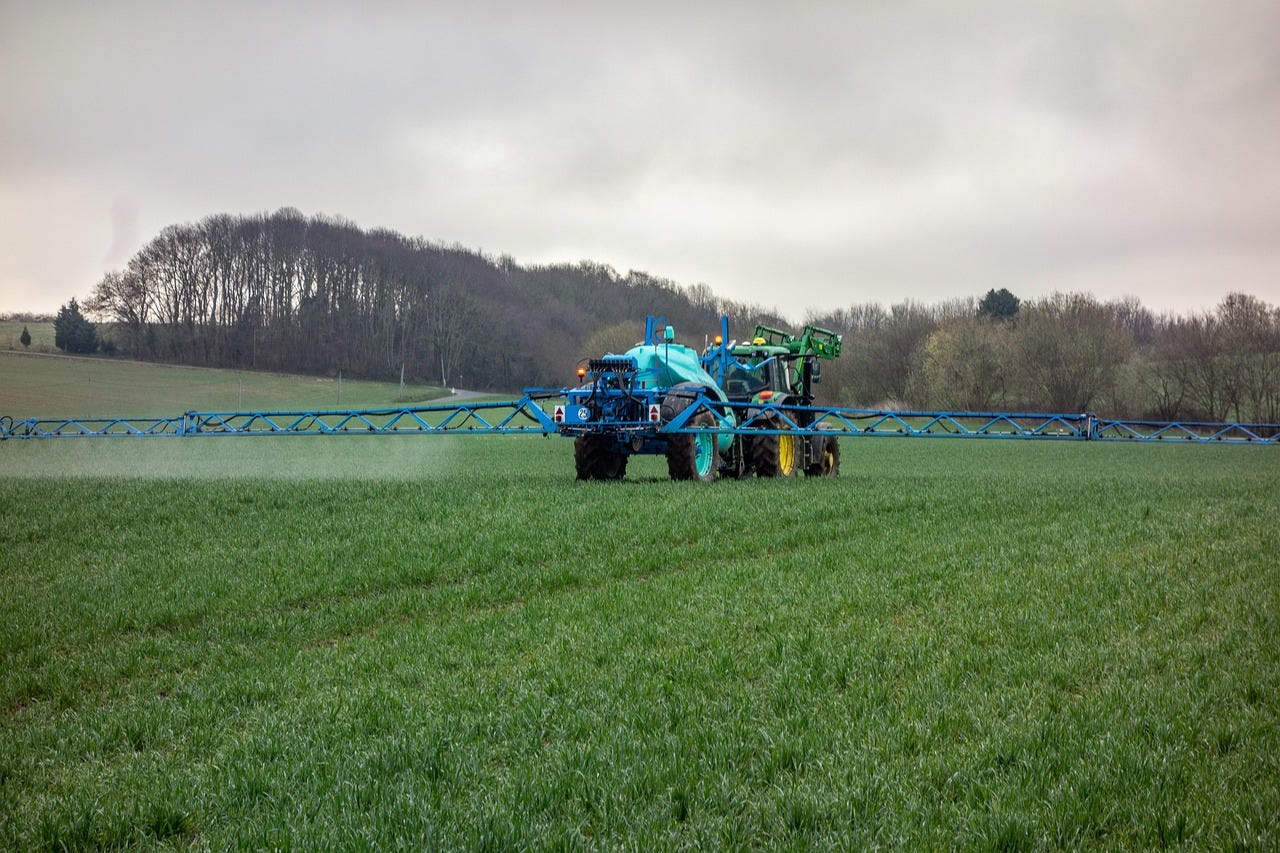
But where were the nitrates coming from? During the build-up to World War I, Germany pushed its scientists to develop a faster way to manufacture ammonia, an ingredient in explosives. This rapid process, dubbed “Haber-Bosch” after the chemists who invented it, was repurposed to create fertilizer badly needed by farmers. By the 1940’s early adopters from the American farming community were lining up to try the new synthetic fertilizers on their crops. Though Dr. Comly’s discovery about the cause came relatively early in the fertilizer revolution, the ensuing decades saw stratospheric increases in fertilizer use as the “Green Revolution” pushed crop productivity to its limits. The new synthetic fertilizer boosted plant growth, but no one thought about what it did to the water. After all, how could something so good for plants – basic nutrients – possibly have a downside?
The unfortunate “blue babies” proved that nitrate-laden water can be dangerous for the very young. Further research identified the complexities underpinning the nitrate – methemoglobin connection. In a nutshell, infants are uniquely susceptible to nitrates because their metabolism differs from adults’ in critical but obscure ways, most notably, the speed at which their guts process nitrates, and fetal hemoglobin, which remains in their system for the first few months, is more susceptible than “regular” hemoglobin.[ii] With this discovery, national and international standards for nitrate were established. The first U.S. standard was set at 45 mg/l in 1963, but with additional study, it was discovered that concentrations even half that amount could trigger the syndrome.[iii]
In the 2002 update of the Safe Drinking Water Act the level was set at 10 mg/l, which is where it remains today. While that’s a huge help, it only applies to municipal or public water supplies. There are another forty million people, more than ten percent of the U.S. population, who rely on private, essentially unregulated, wells, primarily in rural areas.[iv] It’s those kids that are most likely to be exposed to excessive nitrates.
Even at lower levels, long-term exposure to nitrates – which natural gut bacteria convert to more dangerous nitrogen compounds which are then absorbed into the bloodstream - can trigger all sorts of repugnant conditions. Developing fetuses are especially vulnerable. A larger study of babies in Texas and Iowa found a clear correlation between drinking water with just over 5 mg/l of nitrates – well under the federal drinking water standard - and spina bifida, cleft palate, limb deformities, and even anencephaly (i.e. the lethal condition where the brain is missing some of its parts).[v]
Adults are not immune to the ills of chronic nitrate exposure. A review of more than 30 studies found clear links between chronic nitrate exposure through drinking water – often well within the regulatory limits - and adult health problems, particularly colorectal cancer and thyroid disease. [vi] Activists in Iowa are particularly worried about this connection. Whereas the U.S. has, thankfully, been seeing a slow but steady decline in cancer rates in recent years, Iowa not only has the second-highest cancer rate of any state in the country, it also has the fastest growing rate of cancer. There are a whole host of reasons why this could be happening, but experts are quick to point out that the factor that differentiates Iowa from other, less cancer-prone states, is agriculture. Herbicides and pesticides are certainly a concern, but nitrates are front and center in the discussion.
Like many environmental problems, the solution is obvious. Cut back on chemical fertilizer use. Improve soil health so that this lower amount of fertilizer stays put rather than leaching into wells and rivers. Grow plants with deeper roots that are more likely to capture nutrients. These principles apply to the 40 million acres of turfgrass in America’s lawns, golf courses and office parks just as equally as they do to farms. Getting people to do this is the trick.
I feel like I say this with practically every post, but it’s because I don’t know of anyone else writing as pointedly about water quality: Chris Jones’ (aka “River Raccoon”) Swine Republic takes my 30,000-foot view straight to the front lines of the war. “The trick” to getting our water clean isn’t just about chemistry and fertilizer habits. It’s about big money - as in Big Fertilizer, Big Agriculture – and politicians who think that following that money is more likely to get them elected than following public health or clean water. Check out his most recent post, but also pretty much anything else he writes.
Also, keep reading Water-philic. I feel like I’ve barely scratched the surface of our nitrate troubles, particularly the unfair burden that regular folks – the ones who like to drink water and swim or fish in lakes – carry so that others may profit.
[i] https://www.americanscientist.org/article/the-blue-baby-syndromes
[ii] The Blue Threat: Engineering Against Nitrate-Induced Methemoglobinemia | Ecologix Environmental Systems and Fetal hemoglobin - Wikipedia
[iii] nitrate-nitrite-history-feb2017-rev.pdf or https://pmc.ncbi.nlm.nih.gov/articles/PMC1638204/?page=1 or Nitrate/Nitrite Toxicity: What Are U.S. Standards and Regulations for Nitrates and Nitrites Exposure? | Environmental Medicine | ATSDR (https://archive.cdc.gov/www_atsdr_cdc_gov/csem/nitrate-nitrite/standards.html - says it is archived and no longer being updated. ASTDR was consididated with other programs on April 2nd 2025 as part of MAHA.
[iv] Updated Information on Locations of Domestic Well Use | U.S. Geological Survey
[v] https://www.disabled-world.com/fitness/nutrition/foodsecurity/nitrate-defects.php
[vi] D https://www.mendeley.com/catalogue/db3139c4-0803-33da-b56a-27dda46c1a47/rinking water nitrate and human ... preview & related info | Mendeley
No posts
Comments
Nothing yet. Say the first thing.
Sign in to join the conversation.