
A recent paper by Jesús Fernández-Villaverde (JFV) makes the claims that fertility decline is “terra incognita,” that low fertility and low/negative population growth is a new phenomenon, that basically none of the candidate explanations for fertility decline “work,” and that the real explanation is (cue spooky noises) modernity. So the basic one sentence thesis I’m critiquing here is, “All those niche empirical theories of fertility decline are wrong— my model shows it’s a global diffuse spread of modernity.” JFV can tell me if that’s an unfair reading, but, as you’ll see from quotes, I think it’s pretty fair.
Let me also start out by saying I appreciate the work JFV is doing drawing attention to falling fertility. He is a rare prominent economist taking the issue seriously and studying what to do about it. And I will note he has some very good moments in the paper: a fair and sober assessment of where the evidence stands on pronatal policies, a reasonable rejection of intrinsic feedback mechanisms, a mostly reasonable verbal discussion of candidate explanations for recent declines (even if, as you see, I disagree with his gloss on them), etc, etc. There’s much that’s good here. He’s also right that the UN WPP data is of very mixed quality. He’s also a fellow at AEI so broadly on my political “team” too. My friends would tell me I should do this privately, that I shouldn’t do friendly fire.
But does that sound like me!?!?! No, no that’s not me. Today we’re choosing violence. We’re doing friendly fire, because, you see, what I don’t appreciate about JFV’s approach to the topic is the obscurantism it introduces. I think that rather than correctly recognizes a “terra incognita” of fertility decline, he’s mostly just burning the maps.
So let’s dig in. Here are the major points:
The main cause of falling fertility globally over the last 200 years has been declining child mortality. Period. Solved. It simply isn’t important to understand that issue further. We mostly know why child mortality has fallen (medical improvements, public sanitation, better nutrition, hygiene, lower infanticide, etc), and we know there is a rock-solid causal arrow between child mortality and family size. I have written about this ad nauseum, the latest version is here, but you can see the thesis all the way back here as well. JFV knows this, and acknowledges it in the paper, but then doesn’t use mortality-adjusted fertility in his actual models. I’m not joking! He has a whole section where he’s like “We know child mortality explains prior declines, that’s solved” then just doesn’t use surviving family size as his key dependent variable in later analyses. Classic case of acknowledging in your lit review issues you do not plan to account for in your model.
Thus, the only interesting question to study is why surviving fertility is declining. On that, the abstract makes big promises: “None of the commonly cited mechanisms can account for this pattern, so we offer a conjecture: modernity itself, which makes a third child expensive and childlessness cheap.”
So you’d expect the paper contains, like, some kind of model, yes? A model which shows, say, that the coefficient in a panel model with fixed effects between education, or GDP, or mortality, or whatever, fundamentally changed between 1980 and 2020? That kind of model?
No! There’s no model! None at all! It’s purely a verbal argument! He just sort of dismisses offhand vast literatures! And he dismisses them all the exact same way: “This one variable doesn’t explain all observed variation, therefore it cannot be very important.” That’s the move. Here, receipts:
On economic fundamentals:

On housing:

On shifts in priorities:
Actually they didn’t make a rebuttal to a Kearney-style priority shift argument!
On cell phones, which actually are a temporal match:
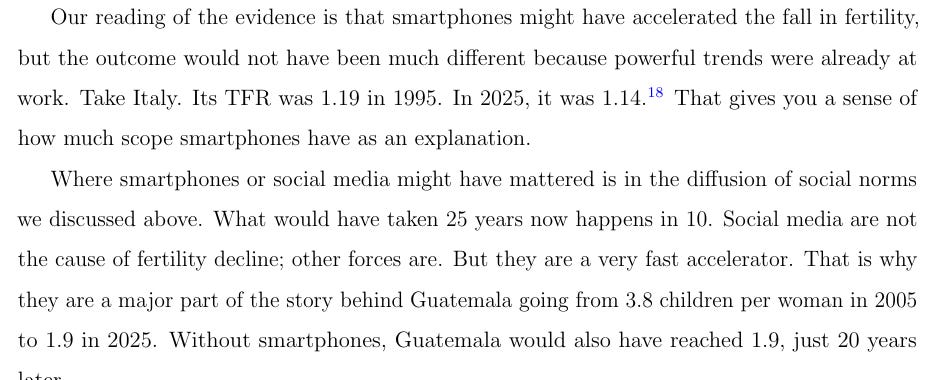
There’s no actual claim here, just hand-waving.
Note JFV also did not even consider the actual leading theory: marital decline. On twitter he says the reason why is because it’s a “proximate” rather than “ultimate” cause. What he means here is “Sure, marriage decline may cause fertility decline, but that just pushes the question one step back: why is marriage declining?”
Yes, true— but it’s an interesting step back! If marriage decline really is the proximate cause then certain ultimate causes may lose their credibility (such as the one JFV outlines: demand-satisfaction kinks at integer parity numbers, which would not necessarily prevent marriages for forming) whereas others may gain credibility (housing, wage differences, gender norms, or cell phones— any of which might influence marriage in various ways). The fact he didn’t even consider, and then waived off without explanation, the actual leading explanatory factor and cause of low modern fertility boggles the mind.
So there was no actual rebuttal here. Just “two explanations aren’t a perfect fit for the data, one… I just won’t address, and one… well maybe it’s the explanation but I won’t admit it so here, instead, it’s modernity.” There was no actual analyses here, and a massive omission. “Other explanations didn’t fit” my friend, you did not even try the other explanations on for size.
Then he gets to his preferred explanation, “modernity.” What is modernity?
You might think “modernity” means education, or higher income, or capitalism, or scientific thinking. For JFV, it is none of those. First, he says:

Okay, cool, so we are about to get an analysis of formal institutions, specialized expertise, and state capacity, right?
Hahaha, no
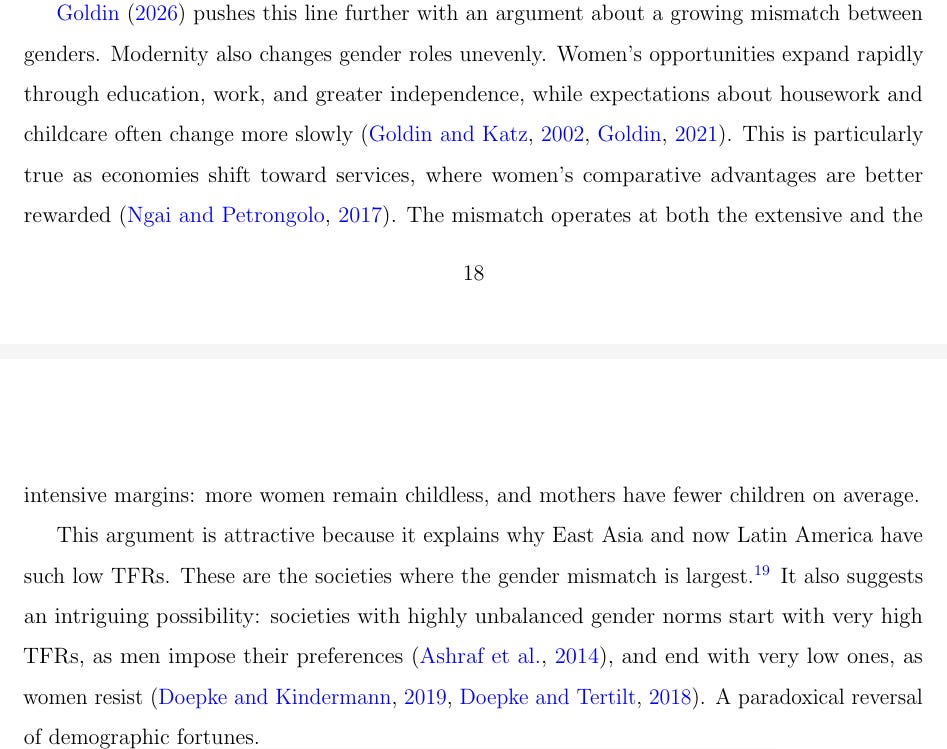
It’s just more Incomplete Gender Revolution/Feminism Is The New Natalism stuff. Modernity? Nah, it’s just a mismatch in gender ideology.
I’ve written about this before, but the TL;DR is simple: within societies, more gender-egalitarian people almost never have more kids than less gender-egalitarian people, and in a panel model, changes in the mismatch rate have no relationship to fertility. This theory is wrong, wrong, wrong, but like all zombie ideas, it just won’t stay dead.
So the gender equality argument JFV is advancing is dead on arrival. But maybe he shows new evidence for it? Maybe he has a cool model for it?
Hahahaha, no. JFV has no actual test of his theory. There’s no model where he has some variable for “modernity” or “gender egalitarianism” and shows some effect. He ruled out all the actual, measurable variables because they were an imperfect explanation, and instead offers a vague, diffuse variable, for which he has no measure, and which is not actually included in his model.
So what’s the model? Here, I warn you… we’re going to do math.
Here are the key model results:
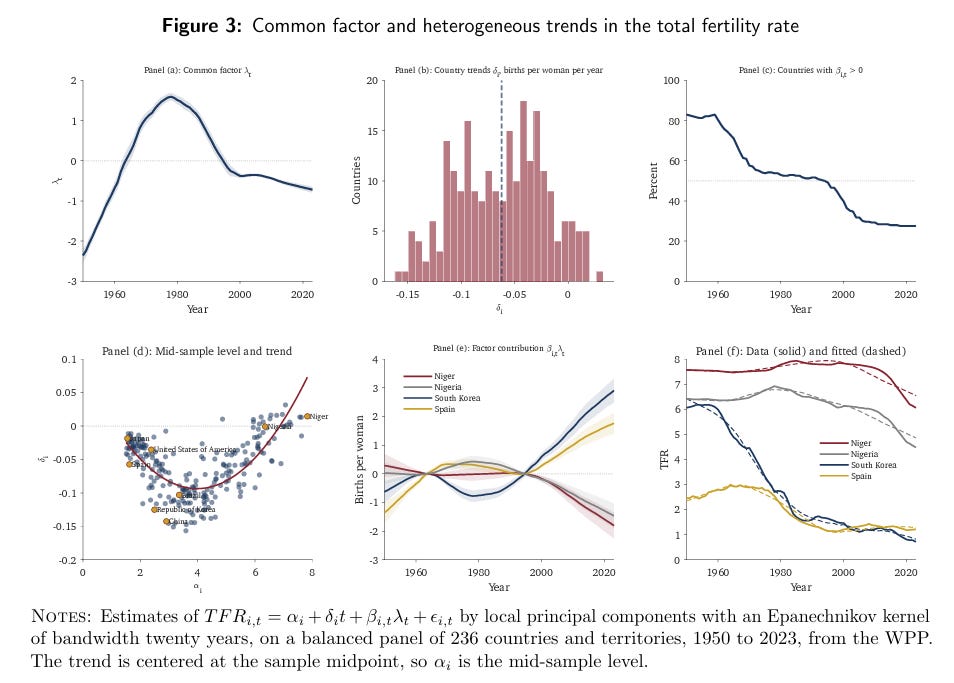
For laypeople, the basic model works like this: they fit a common factor of fertility across all countries for each year, under some constraints. So in some years where all countries are atypically high, the top left graph is high. In years where all countries are low, top left graph is low.
Then there’s also trends for each country created by smoothing recent changes. That’s panels b, c, d, and e shown in various ways. Countries are allowed to have various trends.
As you can see, there are no substantive variables. No GDP. No education. No gender equality. No marriage.
This is like trading stocks through technical analysis. Maybe somebody makes money off it, but the real way to make money on the stock market is… substantive knowledge! Have an insider scoop on what vaccines work or what technologies will pan out! The demand for explanations of low fertility is entirely a demand for variables which will reduce these technical trends to near zero. That’s the whole project!
Think about this model. All this model is doing is saying, “Look, fertility is low in X year in many countries, and here’s an average trend.”
How would you use that for, say, a forecast? You couldn’t! Because the input data is the contemporary output data. The model here is merely a summary. Suppose you think GDP growth will double due to AI: what does this model tell you about that? Answer: nothing. Suppose you think gender equality will get better: does this model tell you anything? No! It doesn’t!
The whole project of studying fertility is to find some variables that can account for the effects JFV measures, and thus reduce them as close to zero as possible. We don’t want big residuals! We don’t want our models to depend on arbitrary parameters! We want substantive foundations. What JFV is doing here is a fun quantitative exercise of the sort many demography students will do in an advanced methods class, but it is not, in fact, an explanation.
It’s also… not empirically credible. For the model nerds, here are some issues you might notice:
The cross-country factor analysis is actually normalized in two ways. The factor is forced to be orthogonal to both a constant and a linear trend. A series orthogonal to a constant must cross zero; being orthogonal to a linear trend also means it cannot be monotone. In other words, JFV’s factor is mathematically required to rise and then fall (or fall then rise). The existence of a peak is imposed by the normalization, not discovered. Only its date is data-driven. This is akin to when somebody uses Variable and Variable Squared and then DISCOVERS a U-curve effect in a variable. No shit bro! You designed a model that maximizes on discovering such a curve!
Now read the paper's rhetoric: "the common factor resembles a bygone wave: it peaks in 1978 and shows little change over the past fifteen years." That wave shape is a predetermined mathematical artifact!
Suppose you observe a product equal to 12. Is it 3 X 4 or 6 X 2? You don’t know! The model use splits an observed change into two unobserved components in a similar way. To do it, a rule has to be added: the loading component must change slowly, the factor component may jump around freely. Nothing in the paper tests that rule. Basically JFV has an aesthetic preference about which graph should carries the wiggles. About a quarter of their total effect comes from this one assumption. They report robustness across bandwidths from ten years to the full sample but never show how δ moves along that grid, making it hard to understand exactly how much of their result was predetermined by their assumption about how to decompose the observed trend.
They assumed exactly one global story (i.e. one global factor) and never checked (or never reported checking) whether two fit better. One factor with shifting loadings and two factors with stable loadings are very hard to distinguish! JFV picked the version that supports the one-factor narrative. Suppose there really are two factors: a mortality-decline factor that finished its work decades ago, and a second modernity factor still running today, loading positively on countries the first one has passed. You’d see exactly their Figure 3 — a “peaked” first factor, loadings flipping sign, rising dispersion. But the conclusion inverts completely: the common global force isn’t spent, it’s been replaced. Testing and disclosing more factors isn’t hard at all.
The factor’s ability to pin down a country’s loading depends on how much λ is moving locally. But according to the paper, that quantity drops sevenfold from the 1970s to the 2020s. Today, λ is nearly flat. Estimating how strongly a country responds to something that barely moves is like estimating a car’s steering ratio while it drives in a straight line: the ratio explodes and means nothing. That’s why some of their other country-specific estimates inflate in later years, and why they report βλ instead of just one of those estimates. It’s Charlie Brown’s football. Reporting the product keeps the number apparently stable. The recent period they most want to talk about is the period the model can say least about!
The median R2 of 0.967 is reported after removing the level and the trend. Each country gets its own intercept, its own slope, and its own smooth loading path fitted to 74 observations. That’s a whoooooooole lot of parameters per series. A really good model fit is close to guaranteed. Pretty much anybody, given that many parameters, can fit a nearly-perfect model. In fact, with that many parameters, I’m not even confident that this model is the best fit you could achieve, nor am I sure this is the most parsimonious model which could achieve that R2.
The key point is simple: this model tells us nothing. We learn nothing from it.
JFV cites and discards a lot of really good empirical papers in this paper. That’s sad. Engaging more deeply he might have learned something from them.
We have reams of high-quality, robust empirical papers showing that fertility is influenced by many factors. The urge to find a single common factor is simply a theoretical error, and one the empirical evidence strongly refutes by virtue of the fact that we keep finding new causes that have real effects.
The result of “oooooo it’s modeeeeeeeernity” is the closing of curious minds. This kind of argument shuts off serious work into what is it specifically about modernity that matters. The theory it’s bureaucracy or state capacity is worth testing! JFV should test it! “Modernity” is not a theory; modernity is cope.
At a bigger level, we need a better theory of social change. People often have theories that go like this:
Mechanistic Cause—>Mechanistic Effect
Cool, right?
A more plausible model of the world, however, is:
Probablistic Cause—>Probabilistic Effect Which Sets Conditions For a Complementary Probabilistic Cause—>Probabilistic Effect Which Sets Conditions For a Complementary Probabilistic Cause—>Probabilistic Effect Which Sets Conditions For a Complementary Probabilistic Cause—>Probabilistic Effect Which Sets Conditions For a Complementary Probabilistic Cause—>Probabilistic Effect Which Sets Conditions For a Complementary Probabilistic Cause—>Probabilistic Effect Which Sets Conditions For a Complementary Probabilistic Cause—>Probabilistic Effect Which Sets Conditions For a Complementary Probabilistic Cause—>Probabilistic Effect Which Sets Conditions For a Complementary Probabilistic Cause—>Probabilistic Effect Which Sets Conditions For a Complementary Probabilistic Cause—>Probabilistic Effect Which Sets Conditions For a Complementary Probabilistic Cause—>Probabilistic Effect Which Sets Conditions For a Complementary Probabilistic Cause—>Probabilistic Effect Which Sets Conditions For a Complementary Probabilistic Cause—>Probabilistic Effect Which Sets Conditions For a Complementary Probabilistic Cause—>Probabilistic Effect Which Sets Conditions For a Complementary Probabilistic Cause—>Probabilistic Effect Which Sets Conditions For a Complementary Probabilistic Cause—>Probabilistic Effect Which Sets Conditions For a Complementary Probabilistic Cause—>Probabilistic Effect Which Sets Conditions For a Complementary Probabilistic Cause—>Probabilistic Effect Which Sets Conditions For a Complementary Probabilistic Cause—>Probabilistic Effect Which Sets Conditions For a Complementary Probabilistic Cause
It’s a cascade.
Consider an example. You have a job. You accidentally make a mistake on a huge project. You get fired. You go to the bar. You drink too much. You get in your car. You drive home. You get dizzy while driving. You veer into another lane. You swerve and hit another car, killing its drive. That driver was a man who otherwise would have been Hitler 2.0. You just prevented the Holocaust 2.0.
You could say there’s causality Mistake—>No Holocaust. Or Fire—>No Holocaust. Or Going to the Bar—>Drunk Driving
All true!
But the better conceptual framework is that each event set the stage to increase the probability of the next event. Having a job created the probability space where you could get fired, but did not fully determine it. Getting fired created a higher probability of going to the bar, but did not fully determine it. Going to the bar created a higher probability of overdrinking, but did not full determine it. At every stage, your prior choice nudged the odds just a bit. The result is what we could call a “causality cascade,” where a “weak” initial cause ends up increasing the probability of an additional cause with a correlated effect direction.
We can see this in policy. Once you’ve mandated schooling up to 5 years, you’ve caused a more educated society where parents expect kids get educated and employers expect some education from workers— which makes a demand for extending to 6 years likelier, then 7, then 8. Each expansion increases the probability of future expansions.
Obviously causal cascades can intervene on each other. Each educational expansion sets conditions for further expansion, however, it may also boost incomes, and higher wages create stronger incentives to finish school faster and get to work. I’m not arguing there are never “disciplining” dynamics, but just that social forces often ratify and reify one another.
As a result, the idea that 50 different small causes may stack to cause falling fertility turns out to be extremely plausible. Not because there were 50 coincidences (that’s implausible!) but because the first small cause made the second one more probable. Once religiosity started falling in early-18th-century France and Massachusetts, it made the next thing (mortality falls? inheritance changes? educational expansions? it can vary) more likely to happen. This is also why the “kickoff” factor for fertility transition varies by country, why countries often do phases of fertility change out of order, and why predictions like “75% of countries have seen X happen, it will probably happen in the other 25% eventually” tend to be true. Each small causal factor shifts the probability distribution of the other causal factors occurring or reaching a level where they impinge upon fertility.
Beyond causal cascades, you also have interactions. A variable may not matter at all— until it does. The simplest case is fertility delay. For a society with a 2-child norm, delaying first births from age 15 to age 17 likely has very little effect on odds of achieving 2 kids. For a society with a 6-child norm, it may impact odds of hitting 6. But delaying first birth from 29 to 31 may impact the 2 child norm— it probably doesn’t effect odds of hitting 6 because that ship has sailed. You’re approaching a zero lower bound there.
Which variables matter depends on the level and structure of other variables. Just as individuals have a life course where events are essentially sequenced, so too do countries have sequenced events, which means you have to care about interactions.
What JFV argues is, basically, “There’s one big cause, but we basically have no idea what it is. The problem is simple, but obscure.”
What I argue is, basically, “There are a lot of causes, but we basically know what a whole lot of them are. The problem is complex, but relatively clear.”
JFV’s argument is probably better for fundraising and social media engagement. Mine is better if you’re interested in seeing countries actually raise their fertility rates.
No posts
Comments
Nothing yet. Say the first thing.
Sign in to join the conversation.