
Last April, I presented data at the Institute for Family Studies showing that couples with shared surnames had higher marital satisfaction, longer duration of marriage before eventual divorce, and likely had lower overall divorce rates. It drew a lot of interest online and some critique. In this post, I’m going to double down in detail: you should share a surname with your spouse, doing so makes a real difference, and if your partner really doesn’t want to share a surname, that’s an honest-to-God red flag.
You can read the original article, but the simple take is in this graph:
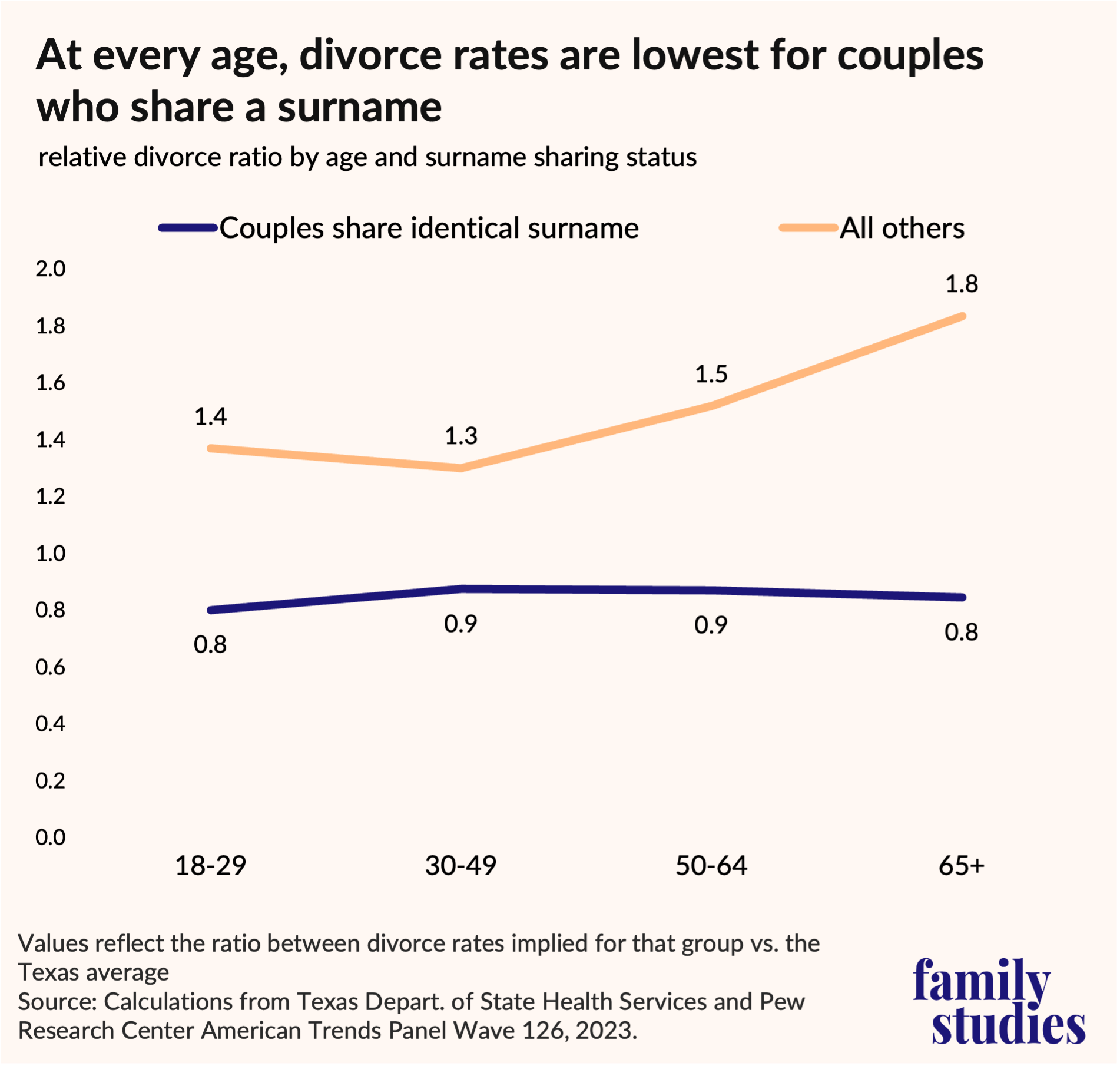
As you can see, divorce rates are higher for people who don’t share surnames. A lot higher.
A plausible reason for this is people who don’t share surnames are just more chill about divorce and less committed on average. I show evidence for this in the post.
Now, to be clear, I’m not saying 100% of this effect is causal. I’ll just paste here my whole take on causality from the original post in April.
On the spurious side, obviously couples who do not share a last name will include some very thoughtful partners who are philosophically opposed to taking the husband’s last name—but it will also include a lot of couples who got married on the spur of the moment and who couldn’t be bothered to get their paperwork in order. Because non-shared names may partly select for hasty, ill-considered weddings to begin with, its association with divorce may be just that—an association, not a causal tie.
Likewise, women who philosophically prefer to keep a maiden name or to hyphenate may simply have different values—we already showed above that this is the case. Liberals may simply not view divorce in the same way conservatives do, and so higher divorce rates could be seen as a positive thing. If women who keep their names are more liberated, maybe it’s good they shed deadbeat men faster, this argument would suggest. More importantly, making a woman with liberal dispositions take her husband’s name hardly seems conducive to marital happiness. Thus, again, the relationship between divorce and unshared names may be spurious.
But there are two very real dynamics that may create a causal link between name sharing and divorce. The first is simply administrative: bureaucratic hurdles shape divorce rates in powerful ways. Changing a legal name is a huge hassle. It may be that the prospect of having to change back to a prior maiden name, to have one more set of papers to file, actually somewhat discourages couples with shared surnames from divorcing. This effect is speculative, but other studies have shown that other kinds of bureaucratic elements of the divorce process may alter divorce rates.
Second, and more substantively, nowadays most couples will at some point discuss their surnames. Because having different last names is very common, shared surnames are unlikely to be taken for granted. This conversation, about the meaning of family and gender roles, may shape how couples enter into marriage. It is possible (if speculative) that a clear conversation where a woman explains to her groom-to-be her hesitancy to take his last name, and he communicates his desire to build a family together without robbing her of her independence, to make “his” name “their” name, may actually strengthen that relationship. Research on marriage also suggests that couples who hold more things in common—from names to money—are more likely to take a “team-first approach to marriage life” that reinforces cooperation, trust, and a sense of a common future. Again, while this causal channel is speculative, it’s perfectly plausible: other research has found that conversation-based premarital counseling may have some modestly positive effects on relationship quality. And indeed, the 2022 State of Our Unions survey found that couples who share a surname really do have slightly higher relationship quality, even controlling for background demographic factors.
Now then, in today’s post, I’m going to respond to critiques and argue again that, yes, surname sharing matters.
By far the most common critique I got was that Texas (where the source data is from) has many Hispanic couples, and in most Spanish-speaking countries today surnames are not shared. I knew this going into the project, so put great effort into identifying Hispanic surnames. We showed a graph showing that divorce effects were shared across races, but more work can be done to clarify this issue.
To begin with, it needs to be said: our findings only apply in the U.S. or other societies where surname sharing is typical. In the past, surname sharing was typical in many Hispanic societies—even in the Texas data, I found many hundreds of couples where the husband had a surname like “Santos” and the wife had a surname like “De Santos.” The “De” prefix historically indicated a surname taken from a husband, and was common in the past. However, this practice is less and less common in Hispanic countries today. Instead, many Hispanic families simply give their children hyphenated names: the father’s father’s surname, and the mother’s father’s surname is the most typical arrangement (but hardly universal). But today, in the many countries where surname sharing is not standard (most of Latin America, much of southern Europe, virtually the whole Arab world, much of Asia), I would expect the predictive power of surname sharing to be heterogenous and hard to predict. The reason for this is that, while some couples might still change a surname as part of a signal of family unity or traditional authority (I did find some recent marriages in Texas using the “Surname-De Surname” format!), as surname-sharing becomes less common, the share of shared-surname cases where surnames are shared by coincidence will rise. In a society where taking the surname is common, coincidences where a man surnamed “Roberts” marries a woman with a maiden name “Roberts” will be a small share of marriages with shared names. But in a society like Quebec, for example, where surname-changing for marriage is illegal, you’d expect almost 100% of shared surnames to be coincidences, not choices, suppressing any effect size.
So how did I handle this issue? Well, the biggest answer is that I tried to identify non-Hispanic whites for whom the surname sharing would apply best. But since doing that work, AI has improved, and so I have been able to run a stronger set of inferences using a massive database of names from around the world. Using that vastly expanded ethnic matching dataset vs. the 1930 census I previously used, I am able to reduce the unmatched rate from 12% of individuals to less than 1%, and greatly improve matching of Asians and Africans in particular. Here’s the result, in terms of how surname-sharing practices for divorces vary across groups:
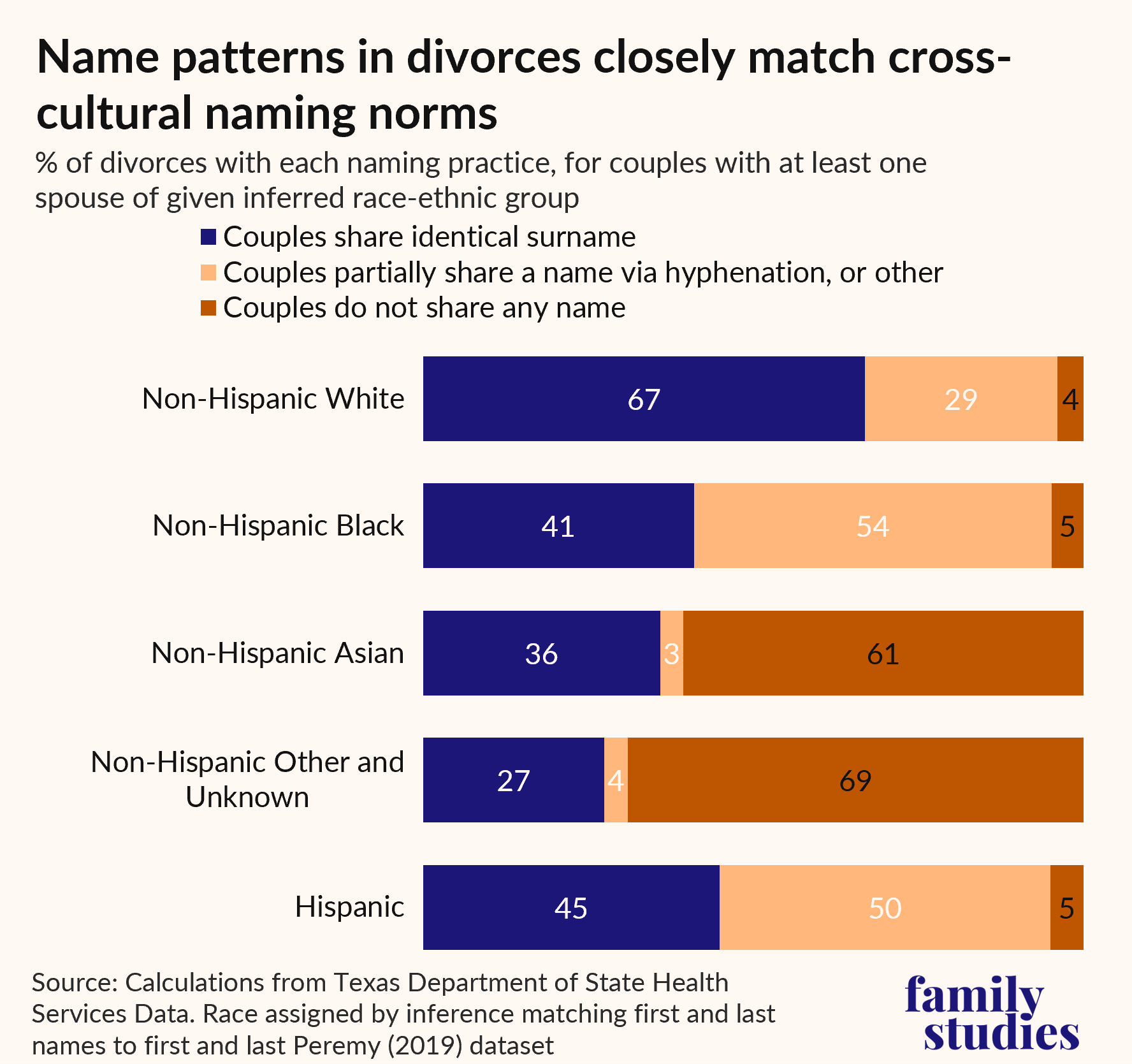
In most Asian countries, women don’t take their husband’s name, and hyphenation is uncommon. As we would expect, most Asian divorces have no shared names—and those that do may sometimes be coincidences, as some Asian countries have very low surname diversity.
Likewise, as we would expect, a lot of Hispanic couples have partially-shared hyphenated names. Some of this is by coincidence: it’s not uncommon for two individuals with a last name like “Garcia” to marry each other. But it may also reflect an emerging hybridized norm for Hispanic Americans: hyphenated names, where one of the names is the spousal surname.
Note that these estimates include interracial marriages: some Hispanic or Asian individuals may be married to Non-Hispanic white spouses, for example, and so name-sharing norms may operate across racial and ethnic categories.
Regardless, the divorce data maps very well onto well-known cultural differences in naming.
How does this shake out with respect to divorce rates?
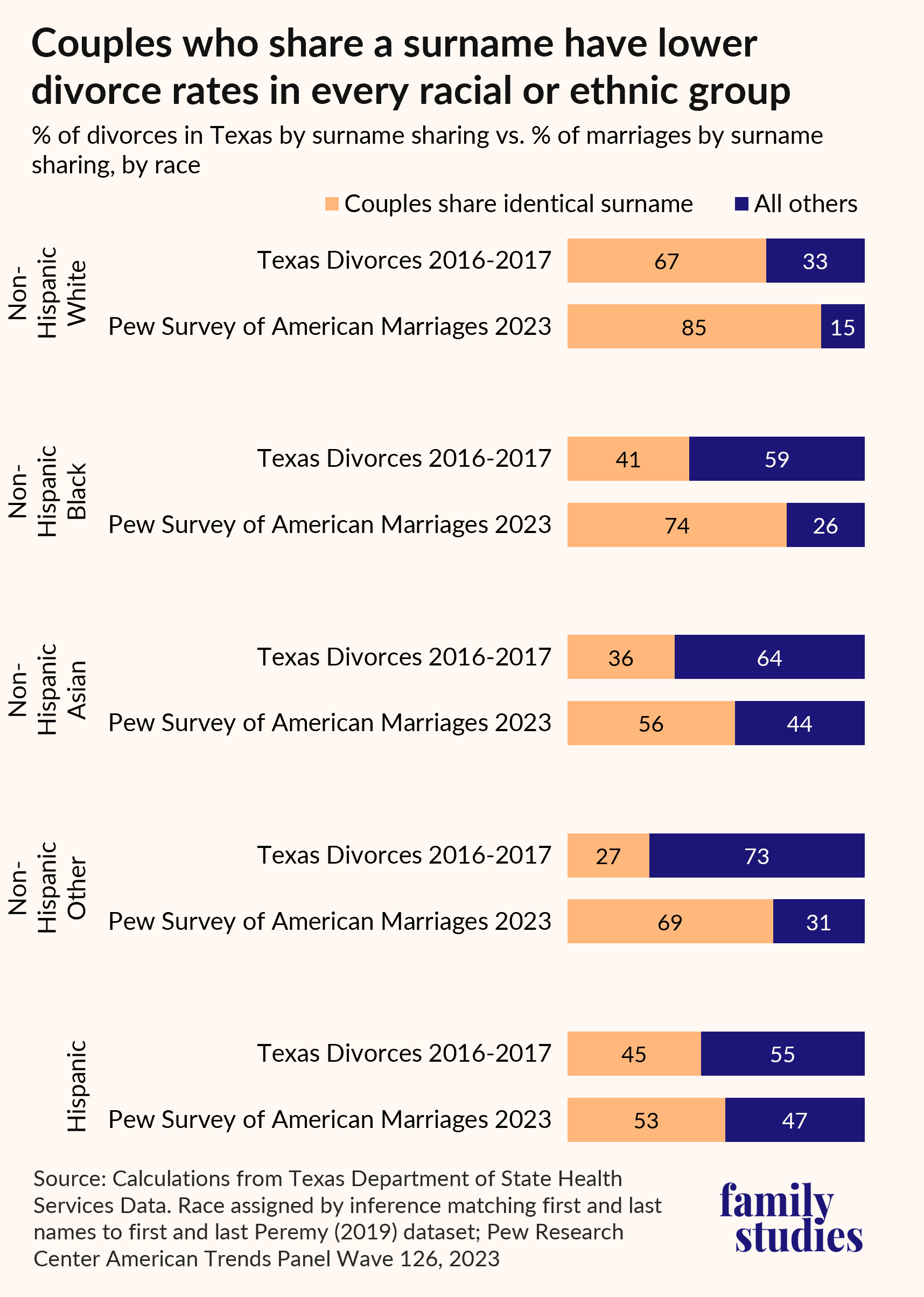
As you can see, for every single racial-ethnic group, individuals who did not have a single shared surname are over-represented in divorces vs. their likely share of the married population. In other words, within race, it seems likely that non-shared surnames predict higher divorce rates. This is not just a racial composition issue.
That said, there are obviously large differences. Among Hispanics, non-shared surnames barely predict divorce, whereas among white and black Americans, there are rather large differences; Asian Americans fall between those.
As we did in our previous post, we can very approximately convert those relative shares into relative rates, that is, estimating how divorce rates within surname-sharing type compare to the overall average divorce rate for a group. We can also look at differences in marital duration upon divorce within those same groups.
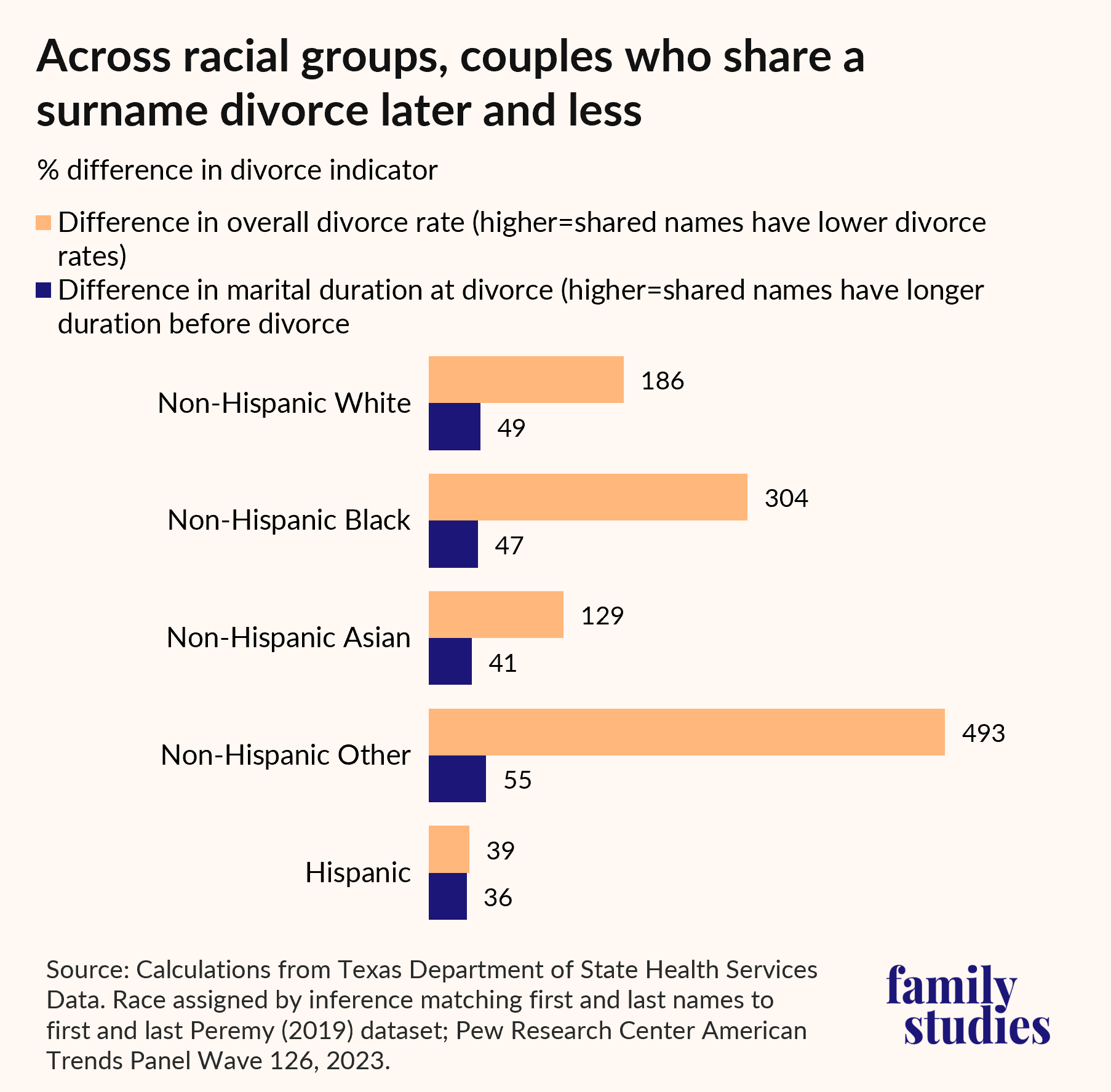
The orange bars simply present the data from the prior figure in a more direct comparison: non-Hispanic whites who don’t share a surname have 186% higher divorce rates than those who do (but note a major caveat on this in the next response below!). The blue bars compare time-to-divorce among those who do eventually divorce—it’s 49% higher for non-Hispanic whites who share a surname.
But again, you can clearly see that effects vary widely across racial and ethnic groups. For Hispanics, nonshared surnames predict only 39% higher divorce and 36% higher duration-at-divorce. For Asians, it’s 129% and 41%. In other words, the two groups with the clearest norms against nonshared names have the smallest divorce effects.
The conclusion here is simple: we never claimed that surname-sharing would have the identical associations in ever society, and our suggestion that selection effects are significant drivers of these associations implied that we did not expect effects to be cross-culturally universal. Indeed, we wouldn’t even necessarily expect the causal components to be universal, since, for example, in some societies women retaining their father’s surname is in fact a more traditional and patriarchal practice than taking a husband’s surname! In some societies, retention of the paternal rather than spousal surname is a signal of continuing attachment to family or clan of origin.
Nonetheless, we think that among couples for whom surname sharing is within the cultural milieu, the predictive power of surname sharing is genuinely strong, and plausibly does have some causal component.
A few people suggested our results could be biased because people seeking a divorce might legally change their name before divorcing. If women changed their name as a precursor to divorce, our results would overstate the divorce rates of couples with unshared names.
This is unlikely to be a problem in most cases, however.
First, many women don’t change their legal name even after divorce, especially if they have children who have their husband’s surname; so a strong prior that women would rush to change their name pre-divorce is certainly not universally warranted.
Second, surname changes in Texas require either a specific legal suit to change name, which has its own costs and paperwork, or some other legal justification. Grants of divorce are that legal justification. Individuals changing names before divorces incur extra costs in time, paperwork, and money, vs. simply requesting that the judge overseeing their divorce include a name change in the proceedings. Thus, name changes before divorce are unlikely.
Third, form VS-142.9 is in fact a legally binding court document; couples filling it out are instructed to provide their legal names, which match other identification documents they are required to provide, including Social Security Numbers. They are provided a separate field to report their maiden name where applicable. The Texas Divorce Index data specifically provides the full name of the petitioner, and the full name of the other spouse, not the maiden name. Thus, surnames in the death index are indeed legal names as they existed before divorce.
However, the Texas Divorce Index isn’t perfect. Divorcees fill out their forms by hand and mail or carry them to their county courthouse. These forms sometimes have errors—indeed, I had to recode thousands of cases of couples for whom one had a surname “De La Rosa” and the other had “Delarosa,” and similar errors. When clerks receive these records, they hand-type them into their computers, creating more errors. These errors would tend to inflate the share who don’t have a common surname. The degree of inflation is probably not terribly high, but it’s not nothing.
Consider an extreme case, where fully 30% of cases I have deemed non-shared surnames are actually typos or misreports of some kind. This seems extremely unlikely, but it’s worth testing, just to understand how sensitive the estimates I gave might be. In that scenario, divorce rates for non-Hispanic whites with non-shared surnames would still be 74% higher than for those with a shared surname (for blacks, 98%; for Asians, 5%; for Hispanics non-shared surnames would actually have a 29% lower divorce rate). For the groups where surname-sharing norms are most relevant (Non-Hispanic whites and blacks), the effect of non-shared surnames remains positively massive.
On the whole, the Texas Divorce Index yields pretty credible data, but it probably does inflate the estimated divorce rates of people with unshared names by some amount.
Comments
Nothing yet. Say the first thing.
Sign in to join the conversation.