
Voters overwhelmingly say that cost-of-living concerns will decide their vote. While voices on the left are calling for socialist solutions, voices on the right are arguing over the proper response to complaints about a $20 burrito.

The disconnect has never been more apparent.
If the right wants to win back young voters, and keep the ones it already has, it needs to cast a convincing vision of a free-market path toward affordability and prosperity, not just counterarguments to the socialist solutions increasingly proposed by the left.
In July, the Democratic Socialists of America released their new platform, which included proposals to abolish the Senate, defund the Department of War, and institute “aggressive wealth taxes,” which have received varying levels of both public shock and support.
Meanwhile, leaders on the right got sucked into a heated debate over a young adult struggling to buy a “$20 burrito.” Some were sympathetic to the affordability challenges facing young people, while others mocked those concerns outright.
Rep. Dan Crenshaw’s (R-Texas) commentary highlights the problem. He suggested young people should get more roommates and eat ramen:
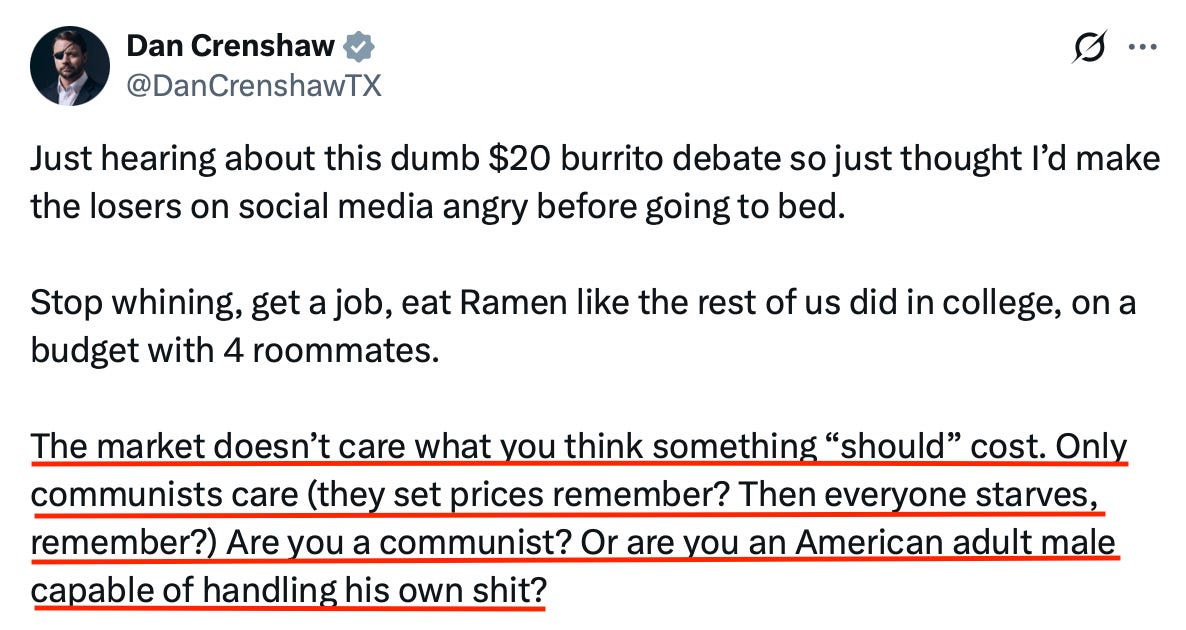
It’s a dangerous gamble to tell a young person who feels like they’re being asked to pay more than they should that they’re a Communist. Especially when the so-called Communists seem to be waiting with open arms.
And herein lies the biggest divide between growing trends on the left and right. The Democratic Socialists are offering young people a vision in which “everyone is free, equal, and cared for.” They say rent control will keep housing affordable, universal healthcare will keep people healthy, and government grocery stores will let people eat more than just ramen.
Republicans respond that rent control leads to dilapidation, that universal healthcare will leave the medical system slow, and that government-run grocery stores lead to bread lines.
All of those statements are true. But those “truth bombs” only work when you have your own vision to redirect people to. The problem is that current Republican leaders and candidates aren’t bringing that vision to the conversation.
Despite many of them holding beliefs that free-market policies can reduce prices and lead to prosperity, they don’t lead with them. Instead, they, like Crenshaw, ask young people to tough it out for the sake of principle — or the simple sake of not being labeled a Communist.
That strategy isn’t going to hold up in the long-run. Conservative politicians are missing the opportunity to talk about how abundance policies work to bring down costs and what a Capitalist society can bring to the average young person.
The results of Democratic Socialists and their allies on the left sharing their vision are wins across the nation and at all levels of government.
Abdul El-Sayed, who identified as a “progressive” Democrat, recently beat U.S. Rep. Haley Stevens in the Democratic primary for Michigan’s Senate race. Mayors Zorhan Mamdani of New York City and Katie Wilson of Seattle both identify as Democratic Socialists. Claire Valdez and Darializa Chevalier won primaries for Congressional seats in New York, with Chevalier unseating a more moderate incumbent.
Pro-Capitalist politicians can dominate elections with persuasive plans too. They’re actually better positioned to do so because they can put forward a vision supported by solid economics and history, unlike the Democratic Socialist vision, which is emotionally compelling but not rooted in evidence. A perfect example of where this would be effective is in housing policy.

From 2019 to 2024, median single-family home prices rose nearly 50% while median incomes rose only 22%. A CNBC poll found that housing costs are the top issue for young voters.
That means the party that can effectively convince young people it will solve the housing crisis will get the most votes.
Gimmicks like a 50-year mortgage floated on Truth Social by President Donald Trump aren’t convincing anyone. If anything, they do more harm by perpetuating the idea that market-based solutions aren’t really enough to make a difference.
Democratic Socialist solutions, such as rent control, are poisoned by broad economic consensus that the policy is harmful: 93% of economists say it doesn’t work.
Housing abundance, popularized by groups such as “Yes, In My Backyard” and journalists such as Ezra Klein, is uniquely bipartisan. It identifies how government bureaucracy has made building more difficult, leading to fewer homes and, as a result, higher prices. The solution is to remove those unnecessary hurdles to encourage the production of more housing of all shapes and sizes.
The language of the movement aligns squarely with free-market principles rather than socialist ones, and in cities like Austin and Houston, that idea is proving effective, as increased production leads to lower prices. The right should embrace this kind of policy and language in the coming elections.
This visionary approach need not be limited to just housing. Counter the calls for universal healthcare by instead empowering more Americans to have tax-free health savings accounts and to purchase their prescriptions directly from the creators rather than being forced to go through insurance companies. Respond to the outright resistance to data centers by showing how enhanced computing capacity in our hospitals, schools, and businesses will create greater prosperity for everyday people. Tell a story about how more energy from diverse sources will lead to lower costs and more economic opportunities. Rather than promising to shift around the tax burden like the Democratic Socialists, promise to cut the government spending that drives taxes higher in the first place — such as sales, delivery, and even meal taxes. Those are the very taxes that probably played a considerable role in setting the price of that $20 burrito, and they drive up the costs of many of the purchases Americans make every day.
Countering the rise of socialism among young people in America will require more than just criticism. It will require an alternative vision for America, one that is just as compelling, if not more so, and grounded in economic evidence. Free-market politicians are well positioned to do that, if they’re willing.
No posts
Comments
Nothing yet. Say the first thing.
Sign in to join the conversation.