
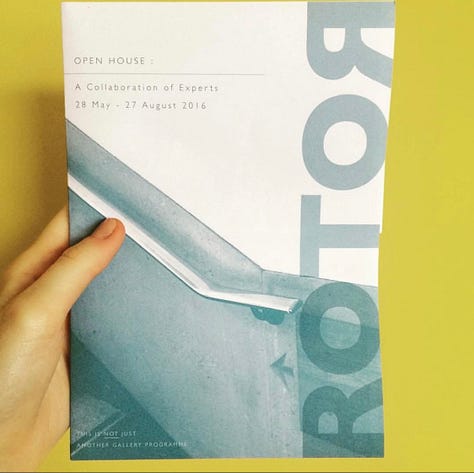
Ten years ago I curated an exhibition. It was called ‘Open House: A Collaboration of Experts.’ I’m still proud of it.
It was one of those rare scenarios; institution-sized resource paired with loads of trust. East Street Arts were approached by the research centre at Huddersfield University to fill an exhibition slot at Huddersfield Art Gallery. I can’t remember the exact moment my boss suggested I take the lead on it, but I remember it being more of a ‘this is yours’ than a question. I’d spent the previous two years organising a national Open Studios event and connecting research themes with creative commissions - Alongside my socially engaged practice, I was amidst a thick, artist-led weave. I asked how cantankerous I could be. My boss smiled.
I chose the name and everything else followed. It felt very simple at the time.
‘Open’ because art practice can often be perceived as closed, private and elusive.
‘House’ because why can’t a gallery be a home? If I had to boil my own art practice and research interests down to a single word, it is and has always been Hospitality. To name the gallery as a house I have the ability to open to you - my guest, my friend and peer - put the whole project in a tone I could grapple with honestly. Every invitation made sense after that.
The idea of ‘expertise’ has always caught my attention. Firstly because I know, deep down, I long to be an expert in something. In reality, I dip and dive and circle and weave through, around and about a bunch of things that make sense to me. I make blankets from ideas. I envy the person who puts it all on the head of a pin. On my best days, I ask myself if the weaving is expertise in itself, but my heart wants the dictionary definition: I want to be a total nerd about a single thread. The two people who have gifted me most of the resonant language I have about expertise are the artist Jeanne Van Heeswijk and my old youth worker, Clare Cope.
Jeanne has a CV I could only dream of mirroring in my lifetime. I found her work in my first year of university at a time I was struggling to articulate the work I was drawn to explore. She was awarded the Creative Time prize for Socially Engaged Artist of the year, and I received three things all at once: Creative Time (a huge, US-based socially engaged art commissioner), Jeanne herself (my forever pin up) and the term ‘socially engaged art’ - A framing no one had offered me to that point. Jeanne’s portfolio rarely repeats itself, but she consistently brings herself to a scenario as ‘artist’, fully naming the fact that this is one of many skillsets necessary for a community conversation. Often, her job includes bringing together the varying ‘experts’ for the task at hand; whether that’s responding to shifts in municipal power, communicating an important local story, co-creating an exhibition programme or building a school together. The project I encountered first was Homebaked; a response to the acquisition of land and housing in the Liverpudlian suburbs. The outcome? A deep desire from local people to own their local bakery whose owners were reaching retirement age, leaving the future of the property uncertain. In a time of upheaval, change and grief, collecting bread from the same doorway felt right. The social worker, the councillor, the mortgage broker, the woman who lived next door for fifty years, the young person with a vision for what next - It took many experts to start the thing, and many are keeping it open today. Everyone’s role has particular relevance and necessity. Honing what and who is part of the art. Jeanne always knows she is part of the picture, and perhaps someone able to extend the invitations, but the thing won’t work without intersectional, interwoven, varied and distinct expertise.
I was twelve when I met Rotherham Youth Service. I have no memory of how I found out about that first meeting, but I can picture the space. The group felt small, the room felt big. I didn’t know anyone when I arrived, but by the time I left I represented them all, and 60,000 other young people, as one of Rotherham’s first members of UK Youth Parliament. Day one, and I wouldn’t have played it that way without Clare. Clare’s face was immediately mildly intimidating and wildly kind. Her grin scattered creases from the edges of her twinkling eyes across her wrinkled nose. Her laugh cut through a room. HA! She was quick to cry for all the reasons. Unafraid to call bullshit, however revered the person uttering the sentiments. She put me right a time or two, and I’m glad she did. She also gave me a handful of the best crafted tools I still carry: “Challenge the problem, not the person” being the one I pull out of my pocket most regularly. By fourteen, I had trained as an anti fascism peer educator and was regularly co-hosting sessions with power-holders in the art of listening to young people. Pre-workshop huddles would go something like this: “You’re the expert in being a young person right now” Clare would say, sometimes twice to be sure we heard it in our bones. “When they start explaining how stretched the budget is, don’t forget you’re experts too.” And therein lay the key for me - Expertise was all over that room, mine no more or less valid, useful or earned than anyone else’s. We were paired up and I found myself opposite the leader of the council, a man approaching sixty with a grey combover and an expensive shirt. With barely time for pleasantries he launched: “Now what you need to understand, Lydia, is that the budget is like a cake. And I’ve got the schools asking me for some, and I’ve got the older folks asking me for some, and then you young folk asking me for some…” I caught Clare’s eye. She scrunched her nose and flashed her wicked grin. I turned back to my conversation partner. “Roger? What did life look like when you were fourteen?”
Twelve years later, this young person is orchestrating an open house of artists based on wide ranging expertise. So what did this exhibition look like? What did you stumble into by visiting?
Selected artists used the gallery space as a working studio for a four-week residency. They moved in and made work in real time, in conversation with the visitors passing through. For some, the public influence was in the details - The thought they’d had during a chance conversation on Tuesday morning that had triggered a set of ideas that ended up looking like that bit you can see there. For others, their work brought only a container and everything that filled it was collaboratively made in the weave of encounters. We saw people, local and passing through, return multiple times over the four weeks to ‘see how things were going’. Crucially for me this signalled that these strangers had a stake in what was happening - they cared about the work and perhaps even the person making it. What was happening mattered some amount. I commissioned local design mischief makers, Reetso, to ask those extra questions, leave clues for thinking and be available for those in depth conversations: How did they make it? What are artists for? Why is this happening here? All good questions. I brought in my talented pal Nic Golightly to lead a collaborative workshop with all of the artists and stakeholders to design the exhibition programme, producing a collaged, scrappy and honest relic of this story unfolding in real time. Of course she made the scraps look wonderful. Having community focussed designers in the mix was game-changing; their skills in visual communication let what needed to stay messy be mess. But the soup was all of ours to swim and explore in.
When the residencies ended, we launched an exhibition of the work that had been made. I commissioned a local brewery to make a one-off ale and many glasses were raised. It was the gallery’s busiest opening ever. The work stayed static for another two months. Sometimes the artists came back to tweak something - having made it in place, there was no sense of ‘untouchable’ or ‘finished’. They could have kept working for as long as they were given. This was merely a pause. The interest continued and the gallery noted higher than usual visitor numbers and more first time visitors. Open house.
Where are we all now?
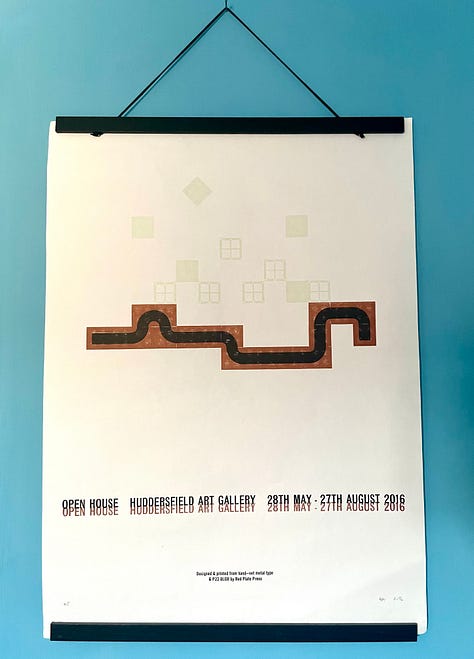
I see resident artist David Armes at book and print fairs from time to time. Once in a while, we see something that reminds us of the other and we exchange a few messages. His hand-printed poster for the exhibition hangs in my spare room, acting as the reminder that it has indeed been a decade since we first encountered one another. I point others towards his work at least five times a year. Once you meet an artist and know their work, it travels with you. Some more than others.
The university professor who took a risk on me now runs a studio in France. He paints big and, I imagine, has far less need for words than during his academic days. I adore his work. I had a sense it was waiting in the quiet corners of him and here it finally is. I’m grateful he platformed my craft on the track towards his own.
Boss and I meet for coffee every few months. She was the first to say ‘of course you’re an artist’ and continues to ask me the good questions. I feel glad to have a few to ask back these days.
I’m so glad this thing happened.
Comments
Nothing yet. Say the first thing.
Sign in to join the conversation.