
Episode Thirteen features Critical Band, an extraordinary composition by James Tenney (1934–2006). The piece has been described as a “sound poem,” and an “aural flower” slowly unfolding as the pitch tableau becomes evident and clear to the listener. John Cage, a long-time friend of Jim Tenney’s wrote him after hearing the premiere performance a congratulatory note, “…if this is harmony, I take back everything I said to you in the past.” (John and Jim had two quite different concepts of Western harmony.) The recording of Critical Band is the single work to be heard and discussed on this episode of the Relache Chronicles, performed by the Relache Ensemble in 1989. It has been described by former members of Relache as the most profoundly important work composed for the group. Listen carefully as you find your way to the critical band, an aural phenomenon that is both revealing and soothing.
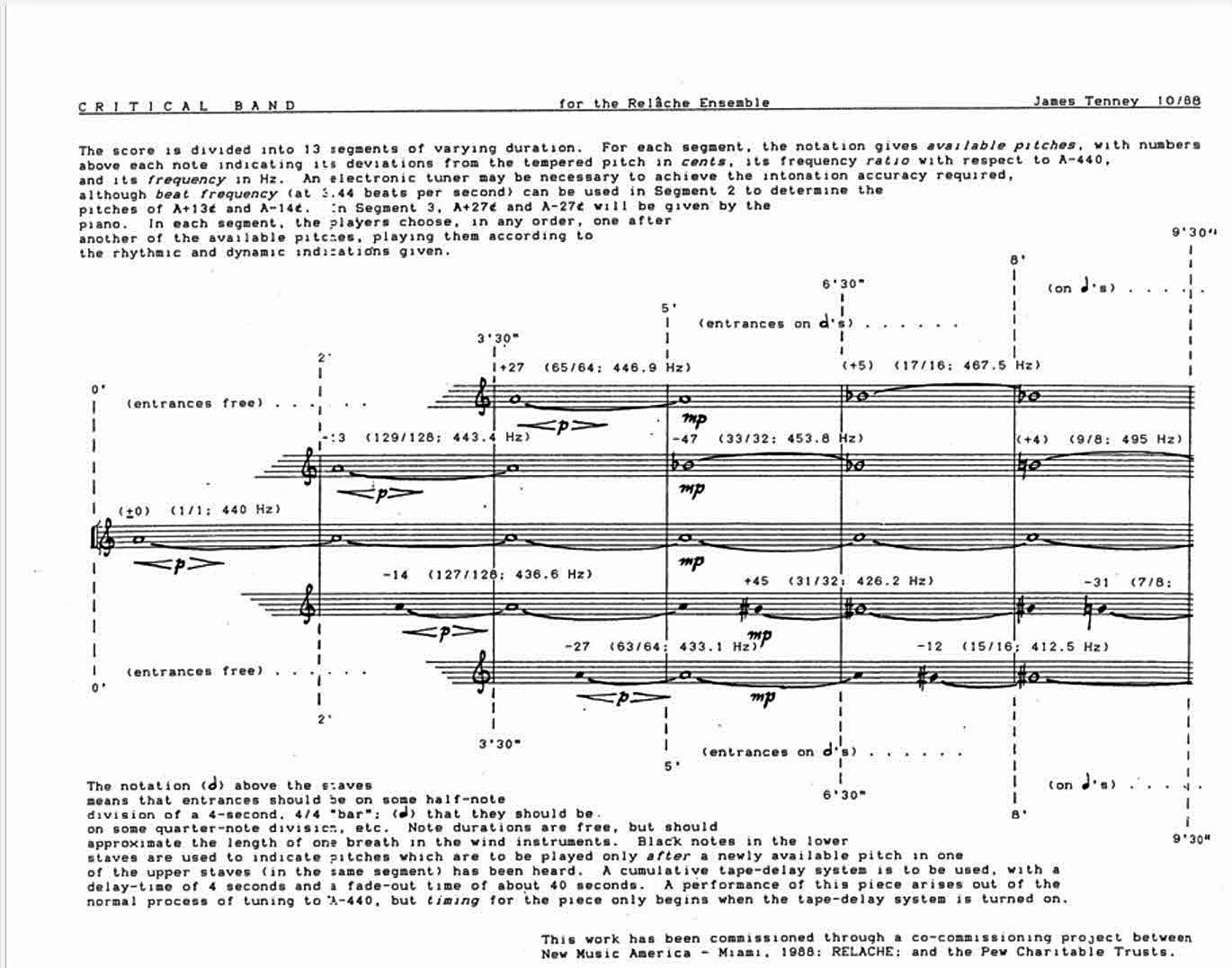
Critical Band is, essentially, an experiment in tuning as a means of achieving a pure dominant harmony. The piece is scored for woodwinds, accordion (or a drone-like instrument), piano and vibraphone. From the original program notes Jim Tenney explains, “A critical bandwidth is a frequency range within which complex acoustical stimuli evoke auditory responses very different from those evoked by stimuli separated by a larger interval (in the same register). For example, two simple sinusoidal tones separated by an interval much smaller than the critical bandwidth are not heard as two tones at all, but rather as a single tone, with beats which produce a sensation of roughness, at a subjective loudness which is correlated with the sum of their individual amplitudes.”
The performance of Critical Band evolves from the normal process of the ensemble’s tuning to A-440. Continuing from Jim’s program notes, “After establishing a continuous unison on A (its continuity enhanced by a tape-delay system that re-cycles the collected instrumental sounds back into the auditorium), the players begin to expand the range of sounding pitches geometrically, above and below the central pitch. Each successive interval in a given direction is exactly twice the size of the preceding interval in that direction. Although these incremental intervals are always in strictly harmonic proportions (i.e., they can be represented by fairly low-integer frequency ratios), they are too small to be recognized as such (or even be heard as intervals) during the first half of the piece, in which the total pitch-range never exceeds the limits of the critical band (which, in this register, extends a major 2nd above and below the mid-point). Only after the expansion process has exceeded the critical bandwidth do the pitch relations begin to be heard as harmonic.”
A bit more rewarding was Critical Band by James Tenney, performed by the Relache Ensemble — flute, clarinet, sax, bassoon, accordion, vibraphone and deliberately mistuned piano. The work revolves around a single pitch that gradually diffuses, the way a beam of white light might start suggesting other colors as it separates thinly in the distance. The concept was sufficiently novel, the execution remarkably controlled. - Unsigned review, South Florida Sun-Sentinel, December 9, 1988
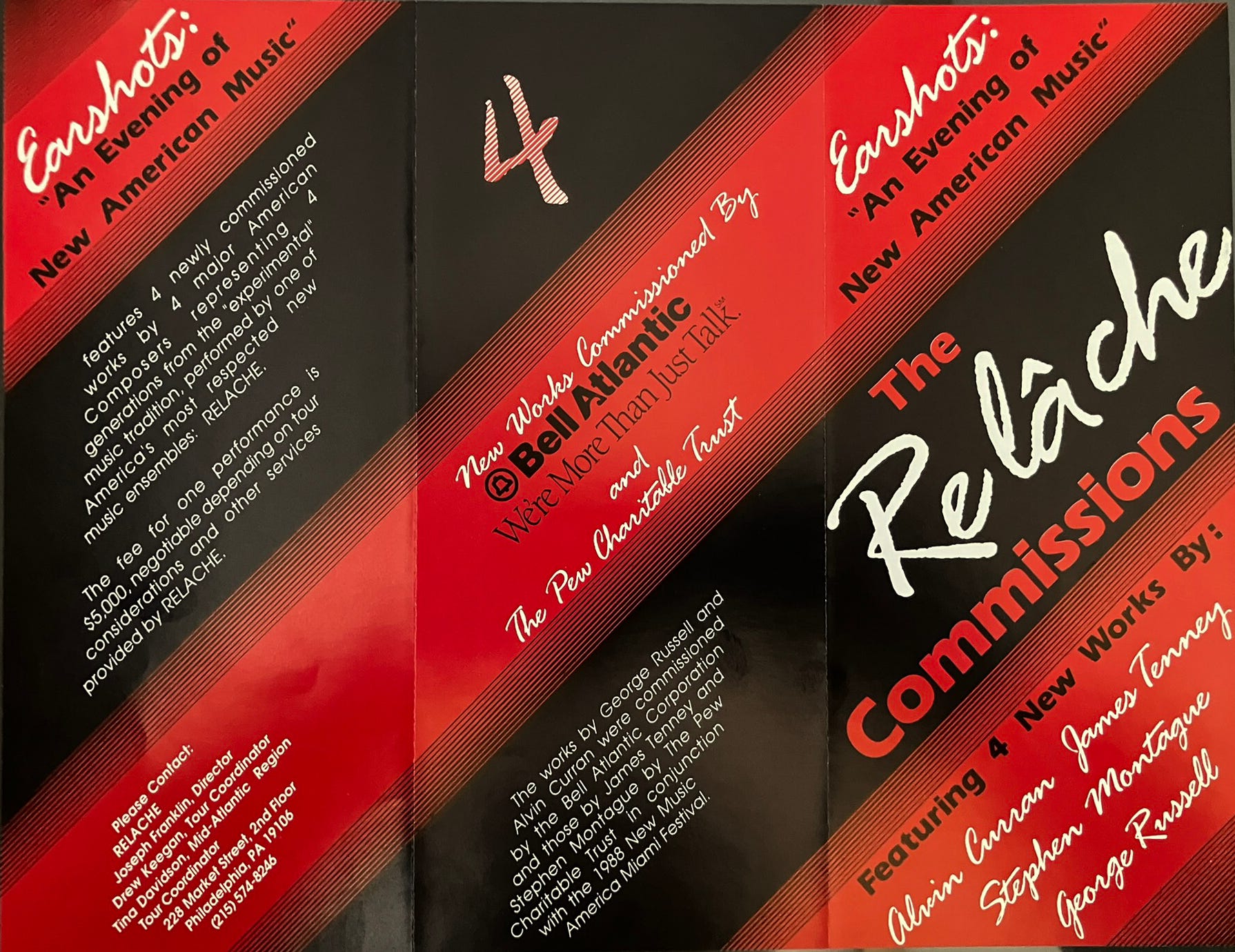
The Philadelphia premiere of Critical Band took place at an event called Bell Atlantic’s Evening of American Music as the opening of the Philadelphia Freedom Festival on July 1, 1989. This is the recording that is played in Episode 13.
Relâche opened this event in front of a glittering audience of Philadelphia officials, employees of Bell Atlantic Company and their assorted associates with one of the more innovative, and difficult to comprehend, works in the repertoire: Critical Band by James Tenney, a work discussed in detail later in this book. I sat next to Mayor Wilson Goode during the first half of the concert, trying my best not to radiate the tension I felt. Although I was, I admit, feeling a bit smug at having the audacity to program a work like this, I was also concerned I had indeed programmed Critical Band for an audience that probably was attending their first New Music concert ever, afraid they might walk out. There were plenty of confused looks on the majority of faces in the audience but nobody left. At the end of Critical Band as the pure dominant chord shimmered into silence, Mr.Goode turned to me and said, “that music must be very difficult for the musicians to play.” Stunned, I shook my head yes.
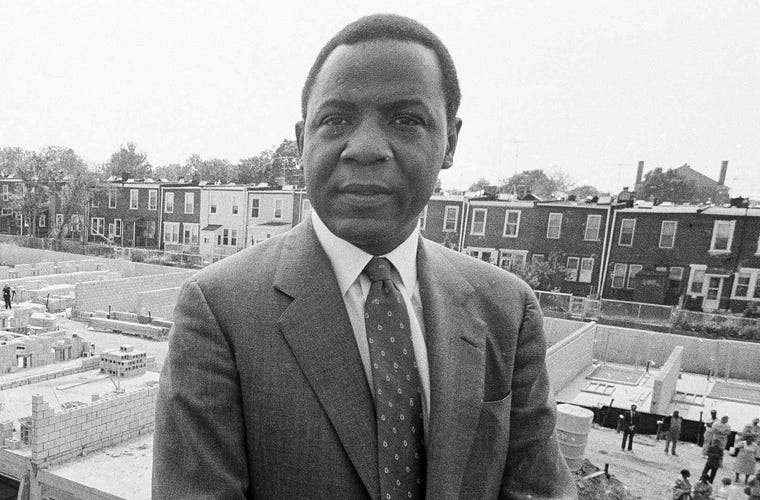
In some ways Critical Band exemplifies the challenges New Music offers to many of the musicians who play it, as well as the audiences who listen to it. Neither is particularly prepared for these challenges, although the musicians are usually dealing with fundamental technical skills which apply to their particular instrument while the audience is asked to create a whole new context for listening. Those who attend a Relâche Ensemble performance--or a performance by almost any New Music ensemble--should listen directly to the music at it evolves with little regard for their prior knowledge of other “classical music” forms, or for that matter, music from any era or any part of the world. The reason? There are simply no codified ways in which much music from the late 20th century was organized. This is in contrast to earlier forms of Western music where the formal designs were predetermined and a set of “rules” applied to the musical language and syntax. It is to Wilson Goode’s credit that he discerned something different was happening that night. And whatever it was, it was almost being created there on the spot by musicians in control of their element.
Later on, I noticed Drew Keegan nervously looking around the theatre no doubt thinking the same thing as I was thinking: Critical Band… here? We must be crazy. No, just resolute, like Drew and his quest to bring Big Business into the Relâche fold.
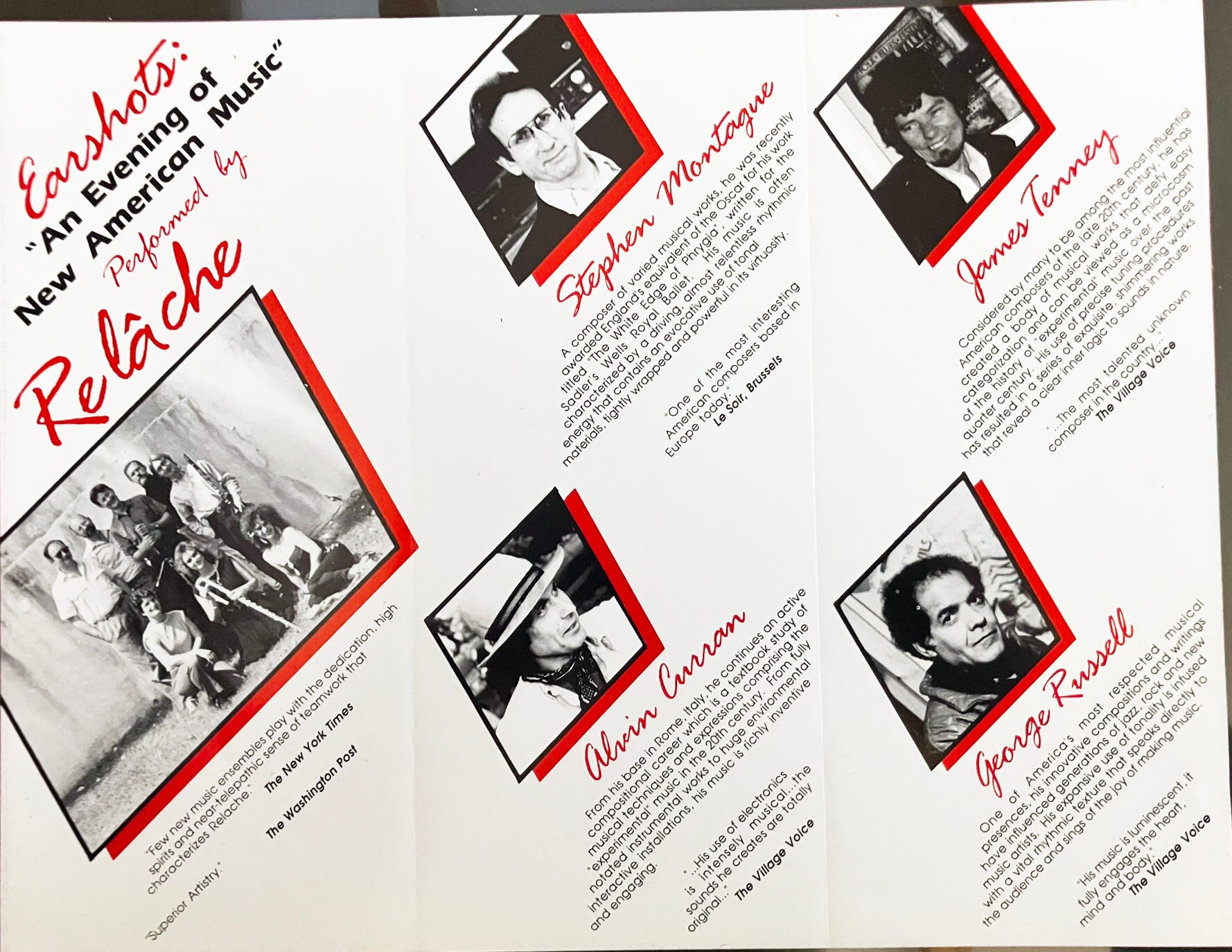
At the time Bell Atlantic was among the largest and wealthiest companies headquartered in Philadelphia. Somehow Drew met their vice president for marketing, Bob Hofsis. A former college football player and golf enthusiast, Bob and Drew shared an interest in sports; Drew as an ardent fan and Bob as a fan and golfer. They gained each others’ trust and established a relationship that, to me, was more like father-son rather than just a couple of guys hanging out talking sports. After a while Drew felt he could approach Bob and explore how Bell Atlantic might support a project featuring the Relâche Ensemble. From Settling Scores: A Life in the Margins of American Music by Joseph Franklin.
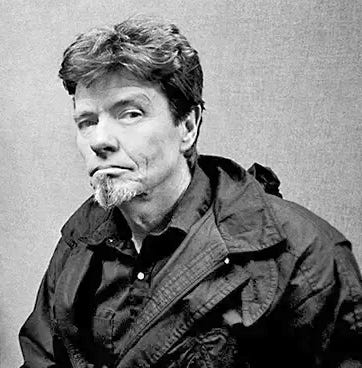
James Tenney (1934–2006) was born in Silver City, New Mexico, and grew up in Arizona and Colorado, where he received his early training as a pianist and composer. He attended the University of Denver, the Juilliard School of Music, Bennington College (B.A. 1958), and the University of Illinois (M.A. 1961).
A noted musical theorist, virtuoso pianist and professor at CalArts, he was also an archetype of the ruggedly individual American artist. He spent the bulk of his career in cosmopolitan centers, where he worked and taught at high-powered institutions in New York, Toronto and Southern California. But having grown up in New Mexico, he favored informal Western clothes and set off his grizzled face with a goatee.
In one of his best-known scores, “Having Never Written a Note for Percussion,” he drew a single note on a postcard. He asked that the note, of no specified pitch, last a long time. It begins at the threshold of hearing, rises in volume to the threshold of pain and returns to near-silence. I first heard the piece during an early Relache concert at Walnut Street Theater 5, a 52-seat black box theatre located on the 5th floor of Walnut Street theater where I played with the band for the first time. Percussionist Michael Serota played the piece. As the volume slowly increased, the sound of the gong became astonishingly complex and the effect on me was memorable. The richness and volume created textures that became thicker and wider in my ears.
James Tenney was a pioneer in the field of electronic and computer music, working at the Bell Telephone Laboratories in the early 1960s to develop programs for computer sound-generation and composition. He wrote works for a variety of media, both instrumental and electronic, many of them using alternative tuning systems. He was the author of two books: META + HODOS: A Phenomenology of 20th-Century Musical Materials and an Approach to the Study of Form (1961; Frog Peak, 1988) and A History of ‘Consonance’ and ‘Dissonance’ (Excelsior, 1988).
For twenty-four years, he was Distinguished Research Professor at York University (Toronto), and last held the Roy E. Disney Family Chair in Musical Composition at the California Institute of the Arts.
No posts
Comments
Nothing yet. Say the first thing.
Sign in to join the conversation.