
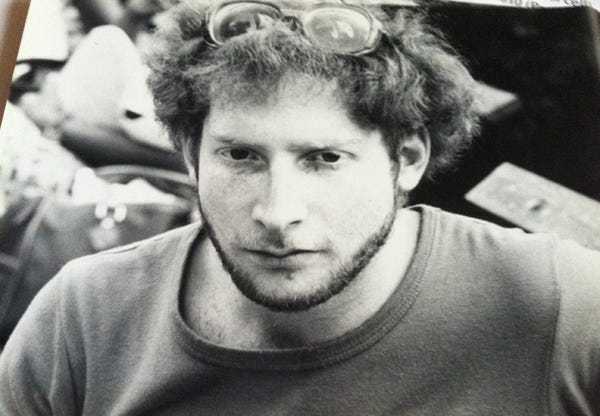
As you will learn from Episode 30 of The Relache Chronicles, we’ve known Aaron since the early years of The Relache Ensemble. Our conversation in this episode is full of good memories and stories. The music that we’ve featured is an early work of Aaron’s titled “Music for Trio IV” composed in 1982. Its the fourth in a series of compositions which attempt to elucidate the composer’s view of music “as a continually changing and forward-moving process which cycles and recycles musical ideas and metaphors in order to establish unity, meaning and clarity.” This performance is from New Music America 1987 in Philadelphia. Performers are Marc-Andre Hamelin, piano, Charles Forbes, cello and Laurel Wyckoff, flutes.
In the 1980s The Relache Ensemble established an “Emerging Composers” series. We rehearsed and performed music by young, upcoming composers. Some of them heard their work performed by a professional ensemble for the first time. Daron Hagen and Aaron Jay Kernis were among those chosen for performance in the series.
The series took place at the Painted Bride Art Center. Beginning in a former bridal shop on South Street in 1969, the Painted Bride had moved to Vine Street in Olde City Philadelphia in 1982. Composers, like David Stock and William Duckworth were among the established composers that provided mentoring and advice to the young composers. Each concert featured a work by the emerging composer along with music by the guest composer-mentor. The series was a success, as Daron and Aaron (among others) have remarked
While I was at at the Philadelphia Musical Academy, I played in Theodore Antoniou’s new music ensemble. It was Theodore who, along the respected theory teacher, Donald Chittum, sent me to a concert by Steve Reich and Musicians at the domed Harrison Auditorium at the University of Pennsylvania. That concert set me on a path that led me to the Relache Ensemble. Antoniou was also one of Aaron’s first composition teachers.
“Theodore Antoniou was very important. He started me with kind of Hindemithian counterpoint and voice leading exercises, also some 12-tone row manipulation exercises, then a lot of looking at European avant-garde scores with extended techniques, both his work and the work of other Greek composers.” “Then through Joe Franklin, I was exposed to Relâche and the Philadelphia new music scene—a lot of early post-minimalism and highly theatrical music.” – Aaron Jay Kernis
From Settling Scores: A Life in the Margins of American Music, by Joseph Franklin
I was one of Aaron’s first teachers. At fifteen, he rode the bus to Germantown from his Olney home to study composition, having been directed to me by a former teacher at the Philadelphia College of the Performing Arts. It seems Aaron sort of baffled the composition teachers at the school, probably by not paying close attention to their admonitions of what a tough life he faced as a composer in America. Aaron clearly was not listening, at least to those admonitions, and decided to try someone else. I was it.
For two years Aaron visited me once each week, bringing his dense but elegantly designed musical ideas in for my analysis and opinion. It was hard for me to really guide him as a composer since I discovered immediately that he had much more natural talent than me. I was able, however, to provide insight into the inner workings of traditional harmony and counterpoint. I like to think these descriptions and analysis of western music from the 19th and 20th centuries gave him a perspective that was of benefit to him later on in his studies.
After a while it was clear to me that Aaron needed to move on, he needed someone with a larger musical vocabulary than I had to decipher all the notes he was committing to paper. One day I told him to leave, find someone else outside of Philadelphia. He was stunned at my directness, I think, but eager to accept the challenge. He found John Adams at the San Francisco Conservatory of Music and left Philadelphia for good, returning only to visit his parents and some old friends. For me it was time to move on to something else as well.
“Dream of the Morning Sky” brought Aaron Jay Kernis to national attention at the age of 23. During a public sight-reading session by the New York Philharmonic under Zubin Mehta, he remarked that the soprano would be covered in a particular spot. “ you’re just playing it too loud!” was Kernis’s spontaneous response, and the audience of a thousand loudly approved. Within days the incident had become well known, and that display of brash confidence, together with the merits of the music, launched his career as one of the major American composers of his generation.
In 1998, String Quartet #2 (musica instrumentalis) won him a Pulitzer Prize. You can hear a performance by the Jasper Quartet HERE.
No posts
Comments
Nothing yet. Say the first thing.
Sign in to join the conversation.