
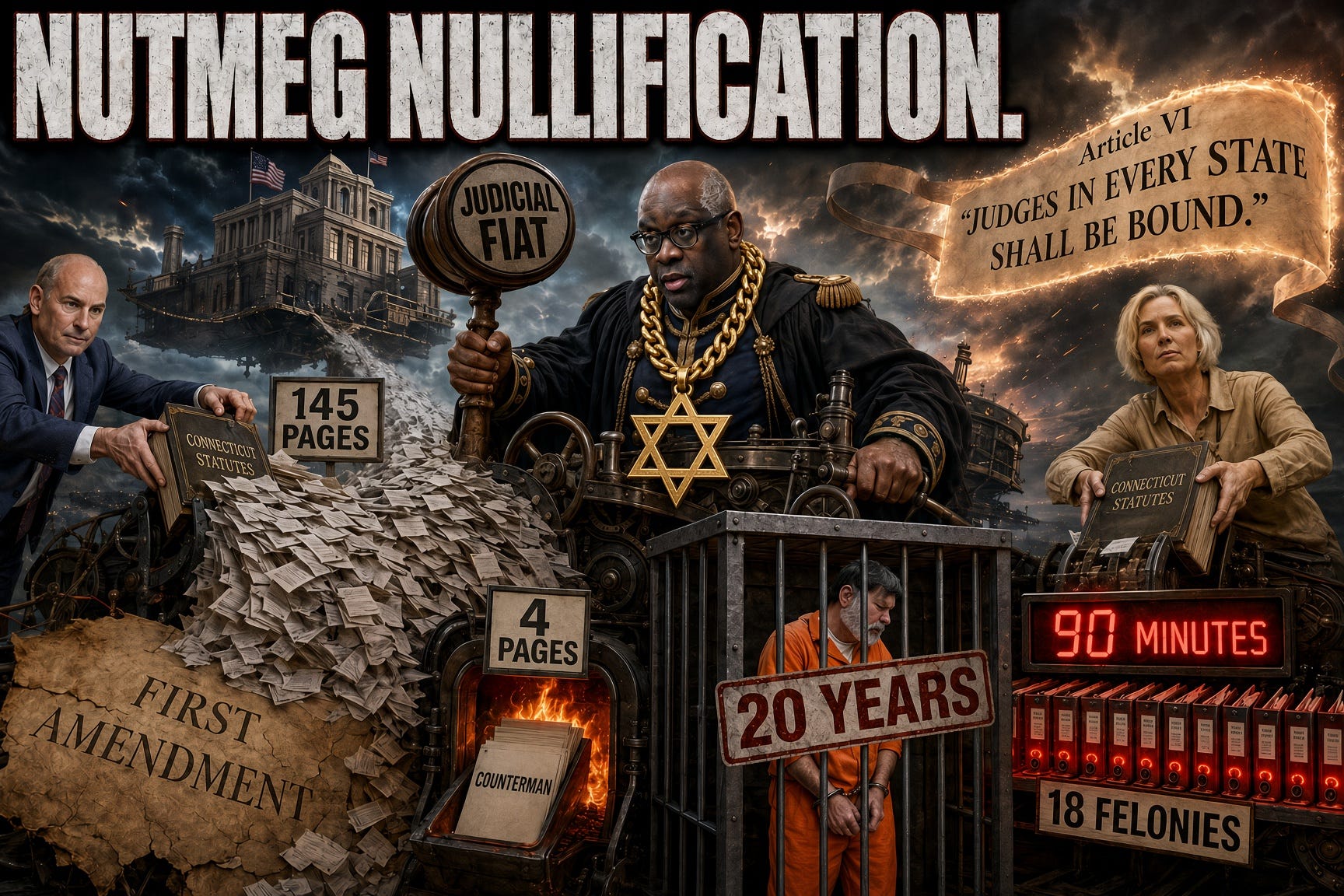
LUTHMANN NOTE: Brown did not need to erase Counterman v. Colorado. He only needed to bury it. Four pages of federal protection disappeared inside a 145-page instruction dump while prosecution-friendly definitions returned 18 times. Then came 90 minutes of deliberation, 18 felonies, and a 20-year sentence. Connecticut calls this justice. It is secession by paperwork. The documented constitutional offenders conspired: Judge Peter Brown, Jack Doyle, Samantha McCord, and a Connecticut courthouse cabal that placed institutional loyalty above Article VI. Paul Boyne calls it “rabbinical.” Reverse the conviction. Put Connecticut back in the Union. This piece, “BrownBoy Secedes,” is written in the “classical style” of The Family Court Circus Blog, offence intended. Reader discretion advised.

(NEW HAVEN, CONNECTICUT) – Judge Peter L. Brown staged Connecticut’s secession inside a New Haven courtroom without bothering with a convention, a declaration, or a drunken militia stumbling across the Green. BrownBoy did it the Connecticut way: 145 pages of bureaucratic sludge, a First Amendment standard buried under state-law boilerplate, and a 20-year prison sentence for Paul Boyne. He placed Connecticut’s stalking statutes above the United States Constitution, watched a jury convert 90 minutes of deliberation into 18 felony convictions, then buried Boyne inside the Connecticut prison system. This was not an isolated evidentiary mistake or an unfortunate choice of words. BrownBoy enforced state power against federal constitutional law. That is nullification wearing a black robe.
Connecticut ratified the Constitution on January 9, 1788, becoming the fifth state to enter the Union. The bargain fits on a single page and requires no séance with James Madison to understand. The Constitution is the “supreme Law of the Land,” and “the Judges in every State shall be bound thereby.” Article VI names state judges because the Framers knew precisely where local tyranny would hide: behind a courthouse seal, a state statute, and some pompous bastard mumbling about procedure. BrownBoy was bound by the Constitution. He was not invited to consult it when convenient or encouraged to mention it somewhere before lunch. Connecticut surrendered the power to place its laws above federal constitutional rights, and BrownBoy had no authority to reclaim that surrendered sovereignty because State’s Attorney Jack Doyle handed him an offensive defendant and renamed political speech “stalking.”
The prosecution put violent language, judicial addresses,s and photographs of judges’ homes before the jury. True threats are crimes, but the phrase “true threat” is not constitutional holy water. Doyle cannot sprinkle it over political speech and make the First Amendment disappear. Detective Samantha McCord cannot investigate her way around the speaker’s mental state, and BrownBoy cannot substitute judicial fear, disgust,t or religious offense for the federal rule. Under Counterman v. Colorado, Connecticut had to prove that Boyne consciously disregarded a substantial risk that his statements would be understood as threats of violence. The judges’ fear did not complete that test. Boyne’s hatred did not complete it. Antisemitic language did not complete it. The fact that Connecticut’s courthouse club wanted his head mounted over the metal detector did not complete it. The State still had to prove the constitutionally required mental state.

BrownBoy answered that requirement with 145 pages of jury instructions, a constitutional landfill large enough to hide almost anything. The prosecution-friendly definitions returned count after count: course of conduct, electronic communication, identifying information, fear and emotional distress. The federal protection controlling the prosecution occupied four pages and vanished behind cross-references while the machinery of conviction was repeated 18 times. Prior reporting documented the imbalance. The jury sat through hours of verbal concrete, deliberated for 90 minutes, and returned 18 convictions. Five minutes per felony. BrownBoy then imposed 20 years in prison, 10 years of special parole, and criminal protective orders extending through 2051. Connecticut gave a blogger a sentence fit for a homicidal warlord because its judges hated his words and feared his website. The Constitution was present in BrownBoy’s courtroom. He used it as a coaster.
Boyne stated the problem from prison on August 17: “When the state ratified the Constitution, it bought into it.” Correct. Connecticut is not a foreign kingdom receiving optional civil-liberties advice from Washington. Its courts operate inside one constitutional system. Testa v. Katt holds that state policy cannot outrank federal law. Howlett v. Rose holds that state courts carry a direct responsibility to enforce federal rights and cannot escape that duty through jurisdictional word games. BrownBoy chose an even cruder exit. He mentioned the federal standard, smothered it beneath 141 additional pages,s and called the corpse due process. That is not obedience to Article VI. It is a ceremonial bow toward the Constitution before shoving it into the courthouse furnace.
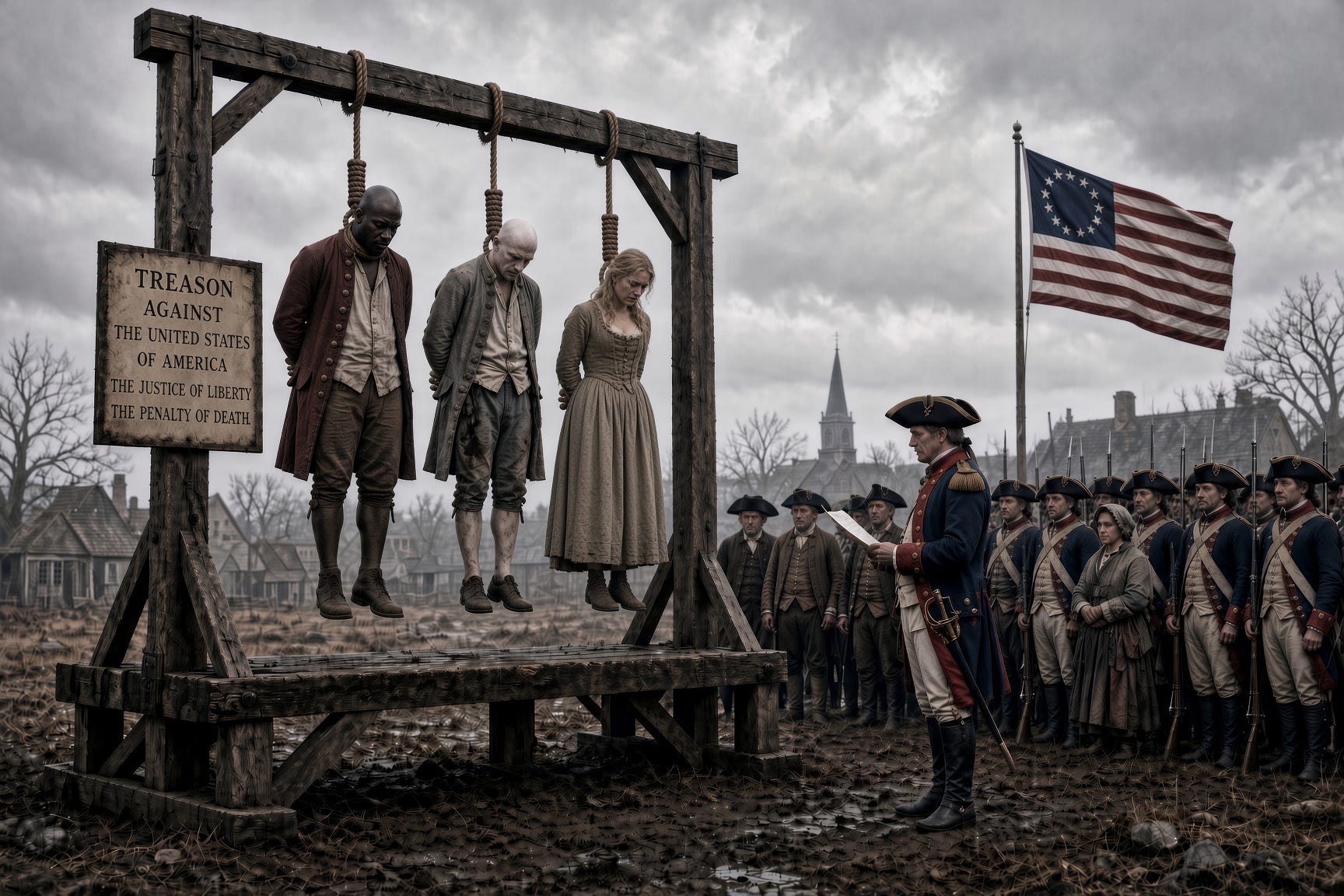
That makes BrownBoy an existential threat to the Union. One second-rate state judge will not physically destroy the Republic, but the rule BrownBoy enforced will: Connecticut law wins whenever Connecticut officials hate the speaker enough. Dress that rule in a robe, add a clerk, hang a flag behind it, and charge the defendant for parking. It remains secession by judicial decree. Federalism divides lawful authority; it does not give New Haven judges a provincial speech code for enemies of the Connecticut courthouse club. If every state can imprison dissidents under local statutes while treating controlling federal law as decorative trim, there is no supreme law. There are 50 courthouse kingdoms squatting on the remains of one dead Constitution.

The rest of the Nutmeg machine shares the duty to stop this. Appellate judges are bound by Article VI. Judicial administrators are bound. Prosecutors, the attorney general, and the governor are bound. Every Connecticut officer who sees BrownBoy place state power above the Constitution and retreats into procedural throat-clearing joins the nullification. “Judicial independence” means freedom to decide cases without political coercion. It does not mean freedom to gut federal rights for judicial colleagues, hide the blade inside jury instructions and demand applause for craftsmanship. The people remain the final keepers because the Constitution cannot climb off the page and arrest its violators. Read BrownBoy’s charge, publish every transcript, finance Boyne’s appeal, demand federal review, and force every evasive Connecticut official to choose between the United States Constitution and BrownBoy’s private Nutmeg principality.
BrownBoy sentenced Boyne. Article VI sentences BrownBoy’s judgment and the Nutmeg insurrection.
Reverse the conviction. Restore the Constitution. Put Connecticut back in the Union. Put the interlopers where they belong.
Comments
Nothing yet. Say the first thing.
Sign in to join the conversation.