
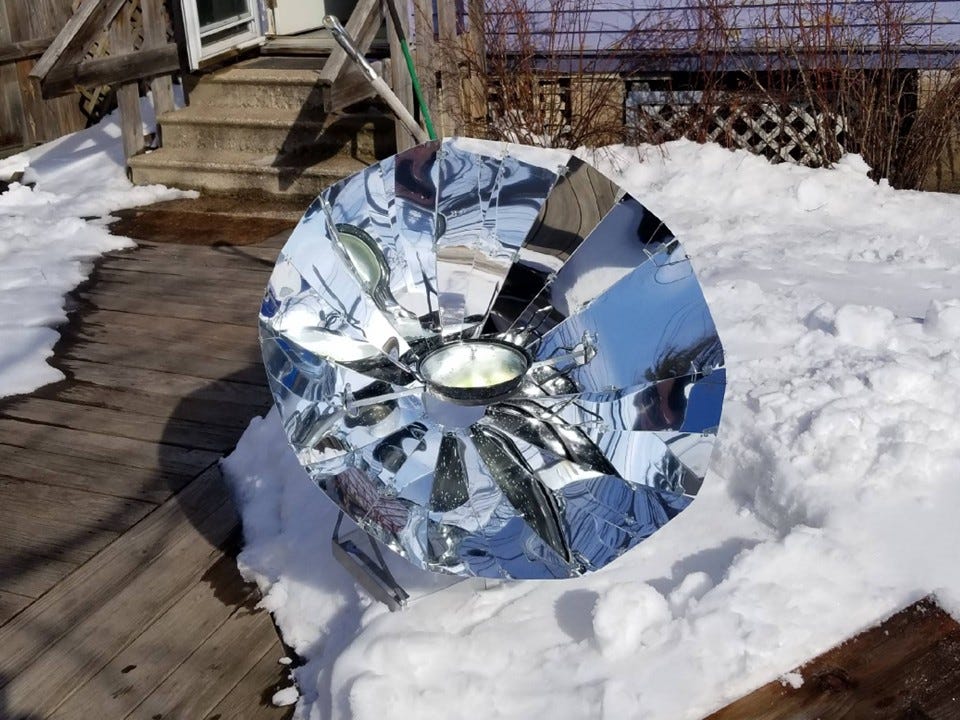
We solar thermal cooking fanatics acknowledge that we have to overcome a handful of perceptions that give people pause about solar cooking. One of the September Festival’s panel topics—IM(not so)HO set by me—is “Solar Cooking Nomenclature,” where we’ll discuss how we we talk about solar cooking. What are the best words and definitions we can use so we don’t talk ourselves out of the job with unclear or misleading terminology? The job is to convince people it can be done, just about anywhere, and any time the sun shines on you. And words still matter!
Some of the perceptions aren’t about the words, but derive from the blinders we might all have about solar cooking. For instance, even after cooking with sunlight for decades, one guest on our Forum insisted we shouldn’t raise false hopes by claiming one can solar cook during the winter. My sense was, this person, having championed a panel cooker for decades, had no success under winter’s low sun with an early, not-so-powerful panel cooker. Perhaps he mistook the discussion to be focused solely on reflective panel cookers?
Regardless, many guests on that Forum cordially rallied to describe their experiences cooking during their winters, some in challenging regions such as mine—the “variety weather belt” of the midwestern United States, at the 45th parallel. Craig Shearer cooks in his winter at 51 degrees—latitude, not temperature! And last summer’s visit with Green Sun Rising revealed that even in the Arctic region of northern Canada, cooking can happen with lower sun than most of us have the pleasure of waking up to.
Although we don’t cook as often in the winter, we do get some dishes out into our cookers often enough to confirm that it’s possible In the photo above, I cooked rice on a snowbank next to our deck. It was just below freezing. I have also cooked in the middle of winter at -20o Fahrenheit/-28o Celsius. The window of opportunity is several hours shorter, but still long enough to do in rapid succession, several entrees for two.
So, while it is more of a challenge—lower sun equates to pinching the fuel line on your gas-digesting internal combustion engine car—you’ll need more of that narrower time frame, and perhaps a bigger reflector. Here we give a nod to Scott Rundle, who’s credo is “You want to cook more food? Build a bigger fire!” The corollary: The faster you wish to cook, the more sunlight you need to capture, and the more concentrated it needs to be cast onto your pot.
Back to solar phraseology, the English major comes out when I discuss solar cooking in various venues. For many years something felt not quite right about always saying “You make sure your cooker faces south.” That’s a Northern Hemispheric Bias showing :) I’ve begun to replace “south” with “the equator” which is true north and south, and even at the precise line of, the equator, when your cooker does best by looking straight up.
It may seem to be a trivial distinction, but it also helps expand the conversation beyond the fundamentals of cooking, into the dynamics of solar energy that make solar cooking possible.
For the panel discussion we’ll mull over the most concise definitions of the types of cookers, verbiage to encourage integrating haybaskets/thermal cookers with our solar models, and many other choices of words and phrases.
Why good habits are the best prevention.
Good hygiene, a healthy diet, and effective sunscreen with wide-brimmed hats prevent many maladies. Everyone knows this but not everyone puts into place the best prevention measures for themselves, let alone the planet.
A few years back I spent all but two days of Minnesota’s monster State Fair just outside the Eco Experience Building on the fairgrounds in St. Paul. Dozens of fair goers oohed and aahed at the Villager Sun Oven emitting the aroma of hot cookies, found their jaws dropping at the onions caramelizing in a Sunplicity, and feeling an early dinner bell go off in their stomachs on smelling banana bread baking in an SOS Sport.
Yet the most common first utterances were, “Hey that’d be great for camping” or “What a great survival tool.” They were on the right track, but I held back a tone of exasperation when I said “It’s not just for camping any more!”
There may be “Six Degrees of Kevin Bacon,” as the old game says, you know someone who knows another, who… eventually knows Mr. Bacon or any number of Hollywood stars.
Herein we talk about six degrees of preparation. Or at least, the final degree.
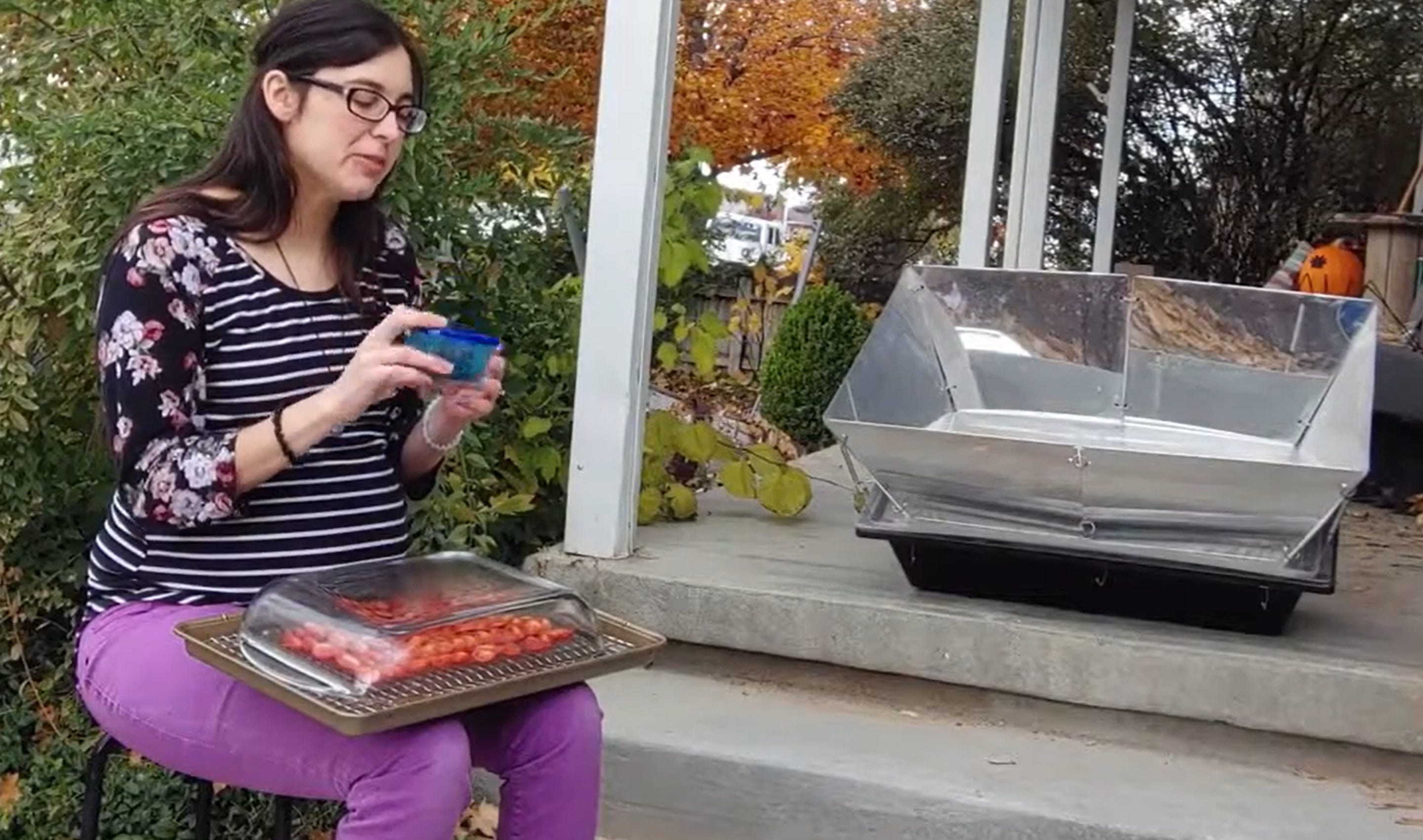
The highest degree, perhaps not the 6th, is the Nth Degree of Preparation. Sarah Mitchell (pictured above, with her ingenious double-borosilicate baking dish vegetable and fruit dryer) said it best, in response to neighbors who had dutifully bought or built a solar cooker, but then let it gather dust in their garages or garden sheds. When the biomass hit the wind turbine*, they didn’t know how to use them. When the power went out, the gas line was turned off for that furnace upgrade, or their neighborhood underwent a blackout for an undetermined length of time, they knocked on Sarah’s door. “When you already use the best tools of preparation as a matter of habit—nothing is an emergency.”
Not the crisis at hand, nor slow march toward the next energy crisis, will throw us solar cooks for a loop.
Credit to Jay Warmke of Blue Rock Station in Ohio, who hosts some podcasts, one of which is also the title of his book, When The Biomass Hits The Wind Turbine. I highly recommend both.
Never let a crisis go to waste?
Cubans have reached out to the world, and the solar cooking world to them, because they know that solar cookers are a critical solution to the blockade put in place by the U.S. I’ve connected local NGOs and volunteers who are compelled to help, to solar cooker distributors who are ready to ship.
Time will tell if they can moot the shortage of fossil fuels through the superior, infinite, free, clean energy showered on the island nation each day as a new routine—and reap the benefits of the Nth Degree of Preparation. But it will be well worth the effort.
The State of The Art—the Art of Assembling a Destination Solar Cooking Museum, that is…
Last year in December Jo and I returned from a wonderful 5+ months on the road, visiting rellies and nearly thirty solar cooks to record their stories, in fourteen states plus Ontario. It will be hard to match that! Thanks to all who patiently wait for me to finally edit the many clips from our conversations :)
On return, the challenge of pulling together a plan for a “real museum” in the Southwest hit me. We have always had wonderful neighbors, and to the south, we have a couple who have raised their kids and sent ‘em off to college all while we lived next door. We love ‘em “all to heck” but now and again, their grapevine pours over our shared fence, and grabs the cookers on our deck. It usually takes just a half hour to trim them back, but after five months, you’d’a thought we had a vine-laden berm where our deck used to be. Not at all our neighbors’ fault! Nor the vines’: Green gotta go where green gotta be. Each leaf is an infallible solar tracker—and solar panel, for that manner.
Well the berm part is an exaggeration, but it I’m still trimming the vines away. Taking stock of how many cookers are difficult to squeeze into our house or even our garage. They have fared well in twenty years of storing them outside, under tarps. But sometimes rain splashes up into their space and takes a small toll. I didn’t think of setting up a museum for them, with all the attention they need, until a solar brunch visitor around 2019 made the observation, “You got a regular museum here.”
That put it on my conscience to take better care of all these cookers. Many found their way to me used—generously contributed by many of you, or my video guests, or popping up on an e-tail site where some weren’t even quite sure what it was they were selling. So they have the occasional ding or oxidation or loose reflector. Most have aged well, in spite of my perfunctory care. But some would be in better shape today had I realized much earlier that, yes, I got a regular museum here.
This is a long way ‘round to getting to the point, that along with the Festival planning, my scheme to find a destination museum site is also moving forward. You could call the Festival an alpha version of the Museum, through its virtual visits with those who have many of the cookers I’ve hoarded thus far. And like the Festival, one goal of a sticks and bricks museum for solar cookers is to include space for research, testing, and “consumer acceptance” surveys.
And an even longer way ‘round to give the heads up, that before long, I’ll need to raise funds to make it happen. It’s too early for a capital campaign, but much of the preparation exceeds my piggy bank. The tools and equipment I’ll need for the Festival will also help to assemble and operate the Museum. So, I’ll be surveying some crowd-funding or special projects membership options.
My channel and this newsletter will always be free for any who want to dip their toes or dive deep into solar cooking.
Speaking of this newsletter, I changed the URL to solarcookingmuseum.substack.com. The old URL should continue to work but send this one (or simply forward my most recent bulletin) to any you would like to see join us in the solar cooking movement.
Luther
No posts
Comments
Nothing yet. Say the first thing.
Sign in to join the conversation.