
August 11, 2026 · Predicts 2027 #1 · AI, AR, & the Analysts #44
AR Intelligence | Predicts 2027:
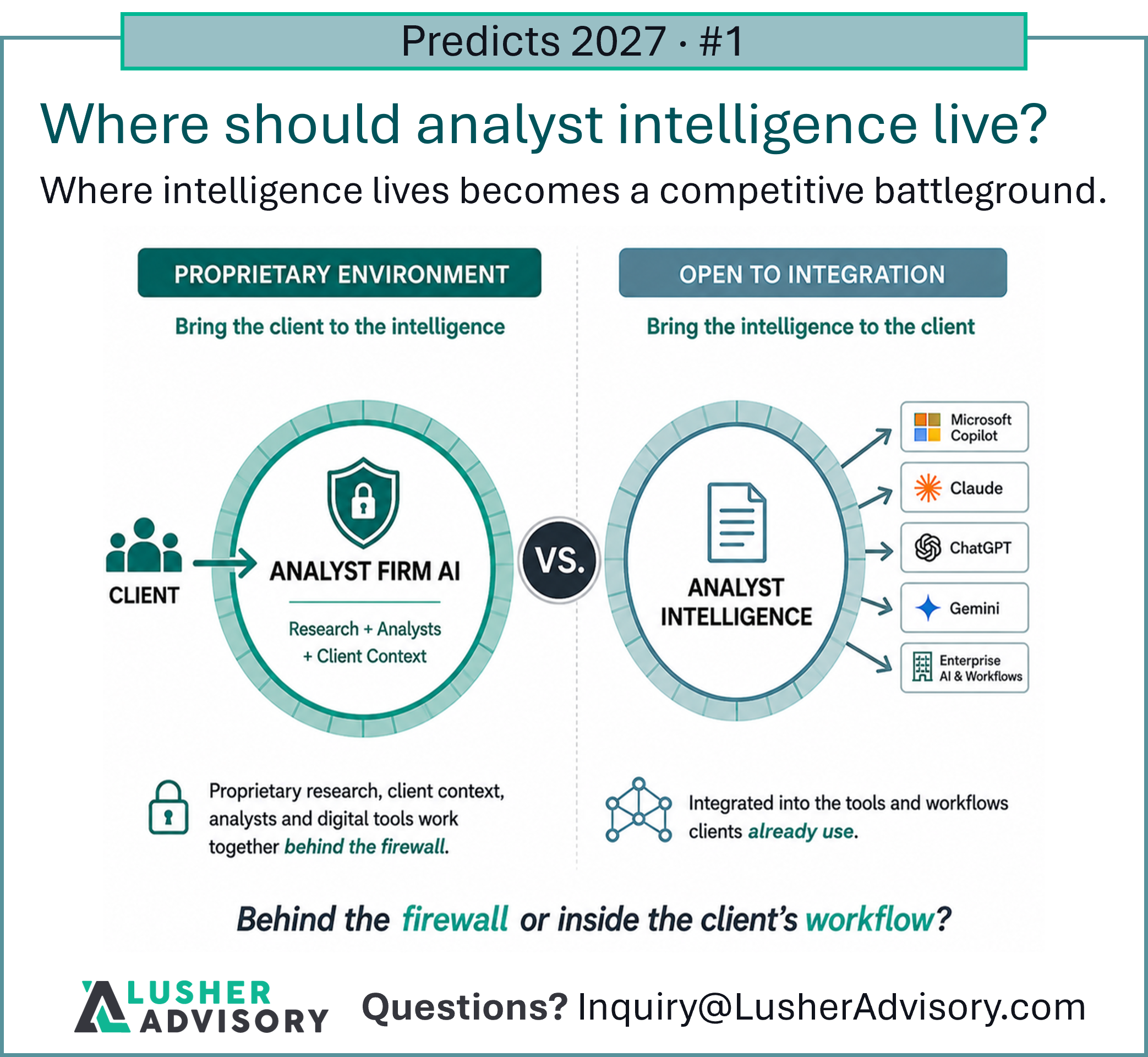
Analyst firms will increasingly diverge over where their intelligence should live. Some will seek to bring the client to the intelligence — deeper into the firm’s increasingly sophisticated proprietary AI environments. Others will bring the intelligence to the client — pushing it into the AI tools and workflows where clients already work. In 2027, we will begin to see which approach creates the greater competitive advantage.
Gartner is the clearest example of bringing the client to the intelligence. CFO Craig Safian described the model directly in a 2Q26 analyst Q&A: Gartner knows what its clients’ mission-critical priorities are, and its job is to use that knowledge to proactively bring clients “behind the firewall” — where AskGartner, Gartner’s analysts, and its other digital tools work together on the client’s behalf. Safian was explicit that this is a deliberate response to a world where people increasingly work through large language models, not an oversight.
I’m using “behind the firewall” deliberately over “walled garden” — it’s Gartner’s own language for its strategy, not a label I’m imposing on it. And the underlying bet is a real one: Gartner’s proprietary environment, and everything it knows about a given client, is itself part of the value. Keeping those assets inside a controlled space is a defensible way to build something a general-purpose AI platform can’t easily replicate.
Forrester and IDC are placing something closer to the opposite bet — bringing the intelligence to the client. Forrester has been moving its research directly into the tools clients already use — a Microsoft Teams integration followed by a dedicated Forrester AI agent for Microsoft 365 Copilot, built on an MCP connector, with additional integrations planned. IDC’s new Quanta platform points the same direction: it’s built to bring IDC’s proprietary research and data into client workflows, including external AI environments like Claude, rather than requiring clients to come to an IDC portal to get it. Their bet is that the intelligence is the value, not necessarily the environment it’s consumed in.
There are strong arguments for both approaches. The behind-the-firewall model gives the analyst firm more control over its IP, client experience, engagement data, and direct customer relationship — and lets Gartner combine research with something a general-purpose AI platform doesn’t have on its own: knowledge of that specific client’s priorities, plus human analysts. Open integration attacks the problem from the other side — reduce friction, and let intelligence come to the client, inside Copilot, Claude, or wherever they already work, rather than asking the client to go find it.
Retention.
Gartner and Forrester both disclose client and wallet retention, giving us unusually useful commercial indicators. Client retention tells us whether customers are staying; wallet retention tells us whether they’re maintaining or expanding spend. No single quarter proves causality, but multi-quarter trends could provide evidence of whether either strategy is strengthening client value.
Engagement.
Gartner is increasingly pointing to digital and human engagement as a leading indicator. If the behind-the-firewall strategy is working, that should show up there.
Integration expansion.
Does Forrester keep adding platforms beyond Microsoft? Does IDC expand Quanta into more AI environments and workflows? Do other firms start following either playbook?
Gartner’s own boundaries.
Maybe the most interesting signal — does Gartner hold its current line, or does it eventually open parts of its research through APIs, MCP, or agent integrations of its own?
There are other firms to watch too — Info-Tech, ISG, QKS, and the analyst boutiques will each have to decide where their intelligence lives. The industry may not divide neatly into two camps.
My prediction isn’t that the walled garden fails or that open integration wins. It’s narrower than that: distribution architecture — where intelligence lives, not just what it says — is becoming a real dimension of competition among analyst firms, alongside research quality, analysts, and data. 2027 should start giving us evidence about which bet — bring the client to the intelligence, or bring the intelligence to the client — is working.
AR Intelligence research notes are intended for a single recipient,
but occasional forwarding is totally fine!
This Predicts 2027 research note is one in a series. Click here to see all Predicts research notes.
If you found this research valuable, here’s how organizations continue the conversation with Lusher Advisory.
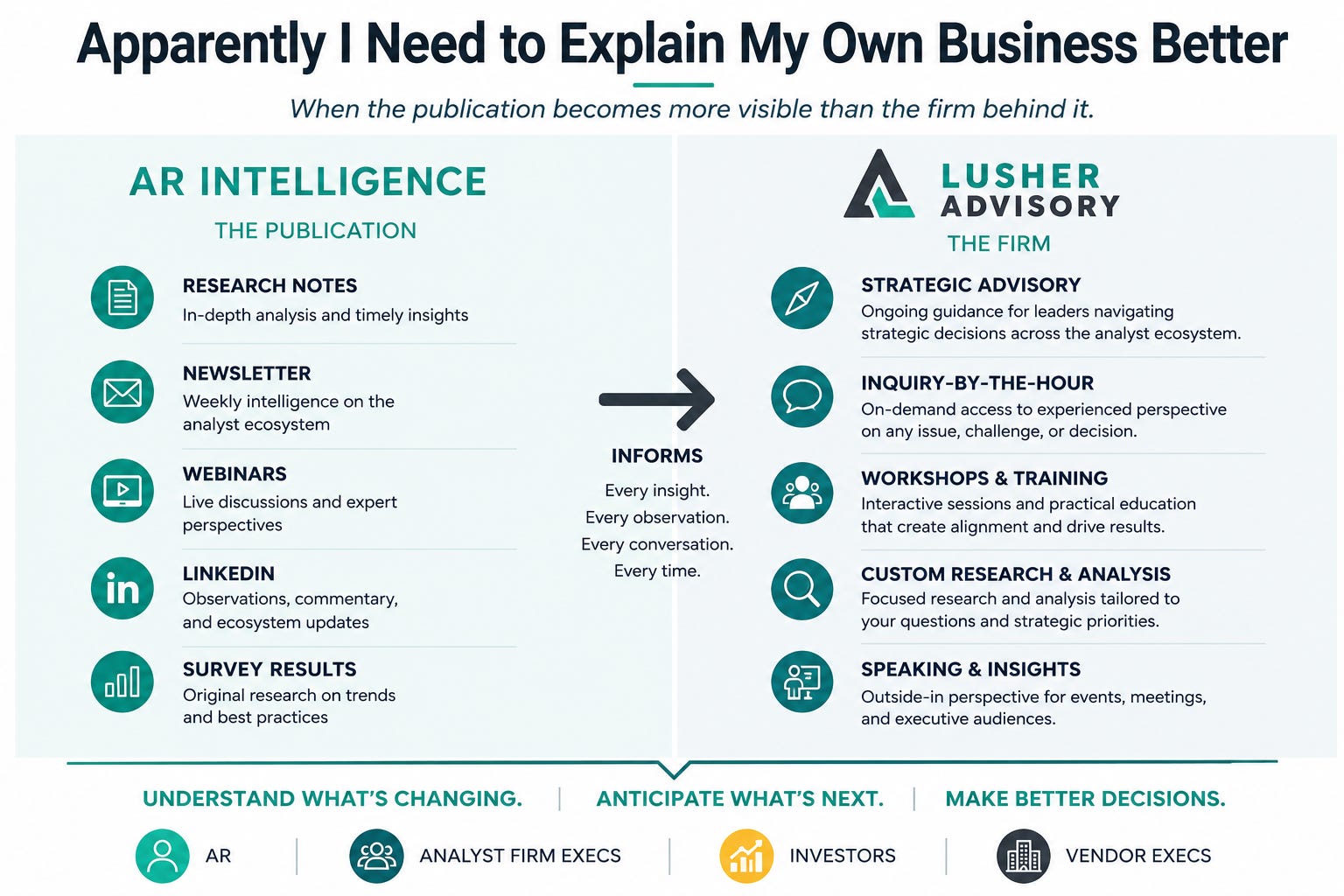
Want to discuss what this means for your analyst firm, AR program, or strategy? I’m happy to continue the conversation:
Meeting: Use this [booking link] and select “1. Discovery Call.”
Call / Text: +1 650-274-8309
Email: Sales@LusherAdvisory.com
I look forward to the conversation.
© 2026 Lusher Advisory, LLC. All Rights Reserved.
This report is copyrighted by Lusher Advisory. Unauthorized distribution or reproduction is prohibited.
Comments
Nothing yet. Say the first thing.
Sign in to join the conversation.