
Writing is easy. You just sit at your typewriter until little drops of blood appear on your forehead.1
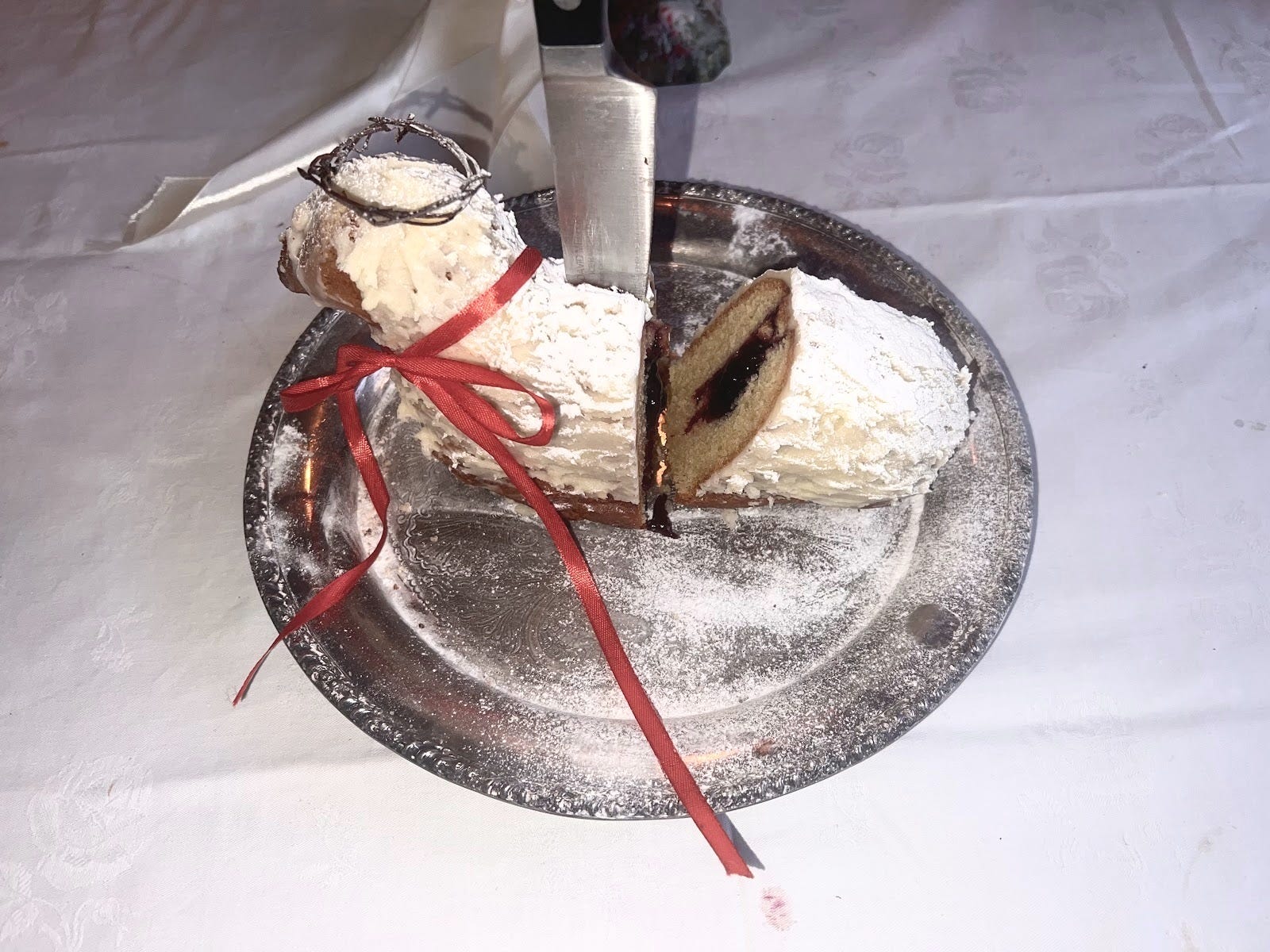
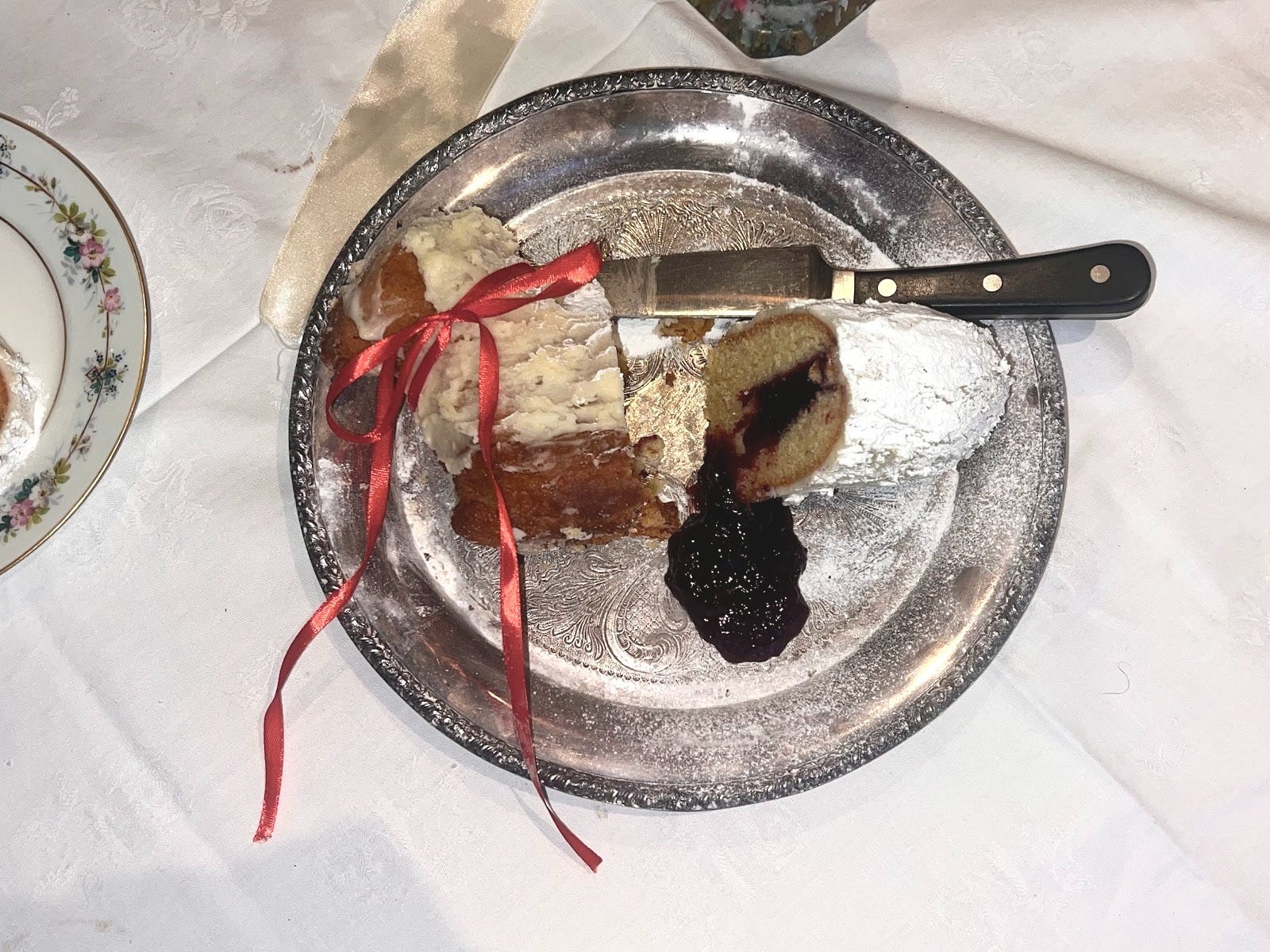
It is the day after the Resurrection and I have been thinking about stigmata. It is a bloody sort of season, where weeping feels very close to bleeding. I made a Paschal lamb-cake with a red-ribboned neck and a crown of thorns, and when I cut it it bled jam. We drank blood-orange juice from a pitcher and it resembled the Eucharist. I started my period on Good Friday.
And I have been thinking about writing as a practice of wound-making. Writing as stigmata, that which ‘stings, pierces, makes holes, separates with pinched marks and in the same movement distinguishes—re-marks—inscribes, writes’; what Hélène Cixous thinks of as the ‘stigmatext’, the ‘transfiguration of a spilling of blood, be it real or translated into a haemorrhage of the soul’.
♱ 𝕾𝖙𝖎𝖌𝖒𝖆𝖙𝖆, 𝔞 𝔡𝔢𝔣𝔦𝔫𝔦𝔱𝔦𝔬𝔫 ♱
The stigmata are a visible, lingering trace of otherness. In its early Greek usage a ‘stigma’ was a cut, tattoo or burn inscribed on the skin that would outcast the individual, branding them as a marginalised entity (slave, criminal, traitor…).
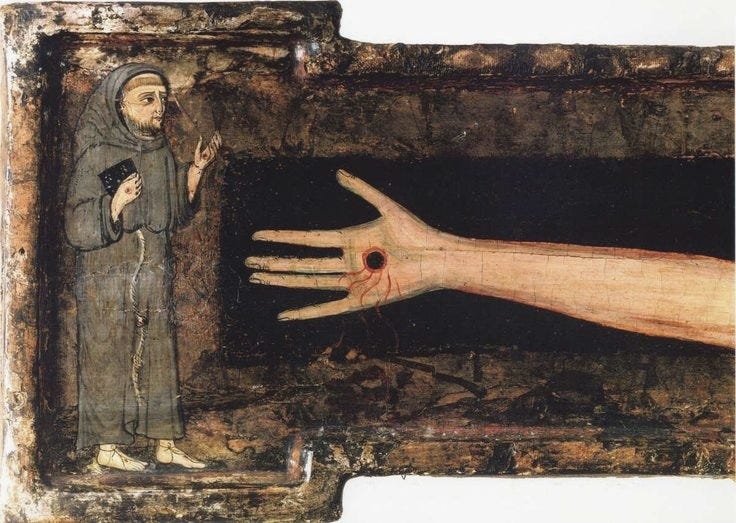
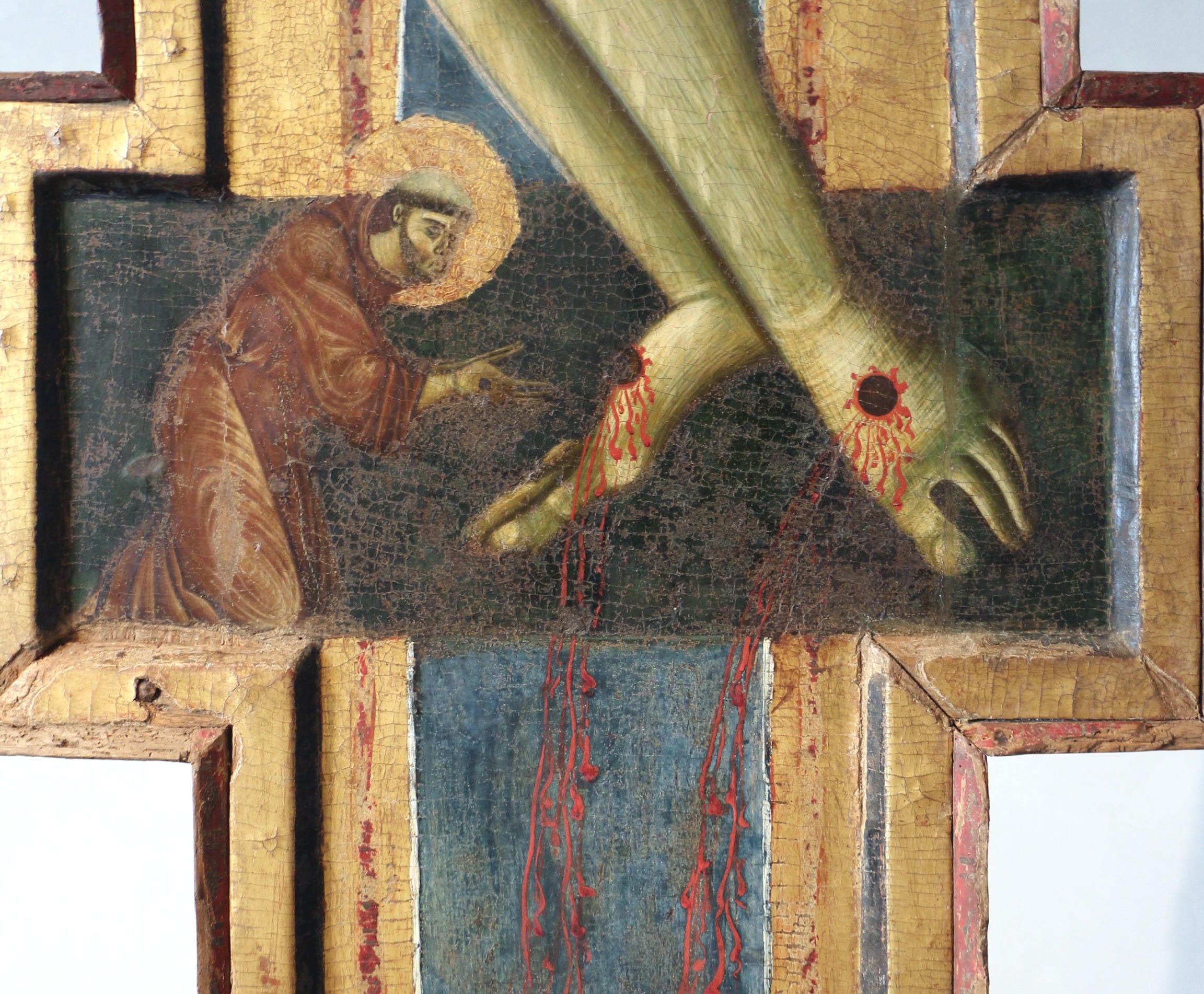
In the Christian tradition this trace is of blood; the stigmata are marks that appear on the body in miraculous correspondence to the crucifixion wounds of Christ, the Five Sacred Wounds produced by the nails piercing his hands and feet, the lance in his side, as well as the wounds from the crown of thorns, the scourging of his back.
The stigmata are themselves literally legible; the ‘book of the Cross’ was the medieval thought that one could ‘read’ salvation in Christ’s wounded body. Aemilia Lanyer, in her 1611 poem ‘Salve Deus Rex Judaeorum’ thus tells of Christ ‘Writing the Covenant with his pretious blood’,
In deepe Characters, writ with blood and teares,
Upon those blessed Everlasting scroules;
His hands, his feete, his body, and his face
This is the inversion of the ‘Word made flesh’.
♱ 𝖜𝖗𝖎𝖙𝖎𝖓𝖌-𝖆𝖘-𝕾𝖙𝖎𝖌𝖒𝖆𝖙𝖆, 𝔞 𝔪𝔢𝔱𝔞𝔭𝔥𝔬𝔯 ♱
Writing as wounding is a well-excavated theory. Hélène Cixous writes that literature is ‘scarry’, that it ‘celebrates the wound and repeats the lesion.’ Jacques Derrida likewise conceives language through metaphors of cuts, circumcisions, grafting, writes that ‘the signature of a poem, like that of any text, is a wound.’
Of course writing, as an embodied practice, yields up metaphors of bodily excretion: think of the Latin word corpus that signifies both a writer’s textual ‘body’ of work, and the biological body itself.
But the stigmatic text is not merely a bloody text, not merely a written expression of violent emotion or trauma. It cannot be the private confession of the bedroom diary, the wound tended in secrecy, because the stigmata requires the visibility of the wound (its publication) and the abjection of its bearer.
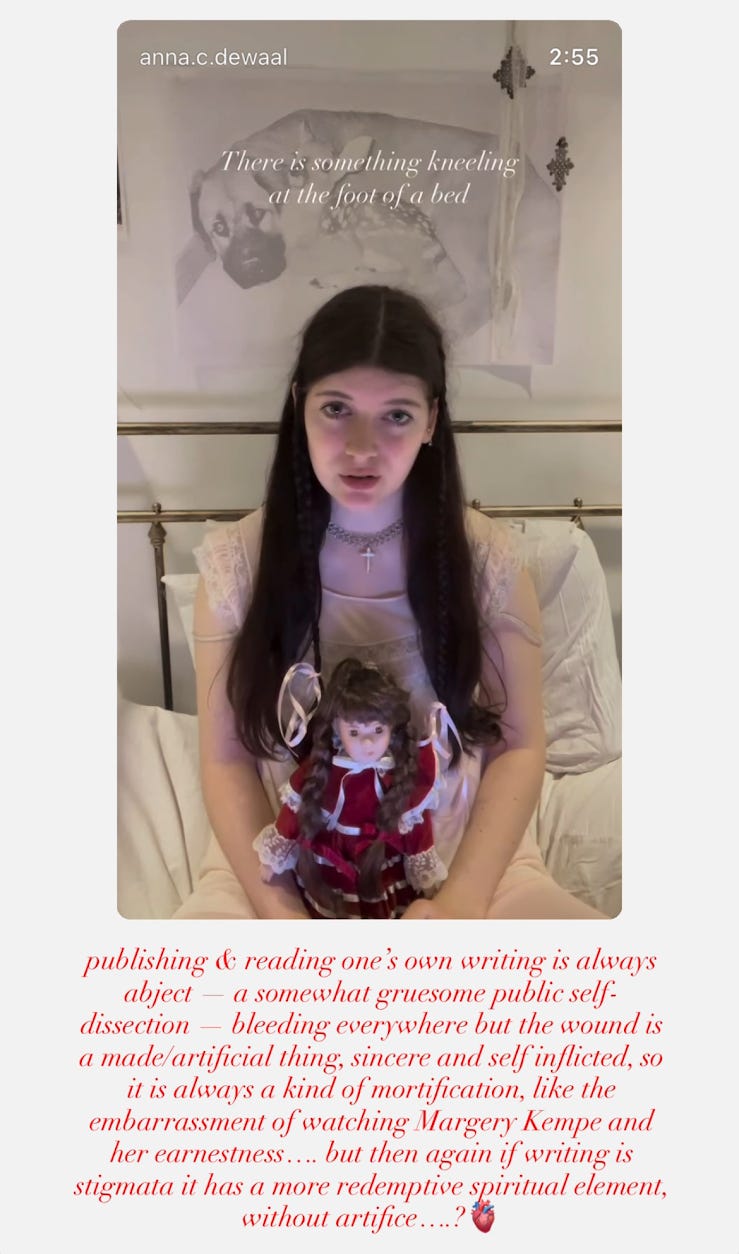
Bluntly, there is something rather embarrassing about publishing one’s own writing. It feels histrionic, narcissistic (‘did the Journal factory explode?’). Writing is the stigma that the writer bears… that there’s something wrong with you, says Rachel Cusk. I feel close to Margery Kempe, my less favourite medieval mystic, who was despised for her excessiveness of passion, the extremity and visibility of her reactions to divine revelation. Her main fault remains that of the arrogance of self-articulation; her loudness is annoying.
I sense my own writing too often emerges as viscera, play-acting the idiom of spilling your guts, a gruesome rummaging around inside my open flesh to bring out a nice tender bit of suffering for public consumption. All my writing feels too awash with fluids, like I am not really writing but leaking, an inky mixture of milk, tears, sweat, and really, mostly blood seeping out at the fingernails.
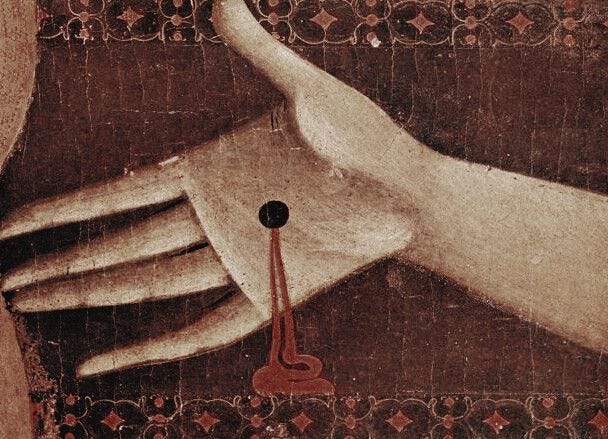
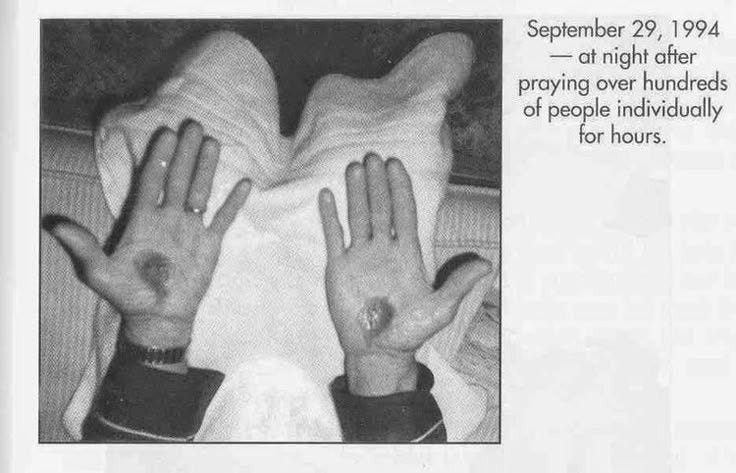
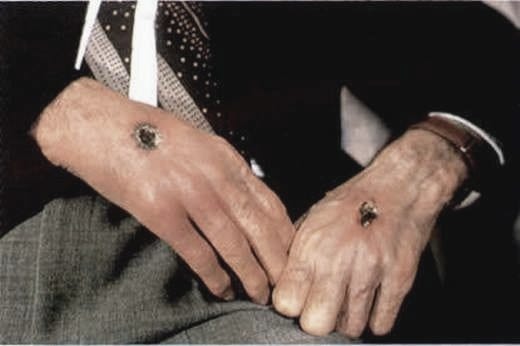
In the Christian tradition, stigmata typically appear to those of exceptional piety, posthumously elevating them into sainthood (Francis of Assisi, Catherine of Siena…). It is a redemption of stigmatisation, a sanctioning and purifying of the abject.
But the stigmata must still begin in its primitive form as the mark of degradation. Blood as blood: not the symbolic blood of Eucharist wine but the unclean and unholy overspilling of fluids, unwanted and unhygienic, getting all over your hands and staining your nice new dress.
♱ 𝕾𝖚𝖇𝖘𝖙𝖆𝖈𝖐 𝖆𝖓𝖉 𝕾𝖙𝖎𝖌𝖒𝖆𝖙𝖆 ♱
Substack, perversely, cultivates stigmatics. Because the site requires no pre-requisite for publication, no editor, no agent, no distributor, only the writer, the text amounts to an essentially raw and ragged thing. The wound is laid bare. This instancy with which one can publish a text has carved out a unique volume of writing that is confession, diary-entry, fragment of a thought or image still bleeding round the edges.2
And in the writer’s stigmata you read her sincerity, the transparency of her desire: to be witnessed, to be read and found worthy, for the wound to be validated, shared, for the reader to poke their fingers in the wound and bring them out bloody, as Thomas did with Christ’s side wound to verify the resurrection.
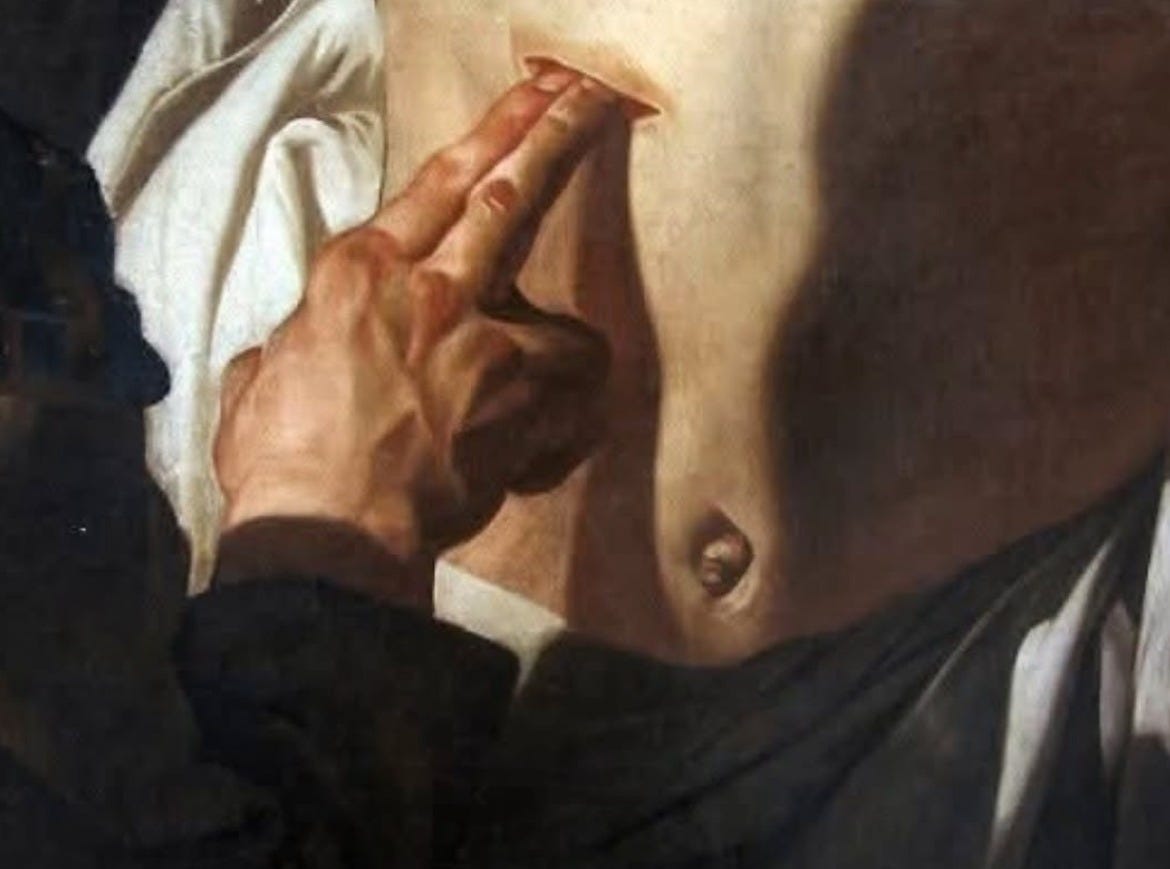
Thus the writer desires to transcend the stigmata as the mark of disgrace, and pass into veneration. Nowhere is this so visible as in the operating-theatre of the Internet. Here is the root of the odd phenomenon in which creative effort is derided as ‘cringe’ or ‘pretension’ until it passes the threshold of apparent success.
So I wonder if my writing constitutes stigmata or whether it is closer to self-mortification; a penance (self-flagellation, fasting) that also relishes morbidly in its performance. I think of those medieval women accused of falsifying the stigmata, manually cutting their palms or foreheads or feet. Imitatio Christi, an act of extreme devotional empathy that led one to replicate Christ’s pain, sincere and nonetheless contrived.
♱ 𝕾𝖙𝖎𝖌𝖒𝖆𝖙𝖆 𝖆𝖘 𝖋𝖊𝖒𝖎𝖓𝖎𝖓𝖊 𝖆𝖇𝖏𝖊𝖈𝖙𝖎𝖔𝖓 ♱
While the most revered bearers of sacred wounds are men — Saint Frances of Assisi, Christ himself — reported stigmatics have been predominantly female. The nineteenth century physician Dr. An Imbert-Goubeyre found that of his census of 321 known stigmatics, from the thirteenth century onwards, 280 were female.
I Catherine, handmaid and slave of the servants of Jesus Christ, am writing to you in His precious blood, yearning to see you a follower and lover of the truth. — Catherine of Siena, Letter 272
This makes sense; bleeding has been an exclusively feminine stigma, where the blood of girls has long been considered spiritually unclean. Male blood might speak of the valour of battle, bravery, sacrifice. Female blood can only represent shame.
Bleeding in secret is the appropriate, feminine thing to do — menstruation is the most literal stigma, requiring disguise and denial, the terror of its visibility. It is the emblem of fertility, the preparation of the maiden for sex and therefore Sin. When Stephen King’s Carrie has her first period, her mother forces her to pray: O Lord … Show her that if she had remained sinless the Curse of Blood never would have come on her.
Indeed, menstruation might be read as an explitising of female genitalia as itself stigmatic, where the c*nt has long been figured as a ‘wound’, ‘gash’, or, crudely, ‘hole’.
So the female wound should be kept to herself; to announce it is an abjection. It is to dwell in your own degradation. The female stigmatic was, accordingly, often made out as an lunatic, heretic, or fraud by the Church. Such was the case with the female writer, who bore visible stigma by intrinsic virtue of her sex and perceived transgression into the male sphere of writing.
But stigmata is the double-edged sword. While it shames, it also sanctifies.
The resemblance of the iconography of Christ’s side wound to the vulva has been observed both in and outside of scholarship: ‘The Wound of Christ, the Mouth of Hell: Appropriations and Inversions of Female Anatomy in the Later Middle Ages’ by Martha Easton (2006); Jesus through Medieval Eyes by Grace Hammon (2023); ‘Christ’s Birthing Body’; ‘Did Christ Have a Vagina?.
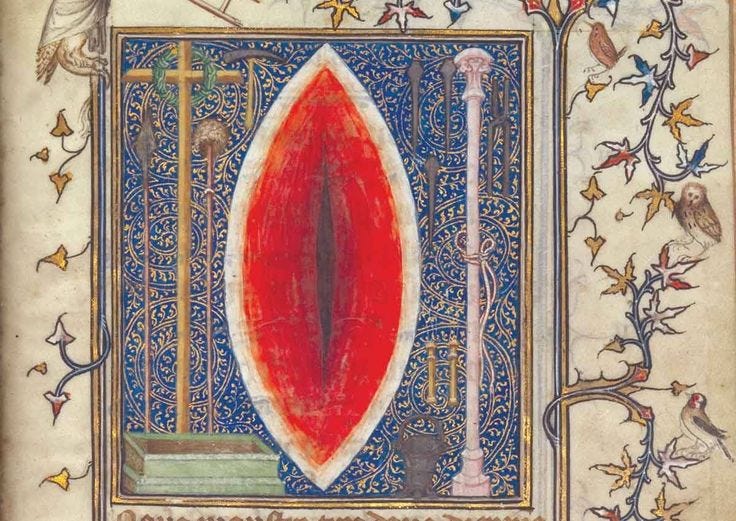
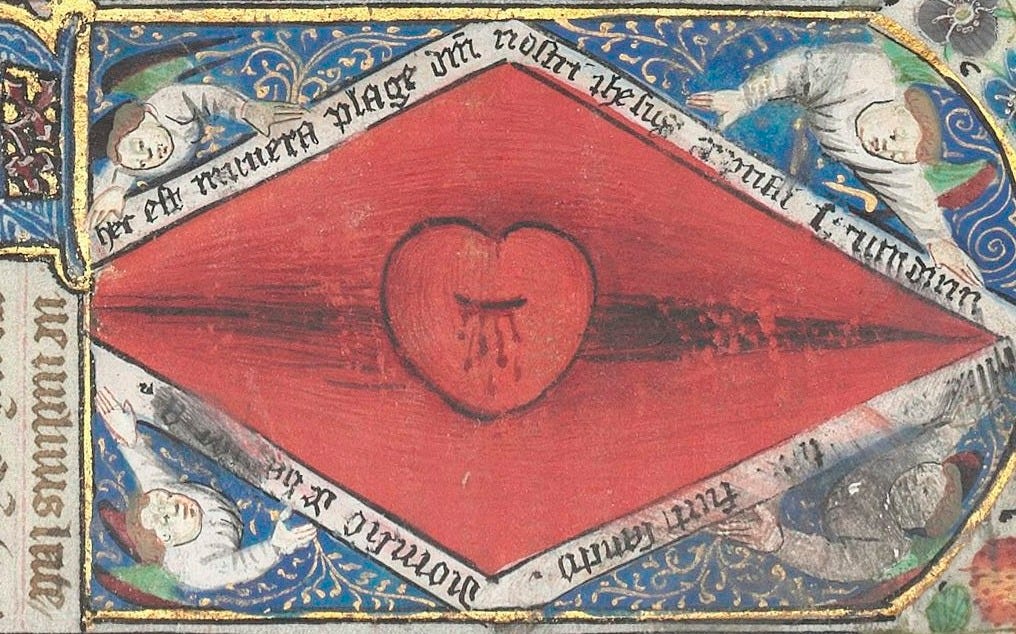
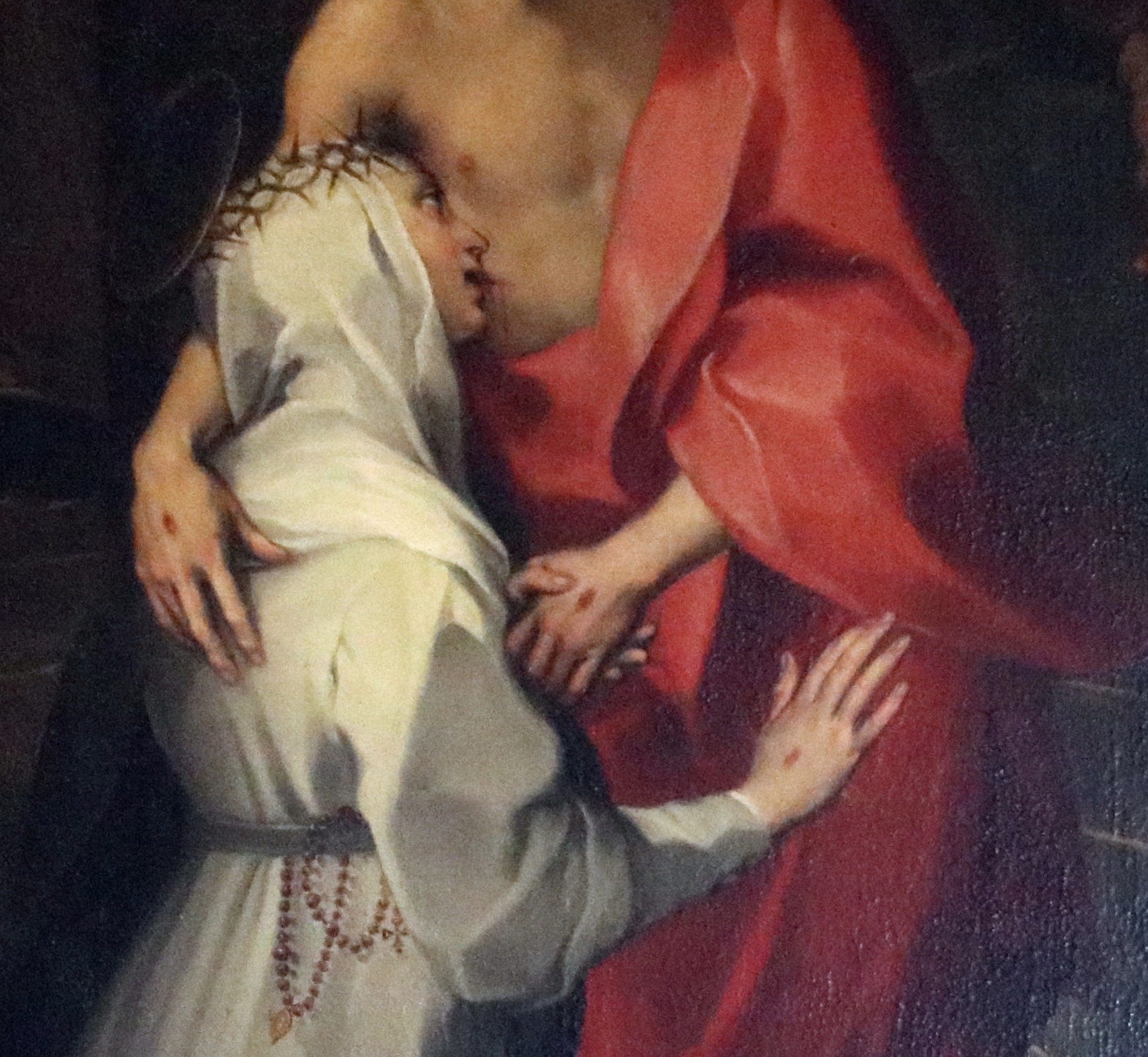
Like the c*nt, the original stigmata are literally life-giving wounds, where Christ’s death is also the birthing of the Church and the deliverance of humanity. Aemilia Lanyer, like Julian of Norwich before her, figures Christ as a Mother, humanity suckling salvation from the wound at his side like milk from a mother’s breast: Sweet milke, wherewith we weaklings are restored,/Who drinkes thereof.3 Catherine of Siena experiences this very mystical vision, and is depicted thus with her stigmata as she drinks from Christ’s breast.
The wound as a sign of ‘fertilization’ and ‘germination’ is also essential to both Cixous and Derrida’s theory of the literary stigmata. In the cavity resurrection is hatched. What is dead and what will live share the same bed, Cixous writes. Tomb-cradle: another definition of Stigma.
A year ago I wrote an essay-confession called ‘my heart is a wound’. It was about victimhood and the aesthetics of girlish bloodiness. I asked a friend to read it and she warned me not to publish it, that it was dangerous, it would not close the wound but perpetuate it, mark me publicly — that it would stigmatise me. It remains unpublished.
The text began: I try and write about my heart, which is a wound, which cannot be sewn up. It keeps bleeding through my white dress. The ribbons start to look like guts. It is a terrible inconvenience, I say, and it won’t stop. It hears me, and responds with more blood.
At what point does the writer’s stigmata become holy and not just unclean? At what point can I publish my wound and not be branded with the mark of the undesirable other? Catherine of Siena’s stigmata were not visible in her lifetime, only verified after her death.
To write the wound is to dwell in it. It can feel necessary as a kind of bloodletting, an expunging of suffering, as in the Renaissance medicinal practice of regulating the humoural body.4 But it is also a masochism, an indulgence, this making and keeping-open of the wound. I return to Cixous and she is like me, or I am like her: I want stigmata. I do not want the stigmata to disappear. I am attached to my engravings, to the stings in my flesh and my mental parchment.
And, because by this time I am trailing devotedly, desperately in the wake of Cixous and her writings, I reread her essay ‘The Laugh of the Medusa’. I come to the line I learned by heart in my first year studying literature, and I weep and again it feels a little like bleeding, just one bead of blood at the corner of the eye, and it trails onto the page.
By writing her self, woman will return to the body which has been more than confiscated from her, which has been turned into the uncanny stranger on display.
— Hélène Cixous, ‘The Laugh of the Medusa’
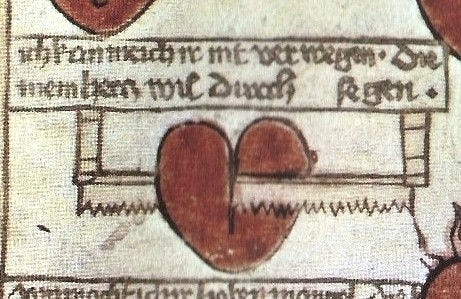
My heart is a wound, I wrote a year ago. I drag my heart around on a leash behind me. It hurt too much in my chest so I took it out. Now it blackens on the concrete. I secretly hope it does me a favour and dies in the night, and when it does I will eat it for my supper because I no longer have another use for it. See; it is a bad metaphor. All the good writing about the heart has been used up on romance.
Some day I will publish the whole thing. In the meantime, thank you for reading my bloody words, thank you for being gentle with my wounds. ꨄ
𝔄𝔫𝔫𝔞 𝔊𝔦𝔰𝔢𝔩𝔩𝔢 𝔡𝔢 𝔚𝔞𝔞𝔩
@anna.c.dewaal & @lunulae.archive
NB. For reference or a summary, the requisites of the stigmata, to be distinguished from the ordinary wound, might include:
♱ the wound as a non-neutral mark, signalling otherness or marginalisation: a stigmatising trace.
♱ a legibility of the wound; the wound as ‘hieroglyphic’, semiotic, and therefore semantically fertile.
♱ mired in the question of ‘authenticity’ — is the stigmata spiritually bestowed, unasked for and therefore a thing of ‘purity’, or has it been falsified, the wound contrived or self-inflicted? does it matter?
♱ inflected by the gendered iconographies of fluids, where menstruation is the most literal realisation of stigmatised blood.
A variation of a popular aphorism, commonly attributed to a number of writers including Ernest Hemingway.
(following from more anonymous digital spaces like Tumblr)
The beginning of Lanyer’s poem is also a wonderful, radical repositioning of the patriarchal Church:
Sauiour Iesus Christ, without the assistance of man,
beeing free from originall and all other sinnes, from the time
of his conception, till the houre of his death, to be begotten of a
woman, borne of a woman, nourished of a woman, obedient to a
woman; and that he healed woman, pardoned women, comfor-
ted women: yea, euen when he was in his greatest agonie and
bloodie sweat, going to be crucified, and also in the last houre
of his death, tooke care to dispose of a woman: after his resur-
rection, appeared first to a woman, sent a woman to declare his
most glorious resurrection to the rest of his Disciples
The 16th century poet Mary Sidney elegises her brother using the metaphor of writing in the ink of her own blood: ‘theise dearest offrings of my hart/dissolv’d to Inke, while penns impression move/the bleeding veines of never dying love:/I render here: these wounding lynes’. This resembles the early modern practice of bloodletting as a regulation of the humoural excesses, to remedy impious excesses of grief or lovesickness. The bloodiness of poetry is figured as medicinal.
This kind of bleeding is self-implemented — writing appears both as a somewhat gruesome, obscene resort and a necessary, clinical practice in order to survive. If you do not write, the black bile will accrete and seize the chambers of your body. If you do not write you will suffer, you might die.
Comments
Nothing yet. Say the first thing.
Sign in to join the conversation.