
In the dark times
Will there also be singing?
Yes, there will also be singing
About the dark times.
♱ Bertolt Brecht, motto to Svendborg Poems, 1939, trans. John Willett
Brecht, arriving in Hollywood as an exile in 1941, wrote that ‘to write poetry here, even topical poetry, amounts to withdrawing into the ivory tower. […] There is something quaint, eccentric, closed-off about it.’ It is hard to refute. How perverse it seems to dwell in poetry! how useless, how spoiled!
And it is easy to write bad poetry; I have written plenty of it. The decorative sentence disguised as verse, poetry that gleams prettily, pearl-white, sounding of nothing. Poetry as the ornaments of the leisured class, obsolete and apolitical. Louis MacNeice thus pleads ‘for impure poetry’; poetry born not of an immaculate, hermetic conception from the ivory tower but ‘poetry conditioned by the poet’s life and the world around him’.
But I am not sure I really believe in a truly ‘pure’ poem anyway. Even by virtue of its medium, every poem is fundamentally mired in the shared, living economy of the human language. The poem, an essentially fissured and occluded artform, is even at its very simplest built of a network that itself is riddled with ‘fracture and lapses’. Poetry is, in this sense, innately concerned with translation.
♱ Octavio Quintanilla, ‘Poem in which the Violence Occurs Backstage’, co-translated with Natalie Trevino:
I have no news.
I no longer believe what the meadows say.
The wheat fields are silent.
They quiet what they witnessed.
The wild bulls swallow their tongues because they can no longer say, “Justice.”
Every morning I wake touching my face.
Want to feel it wet with light again.
Make sure they have not taken it.
This is the marrow of the library of sanctuary: a collection of two hundred books by poets and translators who have made a home in the US with roots elsewhere, or whose cultural identity has been inflected by displacement and dispossession. It follows on from the library of exile (first exhibited in Venice, 2019), and is installed in The Huntington, Los Angeles where it will remain until this October. This is the full reading list; every poem in this essay but two (by Paul Celan) are by poets in the library.
♱ Note: my previous poetry archives, with many excerpts taken from the library of sanctuary as I was making it, may be found here: archives I, II and III. Please also find my fuller commonplace of Palestinian poetry here… and refer to Exiled Writers Ink and the Poetry Translation Centre for further resources… ♱
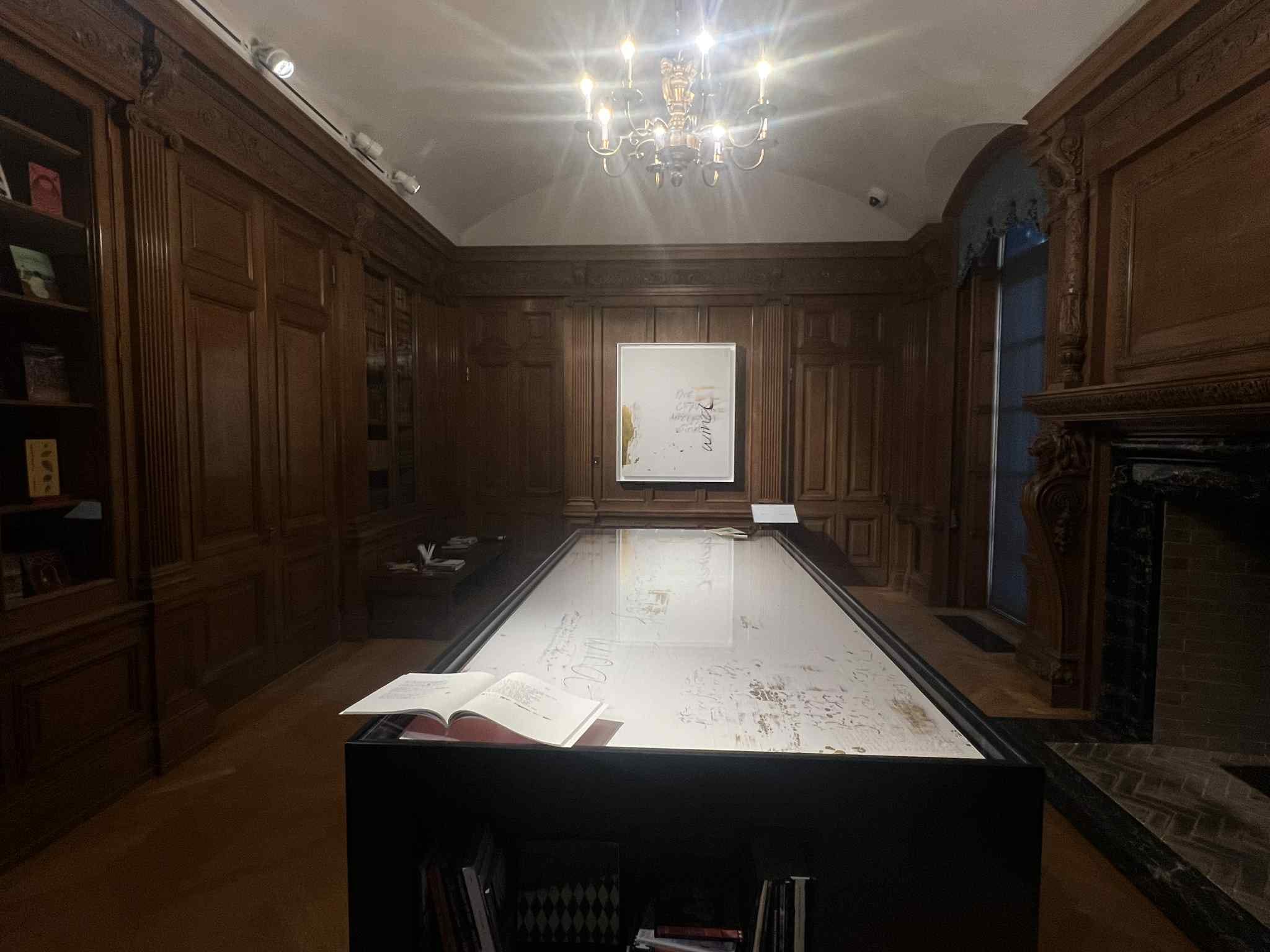
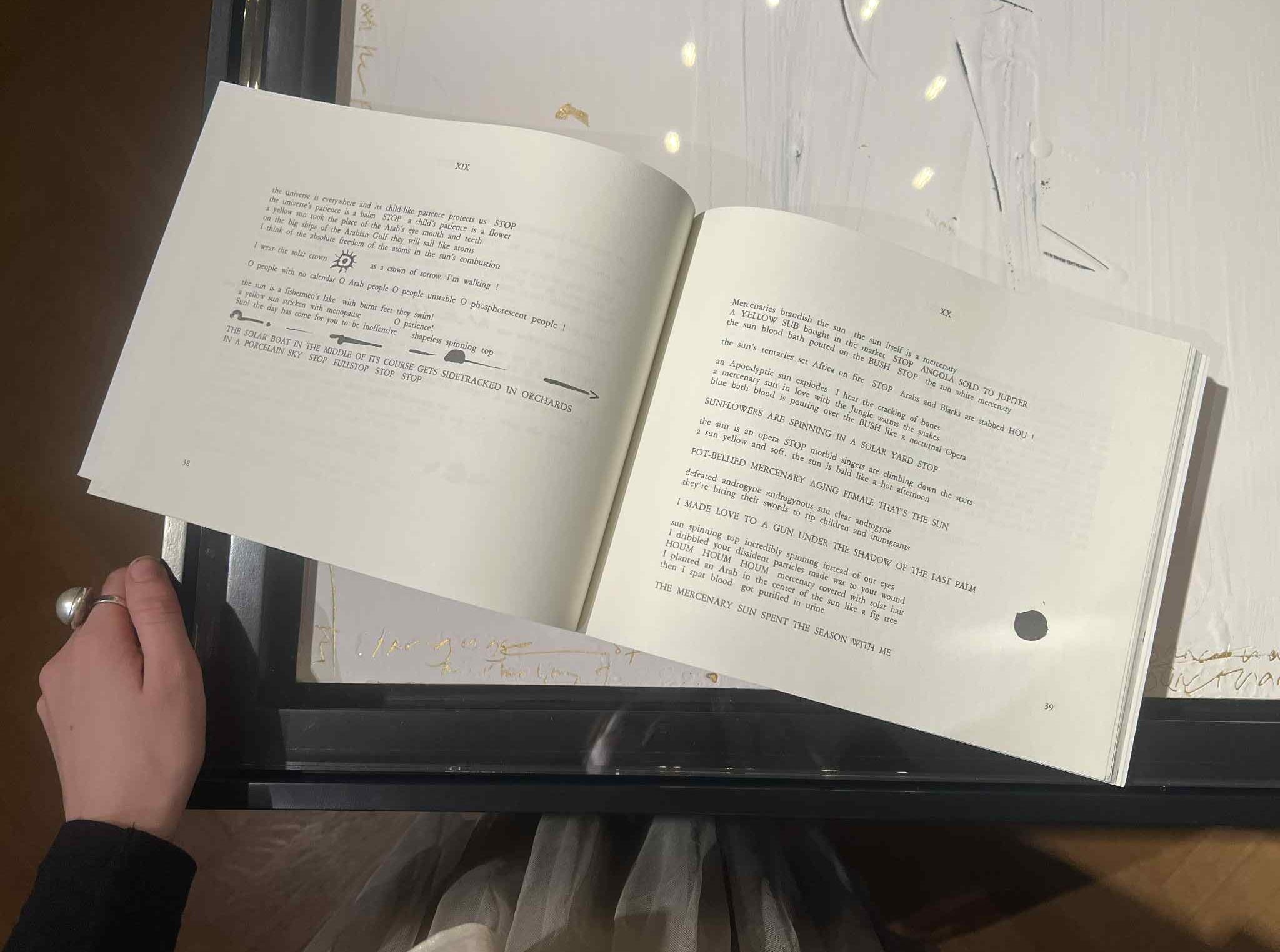
Poetry is an essentially fissured and occluded artform. Fissured because the singular aspect that appears to distinguish between poetry and prose is delineation — the severing and stranding of a line on the page. A poem is, visually, a series of fragments.
And it is occluded because a poem that is utterly transparent, hiding nothing, is not a poem; it is prose. Even something as apparently ‘pure’ as a sonnet is riddled with devices — rhyme, simile, scansion — that asks to be deciphered. Even the Imagists, who sought to crystallise poetic form into a singular, perfect image, the clarity of which seems to announce its transparency of meaning — even their poems are contraptions. They too perplex for that exact same reason.1
All poetry requires the labour of translation. It is why poetry feels so othering to so many. And at one level, this translation must always must fail; translation will always maintain a gap, a separation between the language of the writer and that of the reader.2 Language is ultimately a product of our private, individual consciousness, limited to the borderlands of our interior perceptions.
♱ Kaveh Akbar, from ‘My Father’s Accent’, from Pilgrim Bell:
My father’s white undershirt peeking out
through his collar. My father’s hand slicing skin, gristle,
from a chicken carcass I hold still against the cutting board.Sometimes he bites his bottom lip to suppress
what must be
rage. It must be ragebecause it makes no sound. My vast
terror at what I can’t hear,at my ignorance, is untranslatable.
My father speaks perfect English.
So poetry is a praxis of translation. And if poetry is in itself a translatory activity, it naturally accommodates a secondary form of translation; between geographical languages (German to English to Korean...). A poem read in translation, is, following Mireille Gansel’s Translation as Transhumance, language ‘in exile’, ‘language without a home.’ Within a poem there is often a latent reciprocity between form and theme; a poem might, therefore, be most itself when it is restless, in limine, between homelands.
I think of the poet Paul Celan, the Romanian, German-speaking Jew whose family were murdered in the Shoah. He constructs his own painful, redemptive language out of German, the language of his oppressors. He cleaves words in two and restitches them in a ragged kind of mending, and in doing so makes a language that can bear visible witness to its own violent inheritances: Atemwende (breathturn), Fadensonnen (threadsuns), Lichtzwang (lightduress)...
♱ Paul Celan, untitled, trans. Pierre Joris:
No name, that would name:
its consonance
knots us under the
in song to be stiffened
Lighttent.
♱ Paul Celan, ‘Threadsuns’, trans. Pierre Joris:
Threadsuns
above the grayblack wastes.
A tree–
high thought
grasps the light-tone: there are
still songs to sing beyond
mankind.
I think of Samuel Becket writing that ‘More and more my own language seems to me as a veil, to be torn apart to approach the things (or the nothings) behind it […] A time, let’s hope, is coming when language will be best used when best abused’.
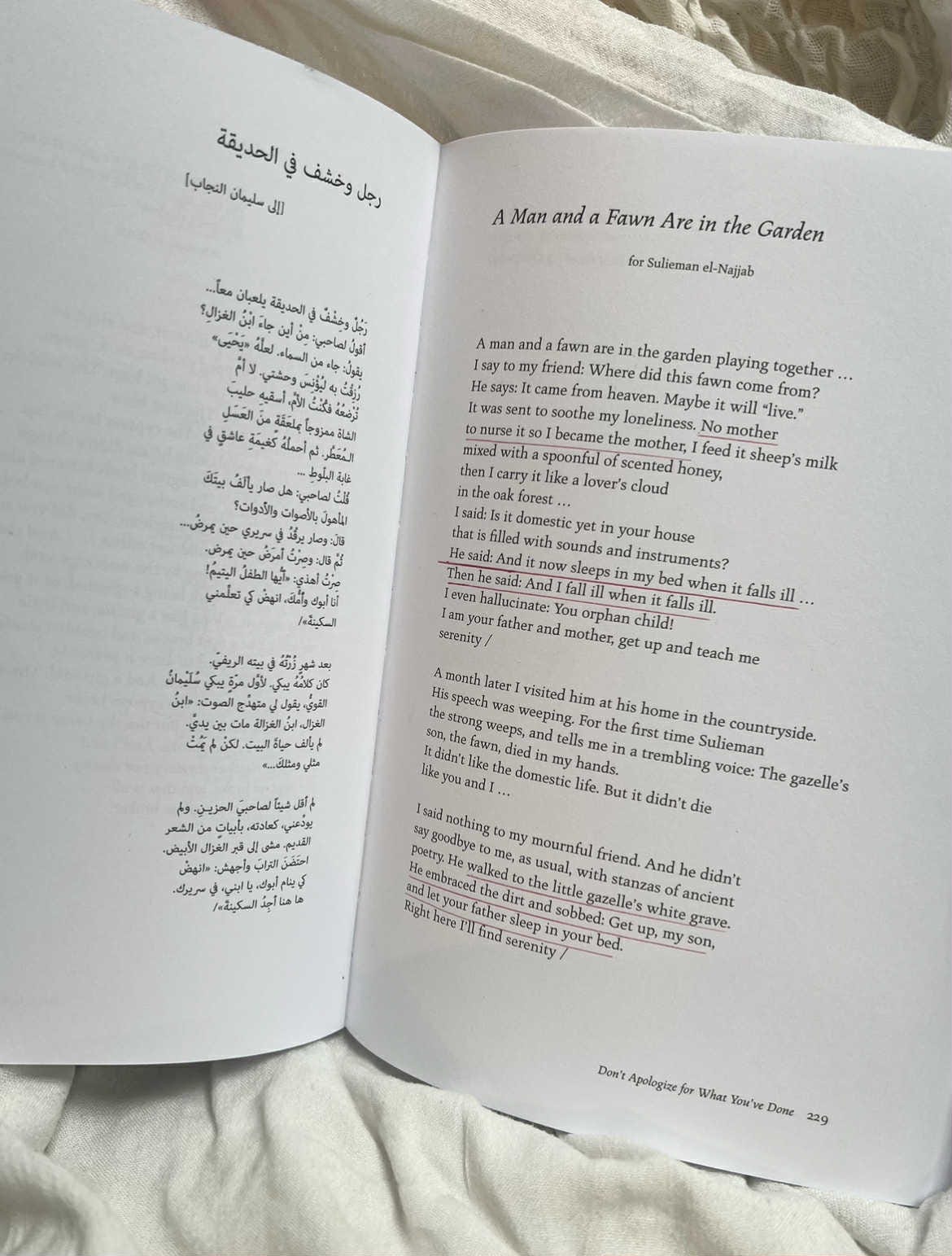
♱ Mahmoud Darwish, from ‘A Man and Fawn Are in the Garden’, trans. Fady Joudah
How do you speak about suffering? How do you write about the violence of exile and the violation of asylum? How do you wake into a burning world, open your mouth and articulate anything true that isn’t just frayed to non-verbal sound — what could ever be as eloquent as the wail or the scream?
I think you must begin at the thresholds of language. This is the strange heart of Tragedy, where pain, incoherent and monumental, is somehow forged into aesthetic artefact. The soliloquy and the howl, howl, howl of King Lear. You must begin with that form that is essentially veiled, full of fracture and lapses, noise against the silence of the white page — you must begin with poetry. This is my supplication to you.
♱
Poetry is dogged by suspicion — that it is contrivedly reserved for the elite, and is performing obliqueness in order to sustain a false superiority. Or that it is an accessory of leisure, saccharine and removed from the grit of reality. And these complaints are not entirely without merit.
But there will also be singing / About the dark times. Remember that poetry is one of the very earliest and most communal artforms. That it first arrived through singing — singing of loss, of destruction, of joy — the hymn, lament, epic, marriage-lyric, dirge. The first line of the Iliad is the imperative to sing of Rage—Goddess, sing the rage of Peleus’ son Achilles…
Poetry seems to me to be a struggling against the bounds of what cannot be said through natural vernacular, that which forces you to test other ways of expressing it because the thing inside you is too terrible to keep inside you — it demands out, it demands to make itself understood. Poetry is a kind of desperation.
So I think also of David Drake, the enslaved 18th century potter in Edgefield, South Carolina who inscribed lines of verse into his pots when literacy was illegal, and signed them with his name: I made this out of number, & cross ‘ ‘ / if you do not lisen at the bible you’ll be lost.
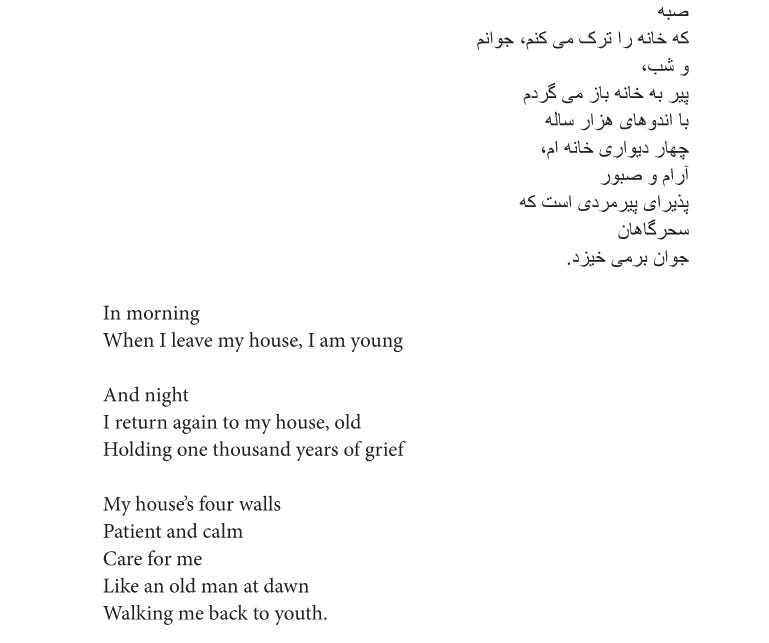
♱ Abbas Kiarostami, untitled, trans. by Kaveh Akbar and Arman Salem:
The library of sanctuary is a library of American diasporic poets. But across from America is a sickness here in the English soil. It is a sickness because it has no wit, no cleverness. It is simply the breeding of a stupid cruelty, trailing doggedly at the heels of its sibling. It is familiar and intolerable.
I am as white as the English rose. I have lived here all of my life. And I am only here because England provided sanctuary for my grandfather when he came here fleeing Nazi persecution as a boy.
My father wrote a family memoir when I was nine and so I have inherited a public and painfully detailed history of the dispossession and displacement of my Jewish, Viennese family. I know that my great-great grandfather read Ovid’s poems of exile, Tristia, after his library was confiscated. I know what the deportation cards of my Parisian cousins look like. I know that my grandfather was ten when he came here and was ninety five when he was restituted his Austrian citizenship, just a couple of years ago.
I am saying this not because I want to claim any kind of stake on suffering, or entitlement to stories that are not mine. I just want to make my anger explicit.
And out of all of this is my fervent appeal: we must read poetry. Not in spite of but because we are faced, always, every day, with the violent efforts to dehumanise and alienate, because poetry offers a means by which we may listen and attend to and try and make sense of our baffling, improbable, shared humanness.
So here is a very partial offering of three poems from the library of sanctuary. They all speak of language, naming, singing:
♱ Zakaria Mohammed, ‘7-24-2019’, trans. Lena Khalaf Tuffaha
I have eulogized the dead my entire life, and this has exhausted me.
When you spend a lifetime singing of the slain, you will be slain as well without knowing how.
You become a victim singing a victim, a dead man embalming a dead man and burying him.
From this day forward, I will not sing of the slain. I’ll sing of the killers.
I’ll sing their shiny daggers, and their hands that do not tremble.
I’ll sing their intuition that leads them to those who emerge from their mothers’ wombs as dead men.
The slain love their executions.
I ask you: how did the white heron turn into stone?
How did he sleep in the rock forever?
He kept on eating stones his whole life.
And I ask you: How did the dead man become a dead man?
For his entire life, he kept eating from the plate of death and searching for a killer to slay him.
♱ Etel Adnan, from In the Heart of the Heart of Another Country:
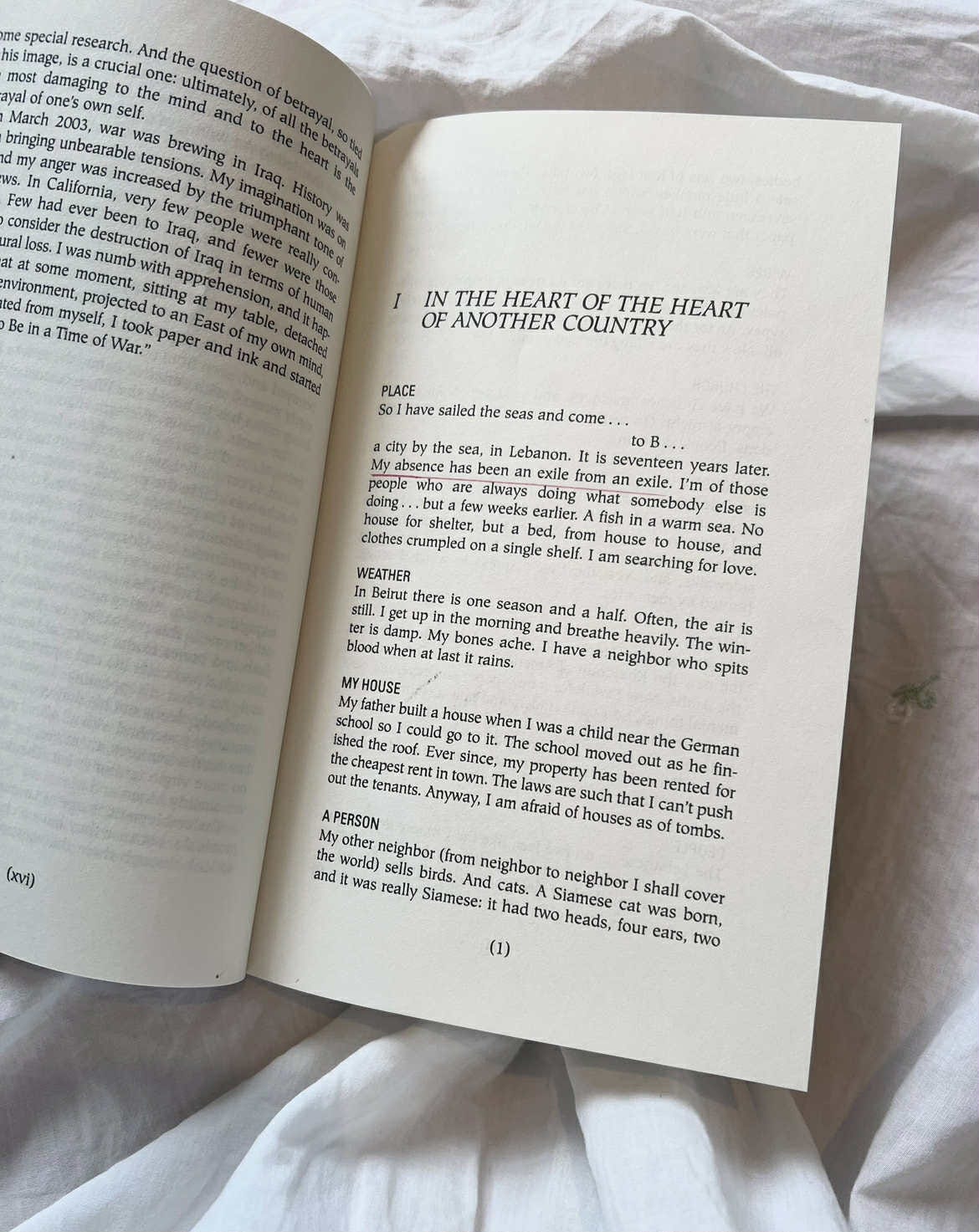
♱ Solmaz Sharif, ‘The End of Exile:
As the dead, so I come
to the city I am of.
Am without.To watch play out around me
as theater —audience as the dead are audience
to the life that is not mine.
Is as not
as never.Turning down Shiraz’s streets
it turns out to be sucha faraway thing.
A without which
I have learned to be.From bed, I hear a man in the alley
selling something, no longer by mule and holler
but by bullhorn and jalopy.How to say what he is selling —
it is no thing
this language thought worth naming.
No thing I have used before.It is his
life I don’t see daily.
Not theater. Not play.Though I remain only audience.
It is a thing he must sell daily
and every day he peddlesthis thing: a without which
I cannot name.
Without which is my life.
𓆸 𝔄𝔫𝔫𝔞 𝔊𝔦𝔰𝔢𝔩𝔩𝔢 𝔡𝔢 𝔚𝔞𝔞𝔩 𓆸
@anna.c.dewaal & @lunulae.archive
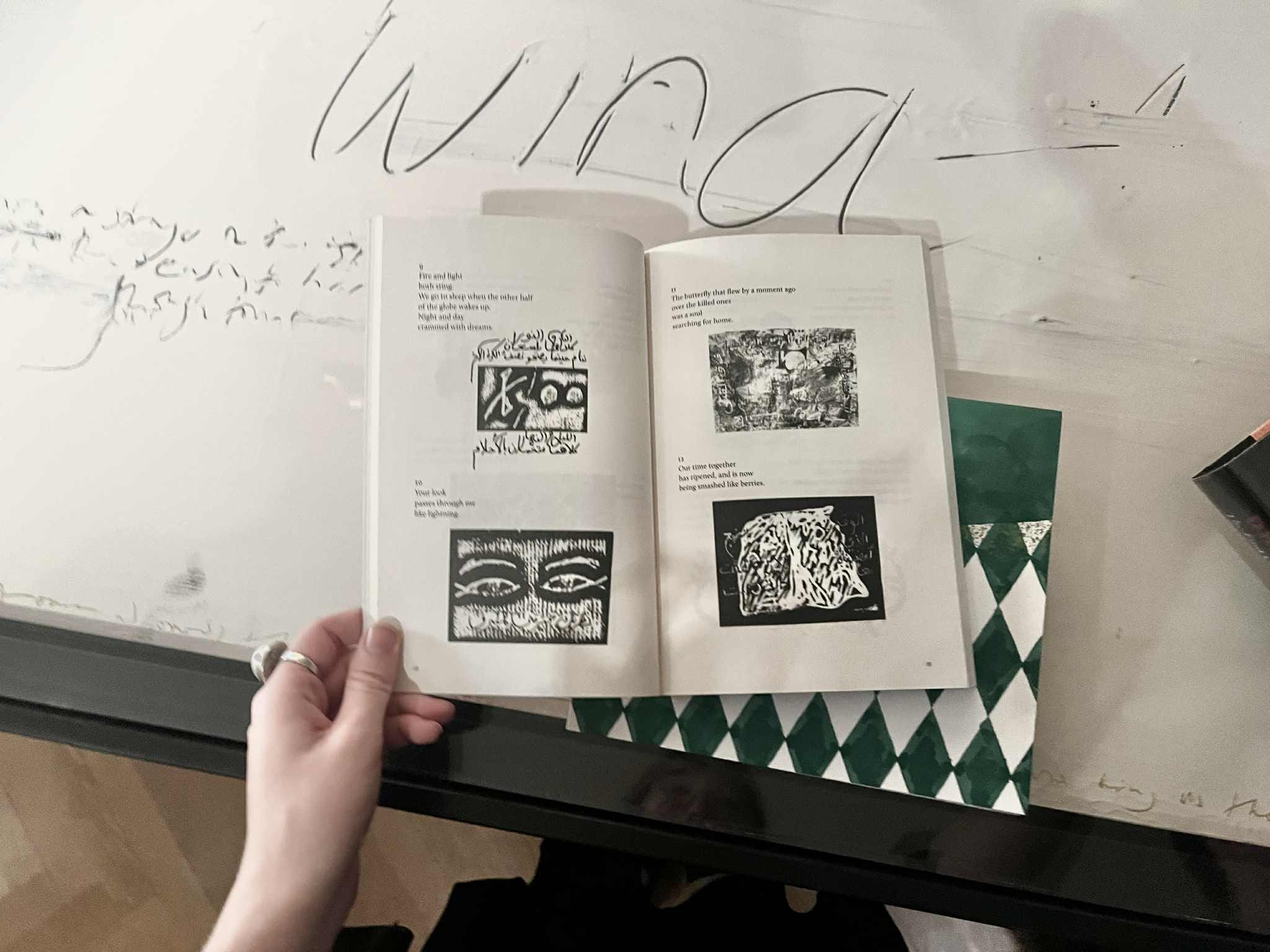
The poetic register deals in defamiliarisation, in the device of the metaphor that transfigures the normative, teases out revelation through linguistic trickery.
The poet seeks to translate something at the borderlands of private perception, qualia, into something externally legible. And then the reader must work to unravel the poem — translate it into the lexis of their own experience. Forgive me; I am generalising.
Comments
Nothing yet. Say the first thing.
Sign in to join the conversation.