
I want to start with a personal story.
A family member, never-smoker, 30s, went to see their doctor for shortness of breath. She got slowly short of breath over a few months. Her doctor initially reassured her. Said she was out of shape and needed to start working out again. Came back with a diagnosis that did not make sense to anyone who knew them.
Large pleural effusion. Workup showed stage 4 lung cancer. Adenocarcinoma. EGFR-positive.
They’re doing better now. But a pleural effusion that size doesn’t appear overnight. This cancer had been growing for a while. Nobody thought to look because nobody expects lung cancer in a young never-smoker.
I also see another version of this story in my clinic.
A never-smoker goes for a coronary CT scan, which incidentally finds a lung nodule. Biopsy comes back as stage 1 lung cancer. Also adenocarcinoma. Usually EGFR-positive. Surgical resection. Considered cured and doing well.
Two never-smokers. Two lung cancers that are adenocarcinomas. One found late because no one thought to look. One found early and incidentally on imaging done for the heart.
Neither of them are offered lung cancer screening. The difference between their outcomes is luck. And a gap in medicine for never-smokers at risk for lung cancer.
That’s what this article is about.
In previous articles, I covered why early lung cancers often don’t have symptoms and what stage 1 vs stage 4 lung cancer means in terms of prognosis & treatment.
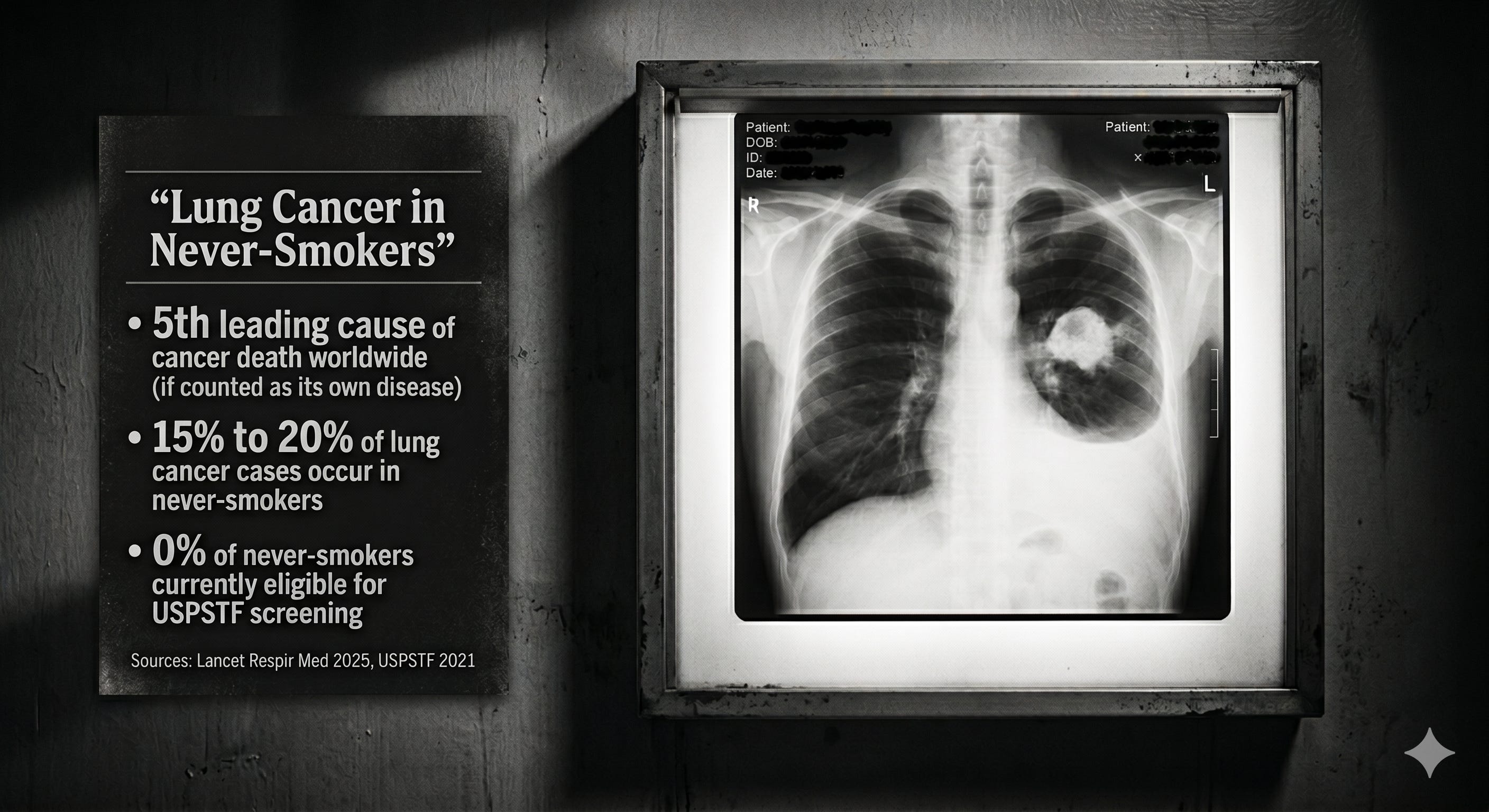
Lung cancer in never-smokers (LCINS) is not a footnote to lung cancer in smokers. It’s a biologically distinct cancer with different driver mutations, different epidemiology, different demographics, and different treatment implications.
Lung cancer in never-smokers would rank as the 5th leading cause of cancer death worldwide if it were counted separately, according to a 2025 analysis in Lancet Respiratory Medicine.
It accounts for 15% to 20% of lung cancer cases globally.
It disproportionately affects women.
It disproportionately affects people of Asian descent.
And it is not screened for by current major guidelines.
Not missed due to oversight. Excluded. Because the screening criteria are built entirely around smoking history.
Here’s the biology that matters for patients. Lung cancer in never-smokers is dominated by adenocarcinoma. It carries targetable driver mutations. EGFR in approximately 50 to 60% of East Asian never-smokers with adenocarcinoma, compared to roughly 10 to 15% in smokers. ALK and ROS1 rearrangements at higher rates. These aren’t incidental details. They change how the disease is treated. A never-smoker with EGFR-mutant adenocarcinoma responds to osimertinib in a way a smoker’s lung cancer may not. The disease is different. The treatment is different. Yet screening recommendations don't acknowledge either.
The U.S. Preventive Services Task Force (USPSTF) recommends annual low-dose CT for lung cancer screening for adults ages 50 to 80 who have a 20-pack-year smoking history (and currently smoke or quit within the past 15 years). These guidelines became the international standard which is why most screening programs still exclude never-smokers.
Lung cancer screening criteria and pack years calculation can be confusing- I cover these more in depth in the article here.
That screening recommendation was designed for the cohort that benefited most in the National Lung Screening Trial (NLST)- long-term heavy smokers. The NLST showed a 20% reduction in lung cancer mortality. The NELSON trial in Europe showed approximately 24 to 25% mortality reduction, with even larger reductions in women. These are real numbers, and the screening recommendations that followed are evidence-based.
The problem with LCINS is not who the guideline includes. It’s who it excludes.
A 54-year-old woman who was born in Taiwan, has never smoked, has a mother who died of lung cancer, and spent 20 years cooking over a gas stove in a small apartment does not qualify for screening. She is not in the risk categories the USPSTF screening was designed to address. She will not be offered a screening CT scan despite being high risk for developing lung cancer.
For EGFR-mutant adenocarcinoma specifically, five-year survival after curative surgical resection at stage 1A can exceed 90%. A large pleural effusion found late is a very different clinical situation. Stage 4 lung cancer at diagnosis has a five-year survival of 10-15%.
And for a never-smoker, finding it early usually requires luck. A chest CT done for another reason that happens to catch it.
In July 2022, Taiwan became the first country in the world to formally offer lung cancer screening to never-smokers with risk factors. The foundational study was called TALENT (Taiwan Lung Cancer Screening in Never-Smoker Trial).
TALENT screened 12,011 never-smokers with at least one risk factor. Detection rate was 2.1%. To put that in context the NLST detection rate in heavy smokers was 1.1%. It’s worth noting that TALENT enrolled never-smokers with at least one risk factor, not all never-smokers, which means this was a selected higher-risk population. Still, the detection rate in that selected group substantially exceeded the NLST benchmark.
Among patients with invasive lung cancer detected in the TALENT study, 96.5% were at stage I. A significant additional fraction of the total detection were stage 0 lesions. Adenocarcinoma-in-situ (AIS) are cancers so early that they grow along the surface of lungs without invading surrounding tissue. Cure rates for AIS after surgery are virtually 100%. An important caveat, which the TALENT study authors acknowledged is higher rates of overdiagnosis. Overdiagnosis is detecting a cancer early that, left untreated, would never have caused symptoms or death during the patient's lifetime. This is part of an ongoing scientific debate about overdiagnosis. Something I’ll address more fully in a future piece.
In the U.S., NYU has been running the Female Asian Never-Smoker Study (FANSS). Early published data reported on 201 participants with a 1.5% detection rate, and every cancer detected carried an EGFR driver mutation. The directional finding is consistent with Taiwan. The detection rates in this population exceed the NLST benchmark and the cancers found carry targetable mutations.
A 2025 modeling analysis in JAMA Network Open from Northwestern University explored what universal age-based screening from 40 to 85 might achieve. Their simulation projected that such an approach could capture 94% of lung cancers and prevent roughly 26,000 deaths per year, at a modeled cost of $101,000 per life saved. It's one study and it uses assumptions that will be debated. But it puts a number on a question that previously had no answer- what would it cost to stop letting luck decide who gets found early?
The risk-stratification science for never-smokers is incomplete. We have more certainty about some risk factors than others.
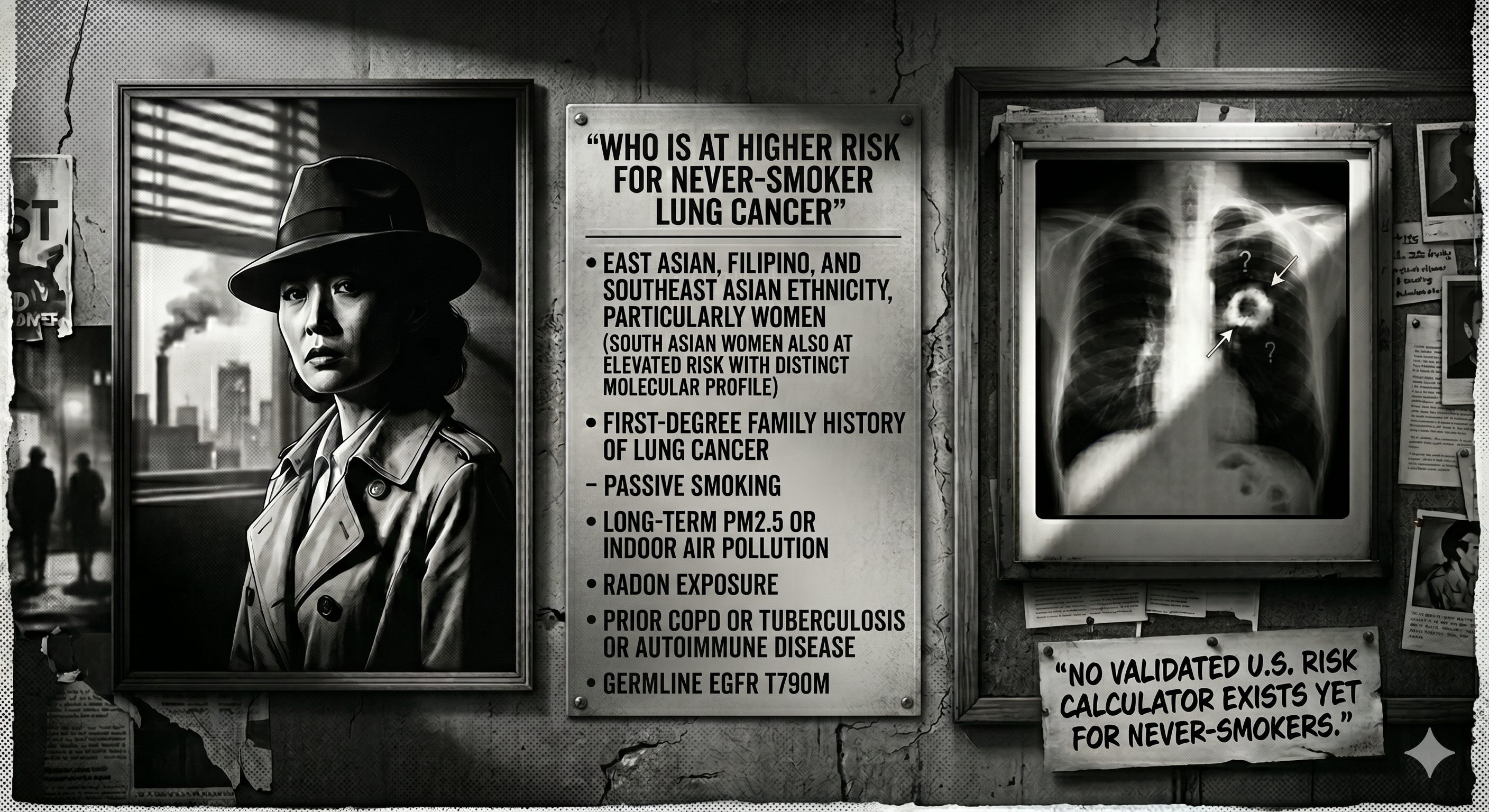
East Asian ethnicity, particularly women. This is the highest-confidence risk factor in the literature. Chinese, Taiwanese, Korean, Japanese, Filipino, and Vietnamese women who never smoked account for a disproportionate share of this disease globally. The biological profile appears similar across these populations, though the data is strongest in East Asian cohorts.
South Asian women (particularly from India) are also at elevated risk for never-smoker lung cancer. The mutation biology differs significantly from East Asian women. The PIONEER study suggested Indian lung cancer patients have EGFR mutation rates of 22% in never-smokers compared to 47% to 64% in East Asian populations. That difference changes which targeted therapies are most relevant and makes comprehensive molecular profiling especially important.
First-degree family history of lung cancer. A parent or sibling with lung cancer increases your risk meaningfully regardless of their smoking status. Taiwan’s national program uses family history (within third degree relatives) as one of its primary entry criteria.
Passive smoking. Long-term household or workplace exposure to secondhand smoke carries roughly a 20 to 30% elevated risk of lung cancer, consistent across multiple large meta-analyses. Especially if you grew up in a household with a heavy smoker or worked for years in a smoking environment.
Air pollution. Long-term PM 2.5 exposure and indoor air pollution (eg. biomass cooking) are associated with lung cancer. Women in high PM 2.5 urban environments face elevated risk regardless of ethnicity. Occupational exposures such as asbestos also increase risk. For the full picture of what PM2.5 actually does to a lung, the air quality piece covers this in depth.
Radon exposure. The second leading cause of lung cancer overall in the U.S. Disproportionately affects never-smokers as a fraction of their lung cancer cases.
COPD, prior tuberculosis or history of autoimmune disease (particularly rheumatoid arthritis). Associated with elevated risk through inflammation-mediated mechanisms.
Germline EGFR T790M mutation. A rare inherited variant. Worth considering in families with multiple lung cancer cases in never-smokers.
There are risk assessment tools (TNSF-SQ from Taiwan, NCC-LCm2021 from China) developed in East Asian populations. Unfortunately these don’t translate cleanly to Western cohorts. For a 52-year-old Asian-American woman with a first-degree family history and 15 years of high PM2.5 city exposure, there’s no validated U.S. risk calculator that tells you if they should get a screening done. That’s a clinical gap without clear answers.
There is no consensus protocol for never-smoker screening in the U.S. and no official guideline. I'm sharing my own clinical reasoning on how I approach this conversation when a never-smoker patient asks about screening.
If a patient is East Asian, Filipino, or Southeast Asian, female, and has at least one additional risk factor (family history, significant PM2.5 or radon exposure, prior COPD), we have a detailed screening conversation. I explain what the data shows, what the guidelines currently say, and that the evidence base is evolving faster than guideline updates. Then I let the patient decide.
If a patient has multiple risk factors regardless of ethnicity, I have the same conversation, with the same caveat that there’s no guideline direction. So this becomes a shared decision about whether the benefits outweigh the risks.
I don’t order CT screening reflexively. Low-dose CT has real downsides. False positives create anxiety and potentially unnecessary procedures for benign nodules. Procedures have their own risks.
There’s also the question of overdiagnosis- finding a real cancer that would never have caused harm but treating it anyway. The Taiwan data illustrates this tension. A meaningful fraction of detected cancers were extremely early-stage lesions (AIS, stage 0) with near-100% cure rates after surgery. But whether surgery was necessary in every case is a genuine question, since some cancers may never have become clinically significant in the patient’s lifetime.
Taiwan's screening program uses every 2 year intervals rather than yearly screening- a practical acknowledgment that you can catch progressive disease while lowering the harms of more frequent imaging. This is also something I discuss with patients. This is why the nuanced conversation matters more than the reflex to order.
Patients with significant comorbidities that would make treatment high-risk, limited life expectancy from other conditions, or clinical factors that would complicate follow-up are generally not candidates for this conversation in the same way. Screening is only meaningful if cancer that is found can be treated effectively.
Most U.S. payers won’t cover low-dose CT for never-smokers. Screening will most likely be out-of-pocket. This can range from $200-500.
The most important thing I can tell you is this- if you have risk factors it is a good idea to think through the details and nuances with your doctor. Whether that conversation actually leads to lung cancer screening CT is an individual decision after weighing all of the above factors.
The USPSTF criteria were designed for the NLST cohort. That was the right approach in 2013.
It is 2026. We now have TALENT. We have FANSS. We have the Northwestern analysis. We have Taiwan’s national program running for four years with promising early-stage detection. China has also updated guidelines to include never-smokers. The USPSTF has not updated its criteria to reflect any of it.
The counterarguments for caution are real. Risk-stratification models for Western populations don’t yet exist at the validation level a national guideline requires. A randomized trial demonstrating mortality reduction from screening never-smokers hasn’t been run. These are genuine scientific limitations. They are reasons to fund the trial, not reasons to leave high-risk patients outside the conversation indefinitely.
It is worth noting that the National Comprehensive Cancer Network (NCCN) does acknowledge in its lung cancer screening guidelines that factors like family history and prior COPD “may be considered” during screening discussions with patients who don’t meet pack-year criteria. It’s a category 2A footnote-level recommendation. Not a systematic pathway for never-smokers, but an acknowledgment that the conversation belongs in the room.
There’s an argument that the current evidence is sufficient to justify expanding the conversation, even without a formal guideline update. Taiwan made that call in 2022. The U.K. is researching LCINS outcomes, and Mexico is screening never-smokers exposed to biomass smoke in a prospective study. The Northwestern analysis put a cost-effectiveness number on it that compares favorably to existing cancer screening programs.
Currently, there is no systematic pathway for never-smokers with risk factors to access screening. A patient’s access depends on three things- a doctor willing to have the nuanced conversation, knowledge of the evidence, and a way to pay for the test.
My family member wasn’t offered that conversation. Neither was the patient in my clinic whose cancer was found accidentally.
It doesn’t have to be this way. Taiwan didn’t wait for the perfect randomized trial. They looked at their population, saw the evidence, and built a screening program. The rest of us can do the same. We can stop relying on accidentally finding these cancers. We can stop telling never-smokers with real risk factors that there’s nothing we can do.
This article is for education only, not medical advice. The clinical reasoning in this piece is intended to help you have a more informed conversation with your own doctor, not as a substitute for one. Decisions about lung cancer screening depend on your complete medical history, comorbidities, and individual circumstances. If you’re considering screening, the right next step is a conversation with your own doctor, not a decision based on this piece alone. The views are my own, not those of my employer.
Luo G, Zhang Y, Rumgay H, et al. Estimated worldwide variation and trends in incidence of lung cancer by histological subtype in 2022 and over time: a population-based study. Lancet Respir Med. 2025;13(4):348-363. https://doi.org/10.1016/S2213-2600(25)00348-X
Murphy C, Pandya T, Swanton C, Solomon BJ. Lung cancer in nonsmoking individuals. JAMA. 2025. https://doi.org/10.1001/jama.2025.XXXXX
U.S. Preventive Services Task Force. Screening for lung cancer: USPSTF recommendation statement. JAMA. 2021;325(10):962-970. https://doi.org/10.1001/jama.2021.1117
National Lung Screening Trial Research Team. Reduced lung-cancer mortality with low-dose CT screening. N Engl J Med. 2011;365(5):395-409. https://doi.org/10.1056/NEJMoa1102873
de Koning HJ, van der Aalst CM, de Jong PA, et al. Reduced lung-cancer mortality with volume CT screening in a randomized trial. N Engl J Med. 2020;382(6):503-513. https://doi.org/10.1056/NEJMoa1911793
Chang GC, Chiu CH, Yu CJ, et al. Low-dose CT screening among never-smokers with or without a family history of lung cancer in Taiwan. Lancet Respir Med. 2024;12(2):141-152. https://doi.org/10.1016/S2213-2600(23)00338-7
International Association for the Study of Lung Cancer. Taiwan launches national lung cancer early detection program. September 2023. https://www.iaslc.org/news/taiwan-launches-national-lung-cancer-early-detection-program
Shum E, Li W, Sequist L, et al. Preliminary results from the Female Asian Nonsmoker Screening Study (FANSS). J Clin Oncol. 2023;41(Suppl 16):8510. https://doi.org/10.1200/JCO.2023.41.16_suppl.8510
Yang HC, Chang A, Visa M, et al. Age-based screening for lung cancer surveillance in the US. JAMA Network Open. 2025;8(11):e2546222. https://doi.org/10.1001/jamanetworkopen.2025.46222
Midha A, Dearden S, McCormack R. EGFR mutation incidence in non-small-cell lung cancer of adenocarcinoma histology: a systematic review and global map by ethnicity. J Biomed Sci. 2015;22(1):9. https://doi.org/10.1186/s12929-015-0114-6
Prendergast EN, Haugen E, Kuderer NM, et al. Clonal hematopoiesis and risk of lung cancer. J Thorac Oncol. 2023;18(10):1306-1316. https://doi.org/10.1016/j.jtho.2023.07.018
Luo YH, Chiu CH, Tsai CM, et al. TNSF-SQ risk model for predicting lung cancer in never-smoking females. J Thorac Oncol. 2021;16(11):1887-1897. https://doi.org/10.1016/j.jtho.2021.07.016
Lu J, Shum E, Samstein RM, Prada D, Hirsch FR. Lung cancer in never smokers: genetics, epidemiology, environmental exposures, and distinct immune landscape. J Thorac Oncol. 2026. https://doi.org/10.1016/j.jtho.2026.XXXXX
Takahashi T, Wu E, Park L, et al. Prevalence of EGFR mutations in non-small cell lung cancer in Hawaii: a multi-center epidemiology study. J Clin Oncol. 2025;43(Suppl 16):e22585. https://doi.org/10.1200/JCO.2025.43.16_suppl.e22585
No posts
Comments
Nothing yet. Say the first thing.
Sign in to join the conversation.