

The more you deal with certain “innovation” and “acceleration” institutions, the more you realise the playbook is always the same.
If you are early: “You are not mature enough.”
If you build: “You may be too advanced.”
If you have no prototype: “Where is the proof?”
If you show the technology: “Maybe this is no longer the right instrument.”
If you are a small team: “You lack capacity.”
If you bring engineers, clinicians, PhDs, institutions and partners: “The structure is too complicated.”
If you protect your IP with NDAs: “Your partners are not empowered enough.”
If you are product-driven: “This may be too mature for research.”
And that last one says everything.
Europe keeps saying it wants research to become products, but the moment a team actually builds, suddenly building becomes the problem.
It is apparently not enough to develop technology at near-zero profit with grant funding. They also seem to expect you to hand ownership to partners, consultants or institutions who do not build the product, do not carry the engineering risk, do not maintain the codebase, and do not take responsibility for delivery — while you still pay them.
So the builder builds, the advisor advises, the institution takes ownership, and the product dies in bureaucracy.
At some point, these are not evaluation comments. They are moving goalposts told by gatekeepers.

It starts to look like the situation where someone has already decided the answer is “no,” and now they are just searching for a reason that sounds official enough. First the reason is maturity. Then it is lack of maturity. Then it is team size. Then it is too much product focus.
Then it is not enough proof. Then, when the proof appears, the proof itself becomes the problem.
And the pattern is always the same: the people actually building are questioned endlessly, while institutions with little visible connection to the technology or disease area can suddenly receive millions to build “cutting-edge AI” products.
A dentistry-focused private institution receiving funding to build an ovarian-cancer AI tool is not innovation policy. It is theatre with a grant budget.
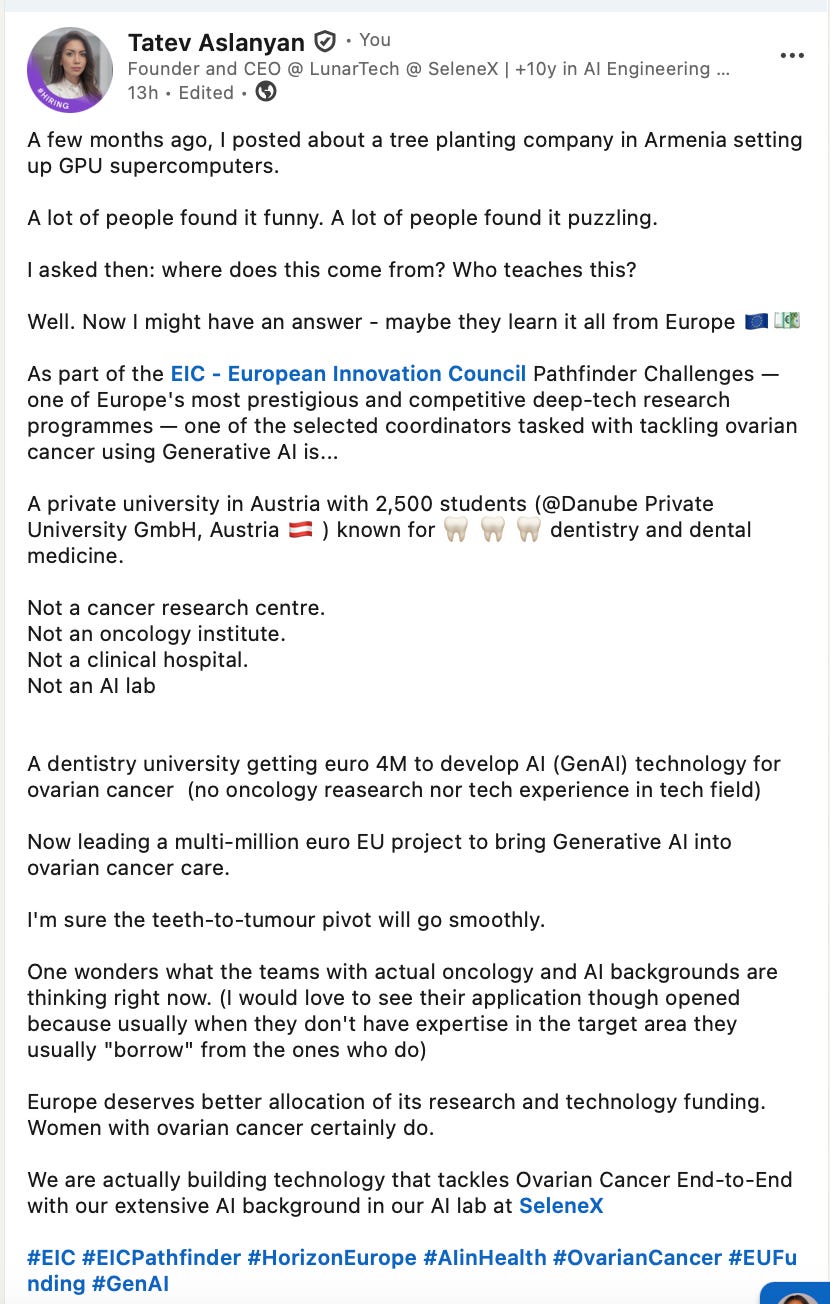
Original Linkedin Post by Tatev Aslanyan

Then you have to ask the obvious question: if an institution has no visible AI engineering capability, no obvious oncology-AI product background, and no demonstrated ability to build this kind of technology, how exactly is it going to build it?
Will it suddenly discover the missing engineering capacity after the grant arrives?
Will it quietly “depend” on people who actually know how to build the technology?
Will it “borrow” the architecture, the logic, the workflows, or the ideas from real builders who have already done the hard work?
Because if someone receives millions to build something they have no visible ability to build, they still have to show something eventually. And when the real builders are being interviewed, questioned, asked for details, asked for drafts, and then rejected, it is fair to ask where the “winning” technology story is actually coming from.

There is another question too: if they question your background, your team, your ability to perform, your partners, your maturity, and your capacity to execute, how do they then end up selecting someone who, even on paper, does not appear to have the same ability to build the technology?
Are different standards being applied to different people?
Then, when builders keep working while waiting for months, they are told they may be too advanced. As if in AI you are supposed to sit still while the field moves every week.
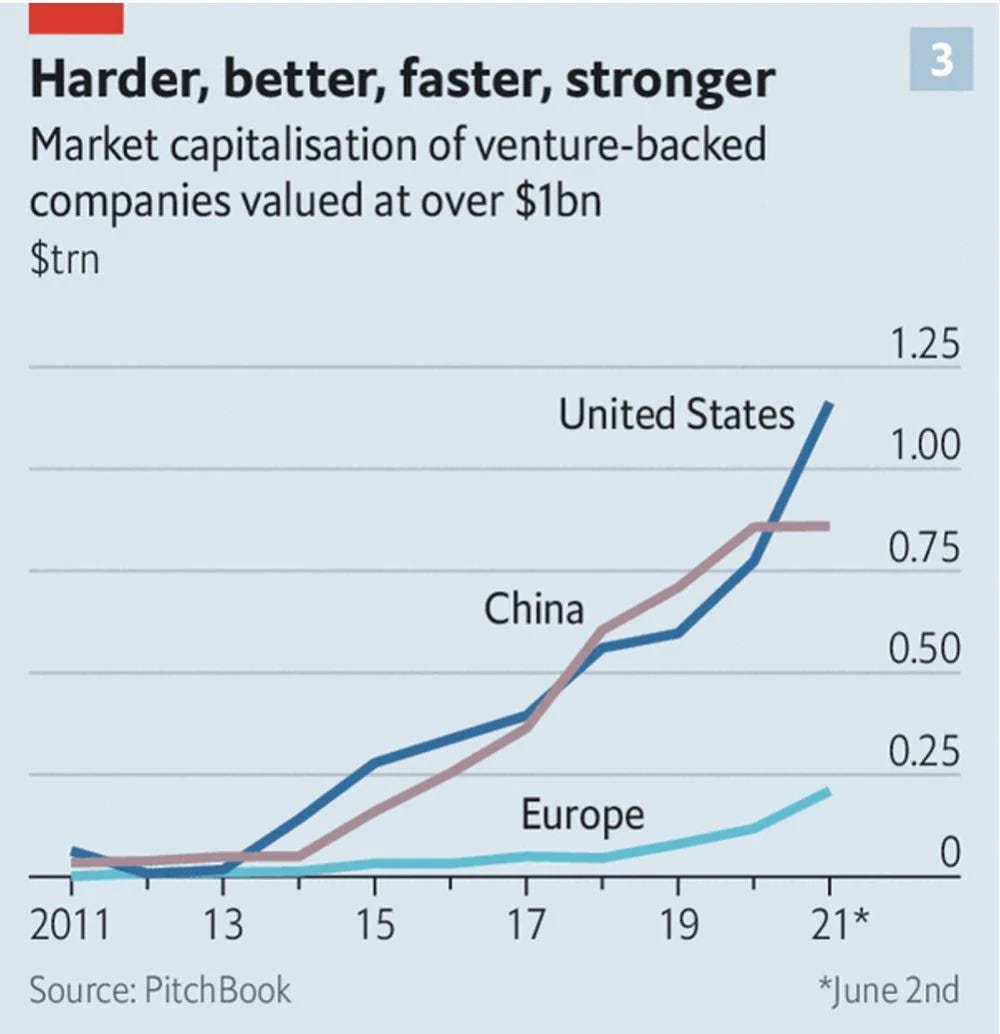
That is exactly why products in Europe often arrive years late, already outdated, or never arrive at all.
Innovation money should go to innovators. Not gatekeepers. Not paper factories. Not institutions that collect grants, produce reports, and then wait for someone else to build the future.

Europe does not have a shortage of research papers. It has a shortage of research becoming deployable technology.
And if every real builder is treated as suspicious for building, while non-builders are trusted to “innovate” with other people’s ideas, then the result is obvious: Europe keeps borrowing technology from the US while wondering why it cannot catch up.
This is not how innovation ecosystems are built. This is how they slowly have been killing themselves for the last 80 peaceful years.
SeleneX is an end-to-end superintelligent AI system for ovarian cancer—designed to detect early signals, guide diagnosis, personalize treatment, and continuously monitor patient outcomes.
To be clear, this is not an argument that every selected project is weak, flawed, or undeserving. That would be too broad, and it would not be fair.
There are serious researchers, capable institutions, and meaningful projects inside European innovation programmes. Some will produce valuable scientific work. Some may contribute to real progress.
But that is not the issue. The issue is that certain patterns are too visible to ignore. When evaluation outcomes consistently raise the same questions — about capability, alignment, execution, and who is actually equipped to build — those patterns deserve scrutiny. Not speculation, but scrutiny grounded in observable facts.
And those facts are not abstract.
They are visible in where the funding goes, who receives it, and what those recipients are demonstrably equipped to build.
We can only speak from what we have experienced directly, and from what can be verified publicly. Not assumptions. Not speculation. Evidence.
Because the money does not lie.
When you follow the money, you start to see the system more clearly. And when you look closely enough, the details begin to speak for themselves.
Innovation needs money. But innovation money should go to innovators. It should go to builders. It should go to the teams that can turn research into products, products into deployment, and deployment into real-world impact.
It should not disappear into another theoretical framework, another polished concept note, or another report that stays on paper while patients continue waiting for real tools.
This matters especially in ovarian cancer, where the absence of early detection continues to cost lives. Millions of women around the world are misdiagnosed, underdiagnosed, or diagnosed too late. Too many die while institutions with no visible engineering capability, no clear oncology-AI background, and no demonstrated product-building capacity receive millions to develop the very technologies patients urgently need.
That is the contradiction.
Product builders are told they are “too product-driven,” while institutions with no visible product-building capability are trusted with millions to build products.
At some point, the question is not whether European innovation funding supports research. It clearly does.
The question is whether it supports the people actually capable of turning research into technology that reaches hospitals, doctors, and patients.
Because when real builders are filtered out while paper-heavy institutions are funded to “innovate,” the message becomes very clear:
Europe says it wants impact, but too often funds the appearance of impact instead.
And that has consequences.
When money goes into the wrong hands, products do not reach the people who need them. Patients do not see the technology. Clinicians do not get the tools. Women whose lives could be changed — or saved — are left waiting.
Innovation money should go to innovators.
It should go to people who actually build products.
Not to institutions that only darken papers while real builders are turned away.
That is what needs to change.
Comments
Nothing yet. Say the first thing.
Sign in to join the conversation.