
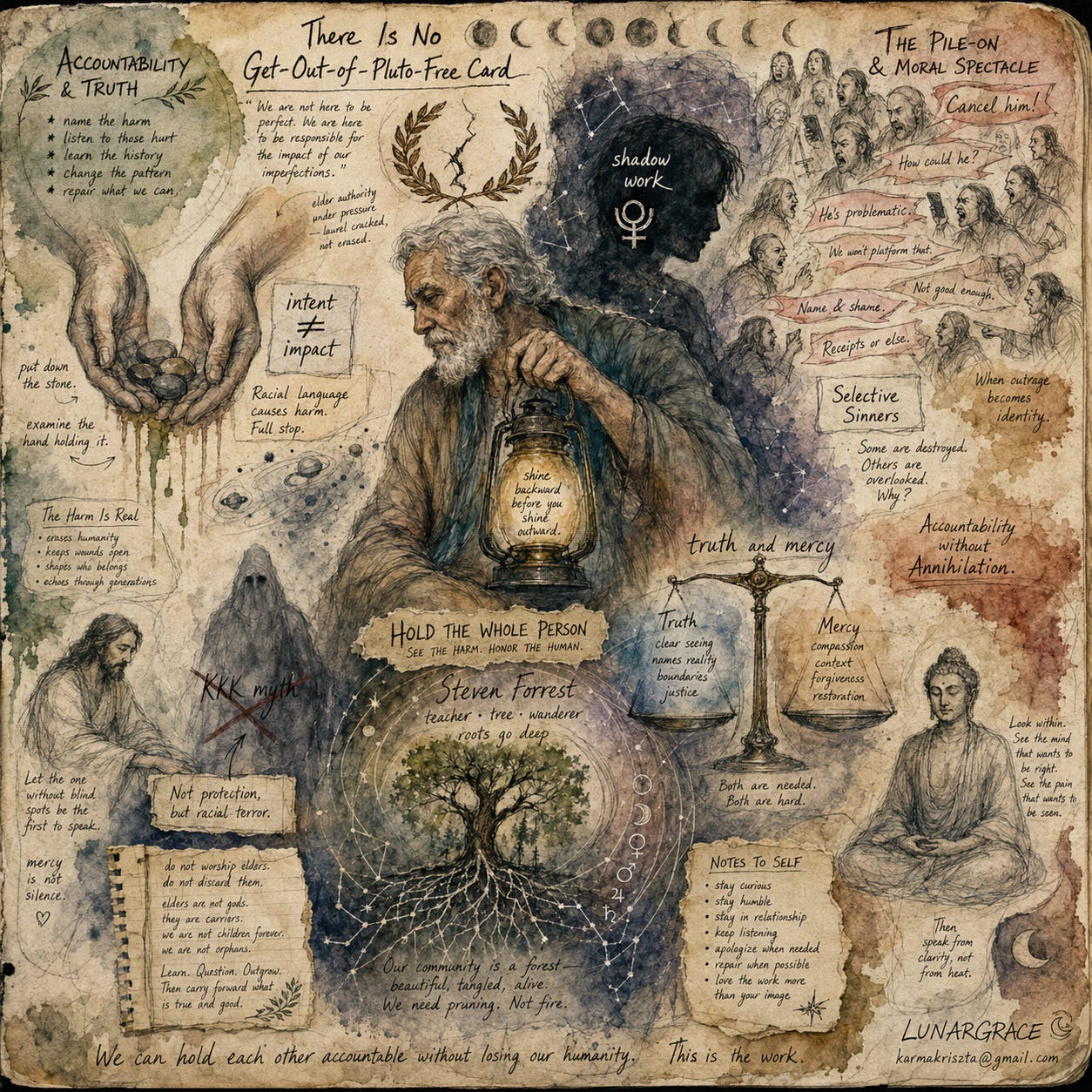
Hi my wise astrology tribe,
Apparently the astrology community decided this week that Mercury, Pluto, shadow work, generational trauma, racism, cancel culture, Facebook unfriending, conference politics, and moral superiority all needed to sit at the same dinner table.
And nobody checked the seating chart.
I have been reading the posts, the comments, the defenses, the outrage, the explanations, the calls for accountability, the accusations of cancellation, and the inevitable screenshots of screenshots. Somewhere in the middle of it all, I kept thinking the same thing.
We astrologers spend an extraordinary amount of time talking about the shadow.
We love Pluto.
We love Psychology.
We love ancestral trauma, karmic patterns, unconscious conditioning, evolutionary growth, and all the delicious psychological material hiding underneath polite behavior.
Until, apparently, the shadow belongs to us.
Then everybody suddenly wants a get-out-of-Pluto-free card.
We just got back from New Orleans.
While we were there, we visited a plantation. I walked through those grounds with my family, past the beautiful old oaks and the manicured lawns, and then into the rooms and the fields where none of that beauty meant anything for the people who were enslaved there. I read the names. I read what was done to them. I felt something sit in my chest that I am still carrying, a sorrow, a humiliation, a pain that was not mine to hold and yet somehow was.
I think that is part of why I feel the pull to write about what just happened in our own small corner of the world.
Because only weeks later, I am watching a tornado tear through our own astrology community. Not a literal one, though it certainly feels like one. And the terrible part is, we were already divided across so many fields before this even started. Now here we are, divided further, grieving something we have not even agreed on how to name yet.
The controversy began after Steven Forrest used the N-word during a podcast conversation and spoke about the Ku Klux Klan in a way that included the idea that it had once functioned to protect white Southern widows. That historical characterization has been heavily challenged, and rightly so. The Klan’s history is not some misunderstood charitable side project that accidentally developed bad public relations. It was built around racial terror, intimidation, white supremacy, and violence.
That matters.
The word matters too.
I do not believe a racial slur becomes harmless because the person using it is discussing shadow work, therapeutic context, personal history, or the evolution of their own consciousness.
Intent matters.
But impact matters too.
Those two ideas can live in the same sentence without requiring armed security.
If Black astrologers say hearing that word from a white elder in the community hurt them, I do not think the appropriate response is to lecture them about what he intended.
They know what the word means inside their own lives.
A person who has never had that word weaponized against them does not get to determine how much it should hurt somebody who has.
That should be simple.
Apparently nothing is simple anymore.
Because almost immediately, this stopped being only about what Steven said.
It became about what kind of human being Steven Forrest is.
And that is where I started getting uncomfortable with everybody.
One camp appeared ready to defend him almost automatically because he is Steven Forrest. Brilliant teacher. Elder astrologer. Decades of work. Thousands of students. Respected books. Important contributions.
The other camp began speaking as though one terrible conversation had magically vaporized everything he had ever taught, written, contributed, or meant to people.
And there I thought:
Oh, wonderful.
We have arrived at the twenty-first-century morality game where every human being must either be a saint or a monster because apparently complexity requires too much bandwidth.
I read a thoughtful defense of Steven that stayed with me. The writer did not pretend his words had never hurt. She had studied with him, learned from him, and still carried moments that had made her wince. Yet she refused to turn those painful moments into the total definition of the man.
That is much closer to where I stand.
Seeing the whole person does not require us to minimize the harm.
It means having enough emotional maturity to hold two truths at once: someone can wound us and still have given something valuable to the world. Accountability does not require erasing everything good, and compassion does not require pretending nothing bad happened.
Human beings are rarely one thing. That is the uncomfortable part.
Steven Forrest can be an extraordinary astrologer.
Steven Forrest can have changed people’s lives.
Steven Forrest can genuinely believe in equality.
Steven Forrest can also have said something deeply inappropriate.
He can have repeated bad history.
He can have blind spots.
He can become defensive.
He can need to learn something at seventy that he did not understand at thirty.
All of those things can be true.
Why is this so difficult for us?
Perhaps because human beings have become addicted to moral categories.
Good person.
Bad person.
Racist.
Anti-racist.
Victim.
Perpetrator.
Ally.
Enemy.
Cancelled.
Vindicated.
But human beings do not actually live inside those neat little filing cabinets.
And one of the strongest points I saw in the criticism of Steven was this:
A person does not have to be reducible to the identity of “a racist” in order to participate in racist behavior.
That distinction is essential.
If the only racist we can imagine is a hooded psychopath who consciously hates every Black person he encounters, then almost everybody gets to announce themselves innocent.
That definition protects our self-image.
It does not necessarily protect anybody from racist behavior.
A decent person can carry racist conditioning.
A loving person can carry sexist conditioning.
A generous person can still be classist.
A spiritual person can be arrogant.
A therapist can manipulate.
An astrologer can have absolutely spectacular blind spots.
People do not stop being products of culture, family, history, prejudice, fear, and childhood simply because they learn the glyph for Pluto.
Which makes the shadow-work part of this controversy almost painfully ironic.
Because shadow work is not:
“Look at that horrible thing inside Steven Forrest.”
That is called looking at Steven Forrest.
Shadow work begins when somebody turns the flashlight around.
Perhaps Steven’s shadow includes racial assumptions from the world in which he grew up that he sincerely believed he had already resolved.
Perhaps some defenders have a shadow around loyalty. They cannot tolerate criticism of someone they admire because criticism feels like betrayal.
Perhaps some critics have a shadow around punishment. They experience genuine moral concern and then discover, somewhere underneath it, a little pleasure in watching somebody powerful fall.
Perhaps our community’s collective shadow is believing that astrologers are somehow more conscious than ordinary people.
That one makes me laugh.
Spiritual communities are full of ego.
We just give ego better vocabulary.
Instead of saying:
“I am better than you.”
we say:
“I have done more shadow work.”
Much more sophisticated.
Both cologne, different scent.
Then Chris Brennan entered the conversation and emphasized something the community needed to sit with. In the material circulating through the community, he identified several distinct problems, not only the slur itself.
He emphasized the KKK story and the need to correct it.
He emphasized what he saw as Steven centering frustration with cancel culture rather than the hurt that had been caused.
He discussed Steven’s admission that earlier in life he had held deeply troubling assumptions about Black intellectual equality.
He emphasized the tone of Steven’s response after the controversy began.
And perhaps most pointedly, he emphasized that a conversation about shadow work had exposed Steven’s own unresolved shadow.
You can disagree with Chris’s conclusions about consequences, UAC, or what accountability should ultimately look like.
But those arguments deserve engagement.
Not:
“He hates Steven.”
Not:
“He is trying to destroy him.”
The arguments.
Likewise, people criticizing Steven should engage with Steven’s actual explanation rather than inventing motives they cannot know.
Steven knows what he intended.
Others know how his words affected them.
Neither side possesses the other person’s interior life.
Intent does not erase impact.
Impact does not automatically prove intent.
Again, apparently a revolutionary concept.
And then Mychal A. Bryan wrote what I thought was one of the most interesting contributions to the entire controversy.
Importantly, Mychal did not say Steven’s language was fine.
Quite the opposite.
He explicitly called Steven’s use of the word a problem.
But he also turned the camera toward something else.
American bandwagon culture.
And thank God somebody did.
He asked why every controversy suddenly needs its own podcast, panel discussion, reel, article, public declaration, commentary series, reaction video, and moral symposium.
Why does everybody need their moment?
Why does outrage itself become content?
Why are people who benefited from someone’s teaching, endorsement, reputation, conference appearances, or professional ecosystem sometimes the first ones elbowing toward the front of the public execution?
Those are legitimate questions.
Because there is such a thing as accountability.
And there is also such a thing as spectacle.
American culture has become very strange around public wrongdoing.
Someone screws up.
Within hours, thousands of people who had never thought about this person before breakfast become emotionally invested in deciding what consequences they deserve.
People choose sides.
Algorithms reward certainty.
Nuance gets approximately fourteen likes.
Rage gets eleven thousand.
Then everybody congratulates themselves for having participated in justice.
Mychal’s point about bandwagonism deserves to sit beside the racial criticism, not underneath it.
Because saying:
“This behavior was wrong”
does not require saying:
“And now let us extract maximum entertainment from destroying the person.”
That is where cancel culture becomes a useful discussion.
I dislike the phrase sometimes because everybody uses it differently.
For one person, “cancel culture” means losing employment, reputation, invitations, income, and relationships over a single mistake.
For another, it means:
“People criticized me online, and I found it unpleasant.”
Those are not equivalent.
Criticism is not cancellation.
Consequences are not always cancellation.
And cancellation is not automatically accountability.
There is a question of proportion.
Should a person’s entire body of work become untouchable because of one serious mistake?
Should conferences remove speakers every time sufficient online pressure develops?
What role should apology play?
What role should pattern play?
What role should context play?
What role should those directly harmed play?
And what happens when the consequence becomes less about preventing harm and more about satisfying our appetite to see somebody punished?
I do not have a cute answer.
That is rather the point.
Mature ethical questions usually do not fit on Instagram graphics.
Then Samuel Reynolds offered another part of the argument.
He emphasized something important about racial harm, specifically that people whose lives have not been affected by a slur cannot authoritatively decide its impact for those who have lived with it.
I agree.
He also shared the argument that a human being need not consciously identify as racist or be reducible to “a racist” in order to participate in racist behavior.
Again, important.
Then Samuel posted that he was grateful for people who had befriended and unfriended him and that he loved when “the trash people know when to take themselves out.”
And that, my loves, is where the shadow entered wearing tap shoes.
Because...
Really?
We are discussing compassion, racism, dignity, consciousness, humanity, accountability, and wisdom.
Then somebody clicks Unfriend and becomes trash?
No.
That is not elder wisdom.
That is somebody being pissed off on Facebook.
And people are allowed to be pissed off on Facebook.
But call it what it is.
Then Stormie Beaston added something that stopped me completely, and I think it deserves to sit at the center of this entire conversation.
Before she shared anything publicly, she reached out to Steven privately first. She said she did that because she loves him, respects him, and considers him one of the most influential mentors in her astrological life, and she believes that when someone has shaped our lives in meaningful ways, they deserve the dignity of hearing from us personally before hearing from us publicly.
She named something I have been circling this entire letter without landing on quite so cleanly. She is also a Black woman. She said those two truths- her love and respect for Steven, and her identity- are not in conflict, and that one of the deepest lessons life offers us is learning to hold more than one truth at the same time. We want people to be entirely good or entirely bad. Life rarely asks that of us. Wisdom asks something greater. Wisdom asks us to remain present in complexity.
She did not believe there was malicious intent behind what was said. She also knew, without hesitation, that profound harm was caused. Both of those things, she said, can be true. Intent and wisdom are not the same thing. A person can have beautiful intentions and still make an unwise decision, can genuinely mean no harm and still create real harm. Intentions explain why we acted. They do not determine whether the action itself reflected wisdom.
She spoke about Steven’s apology and said she believed it was sincere. She believed this moment would weigh on him deeply, that he would wrestle honestly with what happened and with the lessons it asks of him, and that some of the hardest teachers we ever encounter are our own conscience and our own values, lessons that cannot be imposed from the outside, only lived from within.
That did not diminish, for her, the need for accountability. She made a distinction I want you to sit with. Accountability does not end with the words I’m sorry. It becomes most meaningful when it moves beyond public response and becomes personal transformation, when we become quiet enough to truly listen, when we allow ourselves to hear pain we never intended to cause, when we resist the urge to explain ourselves before we have fully understood the experience of those who were hurt.
Then she told us something deeply personal. She had recently applied for German citizenship by descent, and as part of that process she was required to sign a declaration acknowledging Germany’s responsibility for one of the darkest chapters in human history. Signing it affected her more than she expected. She said acknowledging history is not about accepting personal guilt for events we did not create, it is about accepting a shared human responsibility not to continue the wounds that history has already inflicted, and that lesson did not stay behind on that page. She carries it with her, into the history of her own country too.
For her, she said, the N-word is not simply a word. It is a continuation of historical harm, carrying the echoes of slavery, lynching, segregation, dehumanization, and generations of suffering that continue to shape lives today. Her conviction was unwavering. She does not believe the word was ever okay, does not believe it is okay today, and does not believe it will ever be okay, and no philosophical argument, educational objective, historical explanation, or attempt at reclaiming changes what that word has carried through history or what it continues to carry now. For her, choosing not to speak it is not political correctness. It is historical responsibility. It is her way of refusing to let the wounds of history continue through her.
She extended this beyond Steven alone, naming that the language used throughout the discussion weighed on her heart, and that this word does not belong in a professional educational setting, or in any setting, regardless of who is speaking it. As educators and conference speakers, she said, we carry an ethical responsibility to create spaces where people can learn with dignity, and that responsibility belongs to everyone who stands on the stage, not only to the person holding the microphone in any given moment.
She pushed back, gently but firmly, on those who dismissed the concern as simply being woke. This was never about politics, censorship, or cancel culture, she said, it was about ethics, wisdom, and historical responsibility. We spend our entire professional lives telling people that symbols carry energy, that archetypes live across generations, that vibration and resonance matter. Words are symbols too, she reminded us. They carry vibration, memory, history, and the collective suffering of generations. Naming that is not being woke. It is being awake to the humanity of another person.
She closed with something I have not been able to put down since I read it. Love without accountability becomes permissiveness. Accountability without love becomes punishment. She still respects Steven, and because she cares about him, she believes he is capable of the kind of listening, reflection, and growth that true wisdom requires. And she reminded all of us that our greatest moments as teachers are not found in never making mistakes, but in the humility to learn from them, the courage to repair them, and the wisdom to become different because of them.
This is actually one of the things about the whole situation that fascinates me most.
We have older respected men in an astrological community filled with teachers constantly talking about consciousness, yet humility seems to be the rarest transit of all.
Why is “I was wrong” so damn difficult?
Three words.
No ephemeris required.
No certification.
No master’s degree.
No seventeen-page psychological defense.
Just:
I was wrong.
And this brings us to the cultural idea of elders.
I was born in Hungary. Respect for elders was not exactly optional.
You respect older people.
You listen.
You understand they have lived through things you have not.
And I still believe in that.
I think we have lost something when we treat elders as irrelevant simply because their vocabulary, humor, or assumptions reveal another generation.
Older people carry history.
They carry stories.
They have watched countries change.
They have buried people.
They have survived mistakes younger people have not yet had time to make.
There is wisdom there.
But respect is not immunity.
Age does not create moral diplomatic status.
Being seventy does not mean nobody can correct you.
Being twenty-seven does not mean everything you say is automatically naive either.
I am tired of both stereotypes.
The elder saying:
“Young people are too sensitive.”
And the younger person saying:
“Old people are hopeless.”
Both are lazy.
A truly wise elder should be capable of hearing:
“That language hurt people.”
without experiencing the sentence as an attack on their entire life’s worth.
And a truly mature younger person should be able to say:
“That language hurt people.”
without adding:
“And therefore you should be stripped from history.”
Which brings me, inevitably, to Jesus.
And I know some of you just sat up.
Good.
Because we throw the word forgiveness around constantly while demonstrating remarkably little understanding of what it actually asks of us.
Jesus did not teach moral indifference.
This was not some ancient version of:
“Everyone’s truth is valid, babe.”
He confronted hypocrisy.
He confronted exploitation.
He overturned tables.
He challenged people in power.
He told people to change.
But he also continually challenged humanity’s obsession with condemning others while ignoring itself.
The story of the woman facing public condemnation remains one of the most psychologically intelligent images in religious history.
Everybody arrives carrying stones.
Everybody knows what she did.
Everybody knows what punishment she deserves.
Then the focus changes.
Who among you is clean enough to throw the first one?
Suddenly morality becomes less recreational.
That is the part of Christianity people often conveniently forget.
We are selective sinners.
Every single one of us.
When we screw up, there is context.
We were tired.
We were traumatized.
We had a difficult childhood.
We misunderstood.
We were joking.
We were angry.
We were raised differently.
We were scared.
We were under pressure.
We did not mean it.
Lord, we become Atticus Finch when defending our own behavior.
But when somebody else screws up?
Suddenly we are Judge Judy with nuclear weapons.
No context.
No appeal.
No parole.
And every one of us has sins we understand and sins we despise because we cannot imagine committing them.
Someone has endless compassion for addiction but none for infidelity.
Someone forgives infidelity but cannot tolerate cowardice.
Somebody understands greed because they call it ambition.
Someone understands control because they call it protection.
Someone understands cruelty when their political team does it.
Someone condemns offensive language publicly while speaking with breathtaking contempt privately.
We rename our favorite sins.
Greed becomes drive.
Control becomes caring.
Vanity becomes branding.
Cowardice becomes avoiding drama.
Rage becomes passion.
Judgment becomes discernment.
And occasionally cruelty becomes accountability.
That one scares me.
Because accountability without compassion can become vengeance very quickly.
But compassion without accountability becomes enabling.
Jesus asked for something much harder.
Truth and mercy.
Accountability and redemption.
And redemption makes absolutely no sense unless a human being is allowed to become more than their worst behavior.
Think about that.
If one terrible action permanently defines somebody, then the entire idea of redemption collapses.
But repentance also does not mean issuing a statement that says:
“I am sorry that some people misunderstood me.”
Can we please send that sentence directly to hell?
A real apology is so much simpler.
“I understand why this hurt. I was wrong. I thought I understood something that I clearly still had more to learn about. I am listening.”
Stop.
Do not add:
“But my intentions...”
Do not add:
“But my generation...”
Do not add:
“But cancel culture...”
Do not add:
“But look at everything good I have done.”
The good work will still be there tomorrow.
Humility does not require footnotes.
And then Buddha walks quietly into this argument and complicates it even further.
Buddhist philosophy asks us to pay very close attention to suffering, attachment, ego, anger, ignorance, compassion, and right speech.
What happens inside us when we encounter wrongdoing?
Do we genuinely want repair?
Or do we want punishment?
Do we genuinely care about the injured person?
Or have we become intoxicated by being seen as morally correct?
Do we want someone to learn?
Or do we want them humiliated?
This is not a defense of silence.
Buddhist compassion is not passivity.
But it asks us to examine the mind holding the sword.
And that is perhaps the shadow-work question missing from much of this conversation.
What pleasure are we getting from our righteousness?
Ouch.
Because righteousness can feel fantastic.
There are few drugs more intoxicating than certainty that we are one of the good people.
And social media monetizes that drug.
Post the condemnation.
Receive affirmation.
Watch people agree.
Feel morally clean.
Repeat.
Meanwhile, the actual human beings involved become characters in everybody else’s morality play.
Jesus might ask us to put down the stone.
Buddha might ask us to examine the hand holding it.
Neither would ask us to pretend the harm never occurred.
That is what I wish we understood.
Compassion is not pretending.
Forgiveness is not amnesia.
Accountability is not annihilation.
And disagreement does not transform someone into trash.
This is also why I found Samuel’s “trash” comment so revealing.
Not because I think Samuel is terrible.
Exactly the opposite.
Because it demonstrates the entire point.
A thoughtful person can make an insightful argument about human dignity and then five minutes later speak from hurt, anger, ego, or contempt.
Human beings are inconsistent.
Welcome to Earth.
Steven’s inconsistency does not make him irredeemable.
Samuel’s inconsistency does not make him irredeemable.
Chris’s anger does not invalidate every point he makes.
Mychal’s concern about bandwagonism does not excuse Steven’s language.
One truth does not automatically murder another.
Maybe we need to stop thinking ethical maturity means choosing the perfect team.
I do not have Team Steven merchandise.
I do not have Team Cancel Steven merchandise.
Frankly, I have enough laundry.
My position is much less satisfying.
I think Steven’s use of the slur was inappropriate.
I think the KKK narrative needed correction.
I think Black astrologers hurt by his words deserve to be heard.
I think saying “that was racist behavior” is different from declaring the totality of a human being “a racist” and closing the case.
I think intention should be considered.
I think intention does not erase impact.
I think his decades of contribution still matter.
I think age deserves respect.
I think age does not deserve immunity.
I think public accountability can be necessary.
I think public humiliation can become addictive.
I think Mychal Bryan is right that American bandwagonism deserves serious examination.
I think Samuel Reynolds is right that those untouched by the history of a slur should not dictate how painful it is.
I also think calling people “trash” because they leave your Facebook circle is exactly the kind of dehumanizing shortcut we should be trying to outgrow.
And I think Chris Brennan is entitled to make a serious case for stronger accountability without automatically being cast as a villain trying to destroy an elder.
I think Stormie Beaston showed us what it actually looks like to hold love and accountability in the same hand without letting either one cancel out the other, and I think her distinction between intent and wisdom is one of the most useful sentences to come out of this entire conversation.
See how irritating nuance is?
Nobody gets everything they want.
Maybe that is adulthood.
The irony is that we spend so much time discussing evolutionary astrology.
Evolution.
Not perfection.
Evolution assumes unfinishedness.
It assumes mistakes.
It assumes consciousness grows.
It assumes a human being at seventy can discover something about themselves they missed at sixty.
Otherwise what exactly is the point of all this astrology?
If Steven cannot change, then why teach evolution?
If people criticizing him cannot change their relationship with punishment, why teach shadow work?
If Samuel cannot have a moment of contempt and later reconsider it, why speak about consciousness?
If younger astrologers are automatically dismissed as hypersensitive, why talk about cultural evolution at all?
And if elders are automatically disposable whenever they reveal the conditioning of their generation, what exactly are we planning to do when our own generation becomes old and our grandchildren discover all the ways we were idiots?
Because they will.
Oh, they absolutely will.
Twenty-five-year-olds of 2070 will look at us and say:
“You people did WHAT?”
And we will attempt to explain the context.
We will say:
“You have to understand how things were then.”
Sound familiar?
This is why humility has to travel in both directions.
I want elders who are willing to say:
“I have lived a long time and I still do not know everything.”
I want younger people willing to say:
“You hurt us, but you are not only the thing that hurt us.”
I want white people willing to listen when Black people describe harm without immediately defending their intentions.
I want Black people to have space for anger without being required to educate everybody politely while hurting.
I want people criticizing racism to remain vigilant about contempt inside themselves.
I want people defending an elder to understand that loyalty is not the same thing as protecting somebody from truth.
I want apologies that sound like apologies.
I want forgiveness that does not erase responsibility.
I want consequences that leave room for transformation.
Maybe I am asking too much.
But if astrologers cannot hold contradiction, who the hell can?
We literally work with squares and oppositions for a living.
The chart itself teaches us that opposing realities can exist simultaneously.
Saturn can protect and imprison.
Jupiter can bless and inflate.
Mars can defend and destroy.
Neptune can inspire and deceive.
Pluto can transform and obsess.
Why would human beings be simpler than planets?
Steven Forrest is not only his worst sentence.
He is also not exempt from responsibility because he wrote brilliant books.
Samuel Reynolds is not only one angry Facebook remark.
But that remark is still worth questioning.
Chris Brennan is not automatically correct about every consequence because he is correct that harm occurred.
Mychal Bryan is not defending racism because he criticizes the machinery of public shaming.
These are whole people.
Complicated.
Contradictory.
Capable of grace one day and complete nonsense before lunch the next.
Like the rest of us.
And that is perhaps the most uncomfortable thing about this entire controversy.
We are all selective sinners.
We want compassion for the behavior we understand.
We want justice for the behavior we hate.
We want forgiveness when we are explaining ourselves.
We want accountability when someone else is explaining themselves.
We quote Jesus when our friend screws up.
Then become Roman prosecutors when our enemy does.
We quote Buddha when somebody else needs to release anger.
Then refresh Facebook fourteen times waiting for the next comment that validates ours.
Selective spirituality.
Selective forgiveness.
Selective compassion.
Selective sinners.
Every bloody one of us.
Maybe real shadow work starts there.
Not with deciding who gets kicked out of the tribe.
Not with declaring someone pure or contaminated.
Not with pretending language does not matter.
And not with pretending decades of humanity disappear because somebody failed publicly.
It starts with enough courage to say:
That was wrong.
Enough compassion to say:
You are still human.
Enough humility to say:
I could be blind too.
Enough maturity to say:
Repair it.
And enough mercy to leave open the possibility that repair might actually work.
Do not worship elders.
Do not discard them either.
Correct history.
Retire the slur.
Listen to the people who were hurt.
Call out racism when it appears.
Challenge hypocrisy.
Question mob behavior.
Question your own behavior too.
Demand better from our teachers.
Demand better from the people demanding better.
And please, for the love of all twelve houses, leave enough room for a human being to actually become better.
Otherwise this is not transformation.
It is just punishment wearing Pluto earrings.
Jesus asks us to put down the stone.
Buddha asks us to examine why we picked it up.
Shadow work asks us to notice how badly we wanted to throw it.
And astrology, if it is worth anything at all, should remind us that nobody is finished.
Not Steven.
Not Samuel.
Not Chris.
Not Mychal.
Not Stormie.
Not me.
Not you.
Thank God.
Because if we were already finished, there would be nothing left to learn.
And that would make astrology terribly boring.
Tell me where you land in all of this, my loves. I read every comment.
Stardust and shimmer, Nam Myoho Renge Kyo
Krisztina Simon LunarGrace Astrology [email:karmakriszta@gmail.com] www.lunargrace.com
YouTube: LunarGrace Astrology
Disclaimer: This piece reflects personal opinion and commentary on a public discussion within the astrology community. It is not a statement of legal fact regarding any individual and is intended for reflection and discussion, not as professional, psychological, or legal guidance.
No posts
Comments
Nothing yet. Say the first thing.
Sign in to join the conversation.