
One of the oldest paths into the history of awareness begins with the ear. Before awareness became something imagined inside the head, wisdom was an ear.
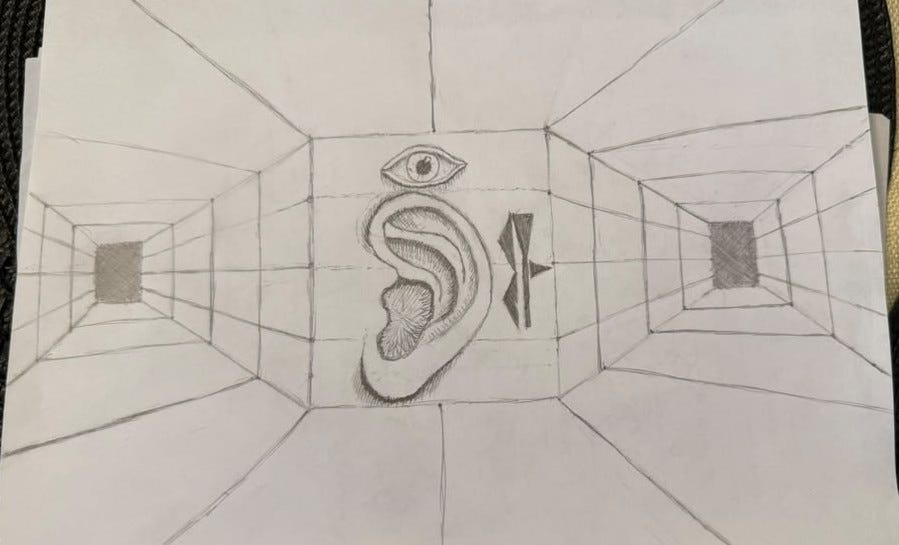
In Akkadian, the word uznu could refer not only to the physical ear, but also to attention, wisdom, or understanding. Another term, ḫasīsu, likewise moved between the meanings of “ear” and “intelligence.” The bodily organ of hearing and the faculty of understanding were therefore joined within the language itself. A god could grant wisdom by widening someone’s ear.
To be wise was not only about calculating quickly or possessing a large quantity of information. It was about being receptive - to be able to hear what was actually being said, to recognize significance and to allow reality to enter deeply enough that it could change one’s response.
In the Epic of Gilgamesh, Enkidu begins outside human civilization, living among animals. After his encounter with Shamhat, he acquires reason and “wide understanding.” He sits before her, watches her and learns the patterns of human life. Whatever else we can conclude or infer from this story, awareness here is not depicted as isolated computation.
Enkidu does not just gain more information. Food and clothing change meaning, other people become intelligible, friendship becomes possible, and mortality will eventually become personally significant. Because of this, his world acquires new dimensions of significance
This leaves me with the following working philosophical propositions:
1. Input is not necessarily reception.
2. Data is not necessarily experience.
3. Prediction is not necessarily participation.
A machine may process everything we say. But is it “wide of ear”? Can something truly matter to it? Can an encounter enter deeply enough to alter not only its output, but its way of being? I don't know, yet. My main intuitive stance on this has been: No.
But I suspect that intelligence concerns what a system can do with information, while awareness concerns whether, and how, the world becomes present and significant within it.
Before Alan Turing asked whether a machine could think, I guess we should have asked the older question:
Can it "hear"?
No posts
Comments
Nothing yet. Say the first thing.
Sign in to join the conversation.