
Humans have been celebrating the midwinter turn of the year for thousands of years, long before Christmas came into being. Originally marking the winter solstice and the return of the light, people would decorate their homes with evergreens and fir branches as a reminder of the coming spring. Later, the Romans celebrated Saturnalia over this period, hanging decorations to honour the god Saturn. Then with the coming of Christianity, the evergreens came to represent the promise of everlasting life with God.
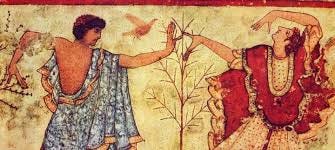
Cutting down fir trees to celebrate Christmas came much later, an idea thought up by either Estonians or Latvians (they’re still arguing about who thought of it first). Either way, they first appeared in town squares thanks to the Brotherhood of Blackheads. I went down a google rabbit hole to find out more about the Brotherhood of Blackheads, so to save you a bit of time and effort, they were a group of Christian merchants - male, single and mostly German. They banded together to put down an uprising by the indigenous pagan population of Estonia, who wanted to get rid of the Christian foreigners). The Brotherhood succeeded in quashing the Estonians, and started an annual Christmas celebration, dancing around the fir trees they put up in the centre of town.
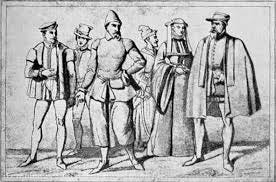
The first indoor tree we know about was erected in in the guild house in Breman in Germany in 1570, and decorated with apples, nuts, pretzels and paper flowers. It possibly wasn’t the very first indoor tree, but it’s the first one someone took the trouble to make a note of in the town records.
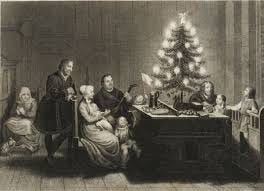
There are various legends as to why the people of Germany started bringing fir trees into their own homes. The most popular is that Martin Luther was gazing up at the stars sparkling through the trees one night, and thought of Jesus, who left the stars of heaven to come to earth at Christmas. Luther brought a small tree indoors to tell the story to his children.
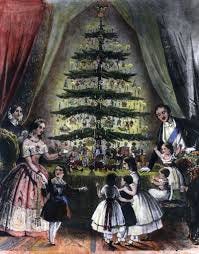
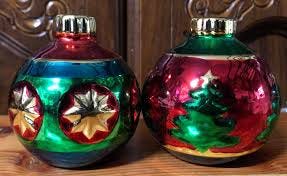
Whatever the truth of this legend, indoor Christmas trees soon became popular throughout Germany, and were decorated with lighted candles (to represent stars), edible treats and roses made of paper or gold foil. A figure of the baby Jesus was placed on the top, later replaced with either a star, to represent the Star of Bethlehem, or an angel, who brought the news of the birth to the shepherds. Glass makers started making tree ornaments, and the Christmas tree bauble was born.
Tinsel also started in Germany, originally made from beaten silver. The idea behind tinsel is connected to traditional folktales about the Christmas spider. All versions of this folktale centre on a poor family who can’t afford to decorate their tree and leave it bare on Christmas Eve. Overnight a spider covers the tree in webs, and on Christmas morning the family awake to find the webs have miraculously turned to silver or gold. To this day, spider ornaments and silver webs for trees are popular in the Ukraine and over much of northern Europe, as they are considered lucky.
Christmas trees were unknown in Britain until Queen Charlotte (the German wife of King George III) had one set up in Windsor Lodge in 1800. The idea caught on fast, and by Victoria’s reign, anybody who was anybody had one in their home. All these first Christmas trees were decorated with lighted candles - which led to a lot of house fires. Fortunately someone invented strings of electric lights sometime in the early 20th century, and so these days few of us still run the risk of lighted candles.
Everyone has their own preferences for decorating Christmas trees. Some go for glittering white lights and themed baubles, and some of us have baubles that reappear every year, regardless of fashion. My family always has coloured tree lights, for sentimental reasons - my grandmother loved coloured lights and she lived with us when I was a child. Every year, she’d repeat the story of how they reminded her of her honeymoon, when she and my grandfather went to Blackpool to see the illuminations. Apparently they’d never seen anything so magical. (Of course it was a very long time ago, and neither of them had electricity at home back then). Anyway, our coloured Christmas tree lights remind me of her, and the warmth and love she brought into my life.
Our tree baubles are a hotchpotch, a family history from the last 40 years in bauble form. Some were brought back from my kids’ travels abroad, some given by friends, some chosen in shops, some handmade. Everyone has their personal favourites, and regardless of taste, they all go on the tree.
Your Christmas tree (if you have one) will probably tell something of your own story - whether it’s following family tradition or forging your own path. Either way, I hope you have a peaceful and stress-free festive season, and may all your lights sparkle like magic.
No posts
Comments
Nothing yet. Say the first thing.
Sign in to join the conversation.