
Elon Musk recently pointed out that the Japanese leadership in WW2 was stubbornly split on surrendering, even after the Atomic bombs, as evidence that the bombs were necessary to end the war.
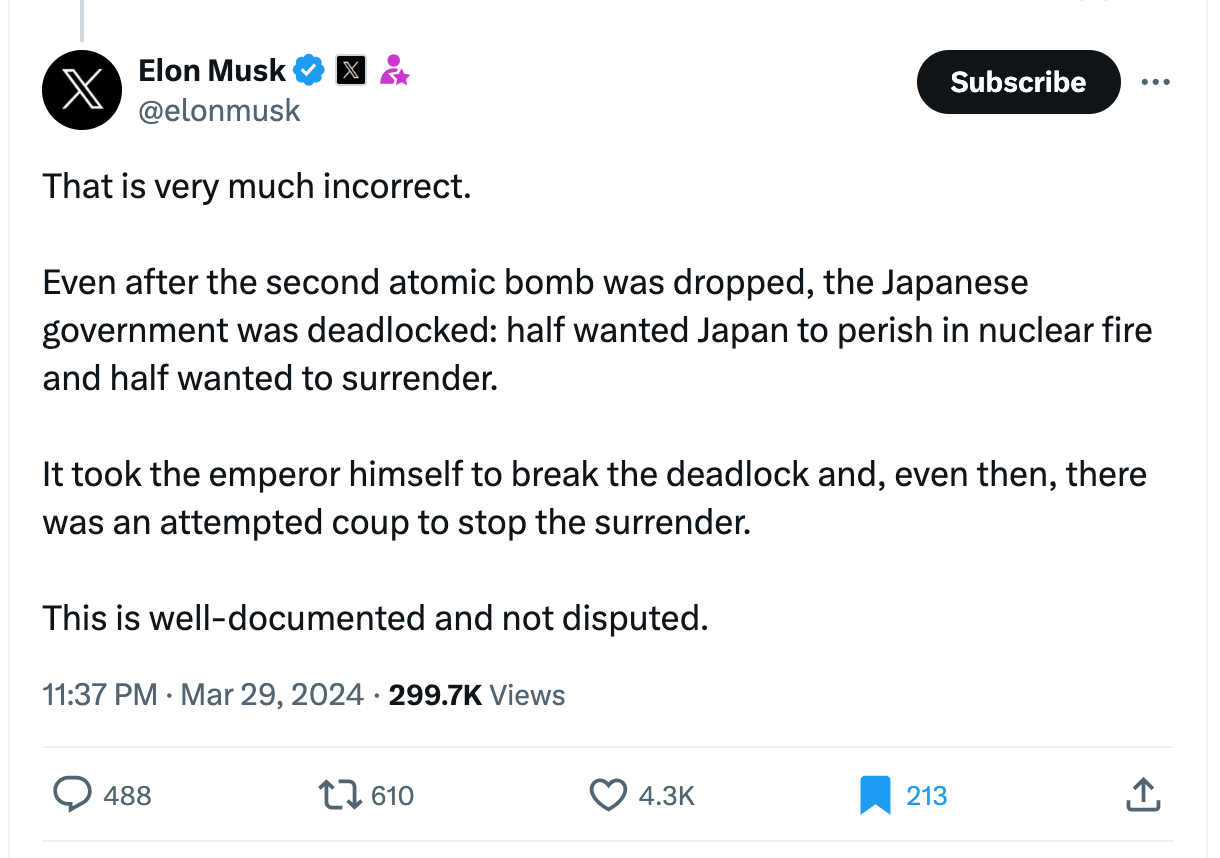
In reality, the war didn’t end with the bombs, it had already ended when the Japanese navy was destroyed, regardless of the nobility's pride.
The US had complete control of the Pacific, let alone Japan, which was not getting any more rubber, oil, steel or anything they needed to operate their war machine let alone their industrial society.
Testing our new bombs on them didn’t change that any more than launching diseased animals would have changed the ultimate outcome of a castle under siege from a well-supplied army.
While it is true the bombs contributed to forcing a decision, the attempted coup Elon referenced also risked pushing Japan into the hands of those most fervent for war.
Knowing what we know about Japanese culture and their suicide intolerance for shame, it shouldn’t be hard to see how the domestic attacks made some people in the military junta more fervent rather than surrendering, or being softened up by it.
This reaction does not prove the bombings were necessary. And even if the coup was successful, they would not have lasted in power long, as the country would continue to fail, cut off from everything.
The Japanese are prideful, but this characterization of them as never negotiating is historically false. No people are ever that one dimensional, not even the Palestinians. The Japanese were already actively negotiating surrender from a position of zero military strength.
The war ended, not from the bombs, but how it started. Over a fight for sanctions and control of trade in the Pacific.
A large part of the WW2 narrative is that US intervention was necessary to secure global trade after the decline of the British Empire. The idea is that without a single power in control, a multipolar world will descend into chaos, with disruptions in trade.
While it is true England and other European powers opened some countries up for trade through military means, the main relevant factor in establishing trade was new transportation technology and the capacity for self-defense.
Once Pandora's box was opened and trade was established, England didn’t need to secure it, they couldn't have used the military to stop it if they wanted to.
As the English empire was becoming too spread out to maintain an active navy presence in the pacific, they signed the Anglo-Japanese Treaty of Commerce and Navigation of 1894 giving equal trading terms, while ceding the so-called protection of regional trade to the Japanese.
This multipolar world did not lead to a reduction in global trade as Peter Zeihan likes to claim it inevitably does. Trade continued to accelerate through the period.
Once a meaningful level of trade is established, countries have a huge incentive to secure their regional trade.
This issue was ultimately that the US refused to accept this arrangement.
Japan didn’t attack Pearl Harbor because the US was free. They attacked Pearl Harbor because for decades we refused to recognize their treaty with England, while engaging in systematic sanctions and blockades to cut the Japanese off from key resources.
Our justification for weakening Japan was that if we didn’t take over the role of England in the Pacific, the Japanese would eventually do what we were doing to them and cut us off from access to goods.
We didn’t need to go to war with Japan to continue trade with Asia. If the US accepted the treaty, and did not make enemies of the Japanese, they would have had less incentive to join the Axis powers and certainly would not have made enemies of us.
The Japanese committed atrocities across the Pacific, but we cannot control every injustice across the world.
Japan's quick collapse in China combined with influence from our Soviet allies, created the perfect scenario for the rise of communist China, which didn’t exactly lead to a regional reduction in human suffering.
Now we are in the same position as the British 130 years ago, too spread out to maintain a global empire after making enemies across the globe, while worrying about the Chinese cutting us off from Microchips that we’re too regulated to produce at home.
You can say there is a risk associated with letting go, but trying to hold on forever at the cost of domestic freedom and positive foreign relations leads to guaranteed failure.
No posts
Comments
Nothing yet. Say the first thing.
Sign in to join the conversation.