
Hey there, fellow gamers! Let's talk about something important—Internet Gaming Disorder (IGD). It's a relatively new issue that arises when our love for video and online games goes a little too far, causing distress and problems in various aspects of our lives. The World Health Organization (WHO) has recognized IGD as a mental health condition in their latest version of the International Classification of Diseases (ICD-11). In plain language, there is a question: does gaming make you an addict? (Of course, we know it is, but can we say it is “official”?)
The American Psychiatric Association (APA) is also concerned about IGD and has conducted research to determine if it meets the criteria to be considered an addiction. Although it's not officially recognized as a disorder in the Diagnostic and Statistical Manual of Mental Disorders (DSM-5) just yet, the APA acknowledges its significance and includes it in the section for conditions that require further study. By the way, do you know what other condition APA includes in the list “for further research”? Caffeine addiction. So, if some guys will be wanting their PhD title really hard and OpenAI will make some upgrades to ChatGPT, then you have a chance to become two addictions simultaneously! Profit?
Several studies on IGD are currently underway and expected to continue. These studies aim to shed light on the prevalence, risk factors, and impact of IGD on individuals and society. Through this research, they hope to develop effective prevention and treatment interventions for this disorder.
The International Classification of Diseases (ICD) is a system used to classify and code diseases. The ICD-10, released in 1992, included a diagnostic code for gaming addiction, but it wasn't “widely” used. Actually, the usage of it is so wide, and by itself, it is so complicated that the doctors have to hire an extra specialist to help “code” the diseases into their medical documentation. In 2018, the ICD-11 came into play and made things even worse, and it recognizes IGD as a disorder under the category of "disorders due to addictive behaviours." This recognition is significant as it enables healthcare providers to diagnose and treat IGD, ultimately reducing the economic burden on individuals and society. I.e. we, white coats, can now put the label on you and cash out on this freely make the diagnosis of ICD and help the gamers that suffer.
A proposed diagnostic tool called the IGD-20 Test is designed to assess the severity of IGD symptoms. It consists of 20 questions that measure the level of distress and impairment caused by excessive gaming. The test aligns with the ICD-11 criteria for IGD, including impaired control over gaming, prioritizing gaming over other activities, and continued gaming despite negative consequences. There is one trick, though. You see, if someone makes a questionnaire in medicine, then it has to be tested really well (to prove its validity. Or everyone can make 5 questions, strap a label “IF YOU ANSWER “YES” ON 3 OUT OF 5 OF THESE QUESTIONS, THEN YOU ARE SICK” and sells it). And after the big, typically not cheap and long research, the given questionnaire can become a useful tool for the diagnosis of the disease… in one language. Let us say it is in English. But doctors cannot say that the translated question in, for example, German will have the same diagnostic “power”. So you have to test it again in a new language! And then we become something looking like this:
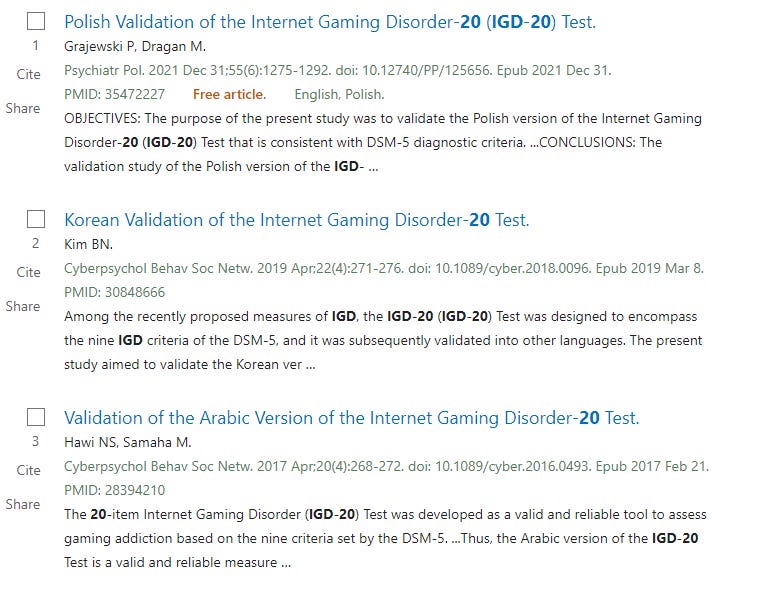
Source:
https://pubmed.ncbi.nlm.nih.gov/?term=igd-20
You can see now how easily one can find the topic for medical research!
As you can see, ONLY the test can not give you the answer. It should be measured, weighted and actually, let us be honest, researched.
You can go through the test yourselves: here.
There are 20 questions there (or “items” as it fancy called), every one of which can be answered with 5 degrees of agreement, from “strongly disagree” (1 point) to “strongly agree” (5 points). The maximum is 100, and the developer of this test says that the cut-off point is 71 points.
What does cut-off point mean? Supposedly if you scored 71 or more, you have the “addiction”. Here is the link to the study.
How come that 71 cut-off-point? Well, the researchers made the so-called Latent Profile Analysis (LPA) and found the group of “disordered gamers” and also a group of “gold standard” gamers and compared them. With some statistical magic comes the cut-off point.
How they came to groups of “disordered gamers” and “gold standard” gamers? What criteria for these groups? What does this actually mean?
Well, I have no idea! In fact, if you look into what LPA is: “…The goal of LPA is to find the best-fitting model that optimally explains the observed data…”.
Well, that is a cool thing, isn’t it then? But please do not ask us if you have the disorder or not!
Internet Gaming Disorder is an emerging concern that demands further research and attention.
And it’s about that. The doctors do not know yet, if it is a disease, if yes, how it could be treated, and what is the prognosis and consequences.
That is why I want to advise you: use common sense! Ask yourselves a question. “Do I play much? So much that I might have a problem?”
At least think about that if your IGD-20 test says that there might be a problem. But please, do not label yourselves based on only the results of the test.
No posts
Comments
Nothing yet. Say the first thing.
Sign in to join the conversation.