
Princess Margaret once let herself be photographed in her Kensington Palace dining room holding up a cushion embroidered with the words: “It’s not easy being a princess.”

It’s not a career choice that I’d personally recommend.
But for some really regrettable royal lives, I’d look to the princesses of the eighteenth century.
Do you remember Queen Charlotte, from Bridgerton? One of her friends once wrote her a letter about her six daughters. (She also had nine sons!)
“What unhappy wretches are some Princesses!” went this letter, “how they are sacrificed! It is to be hoped that they all have not the tender affections of their happier subjects.”
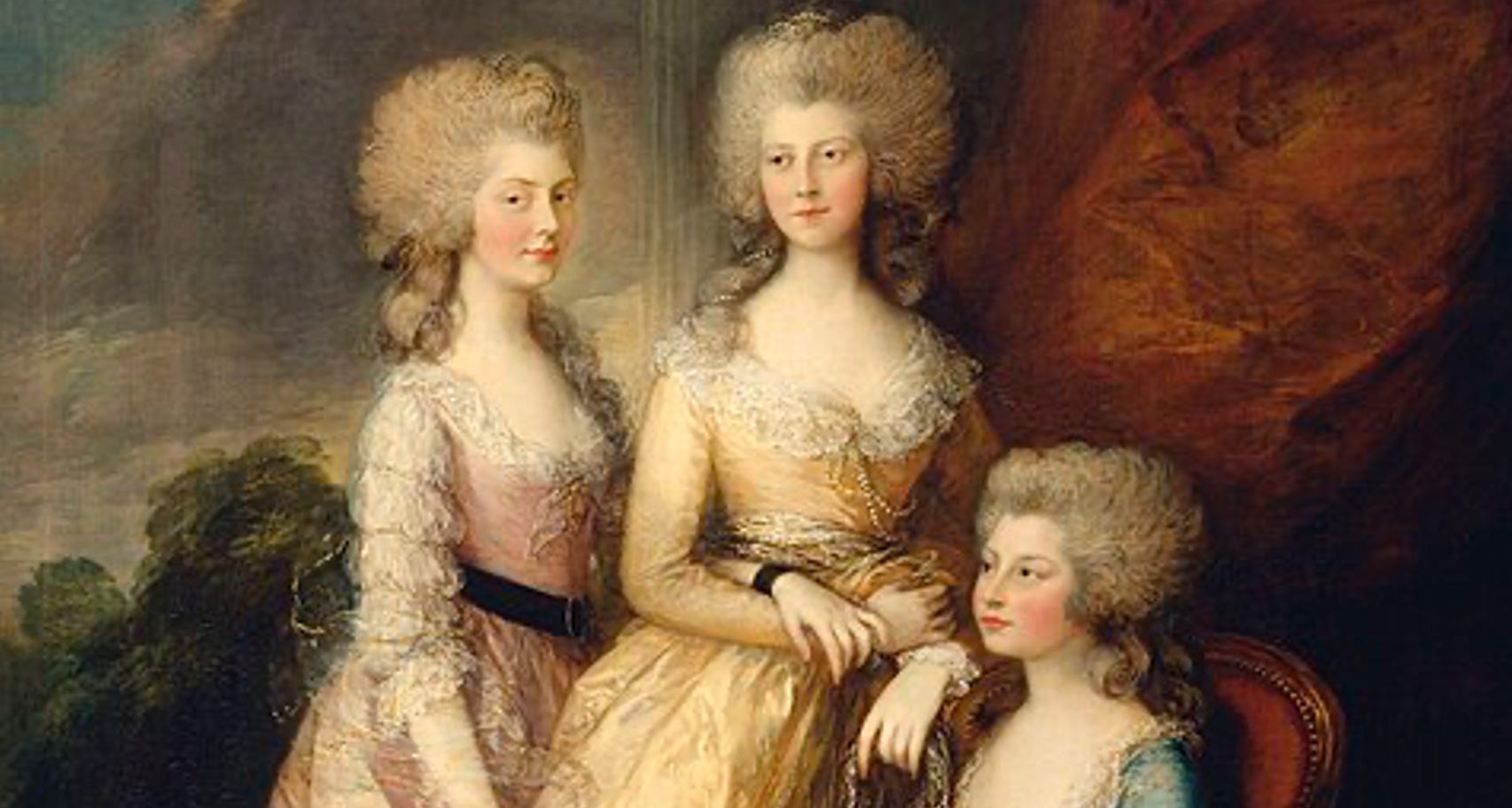
Sadly, her hope proved wrong. These six girls, daughters of Queen Charlotte and George III, knew exactly how much affection was missing from their lives.
This Hanoverian royal family habit of being mean to its girls went back two generations earlier, to a quarrel between George I and his son George II.
The older king once punished the younger by taking away his three small daughters, Anne, Amelia and Caroline. The monarch did have the right to control the persons and education of his heirs.
“We’ve such a good father and such a good mother,” one of them said, “and yet we are orphans.” Asked whether their grandfather George I ever came to see them, she replied: “Oh no, he doesn’t love us enough.”
Anne, Amelia and Caroline’s lives were rich in almost everything else except love. Documents in the British Library record that they were given two embroidered coats each winter, sixteen dozen pairs of gloves a year, a personal staff of five apiece, money for tuning their harpsichord and seed for their pet birds.
There was just one thing missing: no allowance for ribbons.
They grew up and, in due course, were supposed to be get married. Now, as Europe never quite had enough appropriately Protestant princes to go round, there wasn’t much choice involved.
Anne accepted Prince William of Orange, whose breath - said one horrified courtier - was worse than anyone who hadn’t smelled it could possibly imagine.
But by now Anne was so desperate to escape palace life that she said she’d have accepted a proposal from a baboon.
Her sister Louisa was sent off to marry the king of Denmark and died there of complications after childbirth.
Caroline had what would now be called a mental health crisis and spent twenty years as a recluse in two rooms of St James’s Palace.
Their younger sister Mary, was married at seventeen to a German prince she described as brutal and inhuman. She only escaped him when his conversion to Catholicism gave her the excuse she needed.
Amelia, the one sister left unmarried, stayed home to nurse her father George II and an unrequited passion for an elderly courtier nicknamed “Booby Grafton.” She dealt with the tedium by being savagely sarcastic and occasionally sneaking off to the gaming tables of Bath to win huge amounts of money.
These girls had a German sister-in-law, whose life took a turn for the worse, I think, before she’d even unpacked her bags after arriving in Britain.
Sixteen-year-old Augusta of Saxe-Gotha was married to their brother Frederick a matter of hours after she first set foot in England.
She was marrying a man she’d never met, in a language she didn’t speak. Her mother had assumed everyone in Hanoverian England, with their German royal family, would simply have learned German by now, so she hadn’t bothered teaching Augusta any English. She had to have a translation of the marriage service whispered into her ear as it happened.
Things didn’t really improve. When Augusta went into labour at Hampton Court, her husband Frederick was determined to spite his parents (this was traditional in the Hanoverian royal family) by denying them their traditional right to witness a royal birth.
So he forced his screaming wife Augusta out of bed and down a staircase that you can still see at Hampton Court. He pushed her into a waiting carriage, and they drove fifteen bumpy miles to London in the middle of the night.
Augusta arrived with her skirts all soaked through with her broken waters; and with nothing ready to receive her in London, the baby had to be wrapped in a table napkin.
In due course, her own daughter, another Caroline, grew up to be married off to the mad king of Denmark, took the royal doctor as a lover to survive the experience, got caught, watched the lover get executed for the crime, and then got separated from her children and imprisoned for the rest of her own life.
Which brings us to her brother George III’s own six daughters, the ones the letter-writer felt so sorry for in the first place.
Having watched what happened to his sister, George loved his girls enough to refuse them permission to marry, for years on end. This meant, in effect, that they weren’t allowed to do anything else either. It left them in a state of suspended animation.
Several of the unmarried ones ended up squeezed into cramped attic rooms at Kew Palace, in Kew Gardens, a dinky little red-brick palace like a doll’s house, which they nicknamed the Nunnery.
One of them, another Amelia, was slowly dying there of consumption.
One of the sisters, Sophia, saying that they felt like “poor old wretches … a dead weight . . . like old clothes.” She suggested they should all be put in a sack and drowned in the Thames.
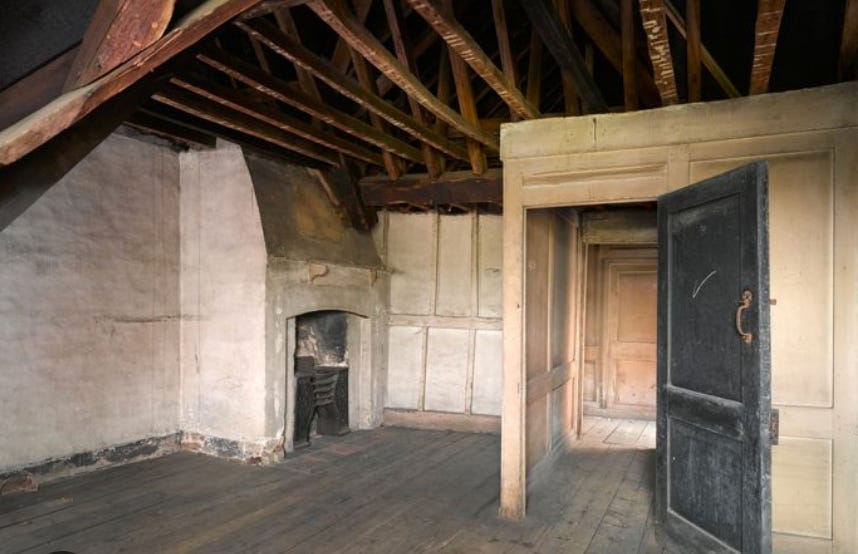
Those attic rooms at Kew still stand, deliberately left unrestored, their walls faded exactly as the sisters left them two centuries ago.
The silence up there has a particular sad quality to it.
Margaret’s cushion, I think, would have made perfect sense to every single one of them.
I tell many more of these women’s stories in my new book, Queens and Kings! The single best thing you could do for me and my ‘own darling Child’ (as Jane Austen described one of her books) is to pre-order it now rather than waiting for publication day. An order placed today ‘counts’ for more than the same order placed later. I’d be ever so grateful! Thank you!
Comments
Nothing yet. Say the first thing.
Sign in to join the conversation.