
My apologies for not posting for a few weeks. It’s not because I ran out of things to say, but because motherhood has a habit of consuming every available inch of bandwidth.
In that time, the activist and media conversation has not calmed down. If anything, it has become more confidently wrong. Somehow the Islamic Republic of Iran has been repositioned as the sensible actor, which is rarely a good sign.
Since the U.S.–Israel confrontation with the Islamic Republic erupted at the end of February, the usual talking points have shown up on cue and, like a bad houseguest, have refused to leave. You can probably recite them by heart: U.S.–Israeli aggression was illegal and reckless. The threat from Iran was not imminent. Diplomacy is always the superior route. Escalation, we are told, is the real danger because it risks repeating Iraq, another war over phantom weapons, apparently orchestrated for oil, with the obligatory nod to Mossad never far behind.
These narratives rest on a simple assumption: that the Islamic Republic is acting like a normal state, telling the truth about its nuclear program and engaging in diplomacy in good faith.
These assumptions are neat, reassuring, and easy to sell. They are also wrong.
The central point they overlook is fairly straightforward: the Islamic Republic of Iran is driven primarily by theology, not reaction. American intervention, Jimmy Carter, and the CIA’s role in the 1953 coup are historically relevant, but they do not explain the regime that emerged in 1979. What followed was not a conventional government but a revolutionary system built to subordinate politics to religious authority.
Under the doctrine of Velayat-e Faqih,1 ultimate authority belongs to a religious jurist claiming to govern under divine law. The system is rooted in Twelver Shi’a Islam, a tradition that sees history as moving toward the return of a hidden messianic figure, the Twelfth Imam,2 who will establish divine rule on earth. In other words, this is not simply a state pursuing policy. It is an apocalyptic project that happens to run a country.
This worldview explains why sacrifice and martyrdom are elevated above material well-being and why deterrence does not always deter. When leaders believe they are advancing a divine mission, the normal incentives that govern state behaviour lose much of their restraining power.
Even North Korea ultimately wants to survive. The Islamic Republic sometimes appears less concerned with avoiding catastrophe than with fulfilling what it sees as a sacred mission, even if the result is widespread destruction on earth.
For Western observers accustomed to secular politics, this framework can be difficult to recognise, let alone take seriously. We have an arrogant habit of projecting our own assumptions onto societies that neither share them nor pretend to.
In the Middle East, where religion remains central to public life, Western analysis doesn’t just go off the rails. It starts drawing its own map. The premise is unmistakably Western: all states are playing a rational game, weighing costs, pursuing interests, responding to incentives, avoiding catastrophe. But the Islamic Republic is not reacting to the world as it is. It is acting on a vision of how the world ought to be.
What looks to outsiders like escalation, recklessness, or even self-sabotage often registers internally as consistency. When the regime refuses to behave according to secular expectations, analysts search endlessly for grievances that might explain it in familiar terms. It is like trying to force a square peg into a round hole, except the peg is on fire and the hole is nuclear-armed.
And this is not merely a philosophical problem.
Before the June 2025 conflict, the IAEA estimated Iran had amassed enough highly enriched uranium for multiple nuclear weapons.3 Soon after, inspectors lost access to key facilities and could no longer verify the stockpile.4
For a regime driven by apocalyptic ideology, that is what strategic imminence looks like: shrinking breakout time, fading oversight, expanding missile capability, and a political culture in which martyrdom is not an embarrassment but a virtue.
You do not gamble with that. A nuclear-armed Islamic Republic would not simply make Israel less safe. It would make the world less safe.
Liberal societies are fundamentally incompatible with jihadist ideology such as the one guiding the Islamic Republic. One system is built on pluralism, individual rights, and secular law. The other rests on submission to religious authority and the expansion of divine rule. These are rival civilisational visions, not competing policy preferences.
That conflict is already playing out inside Western societies through intimidation, radicalisation, propaganda, and ideological capture. Pretending it is merely a local land dispute between Israel and its neighbours blinds people to what is already happening in their own backyards.
Even if Western governments withdrew from every conflict tomorrow and the United States dismantled its bases, the ideological hostility would not disappear, because it is not driven primarily by foreign policy resentments. It is rooted in deeper religious and moral objections — to secular law, gender equality, sexual freedom, religious pluralism, and the idea that political authority flows from citizens rather than from God.
In classical Islamic doctrine, Judaism and Christianity are understood as religions superseded by Islam as God’s final revelation. A sovereign Jewish state governing land once under Islamic rule is therefore a theological contradiction and, within that framework, intolerable. Under this logic, all non-Islamic societies — religious or secular — ultimately fall into the same category.
That belief appears in the charters of jihadist groups like Hamas5 and in the religious narratives embraced by Iran’s ruling clerics. It has also shaped Islamic governance in various forms across different states and empires, to varying degrees, throughout history. This is not merely the worldview of fringe militants but a recurring framework that has influenced political authority for centuries.
If we assume these actors are guided purely by secular calculations, their behaviour will look irrational. Once we recognise the religious framework driving them, their actions become entirely legible — and so does our own tendency to misread them.
When those of us who have only ever known secular democracies train ourselves to overlook the ideological forces shaping the conflict, we will struggle to recognise them anywhere else. If we spend years describing openly jihadist movements abroad as a simple land dispute, we should not be surprised when our own societies grow morally, politically, and intellectually hesitant to name the same force closer to home.
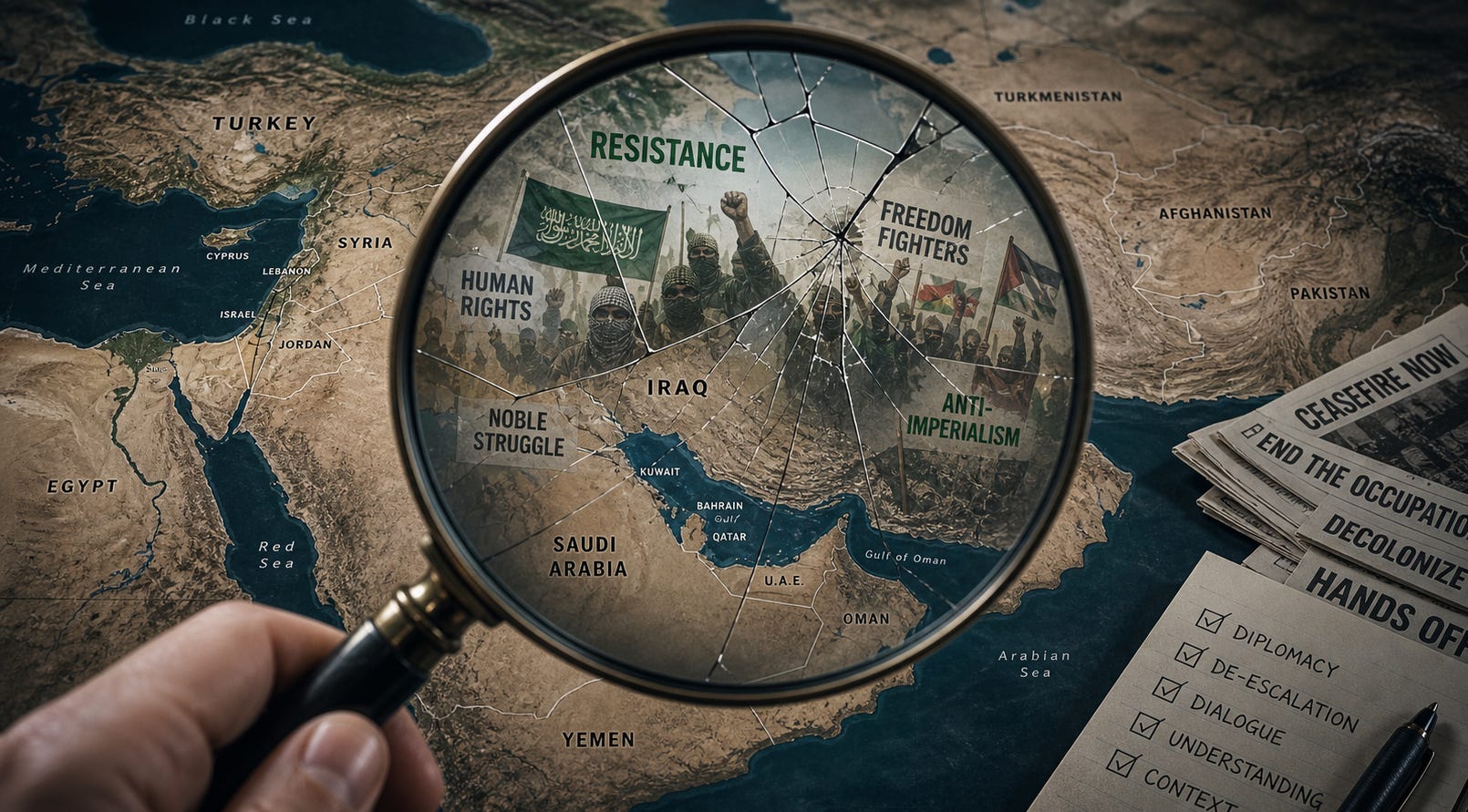
Groups like Hamas, Hezbollah, and the Islamic Republic are highly adept at manipulating Western language. They understand that the vocabulary of “resistance” travels well in societies inclined to reinterpret religious fanaticism as national liberation.
The result is that movements feared across much of the Middle East can present themselves to Western audiences through doublespeak as heroic underdogs, while benefiting from a chorus of useful idiots who mistake ideological aggression for justice.
Western publics are often advancing positions that many Arab governments neither share nor request, while overlooking the threat those governments and their populations live with every day from Iran’s proxy networks, jihadist militias, and destabilising regional violence.
What feels like solidarity in Western capitals can look, from the Middle East, like a profound misunderstanding of the danger, or worse, a refusal to see it.
Here in Europe, North America, and Australia, we are drifting deeper into a form of moral confusion that increasingly romanticises or excuses some of the Middle East’s most authoritarian and violent actors, while blindfolding ourselves to the religious dimension of the ideology in front of us. Again and again, after deadly attacks, we see an almost total unwillingness to name the doctrine that motivates them.
Thinkers like Sam Harris have long argued that jihadist violence cannot be understood without confronting the religious ideas that animate it.6 We are not facing violence driven merely by poverty or grievance, but by doctrines that explicitly reward martyrdom and violence in the name of faith.
Our inability to recognise the threat when it is stated plainly has reached absurd levels. It is as though someone can shout “ISIS” directly into the microphone, and we respond by explaining their grievances. Hamas filmed the atrocities of October 7, celebrated them, and promised to do it again — yet in parts of the West, the preferred explanation is that Israel somehow orchestrated or “asked for” its own massacre.
Likewise, the attack on Jews in Bondi was carried out by a man who had studied Islamist ideology and kept an ISIS flag in his vehicle.7 He was not hiding his motives. Yet in the aftermath, too many rushed to blame Israel, “Zionists,” or Netanyahu, as though the ideology declared by the attacker himself were somehow the least relevant fact in the room.
No, we have settled on an easier narrative, one that is suicidally dangerous: that everything is America and Israel’s fault. Their enemies could not be more delighted.
Of course, this makes no sense at all. Was it America’s fault when Jews were expelled from Medina? Israel’s fault when Boko Haram kidnaps schoolgirls from their dormitories in northern Nigeria? When Islamic State West Africa Province massacres villagers and burns churches in the Sahel? When armed militants storm Christian communities in Plateau State and leave dozens dead in a single night?8
When every ill is reduced to the actions of the CIA or Israel, history is rewritten and everyone else is stripped of agency. It is a profoundly patronising and self-defeating way to view the rest of the world.
These are not random acts detached from ideas. They are acts shaped by an ideology that legitimises violence in the name of religion, even when institutions struggle to say so plainly.
Misreading religious fanaticism is therefore not just an intellectual error. It is a strategic one.
A movement that celebrates death, elevates martyrdom, and seeks the expansion of religious rule cannot be understood through comfortable Western binaries of oppressor and oppressed, coloniser and colonised, good and evil. The habit of projecting our own ideological frameworks onto entirely different civilisations is not merely cultural arrogance. Increasingly, it borders on outright racism: the assumption that non-Western societies lack ideological ambitions of their own and exist merely as reactions to the West.
There is a reason many states closest to these movements often understand the threat more clearly than Western activists do. Egypt keeps its border with Gaza heavily restricted. Most Arab states refuse to absorb Palestinian refugees, despite decades of rhetorical solidarity. Gulf states monitor Islamist radicalisation closely; the UAE has even restricted funding for students studying abroad over concerns about extremist influence.9
Governments across the Middle East, having lived alongside these ideologies for decades, are often far less romantic about them than Western audiences viewing the conflict through the safety of distance.
But distance and safety are temporary luxuries. The problem is no longer that these ideologies are hidden. It is that too many people in the West still insist on misreading them.
If you value this kind of long-form work, paid subscriptions are what make it possible. I don’t post often, but when I do, this is the level of time and care involved.
If subscribing isn’t for you, there’s also a one-off support option here: https://ko-fi.com/lucytabrizi. Thank you for reading and for supporting this work in whatever way fits you.
We Haven’t Learned the Lessons of History
·
November 3, 2025
We all grew up asking, “How could they let it happen?” The ghettos. The yellow stars. The camps. The silence. We saw the grainy footage, the hollow faces behind the barbed wire, and reassured ourselves we would’ve done better. Hidden Anne Frank. Refused the salute.
See Islamic Government by Ruhollah Khomeini.
See Twelver Shi’ism for the eschatological framework concerning the return of the Hidden Imam (al-Mahdi).
See International Atomic Energy Agency reports (2024–2025) on Iran’s accumulation of uranium and the corresponding reduction in breakout time.
See International Atomic Energy Agency reports (2024–2025) on Iran’s enriched uranium stockpile.
See Hamas Charter (1988), available via the Avalon Project; see also the revised political document (2017)
See The End of Faith by Sam Harris.
See Reuters, “Islamic State calls Bondi Beach killings a ‘source of pride’,” 19 December 2025; see also ABC News coverage of the Bondi attackers’ ISIS links and ideological material.
See Reuters, “Gunmen kill dozens in Nigeria’s Plateau state,” 15 April 2024.
See Times Higher Education, “UAE cuts UK from scholarship funding over extremism concerns,” 9 January 2026.
No posts
Comments
Nothing yet. Say the first thing.
Sign in to join the conversation.