
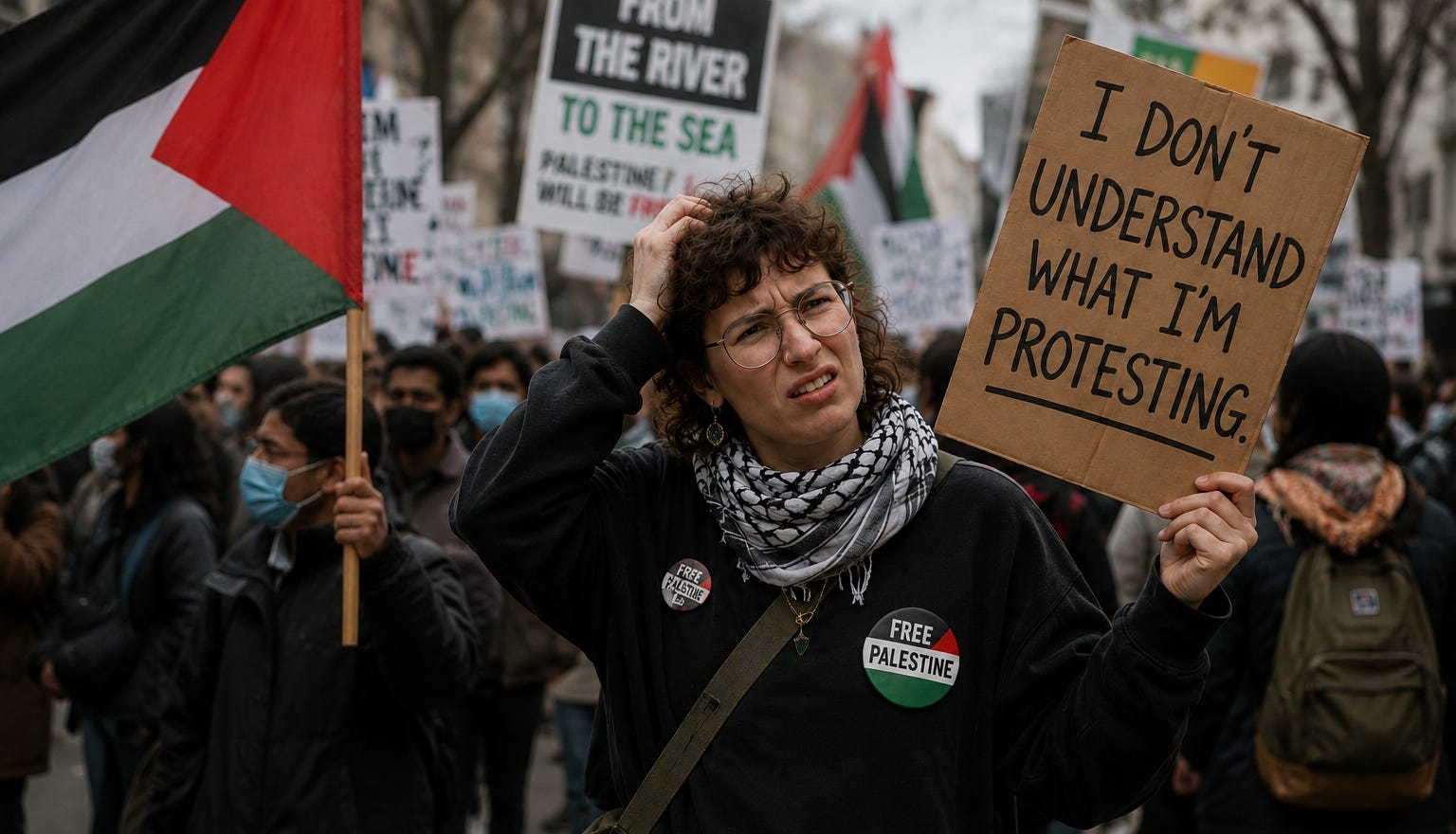
Even with a ceasefire, or at least the Middle Eastern version of a ceasefire where everyone pauses briefly before threatening to annihilate each other again, “Free Palestine” continues to follow me around like an unusually persistent telemarketer.
It has become the political equivalent of Mariah Carey at Christmas. No matter where you go, eventually it finds you. I explored this deeply annoying phenomenon here.
And while this endless public performance may provide enormous satisfaction to the people displaying it, no child in Gaza has ever been rescued by a tote bag in Melbourne.
So I thought I’d do something apparently few people invoking this phrase have attempted: think about it for more than seven seconds.
Firstly, though, I need to address a rather unfortunate historical complication for the slogan's fan club.
Long before it became an antizionist slogan, 'Free Palestine' was being used by Zionists.
Surprisingly few people seem to know this.
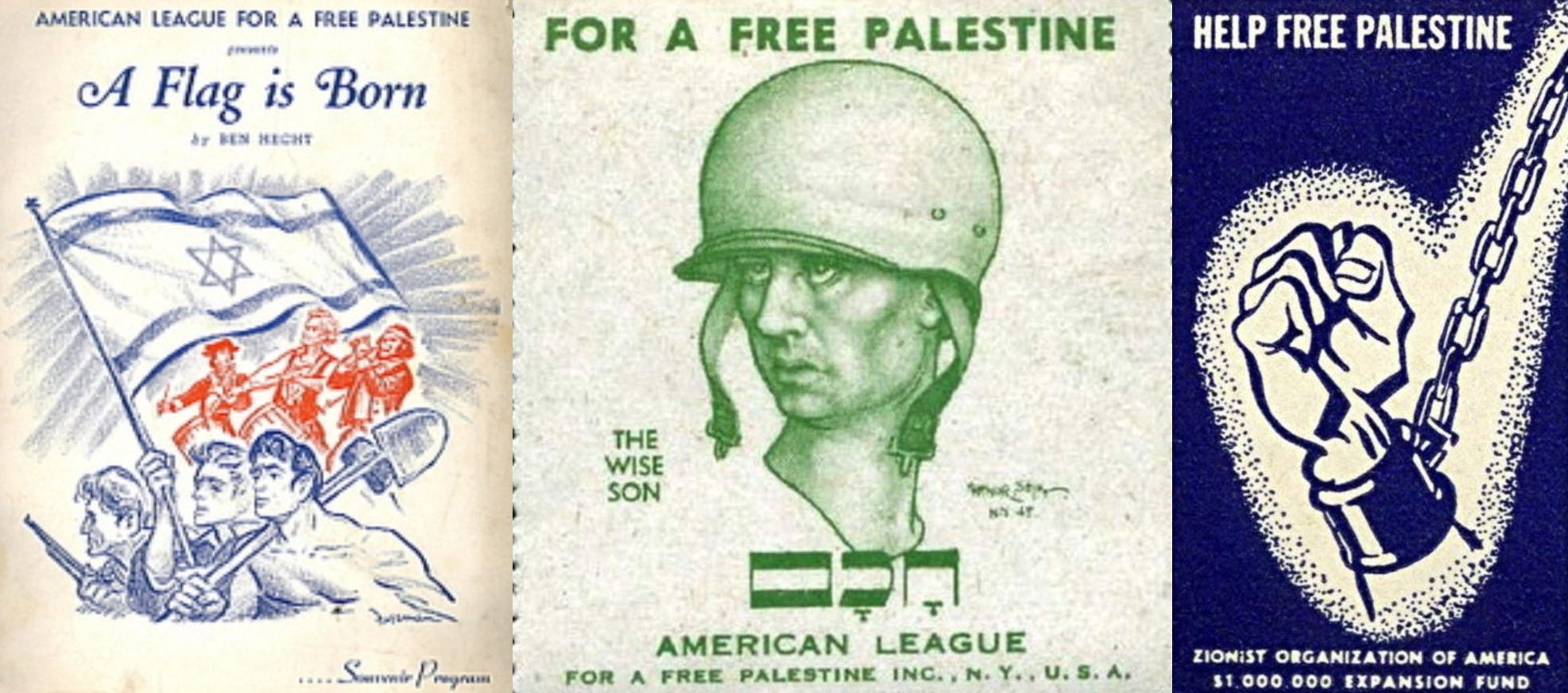
In the early twentieth century, Jewish activists used the phrase “Help Free Palestine” as part of the campaign to end British rule and establish a Jewish homeland.1
This emerged during the age of nationalism, when peoples across Europe and the collapsing Ottoman Empire were pursuing self-determination and statehood. Jews were no exception. Contrary to modern portrayals, Zionism was not a British colonial venture but a Jewish nationalist movement. Britain spent much of the Mandate period restricting Jewish immigration and opposing Zionist objectives, which is a curious way to run a colonial settlement project.2
This was also a period when Jews were commonly referred to as Palestinians. Institutions such as the Palestine Post and the Palestine Orchestra would later become The Jerusalem Post and the Israel Philharmonic Orchestra. Even in Europe, Jews were being told to “go back to Palestine” long before they were being told to get out of Palestine on today’s university campuses.
Which creates a rather awkward irony. A slogan now widely used against Zionism began as a Zionist slogan in an era when Jews themselves were referred to as the Palestinians.
But even after editing out that inconvenient chapter, as many activists today seem to have done, the slogan still makes no sense.
“Free Palestine” from what, exactly?
Let’s start with the version hiding in plain sight: where “free” means “free of Israel.”
This interpretation is often dismissed as a smear, despite the fact that Arabic variants associated with “From the River to the Sea, Palestine Will Be Free” have often been considerably less ambiguous. Earlier and widely used Arabic slogans such as “From the water to the water, Palestine is Arab” leave rather less room for interpretation.
Oddly, the people advocating this outcome often seem the least interested in explaining what happens to the ten million Israelis afterwards. What about the large proportion descended from Jews expelled from Arab lands after millennia of continuous presence? Are they entitled to a “right of return” too?
However, even if Israel disappeared tomorrow, the problem would remain, because none of the Muslim-majority countries in the region are remotely “free” by Western progressive standards. Least of all Gaza, which before October 7 was governed by Hamas, an IRGC-backed Islamist death cult that tortures dissidents, rules through intimidation, steals aid, indoctrinates children, and treats martyrdom as a national aspiration.
As Salman Rushdie observed, a “free Palestine” under current conditions would likely resemble a Taliban-like satellite state of Iran.3
The Palestinian Authority that governs the Palestinian areas of the West Bank is not exactly a shining example of “freedom” either. Elections are endlessly postponed, corruption is endemic, and critics routinely find themselves arrested or otherwise silenced. Political power often resembles a patronage network more than a functioning liberal democracy.
Which brings us back to the question: what does “free” mean?
Because in this context, “free” has become an ideological clown car into which activists cram completely contradictory ideas.
The extraordinary irony is that many of the loudest “Free Palestine” activists in the West belong to movements centred on feminism, queer rights, anti-racism, and liberation, yet have attached themselves to one of the most deeply illiberal political causes on earth. Many of the values they champion are not merely unpopular in Palestine but actively dangerous to express. It is one of the more impressive feats of cognitive dissonance in modern politics.
Let’s move on to a more charitable interpretation, though not necessarily a more convincing one: free from Israeli “occupation.”
The obvious problem is that Israel ended its occupation of Gaza in 2005. Every soldier withdrew, every settlement was dismantled, and every Jew was removed, dead and alive.4 What followed was not a flourishing democracy liberated from occupation. Gaza became an Islamist enclave ruled by Hamas.
As I keep finding myself pointing out, the war in Gaza did not happen because Gaza was occupied. It happened because Gaza was no longer occupied.
The blockade and security restrictions that many activists now retroactively redefine as “occupation” came after Hamas seized power and began launching rockets into Israeli civilian areas. Egypt, incidentally, maintains its own blockade on Gaza and has often enforced it more harshly along the southern border. Curiously, however, nobody seems especially interested in demanding that Egypt “free Gaza.” Nor did anyone spend decades chanting about Gaza needing liberation when it was under Egyptian control prior to 1967.
Almost as though occupation is not the issue after all.
Naturally, whenever Gaza becomes inconvenient, the conversation immediately relocates to the West Bank.
Despite what certain UN officials and activists may imply, the West Bank remains disputed territory. It is also a rather unusual example of an "occupied country," given that no sovereign Palestinian state existed there before the occupation in question. The territory was occupied and later annexed by Jordan after the 1948 war, which is where the name “West Bank” originates. There is a certain irony in citing the West Bank as evidence of colonial occupation while using a name inherited from Jordan's own illegal occupation.
More importantly, the obstacle has never been a complete absence of land on which a Palestinian state could be established. Various proposals have existed for decades. The problem has been the repeated inability of the parties to agree on the terms, including multiple occasions on which Palestinian leaders rejected statehood proposals altogether.5
It is a curious liberation movement whose central demand has repeatedly been declined by its own leadership.
To be fair, there is a more moderate interpretation of the slogan, favoured chiefly by the movement's more idealistic kumbaya wing. Under this version, “Free Palestine” means a single state with “equal rights for all,” in which Jews and Arabs live together as equal citizens in peace and harmony.
History, unfortunately, is not wildly encouraging on this front.
This arrangement effectively asks Jews to surrender the world's only Jewish state in order to create yet another Arab-majority state, and place their trust in a political arrangement that has never successfully existed anywhere else in the Middle East. Prior to Israel's creation, Jews throughout much of the region lived as dhimmis: tolerated but subordinate minorities subject to legal and social discrimination, punctuated at times by outbreaks of persecution and violence. Throughout the twentieth century, many of those communities were massacred, expelled, or ethnically cleansed from virtually every Arab country in the region. The Jewish populations of Iraq, Yemen, Egypt, Syria, Libya, Lebanon, and elsewhere largely vanished.6 There has been no meaningful reckoning and few apologies.
Yet many Western activists now ask Israelis to believe that dismantling Jewish sovereignty would somehow produce the region's first truly tolerant Arab state, complete with equality, pluralism, minority protections, and lasting peace. This despite the small complication that generations of Palestinians have been raised on a steady diet of martyrdom, antisemitism, and the glorification of violence against Jews.7
And this comes from movements that have spent the past two years displaying far more concern for hypothetical future Jewish minorities in the Middle East than for actual Jewish minorities being harassed in their own countries.
Nothing quite screams Western privilege like demanding that other people gamble their survival on your utopian political fantasies.
The strangest part is that the multicultural, multi-ethnic democracy many of these activists claim to want already exists in Israel, where Arab citizens and other minorities possess equal legal rights and participate throughout public life. Israel isn’t perfect, but by regional standards it stands in a category of its own.
It is the only country in the Middle East with pride parades, openly gay public figures, Arab political parties, an independent judiciary, and meaningful legal protections for religious and ethnic minorities. Yet rather than demanding its reform, many activists demand its elimination.
In short, the closest thing the Middle East has to the society many activists claim to want is the society they most passionately oppose.
The slogan becomes considerably less persuasive once somebody asks what it actually means.
Which may help explain why so few people ever define it.
Its real function becomes obvious once you start noticing where it appears.
Raise a question about Hamas? Free Palestine.
Ask what should happen to Israel’s population? Free Palestine.
Point out a contradiction? Free Palestine.
Watch a Jewish woman being ejected from a spa in Barcelona? Free Palestine.
Exist while visibly Jewish? Free Palestine.
This verbal haemorrhaging was never designed to answer questions. It was designed to end them.
Unfortunately, I may have just spent several thousand words explaining this to people who are already every bit as tired of the slogan as I am, and considerably more likely to have read this far.
You could point out every contradiction to the next person wearing the slogan, chanting it, waving it, or posting it online, but it would probably make little difference.
Logic did not give birth to this phrase. Logic is unlikely to be its undoing.
It functions as a rhetorical weapon to intimidate and as a tribal marker, signalling membership, moral status, and allegiance while remaining vague enough to accommodate almost any interpretation.
The vagueness is the appeal.
A slogan that means something can be debated. A slogan that means everything can attract almost everyone.
In that sense, it has more in common with a political salute than a political argument.
I would go so far as to say it is this era’s “Heil Hitler.”
Readers familiar with the historical relationship between the modern Palestinian movement and Nazi ideology will understand that I do not make that comparison lightly. I explored those connections in detail here.
It is no surprise that both phrases function primarily as declarations of allegiance rather than invitations to thought.
“Heil Hitler” was at least honest about what it meant.
If you value this kind of long-form work, paid subscriptions are what make it possible. I don’t post often, but when I do, this is the level of time and care involved.
If subscribing isn’t for you, there’s also a one-off support option here: https://ko-fi.com/lucytabrizi. Thank you for reading and for supporting this work in whatever way fits you.
Jewish Agency for Palestine, "Help Free Palestine" fundraising and advocacy materials, British Mandate period.
British Government, Palestine White Paper (1939).
Salman Rushdie interview with Bild, October 2023.
Israel Ministry of Foreign Affairs, Israel's Disengagement Plan: General Outline (2005).
Camp David Summit (2000), Clinton Parameters (2000), and Olmert Peace Proposal (2008).
Lyn Julius, Uprooted: How 3,000 Years of Jewish Civilisation in the Arab World Vanished Overnight (2018).
Palestinian Center for Policy and Survey Research (PCPSR), public opinion polling on Palestinian attitudes toward armed struggle and October 7, 2023–2025.
No posts
Comments
Nothing yet. Say the first thing.
Sign in to join the conversation.