
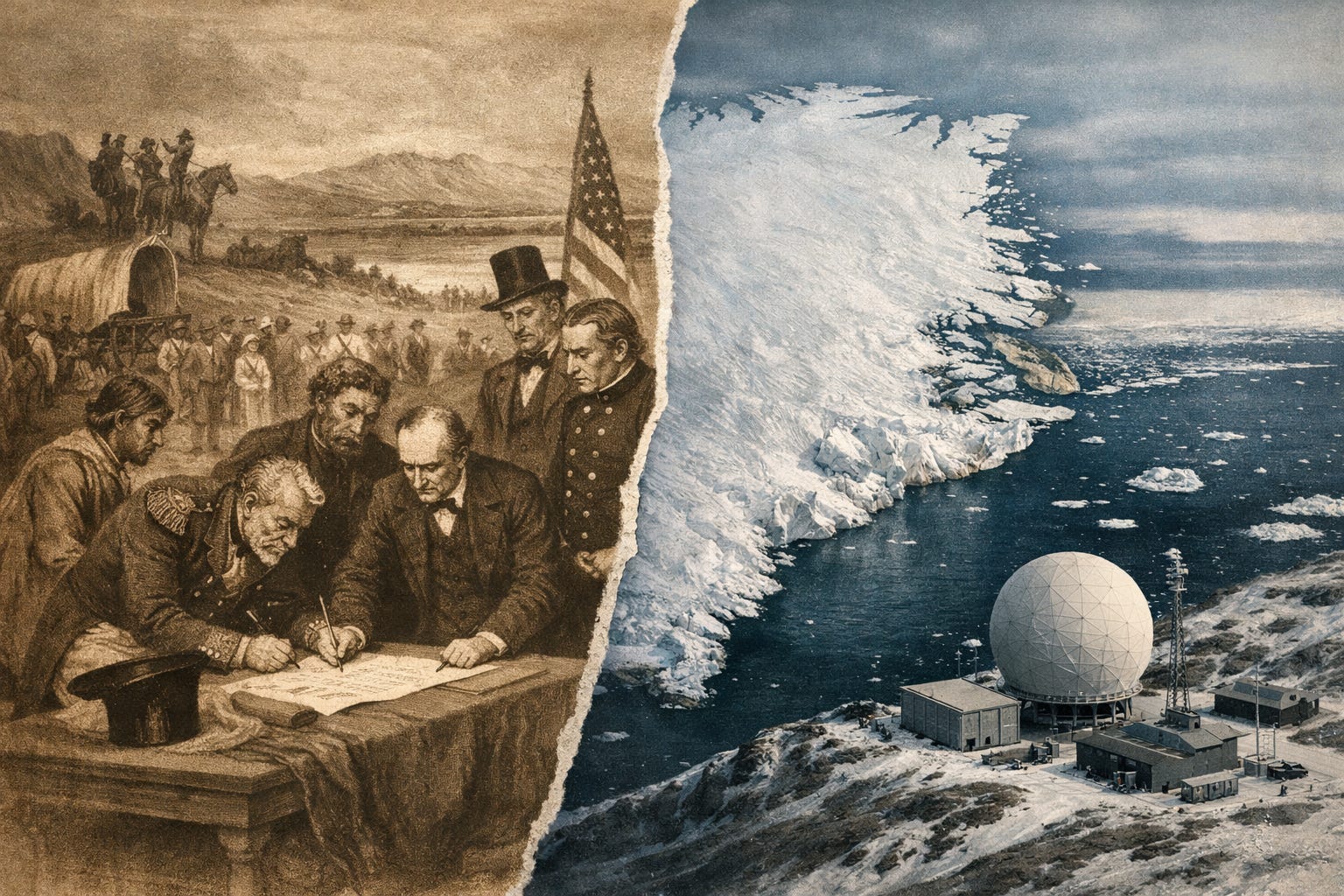
The Trump Administration’s desire to buy Greenland from Denmark has been called many things - imperialist, obscene, insane, and un-American. The first three are hard to dispute, but the last one, historically speaking, isn’t. What makes this weird isn’t the concept—it’s the timing. Here’s why.
The Louisiana Purchase (1803) - $15 million
Thomas Jefferson’s administration purchased 828,000 square miles from France, effectively doubling the size of the nation overnight. It included all or part of fifteen current states, stretching from the Mississippi River to the Rocky Mountains. The deal was simple, albeit constitutionally questionable: Napoleon Bonaparte needed cash for his European wars and decided to sell, the US had cash to spend. The price translates to roughly 3 cents per acre in today’s money. That’s the art of the deal.
Alaska (1867) - $7.2 million
Secretary of State William Seward bought Alaska from Russia for about 2 cents per acre. Critics at the time called it “Seward’s Folly”—I mean, it was a frozen wasteland, what’s the big deal? Russia, weakened after the Crimean War and worried they couldn’t defend the territory from Britain, decided to sell. The discovery of gold and oil later proved Russia spectacularly wrong.
The Spanish-American War (1898)
The Treaty of Paris gave the United States control of Puerto Rico, Guam, and the Philippines (which later gained independence). These weren’t purchases—they were spoils of war. By the turn of the century, acquiring territory through force or transaction was just what rising powers did.
The US Virgin Islands (1917) - $25 million
During World War I, the United States purchased the Danish West Indies for $25 million. The islands’ strategic location near the Panama Canal made them valuable for naval operations. Denmark, neutral during the war and under pressure, was willing to sell what had become an economic burden.
So yes, we would technically be repeat customers with Denmark.
But here’s the thing: this was over a century ago.
What Changed
After World War II, the rules changed. The UN Charter, decolonization movements, and the end of empire-building created new norms: you don’t just buy inhabited land from your allies anymore, especially when the people living there get a say.
Greenland has approximately 50,000 residents who are Danish citizens with substantial autonomy. In 2019, when Trump first floated this idea, Greenland’s government responded with a firm “we’re not for sale.” The US tried to buy Greenland once before in 1946, shortly after using it as a strategic base during WWII. Denmark said no then too. What made sense in the immediate post-war scramble doesn’t make sense now.
The Bottom Line
Yes, there’s precedent for the United States purchasing territory. Our entire continental expansion came from exactly this kind of deal-making. But there’s no precedent for doing it now—in an era of established borders, democratic alliances, and international norms around self-determination.
That’s what makes this feel so jarring. It’s not un-American in the historical sense. It’s just operating by rules from a century we’re not living in anymore.
No posts
Comments
Nothing yet. Say the first thing.
Sign in to join the conversation.