
I’m an over sharer, an anxious mess, an ex publishing professional, a screenwriter, short story writer, personal essayist and a novelist (The Lamb & more soon).
This is where I come to pass and receive nervous notes and be transparent about my writing and my wobbles. It’s part diary, part scrap book, but mostly a collection of extremely nervous notes scribbled down.
I don’t have a paywall (bar one handwritten letter I write to paid subscribers every year), but if you’d like to support me, there’s a paid subscription option with a couple of small perks.
Tell me, what is it you plan to do with your one wild and precious life?
-MARY OLIVER
I’ve been in a little bit of a reading slump lately. Everything I’ve picked up has stalled (usually because of other life things interrupting my reading). That was the case until I picked up Selected Poems (1965-2005) by Mary Oliver.
I already know I’ve lost about half of you at the word poems, but if you’re still here, thank you. I used to work adjacent to a British poetry organisation (we all shared an office and that’s where I first started reading poetry for pleasure). At length, we discussed the PR problem poetry has in the UK despite it being one of the most empathetic and technical writing crafts. It’s seen as dowdy and it’s often the butt of the joke in the cultural landscape with screenwriters making their most cringe-worthy characters an earnest slam poet who cares about relationship break ups and social justice1. Culturally, I often feel that poetry is depicted as cringe. It’s seen as embarrassing and even raucously funny to be sincere and to care about things like poetry and life and art and meaning.
I’m here to tell you that, above every fiction novel I’ve ever read, every screenplay, nonfiction book, and memoir, this is the best book I’ve read in my life and here is why.
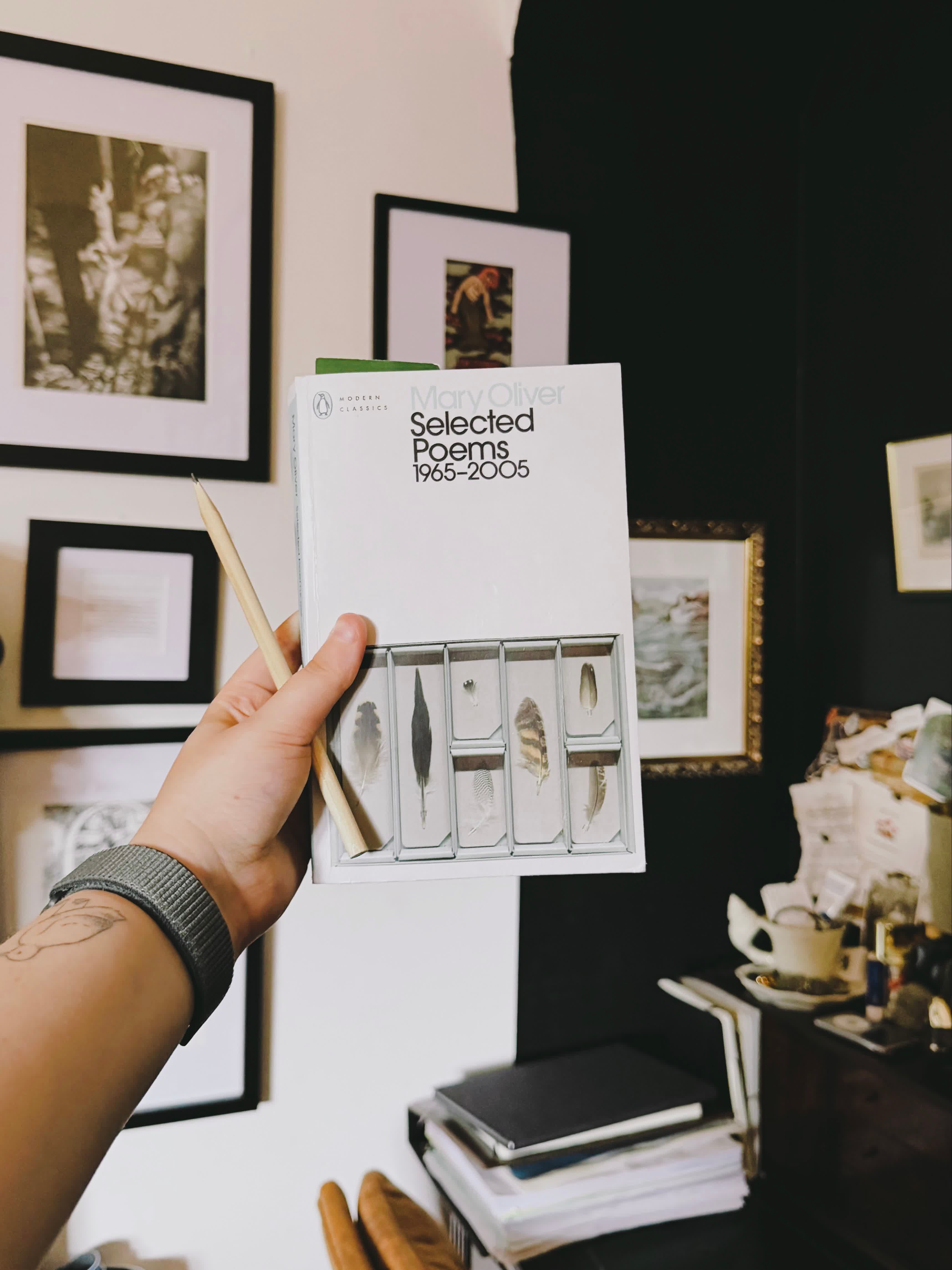
In August, when I felt tremendously alone, on a whim I picked up Mary Oliver’s Selected Poems. She’s one of those writers that is touted as being someone you must read before you die and now I understand why.
Every poem is a snapshot into something beautiful or sad or fleeting or angry. She painstakingly structures her syntax in a way that is so technical and yet so, so emotive. Every poem often reaches to tell us a story, to capture a small moment - the sort of rare pause we’re afforded to briefly catch our breath in life.
At a time of reading, my attention span was failing me because of my mental health, but these poems offered up small pockets of living where I felt myself un-numbing. That’s the thing about depression: it’s not so much sadness as it is becoming frozen and my god, it felt so good to thaw. I annotated my way through the collection, steadily warming up and feeling human again. The sensations returned to my fingers and my toes, and my body felt like it could move again.
In a poem called Robert Schumann (the namesake of it’s inspiration), I read the sentence:
[…], trudging the long road down,
through madness towards death.
Everywhere in the world his music
explodes out of itself, as he
could not.
I’d annotated the phrase: the long road, with a note that said: Depression. Long. Drawn out. No curves or forks. No scenic route. Just one long road and I think it might be endless.
I then went away to read more about this composer and found he had attempted suicide and been committed to a sanatorium, dying two years later of pneumonia after his mental health had collapsed. Later in the poem, Oliver writes this:
Hardly a day passes I don’t
think of him […]
He turns the corner,
he scrapes the dirt from his soles,
he runs up the dark staircase, humming.
This is an example of Oliver giving the reader and indeed, the subject of her poem, a moment of rare pause. Because life is made up of all these small insignificant in-between moments that we writers often don’t deem worthy of committing to paper. I like that she draws attention to the fact our internal worlds can feel all consuming and damning and tormenting, but also documents here the spirit we have to continue with our days despite that horrible darkness no one else can see, still finding it in ourselves to hum a tune as we go up the stairs. Writing this moment for him and for us was a quiet, reflective and somewhat remarkable kindness.
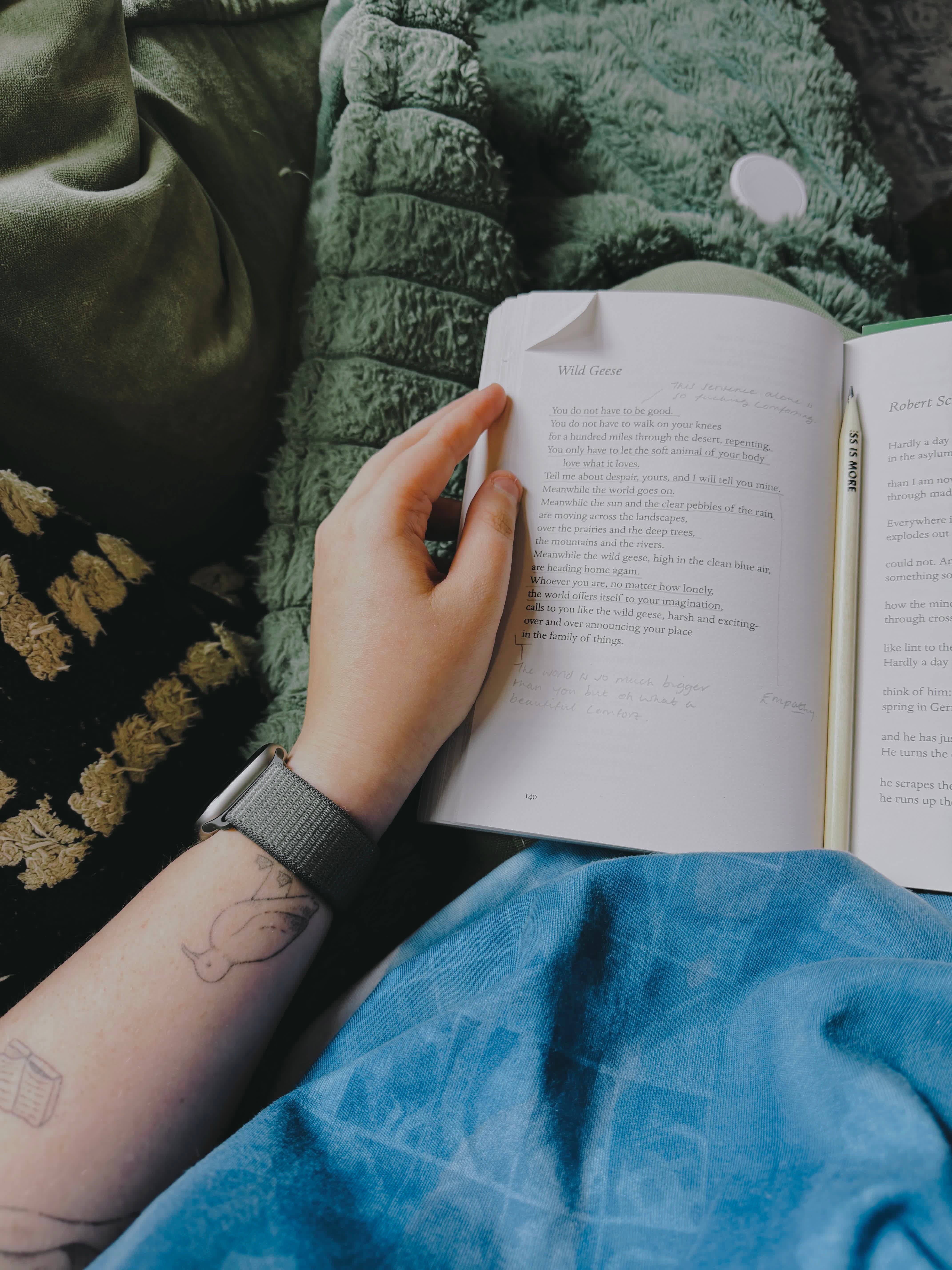
There are countless other favourites too. Wild Geese was a particularly beautiful poem that speaks louder today than maybe it did when it was written:
You do not have to be good.
You do not have to walk on your knees
for a hundred miles through the desert, repenting.
You only have to let the soft animal of your body
love what it loves.
Tell me about despair, yours, and I will tell you mine.
Meanwhile the world goes on.
Strangely, it reminds me a lot of The Good Place, a television show about the afterlife and the sum of our actions becoming the sum of our worthiness. I’m someone who ties themselves up in knots about my Good Place points. Have I bought the most ethical brand? Am I using language in the right way? Am I taking up space where I shouldn’t? Am I writing to my MP enough?2 Do I volunteer enough? Do I speak out enough? Am I donating enough money to important causes? Am I caring equally about all the terrible things happening in the world? Am I active enough in my community? Am I challenging fascistic views in a way that will change people’s minds? Am I protesting enough? Am I wasting my privileges? Am I making a difference? Am I fucking doing enough? Am I good enough?
The world is a mess.
It is impossible to be perfect. But it is human to try. Our activism will not be its most powerful if we can’t rest between resistance. That is what this poem reminded me. It also made me think of Strangers by Ethel Cain:
I tried to be good.
Am I no good?
Am I no good?
Am I no good?
With my memory restricted to a Polaroid in evidence.
This verse feels spiritually aligned to Oliver’s poem because it asks us: will I be judged and sentenced based alone on the moment I didn’t feel good enough? Is my worth sum on this earth my worst moments alone? Our human flaws often present us with complicated inner and external conflicts, but they’re also what make us so interesting. Especially as a trauma survivor, I find my own behaviours confounding at times and wish so badly I could just be normal and easy to live alongside, but because of the marks the world leaves on us, that’s not always possible. Our imperfections should not crucify us. They are evidence we are human and that we are trying to be better, surely. They are evidence that all of us hold the possibility of something more than what we are in this moment.
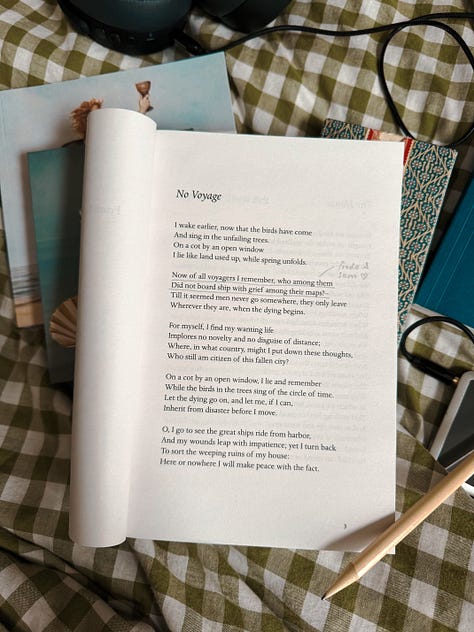
There are countless other poems I loved too, some pictured above. Reading this collection of work felt like walking through a sometimes haunted, sometimes enchanted woodland in summer and in winter, only the magic around us was the things we most often overlook: the ghosts that follow us from moment to moment, the people we have forgotten, the remarkable nature all around us, and what the animals teach us about our inner humanity.
It felt like a Noah Kahan, Ethel Cain or Searows Album. Filled with longing, loving and belonging, this collection pried open my mind and helped me out of what felt like a year living at the bottom of the sea where the world is hardened, cruel, ruthless, unforgiving, dark and heavy. I understand why people love Mary Oliver’s writing so much now, especially those of us who no longer feel like we can keep on existing.
But I think I’d like to leave this musing on a particular stanza that stuck with me. It’s a thoughtful moment from a poem called Hattie Bloom, which is about a lost woman of the same name. Instead of writing a poem to make us wonder where she’d gone, Mary Oliver instead wrote a poem that asked us to question what had happened to her instead.
Pressed to the door, a small and curious child
Eavesdropping on the terrifying world
Of sons and fathers talking of their women?
Stop, screenwriters, I’m begging you. It’s a joke that is literally only funny to a person who has never read a single line of poetry in their life.
I’ve discovered yes, because she’s now stopped writing me back.
Comments
Nothing yet. Say the first thing.
Sign in to join the conversation.