
Volodymyr Zelenskyy’s public frustration this month with China’s support for Russia’s designs on Ukraine has re-opened the question of what drives Beijing’s blatant support for Moscow. Why has Xi Jinping turned China’s pragmatic alignment with Russia into such a personally-inflected partnership?
Is there anything about Xi Jinping’s visit to Ukraine two decades ago that might give clues to his perspective on the war today?
Bear with me, because today’s essay involves a lot of unknowns and some speculation. Maybe someone out there can add more pieces to this intriguing puzzle.
More than 20 years ago, Xi Jinping led a delegation from Fujian Province, where he was governor, to Odessa in Ukraine. The purpose of the visit was to sign a sister province agreement, which was a very popular thing for Chinese local governments to do back in the day.
The Fujian government dates this visit to July 2002, but a book by the Central Party School, regarding Xi Jinping’s rise through the bureaucracy, says it occurred in Oct. 2000. Did Xi visit Ukraine more than once, or is one of these official sources mistaken? I don’t know.
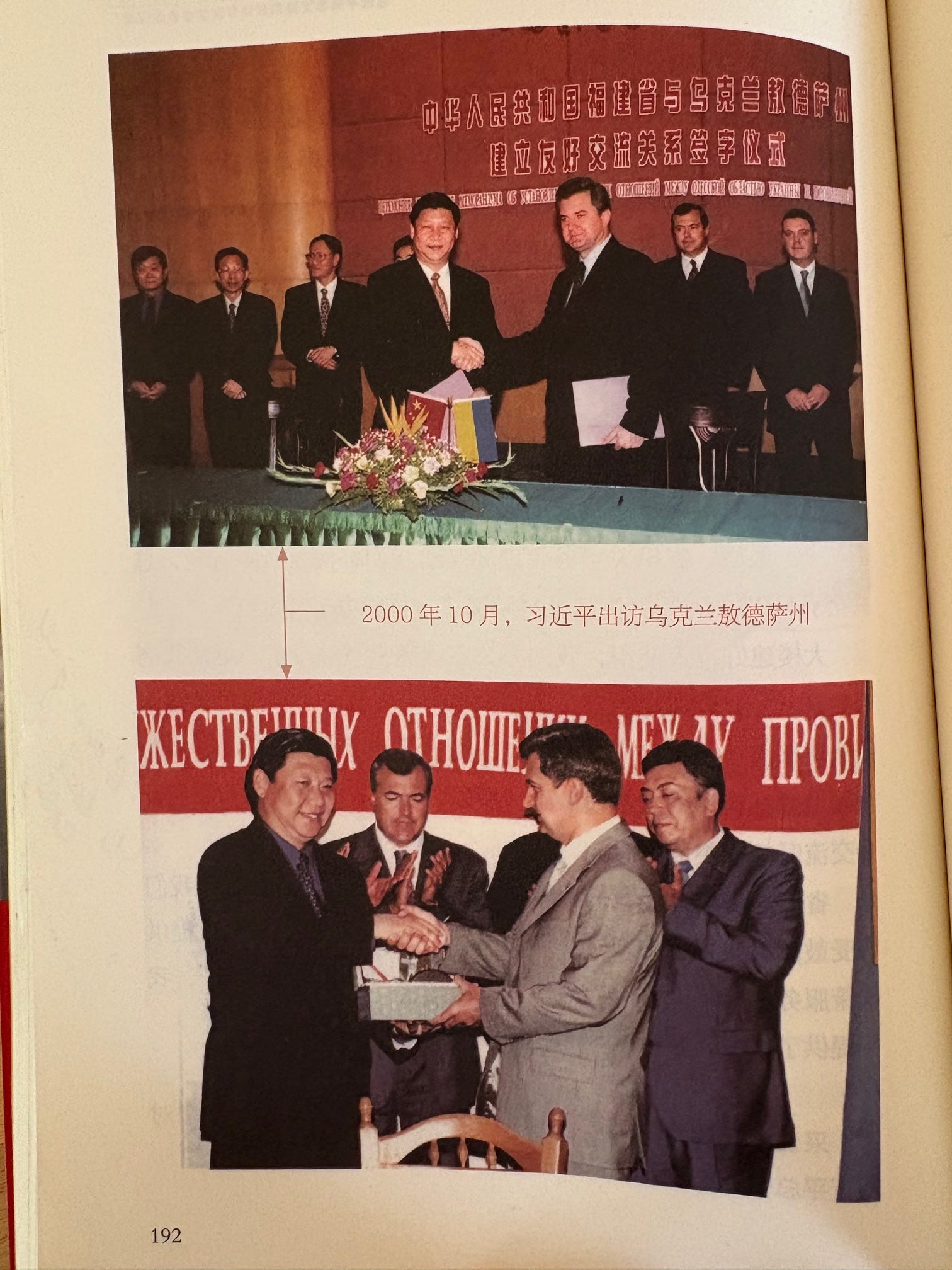
Image from 习近平在福建 (下), published by the Central Party School in 2021.
Either way, as far as we know, this was Xi Jinping’s first visit to any of the former Soviet Socialist Republics. But it wasn’t his first exposure to the Soviet Union – his father, Xi Zhongxun, led delegations from China to the Soviet Union and Eastern Europe in the late 1950s and early 1960s. These missions combined trade and some sensitive diplomacy, according a biography of Xi Zhongxun by Joseph Torigian.
“Xi Jinping was only 6 at the time, but he remembers how warmly his father spoke of what he saw in the Soviet Union,” Russian Sinologist Evgeny Petrovich Bazhanov wrote in Nezavisimaya Gazeta after meeting Xi in Moscow in 2013.
An aside — The Soviet portfolio turned out to be a poisoned pill for Xi Zhongxun. When he was purged in 1962 amid the Sino-Soviet split, he was accused of being inappropriately pro-Soviet, among other sins, and even of maintaining a secret machine for communicating with Moscow (it was actually a color film processor, for his photography hobby, his secretary has written).
Xi Jinping’s host in Ukraine in 2000 was Serhiy Hrynevetskyi (also transliterated as Sergei Grinevtsky), head of Odessa oblast, or province. Hrynevetskyi had a long career as a Communist official in his native Odessa, served as governor from 1998-2005 during the post-Soviet era, and was reappointed as governor by Zelenskyy in late 2020. (Zelenskyy fired him a few days after the Russian invasion of Feb. 2022, and put military men in charge of the region instead.)
Another aside -- Hrynevetskyi seems to view China positively. During his brief second term in office, he welcomed overtures from Chinese businessmen claiming to represent various Chinese provinces. This is not unusual – in the 2010s, Beijing promoted investment in Ukraine, especially by Chinese agricultural firms. It is also common for Chinese businessmen to use loose government affiliations back home to help open doors overseas.
While Xi was in Ukraine, what did he see or do? His only known activity was a visit to Odessa’s Pushkin Museum, which he enthusiastically mentioned during a tea with Russian Sinologists in 2013. The funny thing about that is that many Russians think he must have misremembered – few people have heard of a Pushkin museum in Odessa! The Russian version of his remarks, which was translated into English, says he visited a much more famous palace on the outskirts of St Petersburg. But the Chinese version says “Odessa”.
Xi Jinping was correct. There is indeed a tiny Pushkin museum in Odessa, featuring some rooms where the poet stayed for one month in the early 1800s.

It’s tempting to conclude that Xi Jinping, raised in an elite Communist family that admired the Soviet Union, would have come away from Odessa with an overwhelming impression of Ukraine’s Russian and Soviet heritage. He had toured a museum about one of the most famous Russian poets; the officials he met were former Soviet apparatchiks, who shared the heritage and habits of the Chinese Communist Party even if their current circumstances were sharply different.
By that point, Ukraine had been independent for about a decade. But it’s not clear, from the little information about Xi’s trip that is public in China, that any of the many historical reasons why Ukrainians might want to be their own sovereign country would have crossed his radar.
And that’s it… that’s all we know for sure about Mr Xi’s visit to Odessa. But there’s some more we can comfortably guess.
Usually, during a friendly visit like a sister-province signing, the Chinese delegation spends a few days or even a week in the host country. A little diplomacy, some sightseeing, a chance to tour factories and sound out the other side about future investment and trade. Xi’s known activities – signing ceremony plus a tour of a tiny museum – take up one day at best.
The pre-reform Chinese system – state-owned enterprises, state-run purchasing and trade systems – was identical to the Soviet system, and a lot of it was still intact in China in the late 1990s. If Xi did visit more facilities than the Pushkin museum in Odessa, what he saw would have felt quite familiar.
The Soviet system allocated ‘specialties’ to each province, and Ukraine’s specialty was military tech. So it’s not too much of a leap to suppose that if the Chinese delegation toured any factories, they might have had a military component.
That means it’s likely Xi Jinping would have witnessed the ugly side of the post-Soviet era. State-owned factories were idle and rusting. Officials-turned-businessmen dismantled whatever they could and sold it to the highest bidder (the huge flow of high-quality military scrap out of the former Soviet Union significantly depressed international metals prices in those years). Chinese officials accustomed to the optimism of China’s economic boom viewed this decay and degradation with disgust. While they haggled over the corpse of Soviet military and industry, they vowed that this would never happen at home.
Senior officials in the People’s Liberation Army were especially familiar with the humiliating state of the post-Soviet military. China sent many delegations to Ukraine and Russia in the 1990s to buy up equipment, weaponry and technical blueprints. Point person for that effort was a princeling named He Pengfei, son of He Long, a revolutionary guerrilla who worked closely with Xi Jinping’s father during China’s civil war. Although Xi Jinping was not in the PLA in the 1990s, many princelings he socialized with were. It is likely he would have been aware of these efforts.
To give an idea of the Chinese perception of these types of negotiations, here’s an interview that ran in the South China Morning Post about talks in the late ‘90s to buy the Varyag, a half-built aircraft carrier in the Mykolaiv shipyard, just east of Odessa oblast:
"I felt that I was soaking in liquor back then when I was negotiating with the management of the carrier builder," [military-linked businessman Xu Zengping said]. "At every meal I needed to drink two to three litres of erguotou [a powerful Chinese liquor]. In the critical four days, I brought them more than 50 bottles. But I still felt I had the energy to do it and was always able to keep a sober mind because my drinking was goal-directed; the Ukrainians were drinking to get drunk."
A third aside -- The SCMP’s fascinating 2015 series on Xu’s purchase of the Varyag and its expensive, multi-year, trouble-plagued journey from Ukraine to Dalian was written by Minnie Chan, an excellent reporter who was ‘disappeared’ in China almost two years ago.
Short though it was, that trip to Odessa was Xi Jinping’s first direct experience of the post-Soviet sphere. It might have informed his conclusion in a momentous speech in 2013, shortly after taking power:
“… if [our system of socialism] were not still standing, what would we have? A world of chaos.”
We don’t know what exactly Vladimir Putin shared with Xi Jinping about Russia’s plans for Ukraine, when it annexed the Crimea in 2014 or when it attacked western Ukraine in 2022. But it is possible that Putin’s framing made intuitive sense to Xi – not as the invasion of a sovereign country, but as the restoration of a natural order — and that Xi’s trip to Odessa so many years ago might have helped seed that impression.
No posts
Comments
Nothing yet. Say the first thing.
Sign in to join the conversation.