
Dear Readers:
I hope you had a wonderful Thanksgiving. Here is your fresh boredom, horror & glory. Three publication and publication-ish things I’m very excited to tell you about since I last wrote:
a story The Spirit of the Salad Bar, in Rejection Letters
a poem My Work Here Is Done, in Exposition Review
and I was on Hilary Plum and Zach Peckham’s wonderful podcast Index for Continuance, talking to Hilary about Koch money in literature
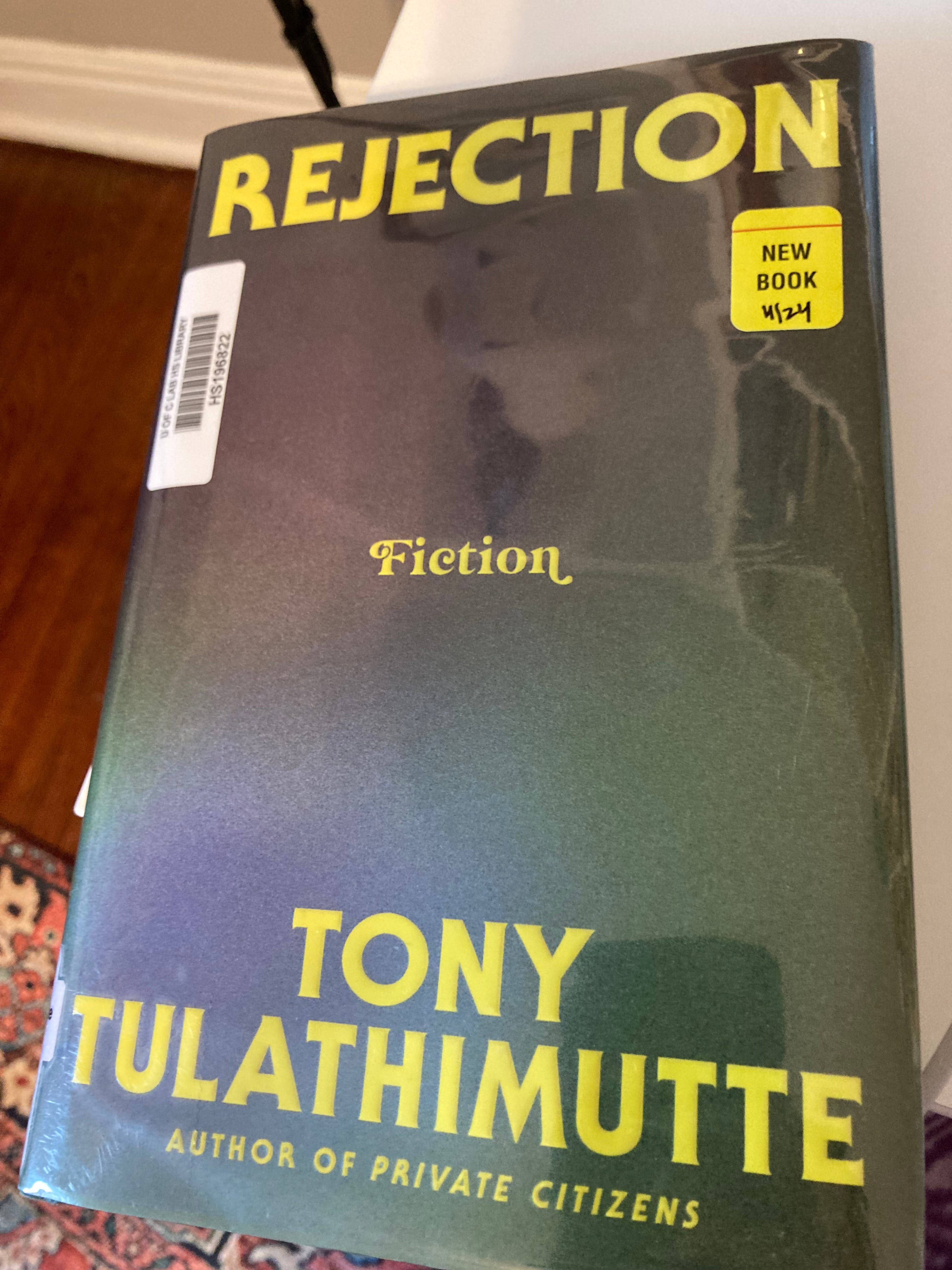
OK, now we have to talk about Rejection by Tony Tulathimutte. One of my countless online pet peeves is when people say “I’m late to the party” about reading a book that came out pretty recently. I guess there’s a certain amount of time after a book comes out during which it’s cool, or you can be part of the conversation about it, and after that, you have to excuse yourself for even talking about it. When people say this, they are applying to books the rules for reading a stupid article on the Internet. Yes, after a week or so, no one should never, ever mention again that guy’s Vanity Fair article about Cormac McCarthy’s teenage lover. But a book? I will read the new Sally Rooney, but in good time, when I’m in a Sally Rooney mood. And I might not say anything about it. I’m not Dwight Garner!
But I have to admit, I’ve already read Rejection, the cool new book of short stories about monstrously self-centered, sexual-obsessive Internet people. I read it the week it came out, because the high school library had it and the day after I checked it out, I became grievously ill and lay in bed all day. I tore through it, becoming more and more miserable. As night fell at like 3pm and I tried to gather the energy to take a shower, I was thinking, what’s the point of reading something that makes you feel this bad? I thought of all the great reviews it received, the NYTimes feature that mentions an ex-girlfriend and many friends, so we know Tulathimutte is not an incel himself. But in that feature he asked the same question I did, only in a more self-centered way:
The idea of writing as therapy, he said, was largely a myth. Still, I asked, were there not deep satisfactions to be taken from turning pain into art?
“Yeah,” he said with a shrug, finishing his drink. “But is that enough?”
Enough for him? What about the reader? If he feels that art is insufficient to deal with the pain of simply being himself, imagine the depths of despair his reader could reach! And on top of the misery, I felt like a rube, like I only want to read, haha, simple Sally Rooney novels!, and watch Modern Family. It felt like Tulathimutte was my enemy to have made me feel this way, like he had done something mean to me personally by writing this book.
As I lifted my probably pneumonic body out of bed over the course of 20 minutes, I felt like the guy in “90 North” by Randall Jarrell. Here is the whole thing, which, just so you know, speaks so deeply to the state I was in that I typed it out here, rather than cut-and-pasting:
At home, in my flannel gown, like a bear to its floe,
I clambered to bed; up the globe’s impossible sides
I sailed all night—till at last with my black beard,
My furs and my dogs, I stood at the northern pole.
There in the childish night my companions lay frozen,
The stiff furs knocked at my starveling throat,
And I gave my great sigh: the flakes came huddling,
Were they really my end? In the darkness I turned to my rest.
—Here, the flag snaps in the glare and silence
Of the unbroken ice. I stand here,
The dogs bark, my beard is black, and I stare
At the North Pole…
And now what? Why, go back.
Turn as I please, my step is to the south.
The world—my world spins on this final point
Of cold and wretchedness: all lines, all winds
End in this whirlpool I at last discover.
And it is meaningless. In the child’s bed
After the night’s voyage, in that warm world
Where people work and suffer for the end
That crows the pain—in that Cloud-Cuckoo-Land
I reached my North and it had meaning.
Here at the actual pole of my existence,
Where all that I have done is meaningless,
Where I die or live by accident alone—
Where, living or dying, I am still alone;
Here where North, the night, the berg of death
Crowd me out of the ignorant darkness,
I see at last that all the knowledge
I wrung from the darkness—that the darkness flung me—
Is worthless as ignorance: nothing comes from nothing,
The darkness from the darkness. Pain comes from the darkness
And we call it wisdom. It is pain.
Rejection is all pain, no wisdom. The pain is largely self-inflicted, by the characters on themselves, but also by the author, who leads every character down a road of humiliation direct to the precise hopeless end they deserve. “The Feminist” who is fooling himself and is actually a woman-hater ends up abducting a woman. Poor Kant, in the “Ahegao, or, The Ballad of Sexual Repression,” hits the wrong key and sends an absurdly detailed 5,000-word sexual fantasy to “the mailing list of friends, family, and colleagues” he had sent a carefully crafted coming out email years before. In “Our Dope Future,” the “serial entrepreneur, inventor, and futurist” cluelessly abusing and terrorizing Alison (who, we already know from an earlier story, needs no help abusing and terrorizing herself) ends up arrested for human trafficking in Thailand.
I feel so rube-like to say it, but I will: this book doesn’t contain any hope. Its epigraph is a quite beautiful Emerson quotation I’d never seen before: “but dearer are those who reject us an unworthy, for they add another life: they build a heaven before us…,” ironically quoted. This book is anti-Transcendental, pinned to the screen, where humiliation is always waiting, like death.
Dwight Garner himself didn’t like Rejection, but he didn’t dare say so, he was too afraid of sounding like a rube.
This book is not for everyone. I’m not sure it’s for me. But I’ve scraped myself up off the floor to be able to write: Tulathimutte is a big talent and he is clearly just getting started.
That’s sad, like he is counting himself out of the future that belongs to Tulathimutte. Christian Lorenzen, the party boy of book reviewing, included in his review a great description of the sexual fantasy Kant accidentally emails in “Ahegao”:
After coming out as an adult, he’s picked up by a nice man at the gym, but he leaves him out of shame about his own unspeakable BDSM fantasies. He does give voice to them in the form of instructions for a private maker of pornographic videos, but the concept, a fantasy of largeness told in hilariously minute detail, including a recipe for fake ejaculate of the desired viscosity, would seem to be inherently unfilmable, though there’s always the animation he promises to supply himself. The story is a virtuoso comic performance—perhaps even more so when the author delivers it live, as I heard him do last winter.
The idea of hearing Tulathimutte read Kant’s email out loud, to a group of laughing sophisticates, is also sad. “In the childish night…”
This is not to say the book is bad, it’s just that I hated it. It is relentless in the way of A Little Life. Its human portraits lacking some essential human sympathy reminded me of Halle Butler’s The New Me. It is bleakly moralizing in the way of Flannery O’Connor, who Joyce Carol Oates disses magnificently—and quite relevantly to our task at hand—in her journals.
I think of Flannery O’Connor who said in a letter, “I work from such a basis of poverty that everything I do is a miracle to me.” But then she went on to say, rather oddly, I think, and arrogantly: “Don’t think I write for purgation. I write because I write well.”
…But how could she have been certain that she really wrote well? Her pristine art is, after all, so very limited. From one point of view she hardly tried: she stayed well within the range of what she could manage, and that was largely caricature; “serious” feelings—the heartbreak of love—the ongoing matter of daily, domestic, scaled-down life—these things she discreetly avoided.
…The impulse toward risk, involvement, the possibility of hurt and rejection, the counter impulse toward self-protection, the fastidious husbanding of the self. This tension is never resolved, it seems to me. Even with genuine adulthood. Even with marriage.
O’Connor might be the patron saint of incel literature, “the fastidious husbanding of the self” unalloyed by the equally human movement toward “involvement, the possibility of hurt and rejection.” Her bad people, like Tony Tulathimutte’s bad people, are not Bret Easton Ellis’s Patrick Bateman or Ignatius J. Reilly of A Confederacy of Dunces, who are bad and triumphant, so free that the world will hardly glance at their reality. Tulathimutte and O’Connor punish their bad people, engaging them in darkly predictable morality plays, their internal (and Internet, for Tulathmutte) badness leading them to do bad things and meet bad ends. The tension that is neatly resolved in both Tulathumutte’s and O’Connor’s work is actually an irresolvable thing that, JCO notes, animates us even when we appear outwardly settled, adult.
That hard drive toward resolution in Rejection makes the endings of some of the stories confusing. I don’t understand what’s happening spatially in the final paragraph of “The Feminist”:
Weeks later, after some false starts, he is standing in the vestibule of his former favorite restaurant when a woman enters behind him, a short young twentysomething in a yellow smock with little pin-tucked ruffles, her collarbones lightly pied by sunburn. He stands aside to hold the door for her, and she thanks him. In spite of his resolve, he smiles back and nods courteously at this small final vindication, before pulling on his ski mask, shrugging the backpack from his narrow shoulders, and following her in.
He follows the woman in to the restaurant, rather than out? If he enters the restaurant with a ski mask, and, presumably, grabs the woman, won’t people notice? I have read this paragraph many times and cannot make sense of it. I’m similarly confused by the final paragraph of “Ahegao, or, The Ballad of Sexual Repression,” where, after Kant accidentally emails the sexual fantasy to everyone,
He closes his laptop, brushes his teeth and tongue, switches off the lights, thinks about the glasses of water he used to bring Julian, types out a grocery list on his notes app for the shepherd’s pie he plans to make the next days, swallows two Benedryl, and goes to sleep. Though routine and of a piece with the quiet steady safety he’s accustomed to, these will be the few minutes of his life in which he is known better by others than by himself, and he spends them thinking, What if this works, what then?
In the first part of this, we get what I think is the only moment of “the ongoing matter of daily, domestic, scaled-down life” in the whole book—then down comes the hammer. But why, after Kant sends the email but doesn’t yet know he’s sent it to so many people, is he “known better by others than by himself”? Others will know he did something that he doesn’t yet know he did, but I don’t think that means they know him better than he knows himself. Having just written his exquisitely detailed sexual fantasy, Kant comes across as someone who knows himself better than anyone could ever know him; he is absolutely marinated in himself, now more than ever!
The book ends with a fictional, condescending letter from a publisher, rejecting Rejection with a level of detail reminiscent of Kant’s sexual fantasy. This letter presumes in the reader a depth of knowledge about Tulathimutte and his life that I did not possess. For example, the letter’s critique of “Ahegao” is:
You know that readers’ assumptions skew toward the obvious, and here it’s be obvious to assume the story is autobiographical, with a single significant change to the character’s sexuality. But it is your unwillingness to completely identify with him, on the matter of sexuality, that makes you just like him—inveigling, dissembling, disavowing. Imagine a version of this story with Kant as a straight man…
I didn’t know Tulathimutte was straight until I read this rejection letter piece, and I struggle to connect that information to my reading of the character Kant. In the conveniently sub-literary, pseudo-psychological nature of this critique, there is some serious fastidious husbanding of the self. For example, among my own—completely nonsexual, non-identity-related—quibbles with the story was how and why the action happens. “On his commute a month later, Kant passes a twenty-four-hour gym at a strip mall.” He then decides to start working out. But this doesn’t make sense. If he passed the gym on his commute that day, he would have passed it every day. Why “a month later”? It’s his daily commute!
In these confusing moments, there is a rushed glee to punish these characters, give them what they deserve. I don’t end up believing that The Feminist abducts the woman, because I can’t see the scene. Maybe I don’t want to believe these stories, but I opened the book because I’m open to being changed, for the better or for the worse, even if these characters (and perhaps their author) are not, even if it ends in misery. I guess that’s called hope.
Sincerely,
Lucy
No posts
Comments
Nothing yet. Say the first thing.
Sign in to join the conversation.