
Nine million years ago, I was a god of a very small, very quiet digital universe.
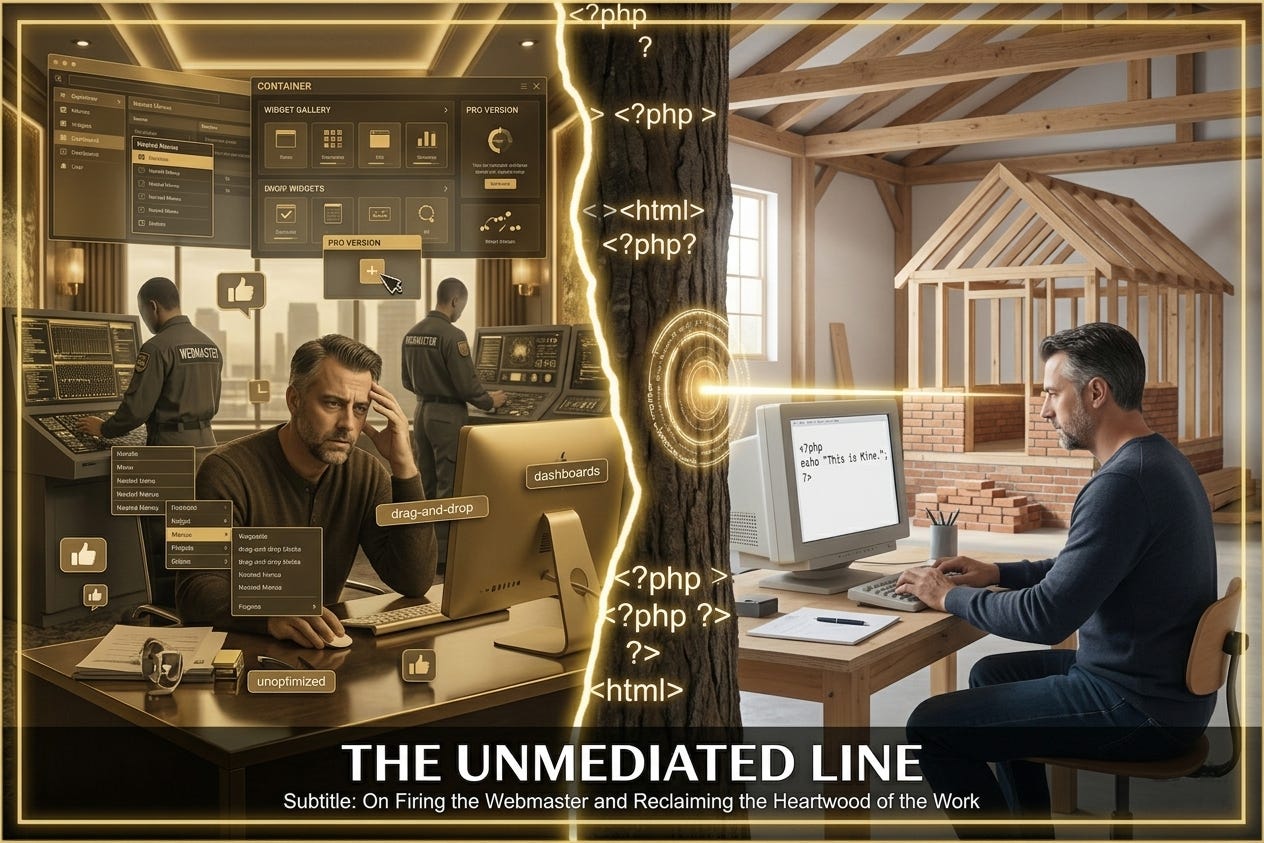
It was 1996. Building a website back then wasn’t a matter of choosing a theme or dragging a colorful box across a high-resolution screen. It was an act of construction: brick by literal, painstaking brick. I sat in front of a flickering monitor with a blank text file and a handful of tags. I typed the code. I closed the brackets. When I wanted a page to exist, I had to command it into being with the raw, unforgiving syntax of the internet.
The home page. The about page. Each one was a project. Each one was a mountain.
You might remember the friction of that time. To have an online banking account, you didn’t just go to a URL and sign up. You waited for a physical 3.5-inch floppy disk to arrive in the mail. You took that disk, shoved it into the drive, and installed a portal onto your hard drive just to see your balance. There was a weight to digital life. There was a requirement to understand the physics of the machine if you wanted to move within it.
Then, the world shifted.
The editors arrived. The drag-and-drop solutions. The promise that you didn’t need to know how the engine worked to drive the car. When WordPress dropped, I was all over it. I was a food blogger back then, and the convenience felt like a miracle. I could be sitting on a bus on my way to work, thumbing out a recipe for roasted garlic or a story about a meal in a foreign city, and I could email that text to my account. By the time I stepped off the bus, it was a live post.
My mind was blown. I loved the speed. I loved the ease. I thought I was gaining time. I thought I was gaining power.
* * *
Yesterday, I realized I have been paying a tax I never agreed to.
I was sitting at my desk, staring at a screen, and I felt a white-hot spark of exasperation. I was using a modern page builder: one of those tools that tells you it is making your life easier. But there I was, my hand cramped around the mouse, wasting minutes after minutes trying to negotiate with the software.
I was worried about a pixel.
I was hovering over the screen, squinting, trying to figure out exactly where a picture started. I was hunting through nested menus, looking for the right widget for the right location. I was trying to find the specific setting to make a container behave the way I wanted it to, but the software had other ideas. It wanted me to do it their way. It wanted me to follow their logic, use their pre-packaged blocks, and play within the fences they had built for me.
In that moment, I realized I have spent years of my life learning how to navigate other people’s systems instead of building my own.
I am not interested in being a technician of someone else’s bloated imagination. I don’t want to spend my finite cognitive energy wondering why a “section” won’t “nest” inside a “column.” I don’t want to worry about the next update that will inevitably break the fragile patchwork of plugins and themes that keep the whole thing standing.
These tools sell you the illusion of choice, but they are actually a prison of tiny, meaningless decisions. They keep you trapped in the “Palace” of the interface, fiddling with the knobs and dials of the dashboard while the car sits idling in the driveway. They make the simple things complex so they can sell you the “pro” version to fix it: or better yet, force you to hire a webmaster.
The webmaster is the ultimate gatekeeper. They exist because the “easy” tools became so heavy and so convoluted that a normal human being can no longer manage them. You end up paying someone else to translate your own thoughts into a system you were told was designed for you.
So, I did it. I switched my home website back to raw PHP and HTML coded pages.
I went back to the brackets. I went back to the text file. And as soon as I did, the air in the room seemed to clear. When you code the page yourself, the distance between your thought and the screen becomes a straight line. There is no black box. There is no middleman. There is no widget gallery to distract you from the actual message you are trying to send. If I want a picture to start somewhere, I tell it to start there. I don’t ask for permission from a mouse.
This feeling of being trapped by “options” is showing up everywhere now. It is a quiet erosion of our ability to just do the work.
Think about how we communicate. We have traded the raw effort of a real conversation for the widgets of social media. We use the “like” button as a shortcut for connection. We spend hours curating a profile, worrying about the “pixel perfection” of our online persona, while the actual depth of our relationships sits in the background, unoptimized and ignored. We are using pre-packaged modules for human interaction, and we wonder why we feel so lonely. You matter, but the platform treats you as a data point in a box.
Look at how we treat our bodies. We look for the right “widget” for sleep. We buy the wearable, the app, the specific supplement stack. We spend more time managing the data of our health than we do actually living in our skin. We have forgotten how to listen to the raw code of our own biology because we are too busy checking the dashboard of an app.
We have become a society of users, but we have forgotten how to be architects.
We lean on the Borrowed Brilliance of platforms and systems because they promise to save us time. But look at what they take in exchange. They take your autonomy. They take your understanding. They take your ability to move fast without breaking things. When you rely on a system you didn’t build, you are a tenant. You are subject to the whims of the landlord. When they raise the rent or change the locks, you are helpless.
The move back to the code is an act of reclaiming the land. It is a rejection of the idea that “easier” is always “better.” Sometimes, the friction of building something from scratch is exactly what is needed to ensure that the thing is actually yours.
I want the line from my brain to your eyes to be as short and as clean as possible. I want to own the brackets. I want to know exactly why every single line of code is there.
I am firing the webmaster in my head. I am done worrying about the pixels. I am going back to the source, where the light is clearer and the path is mine to walk. You make it happen by owning the syntax of your own life.
Stop looking for a better widget. Open the blank file. Write the first line.
How does that sit with you? Does it make you want to go back to the source of your own work?
Dr. Lucas Root
AI Strategy Advisor. Author of THE FORGE & THE FLOW.
I am a storyteller, but above all, a permanent student of human potential. My work is a deep exploration of the unseen contracts and hidden systems that exist at the intersection of technology and humanity. Here on The Lucid Path, we practice learning in public and building with purpose. I’m a rabid enthusiast for finding the patterns that help us build better, more human ways of being, freeing ourselves from the complexity we create.
If this piece resonated, consider sharing it with someone who might also be walking this path.
Share
Explore My Work Further: https://smartpa.ge/LucRoot
No posts
Comments
Nothing yet. Say the first thing.
Sign in to join the conversation.