
Subscribe for future updates. It's free!
This article was supposed to be a quick look at my “Moneyball” approach to health. It’s now 16,000 words. For a seriously condensed version with all of the main points but less of my sophomoric humor, just read what’s in bold.
A reader sent me this line immediately after publishing:
“You expect me, a lazy man, to read all this!?”
It’s a fair point, so I’m adding the AI synopsis he generated so his lazy ass didn’t need to read the entire thing…
The author’s angle: Jonathan Bales is a sports analytics/gambling guy (not a doctor) who applies a “moneyball” lens to health — treating fitness like a game to be solved rather than a medical discipline.
Core principles: Think in probabilities, make +EV bets (meaningful upside, limited downside), favor via negativa (removing negatives beats optimizing in the tails), and prefer reversible mistakes since bad health interventions have asymmetric downside.
Use multiple lenses for truth: Run ideas through the lenses of personal experience, believable experts (track record + logic), math, “what works” empirically, and science. The more lenses it passes, the higher the conviction.
Adherence beats perfection: A worse plan you’ll follow for years crushes a perfect plan you’ll abandon. Engineer your environment, think long-term (ignore daily weight fluctuations), and track what matters without becoming a data scientist.
Key resources: Momentum Shake is the author’s foundational health and longevity supplement. He uses Examine.com to cut through the noise on supplements and studies by weighting for sample size, design, and funder incentives — critical since most studies are junk. Bales also recommends Function Health for bloodwork.
I failed my first college test because I took way too much creatine and my body wouldn’t stop making these ridiculous farting noises, so I just left the classroom.
I’ve told this story in How to Get Better at Anything ASAP: My Extreme Theory of Learning (which I recommend checking out because it’s relevant to this post):
When I began working out a lot, I went to GNC and got protein and vitamins and stuff, as well as some creatine. The directions said to pre-load the creatine, which meant taking four teaspoons a day for the first four days and then one a day after that. My roommate was joining me and said this was to be done four times per day. He meant like one teaspoon four times a day, I think, but for some reason I got it in my head that it was 4x4, or 16 servings a day. And I was doing tablespoons, not teaspoons, which meant I started taking TWELVE TIMES the recommended serving of creatine, which was already too much since you don’t actually need to pre-load it at all.
I started on a Wednesday. I specifically remember this because I had a Spanish test—the first test of my college career—on a Thursday afternoon. I went into that test with 24 tablespoons of creatine eating away at my insides. I failed that test. I failed it after I panicked and started writing shit down in Spanish that made no sense for the first half, then just got up and left before finishing the rest. I did this because my body was repeatedly making this ridiculous farting noise. Not my ass. My body. Like my back and sides and stuff—very loud, very extended farting noises that were making everyone extremely uncomfortable.
Think about the wettest fart you’ve ever had. Now imagine that extending for maybe 3-4 seconds. Now imagine those noises coming from the depths of your body every 30 seconds or so in a quiet classroom filled with your peers who you’ve just met, all turning and staring as your face is dark red, entire body covered in sweat, sitting in terror as you wait for the next eruption.
Anyway, I got super jacked in college. At my peak, I was 178 pounds and could bench press 225 pounds 31 times. I’m not bragging; that’s actually embarrassing, but I’m just trying to demonstrate how much time I put into this. Didn’t learn a word of Spanish, but you should have seen my triceps.
I did eventually stop mainlining creatine, but I got legitimately strong and learned a ton about training and nutrition. And since it’s a passion of mine, I’ve retained a large percentage of the information I’ve picked up over the years.
There was no real strategy behind anything I was doing in terms of learning, but since that time, I think I’ve gotten much better at learning and, in hindsight, can look back and identify specific principles that I’ve built upon as a foundation.
Learning how to learn is more important than racking up useless bits of knowledge, and, similarly, learning how to build, implement, and adjust a fitness protocol is more important than which one you choose or where you start.
The creatine incident was my origin. Since then, I’ve spent an embarrassing amount of time lifting weights, doing stupid fitness prop bets, and collecting more health data than any reasonable person should. Here’s the quick version of my “resume” so you know what you’re dealing with:
As someone who worked at a gym for about six full months, I’m uniquely qualified to give you health advice.
One of my first businesses in high school was as an online personal trainer. I had one client and wasn’t certified to be a trainer. That business generated $60 in revenue over two months before I realized hey this is pretty fucking stupid.
I’ve done a variety of fitness prop bets in my day, including one called the 6-12-18-24 Challenge in which I had to drink 24 beers, eat 18 donuts, jack off to completion 12 times, and run six consecutive miles in a 24-hour period. You might think you know a thing or two about fitness, but try running six miles outside in 105-degree heat with a belly full of beer and donuts after not sleeping because you were up all night masturbating. I know what you’re thinking, and yes, a grown man in a hazmat suit verified each time I jizzed into a napkin.

Hey, are you still reading this?
I also won a bet in which I did 2,400+ pushups in under 12 hours. This was during the start of COVID and because all you degenerates had no sports to watch and nothing to gamble on, there were literally hundreds of thousands of viewers and millions of dollars bet on this. I booked this bet sort of as a joke two days before I completed it, and it was covered by People, Men’s Health, etc. Pretty hilarious.
But seriously, the real reasons I want to write this:
Over the past couple years, I’ve once again gone deep down the rabbit holes on fitness, health, longevity, sleep optimization, etc., so I’m currently very interested in this stuff and I’ve been doing tons of research, putting together my own resources, and collecting a lot of data on my own.
I’ve long been passionate about fitness, but also how people can use analytics to learn, evolve, and win games (whether winning means making money or beating your family’s ass in Monopoly or maximizing happiness). So it’s natural to me to apply data to my health for the same sort of reasons I used to chart every NFL play into 50+ categories for “fun” or how I know, at the time of this writing, I’ve caught 2,021 fish (and 168 different species) in my lifetime.

Holy shit, I can’t believe I just revealed that on the internet.
So, if there’s one unique angle I have, I think it’s living at that intersection and understanding how to properly apply a data-driven approach to health—by turning it into a game and figuring out the optimal way to beat the game. In my opinion, if you can win one game, you can win any game, and basically everything you do in life can be turned into a game. I discussed my strategy for winning the pushup bet in this thread:

Jonathan Bales@BalesBets
1/ One year ago today, I did 2400+ pushups in under 12 hours for money. Most of you already know about the bet (did you happen to catch the stream, @draftcheat?), but there’s a bunch of stuff I never told people. Here’s some of it… pscp.tv/w/1YqxoQkVXQgG…
6:10 PM · Apr 2, 2021
28 Replies · 23 Reposts · 355 Likes
I think there’s a lack of truly useful intel when it comes to fitness, health, exercise, sleep, nutrition, and supplementation. There’s plenty of data and information out there, for sure. I just think it mostly sucks, gets incorrectly interpreted (mistaking correlation for causation being the biggest contributor), generally comes in the form of a much-too-small sample size, isn’t specific to the individual, and almost always is proposed by people/companies with incentives unaligned with yours.
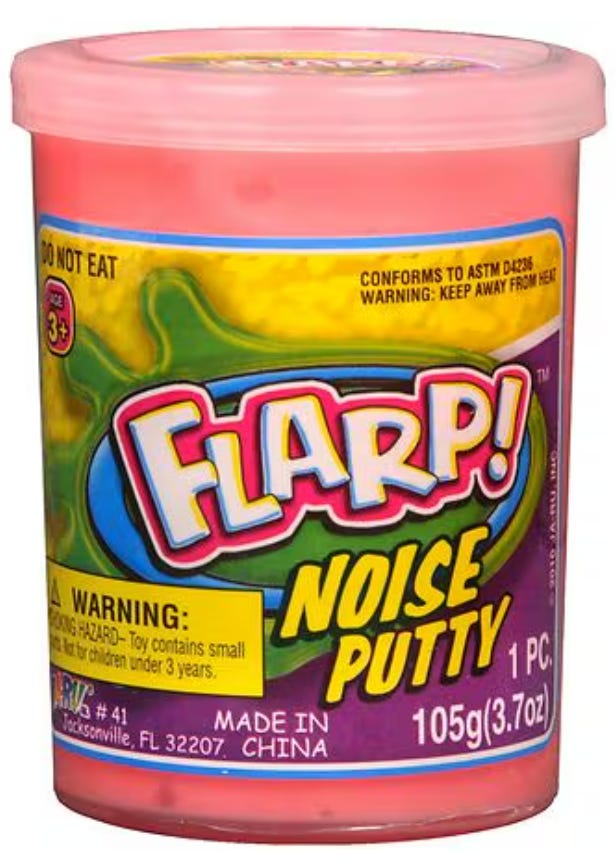
So no, you probably shouldn’t blindly trust the guy who once failed a college exam because his BCC (Blood Creatine Content) led to his back making the same noise you hear when you stick your fingers into this:
But if you’re trying to get in shape without turning into a full-time biohacker, I might be just the idiot you want to listen to. I’ve spent years on this stuff; you can use my obsession, spreadsheets, and general autism to your advantage to get in shape while still being a lazy fuck.
This all might look promising if you squint, but none of it makes me a doctor. So before we go any further, let’s be extremely clear about something…
Disclaimers: I figured I should put disclaimers in here even though I think it’s just painfully obvious you shouldn’t be blindly trusting a guy on the internet.
First, I’m not a fucking doctor. My background is in sports analytics, entrepreneurship, and gambling. I’m simply a dude with some thoughts on how to apply a data-driven approach to life and some experience in doing it for myself. I believe that background is applicable in fitness and nutrition, but none of this is meant as medical advice…obviously.
Second, I recommend some websites, tracking tools, supplements, etc. in this article. As you’ll read later, my approach to uncovering “truth” in wellness is governed first by the principle “Primum non nocere,” i.e. “do no harm.”
I personally use everything I recommend and have done so for a long period of time. For three of these–Examine, Function Health, and Momentum Shake–I have links with an affiliate code. In each instance, I reached out to the company to get an affiliate link–not the other way around–and always because I already used their product.
I could link to many products/services, and I’ve chosen these three because they’ve changed my life: they’re the foundations of my research, bloodwork, and supplementation. I full-heartedly believe they’re the most high-impact purchases you can make for your overall well-being. But please DYOR on any link you click.
And finally, I must reiterate this: I’m a self-taught schmuck. If you want to look into the things that have worked for me, that’s awesome, but I’m just conveying my experiences so you can maybe have a head start in researching on your own. Literally, I’m begging you, DO NOT TRUST ME AND VERIFY EVERYTHING IN HERE.
Before getting into any protocol building, I want to explain the general operating system fueling my approach.
I think the “game” of health/fitness is much like any other game, which includes making better decisions under uncertainty, avoiding obviously stupid shit, and setting your life up so the healthy choice is not only easier to make repeatedly, but also not even really a choice–just a necessary byproduct of your environment.
That’s really all I’m trying to do here.
My background isn’t medicine. It’s becoming unreasonably obsessive about things until I feel like I understand and can solve that particular game by separating signal from noise.
And health is a domain with an absolutely insane amount of noise.
There are studies that contradict one another, many of them funded by those who’ll benefit from a specific result. There are influencers promoting whoever pays them the most. There are pseudoscientists, weird longevity guys, peptide nuts, meatheads, and–somewhere within all that–information that can help you better your life.
So the point of this section is simple: these are the broad principles I use to decide what seems real, promising, risky, or worth trying.
Think in probabilities, not certainties.
A lot of people seem to want health to work like a trial in which there’s a final verdict. Are seed oils bad? Is red meat good? Is this supplement legit? Is that study bullshit? Everyone wants a hard yes or no.
Things are usually not so black and white. Most of the time you’re dealing with incomplete information, mixed evidence, incentives you can’t fully identify, and people who are way more confident than they should be.
Rather than asking, “Is this definitely true?” I think the better question is, “How likely is this to be true, how strong is the signal, what happens if I’m wrong, and how much do I even care?”
That framing alone is helpful because it makes you less dogmatic.
Think in terms of expected value (EV).
This one comes naturally from gambling. A good decision is not the same thing as a guaranteed outcome. You can make a smart bet and lose. You can make a dumb bet and win. That doesn’t mean the dumb bet was secretly smart; it just means you got lucky.
Health is similar. You’re looking for actions where the upside is meaningful and the downside is limited. Lift weights? Clearly a very obvious good bet. Sleep more? No shit. Try a low-risk supplement with real evidence behind it? Depending on your goals, probably fine. Take a foreign peptide because someone else claims positive results? Maybe not as sharp.
Most of what I’m doing in health is just trying to make a bunch of good bets, repeatedly.
Use a “via negativa” mindset.
The fitness world is tricky to navigate because not only are there all kinds of reckless ideas floating around, but there’s a clear financial incentive for many people to make these ridiculous ideas sound sophisticated to sell something. That’s a problem because the downside of being wrong can be a lot more meaningful than in other areas of life.
If you’re wrong about a business idea, maybe you waste time and some money. Or maybe you even iterate on the bad idea until it’s good.
If you’re wrong about some health intervention, maybe your hormones are toast, your sleep is wrecked, or oops shit you’re dead now.
So I heavily prefer asymmetry: meaningful upside, limited downside, reversible mistakes. That’s a really important point: the more easily reversible the mistake, the more feasibly you can take the chance.
That’s also why I think removing obvious negatives (via negativa) matters so much more than adding marginal positives. If you sleep like shit, barely move, drink excessively, eat everything in sight…your problems are probably not going to get solved by optimizing in the tails.
Use multiple lenses to figure out what’s true.
This is a huge part of how I think, and I’m going to get into it in much more detail in a bit, but the basic point is that no single source gets to monopolize truth.
Studies matter. Experts matter. Logic matters. Pattern recognition matters. Personal experience matters. Common sense matters. The experience of smart people with skin in the game matters. And depending on the question, some of those matter more than others.
If you’re trying to decide whether caffeine helps you focus, your personal experience matters a lot. If caffeine makes you feel like you were chased down by a rabid dog, it doesn’t matter that some population-level data says it improves alertness.
If I’m trying to decide whether a supplement is worth trying, I want some combination of robust studies, believable people I trust, logical sense-making, and enough anecdotal real-world signal to justify experimenting. The more lenses something passes, the more confident I get. If it only passes one lens, I’m skeptical.
Later I’ll break down the lenses more specifically. For now, the simple version is: don’t blindly trust studies, don’t blindly trust anecdotes, don’t blindly trust doctors, don’t blindly trust influencers, and definitely don’t blindly trust me.
Use trial-and-error (but not chaotically).
You have to test things on yourself. You are not the median participant in a study. You are one little data point with your own genetics, diet, habits, preferences, schedule, psychology, injury history, and so on–but you’re the most important data point.
So yes, personal experimentation matters. A lot.
But random experimentation is not the same thing as useful experimentation. If you change twelve things at once and then declare that some mitochondrial stack changed your life, you may in fact just be redacted.
The better approach is to alter one variable when possible, pay attention, give things enough time to work, and cultivate your pattern recognition. Some things have immediate effects. Some take weeks. Some are too subtle to judge cleanly in the short term. It’s important to know the correct time horizon you should be using on experimentation.
Be data-driven, not a data scientist.
I love data. There’s no evolution without trial-and-error, there’s no trial-and-error without a survival mechanism for smart beliefs, and there’s no survival mechanism without data.
But that doesn’t mean you need to be drowning in numbers. Many times, how you feel is the only relevant piece of data you need.
The point of tracking things is to improve decisions, not to create a full-time job logging every gram of food and change in REM sleep.
Track what matters and use data to sharpen your instincts and improve your pattern recognition. You can analyze data as much as you want if you find it genuinely interesting, but it’s not necessary to be a data scientist to unlock amazing health–just someone who’s aware of relevant pieces of information.
One caveat here, as I’ll discuss in a bit: the ability to run massive amounts of data through LLMs increases the value of at least collecting it.
Optimize for adherence, not theoretical perfection.
This is where a lot of smart people overthink it.
Finding the “best” plan in a vacuum is worthless if you can’t stick with it. You’re not going to eat healthy all the time. And even if you could, why would you want to?
A slightly worse plan that you’ll actually follow for years is much better than a perfect plan you’ll follow for a weekend.
This applies to everything: your diet, your workouts, your supplement routine, your sleep practices, your step count, your meal timing, all of it. The best plan is the one that gets implemented consistently without you becoming miserable.
A huge amount of health success is just smart architecture. Make the most beneficial behaviors the easiest to complete, both psychologically and practically day to day. Make the bad behaviors annoying. Exploit your own psychology in useful ways.
Think long-term.
Getting in shape is pretty much the ultimate long game. The reality is what you do today is going to have such an inconsequential effect on your overall health to the point that it’s effectively imperceptible.
But your choice of what to do today matters, because that choice can (and must) be repeated, over and over again. The commitment to making the right decisions on a daily basis–and ultimately rigging your environment so they’re not even really conscious choices–is what will lead to compounding benefits.
Eating junk is something that’s obviously short-term fun and long-term detrimental, but people who are actually trying to be healthy can suffer from short-term thinking as well. Some ways I’ve noticed short-term results throw off a long-term plan:
Worrying about day-to-day weight fluctuations, which are influenced by a number of variables, most notably water retention
Eating as few calories as possible to reduce weight (at the cost of long-term metabolism)
Doing cardio because it burns the most calories during your workout (at the cost of long-term caloric expenditure and a lower base metabolic rate)
As mentioned, time horizons are extremely important when it comes to health because they dictate how we interpret data and optimize a path forward.
In general, we want long-term compounding effects over fragile short-term gains.
Turn health into a game you can actually win.
“Health” is a vague concept. There’s no real target. But if you pick your desired outcome and turn the entire process into a game to reach that end state, you can determine the “rules,” work backward from success, and continually iterate and evolve to “win.”
What are you optimizing for? Muscle growth? Cardiovascular benefits? Better sleep? Reduced anxiety?
Pick your game.
Then learn the rules, use the right lenses to identify signal, find the potential edges, and stack +EV bets.
I’m not trying to find one grand unified theory of wellness. I’m trying to make better bets, avoid needless downside, use multiple filters to find what’s likely true, and build a system that works for me in real life.
Everything else in this article is just that idea expressed more specifically.
“Be data-driven” and “balance risk with reward” are nice taglines, but in the real world you’re drowning in information and most of it sucks. There are data points everywhere, and you can confirm any preconception you have if you look in enough places.
The reality is that your job–not just in health, but in every form of life’s decision making–is to weigh each piece of evidence according to its merit (with most being discarded).
To make sense of anything in health, you need multiple filters that you can run ideas through to see what survives.
In his book How to Fail at Almost Everything and Still Win Big, Scott Adams proposes that we determine what’s true through various lenses–personal experience, experiences of people you know, experts, scientific studies, common sense, and pattern recognition.
Once you start running decisions through these lenses, you find that:
A few habits, tools, and products keep showing up as obvious no-brainers.
A few things look promising but need skepticism and testing.
And a whole lot of shiny nonsense reveals itself as exactly that.
Instead of pretending there’s one single source of “capital T” Truth, I try to view ideas through a set of lenses—different ways of looking at the same thing—and then see what survives.
The more lenses something passes, the more confident I am in it. If they conflict, I decide how much I care based on 1) which lenses have historically been most useful for certain types of problems and 2) the upside and downside of being right/wrong.
So that’s the game: use the lenses as a filter for the firehose of truth, then make decisions and build plans based off of your most high-conviction beliefs, followed by your speculative-but-interesting beliefs that have limited downside.
I’ve molded and blended some of Adams’ filters, as well as added some of my own, to look something like this:
There are times when your personal experience matters a lot, and times when it’s sort of irrelevant. For example, when deciding if you can beat a casino at roulette, the fact that you’ve won money in the past is worthless (assuming you didn’t cheat).
In this case, other filters should tell you that your experience doesn’t matter; others have lost money, the math guarantees you’ll lose long-term, and it’s just common sense you’re not going to make money playing roulette.
If you make the mistake of viewing the economics of casino gambling through solely the lens of personal experience–and you’ve won in the past–you’re going to be in for a rude awakening.
In terms of health and fitness, there are times your personal experience is really all that matters. If when you eat almonds you consistently get a horrible rash, it doesn’t really matter that almonds are healthy for the overall population, does it?
Sometimes, though, you might not have personal experience related to a particular decision, or you might have experience that shouldn’t be weighted with great strength. Health is closer to roulette than almonds most of the time because of the vast number of variables that go into your health—sleep, stress, nutrition, exercise, supplement interactions. A particular supplement could be useful and you might not see it over a short timeframe (or vice versa that it’s junk but you see “results” over a short timeframe).
Overall, your personal experience might seem completely representative of reality (and thus predictive of future experiences), but it’s flawed more often than you think due to confounding variables. As an example, let’s say you take a supplement to improve sleep quality during times when you have big upcoming work projects. You track your sleep with your Oura ring and see your total sleep, deep sleep, and REM sleep levels all remain unchanged or even get slightly worse when taking the supplement.
Does that mean the supplement doesn’t work for you? Maybe, but what if during those times you were also working late, causing you to eat dinner very late just before going to bed? Add in additional work-related stress and you can see how you might not see any signal from a supplement that could in fact be effective for you if you were to remove the correlation with life habits that are negatively impacting your sleep.
Another example that pops up all the time is water weight. At any given time, your weight is almost completely the result of how much water your body is storing, which is why short-term weight fluctuations are an absolutely awful barometer for determining the effectiveness of any single variable in your health protocol.
For example, when I start exercising a lot after some time off, I immediately gain a bunch of weight and, for a short period, look worse in the mirror. This is a pretty common occurrence for many people’s bodies when reacting to stressors. It would be foolish to assess the merits of any action you take without acknowledging the impact it has on your fluid retention.
This is why a multifaceted approach to uncovering truth is so valuable; each individual lens through which we view the world is limited–oftentimes in ways we cannot see–and so we have to sort of “bake in” that uncertainty and possibility of being wrong by considering various viewpoints.
Typically speaking, your experience matters when the effects are immediate and repeatable–think of the effect on your energy after drinking two cups of coffee–such that there aren’t 100 confounding variables making it impossible to trust the results.
In Adams’ list of filters, he explains why you should consider the opinions of others in seeking truth. This is undoubtedly accurate–we have to trust other people some of the time, right?–but not all opinions are of equal importance.
One of the most important skills you can cultivate is learning who to trust. I wrote an entire article on this called How to Determine What to Believe that I recommend checking out. Here are the bullet points from that post:
We’re always making implicit judgements on what Ray Dalio labels “believability”—how much you should trust a person and subsequently weigh their opinions in forming your own beliefs.
When you find a highly believable person in a particular area—even if it’s very specific—you can save an incredible amount of time. So much of finding success is being able to identify and tail the right people.
I’ve found two useful heuristics when determining who to trust in specific areas: track record and logic. Has the person accomplished something that suggests they know what they’re talking about, and can they articulate it in a way that is logical and rational?
To accurately (and quickly) identify the logical practitioners, you should first search for those with a proven track record—those with “skin in the game.”
You should determine how believable you are in a certain area by considering your track record and how well you can logically explain what you believe to be true.
Bryan Johnson and your favorite TikTok wellness influencer are both people talking about health and longevity on the internet, but the latter probably doesn’t have millions of dollars invested into testing the viability of every imaginable health-related protocol with clear-defined, measurable goals and transparent bloodwork. I don’t think Johnson’s path is necessarily optimal–he takes a wide array of supplements that are unnecessary for most who aren’t vegan, for example–but he’s certainly a more believable person than your average online fitness schmuck.
This “believability” concept actually embraces the next three lenses through which we find truth: math/logic, “what works,” and science.
We want people who can clearly explain their beliefs (logic), with actual downside tied to their actions (what works), and an evolutionary-like mechanism for strong beliefs to survive and bad ones to die (science).
Perhaps the only lens through which we can know something is true independently of any other lens is with math and/or logic. By math, I don’t mean just numbers from a study, which can be easily manipulated or misinterpreted. Rather, I mean actual logical and mathematical proofs.
An example would be something like:
If I burn more calories than I consume, I will lose weight.
I did not lose weight.
Therefore, I did not burn more calories than I consumed.
This is a logical argument known as “denying the consequent.” If you accept premise A, you must accept conclusion C if B is in fact true.
In a bit, I’ll explain why I think counting calories is overrated and the CICO (Calories In/Calories Out) principle–while technically true–is a somewhat misleading concept. But nonetheless, it is logically true, even if tautological.
Math/logic help you spot obvious bullshit.
“This diet lets you eat as many calories as you want and still lose fat.”
Sure, okay.
I don’t build my health on pure logic—biology is too messy—but if something violates basic math or logic, it’s out.
I have a tendency I wasn’t even aware of until not too long ago to take long pauses before speaking. During this time, I’m processing information and generally unaware of how it might be affecting the flow of a conversation.
This trait has worked to my advantage even when I was completely oblivious to it happening. Silence is one of the most powerful forms of communication. Silence often comes off as strength. This has aided me in negotiations, even when I’ve had no logical reason for taking time to speak; my social awkwardness and proclivity for introspection has at times been very valuable, despite no conscious effort on my part.
Ultimately, we should really only care about what works, regardless of how we get there. The Chinese have a term called “yeet hay” or “hot air,” which is effectively synonymous with foods that cause inflammation (though not a perfect 1:1). Most people in Western medicine would probably say “yeet hay” is bunk because it’s more of a cultural concept with a lack of scientific rigor, but who cares if it leads to a diet that’s long-term healthy?
It really doesn’t matter if we’re “wrong” if 1) the downside is limited and 2) the result of the belief works in terms of accomplishing the objective.
Evolution is the ultimate “what works” mechanism; if something has been around for a long time, chances are there’s a good reason for it.
Through this lens, we’d be more likely to trust bodybuilders than PhDs about how to build muscle; the latter knows the theoretical truth, and the former is a walking representation of it.
Science doesn’t have all the answers, but it’s the best tool we have for falsifying information and slowly whittling away at the truth.
In terms of health, science is the most useful tool we have for asking the right questions. If you want to try a new supplement to help your sleep, you’re not going to just blindly start taking anything. You’ll probably first look at what’s worked for others, and in the world of health, this is represented by studies.
Here’s the reality about scientific studies; they’re potentially of immense value, but widely plagued by:
1) small sample sizes,
2) poor interpretation of data,
3) non-applicable conclusions (such as applying in vitro results to “real life”), and
4) conflicting incentives (many studies are funded by companies who benefit from a specific result).
This is all a giant problem, because the science that we see among, say, theoretical physicists, isn’t the same “science” we see in a study showing the effectiveness of a particular antidepressant that’s funded by the company that makes said antidepressant.
Interpreting studies is an incredibly valuable skill in its own right, requiring an understanding of not only science, but statistics, logic, and even incentives. You can put a bunch of time into this if you find it interesting, but there’s a shortcut: Examine.com.
Examine is, without a doubt, the most accurate and robust online resource for analyzing health conditions, supplements, fitness protocols, and scientific studies. They have a fundamental understanding of what constitutes useful data; they assess who funded a study and the level of scientific rigor involved, they have a strong grasp of the difference between types of studies and what that means for the conclusions, they properly adjust for sample sizes, and overall their results can be trusted far more than any other source of information I’ve found.
I’m highly skeptical of most studies (and the way they’re interpreted) because they’re so often small sample sizes, poorly randomized, not double-blind, funded by those who have a stake in the findings, and draw wildly inaccurate conclusions from the data, most often conflating correlation with causation.
The reality is most studies are junk, but some aren’t. Examine does an insanely effective job of separating the signal from the noise and delivering it in a really useful way. It’s been an unbelievably vast resource with:
Supplement Guides
Step-by-step guides with all the practical information you need (dosage, safety, synergies)
Examine Database
Grades for hundreds of supplements and other health interventions for thousands of outcomes, based on the latest randomized-trial data
Via Examine:
“We provide you with the study’s key details, such as dosage, duration, and the characteristics of the participants. We discuss practical implications and major caveats, such as design limitations, flawed conclusions, or conflicts of interest. And we contextualize each study and its findings within the broader literature.”
Protocol Builder
Turn evidence into personalized supplement plans; get goal-specific dosages plus safety notes.
Examine is indispensable to me as really the only source I trust to help determine the safety and efficacy of various supplements and protocols.
I highly recommend using Examine either for free or, as a time-saver, signing up for a premium subscription. I am about as skeptical as they come, and I’ve analyzed Examine enough–I use it literally every day–that I’d say you can effectively trust their analysis outright. It’s an indispensable tool for anyone interested in health.
Putting this together, what we really want to see when deciding if we can trust someone else’s opinion is a combination of inherent downside if they’re wrong (which thus becomes a powerful incentive to figure out what actually works) and an embracing of math and science, with logical reasoning for their opinions.
Bryan Johnson is an example of a believable person because, whether or not you think he’s batshit crazy, he talks the talk, analyzes every piece of relevant data in a (mostly) sophisticated way, and then walks the walk.
The economist is logical, while the successful entrepreneur makes the money; the trainer knows the science, while the athlete produces on the field; the nutritionist reads the studies, while the bodybuilder implements the results.
The latter person in each category who can logically reason like the former—an admittedly rare combination—is the most believable, and thus the most worthy of our trust.
I’ve long been a data-oriented decision maker, but that doesn’t mean every piece of data needs to come from an algorithm or model or something. Your experience and instincts are pieces of data, too. And as you take a more multifaceted and scientific approach to decision making, your instincts will naturally become more accurate, specifically through pattern recognition.
Your brain is constantly running pattern-matching software, whether you’re conscious of it or not.
“When I eat late in the day, I notice I’m lethargic the next day.”
Is that recognition considered science? Not really. But it’s absolutely useful, particularly when tracked (which then starts to become science).
Use the lens of instincts/pattern recognition to ask the right questions, then use your scientist lens to track data and find the solutions.
If you build your life around data and testing, your “gut feel” continually improves to become a legitimate asset.
No single lens is perfect; each has its own holes. That’s sort of the point. Even math/logic, if flawless in theory, simply might not be the correct filter to use for a specific issue. Ever try to logically solve the problem of someone who’s emotional but looking for support, not solutions? Your logical hat won’t help at that time.
The overarching idea here is that there are a variety of methods through which we can uncover the truth, and the more of these lenses you can hone in, the higher your likelihood of being right. Regardless of the exact filters used, I really like the general concept of approaching new problems from different viewpoints to see how they stand up.
For example, if you’re trying to determine if a particular supplement is effective, there are a variety of pieces of information that could help you get closer to the truth. Maybe there’s been a handful of robust studies showing signal. Or maybe you have some friends who used it successfully. Or maybe it’s been widely used in Eastern medicine for thousands of years.
Each of these things is a different data point. Sometimes these might conflict, at which point you can weigh their respective importance and make a decision. If you’re trying to determine the relationship between coffee consumption and cognition as it relates to your effectiveness at your job, your past experience is really all you need to consider.
Now, let’s say coffee makes you jittery and you want to experience the benefits of caffeine without the downsides, so you consider supplementing theanine, which has been said to alleviate potential caffeine-induced anxiety. You could just try it out for yourself, which is probably safe with that particular supplement, but how are you to know that for sure?
In this particular case, the various studies pointing to theanine’s calm-inducing effects combined with the fact it’s used widely by longevity experts–who’ve spent tons of money and countless hours studying and testing these types of things–suggest it’s something worth trying. Then, after garnering additional feedback via trial-and-error, you can make a qualified decision.
Mostly, what I’m looking for when building any sort of protocol is evidence from various angles and a meaningful asymmetry in the payoffs.
Stacked evidence:
Robust, independent studies support it.
People I trust vouch for it.
It makes logical sense.
It works in practice, including for me.
Asymmetry:
The upside is meaningful.
The downside is minimal and reversible.
One other piece of advice when considering which lenses are most apt at any given time: consider the time horizon. If you want to know the effects of Adderall on your cognition, you don’t need much else if you have personal experience. Take Adderall and immediately respond to 100 emails you were neglecting; the effect is pretty obvious (but you probably still shouldn’t take unprescribed Adderall).
Compare that to the effects of things like probiotics, collagen, antidepressants, Vitamin D, and so on–all of which can take weeks to produce effects. In this case, your personal experience, at least in the short-term, matters less, and the science/studies start to matter a bit more. At the far end of the spectrum is pure longevity, which effectively expands your time horizon to “forever.”
Simply put, the time horizon of effects often dictates which lenses you should weigh most heavily.
There are many times when it’s optimal to seek risk–particularly in game-theory-driven environments in which the crowd is generally risk-averse–but in the area of health/wellness, there’s not much incentive to seek risk for the sake of it.
There are times when taking on some risk is worth the potential reward–think experimental treatments for late-stage cancer–but in most situations, you should minimize risk before upside. Just thinking logically, the upside of being right about a new herbal remedy is, say, slightly better cognition, whereas the downside is maybe uncontrollable diarrhea leading to hospitalization and potentially death. One of those seems more extreme than the other.
If we were to plot the risk/reward of certain habits, we could sort each into one of four quadrants:
1 High Risk, Low Reward
Alcohol consumption, disaster foods (cake, candy, soda, etc.), sedentary lifestyle
2 Low Risk, High Reward
Daily creatine, morning/evening sun, sauna, don’t eat 4+ hours before bed, breathwork
3 High Risk, High Anticipated Reward
GLP-1 agonists, psychedelic therapy, sprinting, TRT
4 Low Risk, Low Anticipated Reward
Grounding, acupuncture, blue-blocking glasses, cupping
For the most part, we are good at identifying which actions are in the health “tails” (quadrants 1 and 2) because they’re quite obvious.
If you’re trying to get healthy, you should first remove everything that’s a clear detriment: sleep deprivation, smoking, excessive alcohol, lack of exercise, etc. This is so much more important than anything you add that it’s really not even worth addressing anything else until you significantly reduce your downside behaviors.
Now, I’m not the type of person to tell you you can never participate in these habits. For some people, occasional alcohol consumption can be a net positive (it can facilitate more social interactions, for example).
But anyone can tell you to do obviously good things and avoid obviously bad ones. The more interesting sections are quadrant 3 (things that are likely effective in some way, but also possess known risks), and quadrant 4 (might work, might not, but unlikely to cause harm).
Note I added the word “anticipated” to describe the payoffs of these. I submit that when it comes to health, it’s much easier to assess the risks than the payoffs for most things outside of the tails. This is especially true in the low risk/expected low reward section; the benefits of acupuncture beyond placebo are highly debatable, but the risks are known and mild.
When you bake in the uncertainty in payoffs, the result in terms of your behavior should be two-fold:
First, you need to have more confidence that the anticipated reward for high-risk choices is greater than your alternatives.
As an example, GLP-1 agonists like semaglutide and retratrutide don’t come without risks, but they’re also highly effective tools for weight loss and metabolic health, among other things. For many people, the risks–even if moderate–are likely not worth it. But someone who is significantly overweight or has diabetes already has lots of downside; the potential benefits almost certainly outweigh the risks for these people.
You don’t need to avoid high-risk/high-reward behaviors; they’re just very dependent on your specific situation. However, you need very high confidence in the benefits to consider these approaches.
Second, you should be doing more experiments on things that are known to be low-risk with uncertain payoffs, even if the rewards are anticipated to be minimal.
The key is that the cost of being wrong is near zero. In finance, there’s a saying “What do I win if I win?” which effectively translates to “What’s the possible benefit to me if I’m right?” I’m going to propose the inverse of that as it relates to health: what do I lose if I lose, or what’s the potential downside if this doesn’t work?
This is the land of the freeroll.
I’ve written about the concept of freerolls in Arbitrage Betting, Chinese Businessmen & Real-Life Freerolls. There’s a five-part article series called the paradox of Chinese businessmen that I really like. In it, Cedric Chin writes:
“First, (I learned) that the most successful Chinese businessmen were often the least educated ones. Second, that Chinese businessmen as a group were more superstitious than most, but that this didn’t seem to have much of an effect on their ability to run their businesses! And finally, that the vast majority of Chinese business people did not think too far ahead. They optimised locally, and by keeping close tabs on the bottom line, shut down lines of business that weren’t performing as well.”
Chinese business is sort of the antithesis to business school. Instead of being rooted in theory, Chinese businesses (and much of Eastern philosophies and ways of living) are rooted in pragmatism..
What’s true is what works.
There are a couple immediate ramifications I can see from this perspective. The first is that payoffs matter more than accuracy. The second related point is that “wrong” beliefs/actions can stick around if they cause no harm. Like the tailbone or the appendix, there are a lot of seemingly vestigial Eastern practices that likely don’t “work,” but like being superstitious for the businessman, it doesn’t matter because they cause no harm.
I bring this up because when you look at something like acupuncture, you’re kind of seeing a situation with little, zero, or negative synthetic hold; that is, the downsides of being wrong are effectively removed and the base case from random bets/ experimentation becomes +EV.
I made a visual representation of this idea:
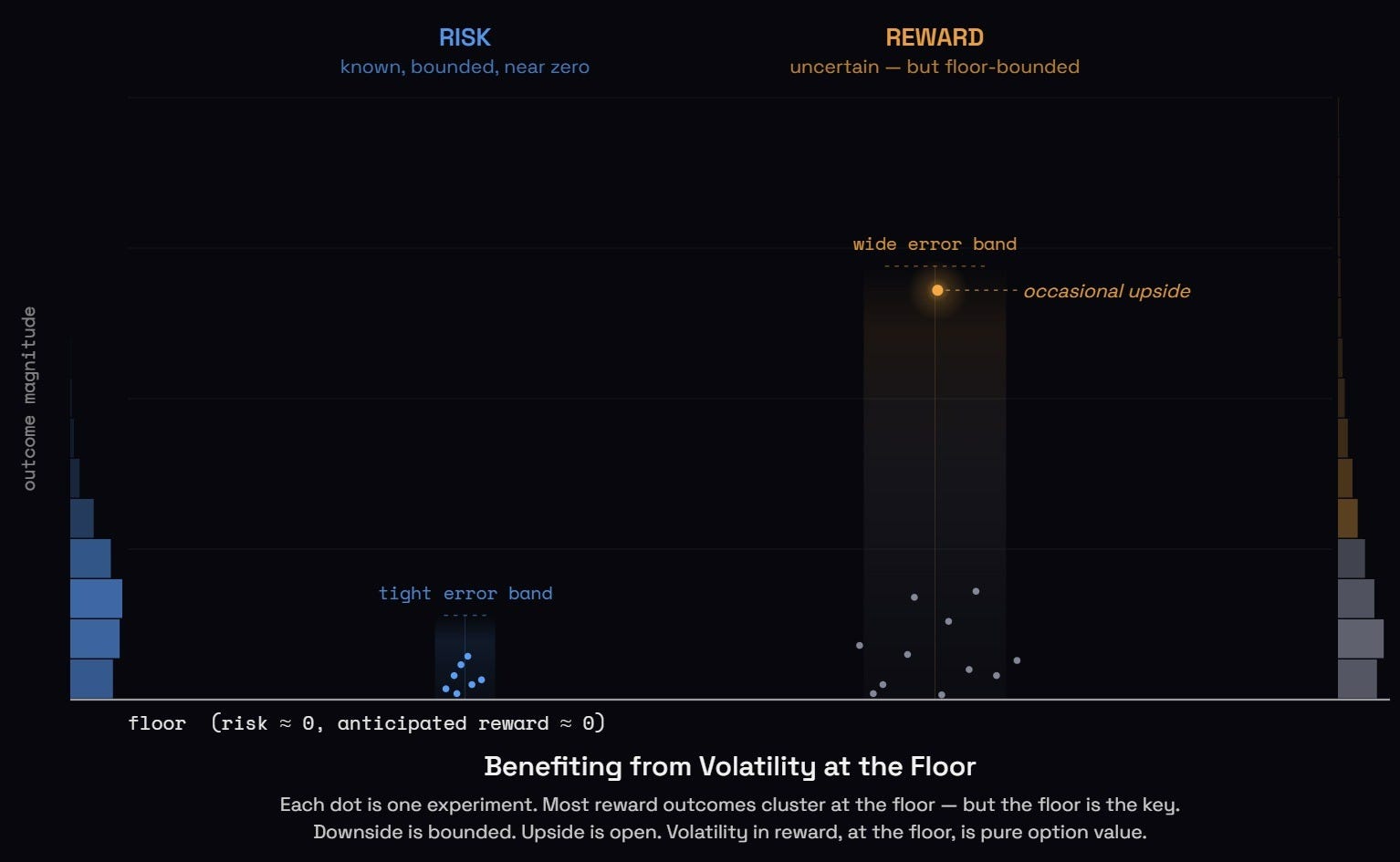
When actions have bounded floor downside but more open upside with a wider error band, this is effectively a freeroll–a chance to benefit from variance, or get lucky.
The more freerolls you can identify, the wider your surface area for luck–in both wellness and life.
Let’s use grounding as an example. Grounding, or earthing, is the practice of touching your body to the earth: walking on grass or on the beach, for example. There are numerous reported benefits, including lowered blood pressure, better sleep quality, and reduced inflammation by transferring electrons into the body that improve blood flow and neutralize free radicals.
When I first heard of grounding, my initial reaction was that it was hippie nonsense. I was at least partly right, because hippies do indeed love that shit. Grounding is considered an alternative therapy and there’s not much research on it, but the initial results are promising.
But here’s the thing that’s most important for us: there’s effectively no downside to putting your bare feet into the ground outside of potentially looking like a crazy person if you do it in an unconventional situation (I’m looking at you Adam Neumann).
And there are tangential benefits to grounding, namely that it gets you outside. And who knows–maybe the benefits we see from grounding aren’t from the practice of grounding at all, but from getting outside, taking in more sun, and being more active in general.
And that’s sort of the entire point of finding health freerolls: we can be right for the wrong reasons and increase our surface area for unknown health benefits–effectively luck. If we’re wrong, it costs us next to nothing.
Note that the opposite effect is also in place in the high risk/high anticipated reward quadrant, except in this case, your reward is unbounded toward the downside. I’m no peptide hater in the absolute sense, but many of the peptides I see people buying from shady foreign sites are a reverse freeroll: known risks with uncertain benefits.
Some supplements that I’ve found effectively act as a health freeroll: theanine, magnesium, glycine, taurine, creatine, NAC, garlic extract, and many others.
The big idea here is that if you can eliminate the downsides of being wrong, you can try more things and increase your chances of finding something that works.
To summarize:
Remove the worst of the worst habits, foods, etc.
Build a foundation upon the most high-conviction actions.
Remove everything else in between that’s non-essential.
Slowly add things back one at a time to properly test their efficacy.
Experiment while emphasizing harm reduction.
In Personal Organization for Degenerates, my friend Brandon Adams–a fellow degen I know from the gambling world–argues that those with degenerate tendencies strongly value the present over the future. This leads to writing checks that your future self needs to cash, with compounding effects; bad habits beget more bad habits, and vice versa.
When it comes to health, I’d argue almost everyone’s base instinct is to be a degenerate. Why? Because optimizing for the present feels a whole lot better than for the future.
What seems better to you, right now: eating a cupcake or eating celery? Disregarding any health concerns or long-term benefits, which one is just tastier?
Which do you think would feel better right now: running up stairs or getting a massage? Doing stairs is a wonderful exercise, but if I knew I would die tomorrow, I’m sure as shit getting my back rubbed at sea level.
So we all are sort of hardwired to want to do at least some things that aren’t good for us long-term, and we ultimately devolve to the systems we put in place around us.
Even those with degenerate tendencies can create a path to success by setting up long-term systems that minimize the impact of their short-term preferences.
The key to creating a lasting health framework is simplicity: I love studying every intricacy of nutrition, exercise, supplements, and anything health-related, but ultimately I need to synthesize all of that information into an extremely simple plan of action, taking all of the nerdy stuff I’ve learned that “probably” works and turning “probably” into action.
The lazy man does this by making the best long-term decision not only the easiest one to make right now, but the default result–what happens when you do nothing at all. Make it difficult to make bad choices, and make your desired outcome the one you get even in your lowest-energy state.
Let me start this section by letting you know I couldn’t give less of a shit about your fitness or health goals or frankly anything about you. No really, unless you’re one of my friends or family, to me you’re just a stranger on the internet and I just don’t care. How could I?
While that means you’re potentially reading the ramblings of a psychopath, it also has one clear advantage: I’m not trying to shill you on a particular way of living your life. If you want to get super jacked at the cost of future quality of life, that’s cool. If you want to increase your lifespan and don’t care about aesthetics, that’s sweet too. If you want to heal your gut or increase your motivation or improve your mood, awesome.
I of course have opinions on some of this stuff—I think certain foods and exercises and supplements and overall philosophies are (generally) better than others for various goals—but I’m more interested in laying out my approach to health from a super high-level view such that it’s applicable enough to build your own protocol, regardless of your goals.
My general approach to solving a problem is this: turn it into a game, figure out what constitutes a victory (your goals), determine the rules you must play by to win, and reverse-engineer a strategy based on the desired outcome.
Because fitness and health are ongoing processes, you’re probably going to have more success if your “goals” are to master some sort of ongoing process: maintaining a healthy body fat percentage is a better goal than losing 10 pounds. Becoming an overall strong person who seeks continual improvement in all lifts is a better goal than benching 225 pounds for X reps.
The reason you have to reverse-engineer a strategy based on your desired outcome is because, outside of the basics, your path to get there is going to look a whole lot different; if you want to be Mr. Olympia, I’d venture to say you’re going to need a different workout and nutrition plan compared to a 55-year old mom trying to get in better shape while minimizing injury risk.
Then, you start with the most basic things imaginable:
Goal: I want to gain muscle (and overall weight).
Fact: You have to be in a caloric surplus.
Goal: I want to lose fat (and overall weight).
Fact: You have to be in a caloric deficit.
Goal: I want to get stronger.
Fact: You gotta lift them heavy-ass weights.
Goal: I want to live longer.
Fact: You have to slow down your quantifiable rate of aging.
You start with things that are logically true—basically tautologies—and then work downward in terms of conviction. What are the chances that, say, eating blueberries is good for you? Pretty high. What are the downsides? Pretty low.
And we just continue to work down a chain of conviction to build a foundation upon which we can build. What are the odds that supplementing with creatine is good for you (and I mean you, specifically)? Well, maybe not as high as blueberries, but still pretty high, based on all current research, with minimal downside at normal dosages.
But how do we actually know that’s true? Well, outside of pure logic and math, we don’t really know anything is true, but we effectively assign a probability of it being true using the lenses discussed earlier. Some people do this in a very concerted way, but everyone does it intuitively and their assessment of the odds is reflected in their actions.
In health, like poker, we are almost always working with incomplete information. So many studies, so much data, so many opinions…
Think of building a health protocol as a sort of pyramid of beliefs/actions. At the base we need our most high-conviction items—things like “it’s important to get good sleep.” In the middle are somewhat speculative things we can test–like “lifting weights three times a week will make me stronger than five times a week” or “using the sauna improves longevity”–but with minimal downside if incorrect. And at the top are things we can decide to experiment with based on our risk tolerance, such as aggressive fasting.
If we build our health protocol on the speculative items, and they’re wrong (which some inevitably will be over time), then the whole thing topples. And without the base (say, high-quality sleep), then the top of the pyramid (say, most supplements) is effectively worthless.
Once we have a base of knowledge and a means of discovering what’s true, it’s time to implement, test, and evolve.
How you test things depends on your goals. For some things–like losing body fat–it’s easy to quantify your results. For others, like improving mood, it might be more subjective.
The key here is to add and remove one thing at a time. It’s already a challenge to find signal in a vast sea of health variables, so trying to test multiple things at a time is suboptimal.
And of course, the most important piece of feedback you’ll receive: how you look and feel. This might be mostly subjective, but just because it’s more difficult to quantify doesn’t mean it’s not important; in fact, I’d argue it’s the most important data point of all (and you can find ways to quantify it).
The best protocol for you is not only one that works, but one that you’re actually going to stick by.
The key to developing a long-lasting protocol is reducing necessary willpower as much as possible. This might sound counterintuitive–and indeed you need to put in work, specifically in the form of intense exercise, to see the best results–but there are things you can do to effectively put your sleep, diet, etc. on autopilot as much as possible.
Make systems that are so easy that the right thing is easiest and the unhealthy thing is difficult. Some examples:
I design my environment to make being healthy as easy as possible. I have an outdoor gym, for example, meaning the excuse to not work out gets reduced from “I don’t want to drive in traffic to the gym” to “I don’t want to walk 20 steps outside,” which becomes indefensible. The biggest environmental factor under your control is what food is in your house, of course. You can eat unhealthy food all you want; just make it more difficult to secure. I’ll be the first to admit that DoorDash and UberEats are a problem.
I don’t personally have a trainer, but a lot of people find success in using one, and, while trainers can be knowledgeable and motivating, I suspect most of their effectiveness comes via a sunk-cost fallacy; “I paid for the trainer so I’d be wasting money if I didn’t work out now.” You can utilize this psychological trick in buying nice workout clothing, for example, if it motivates you to use it.
Commit to the bare minimum. I’m still surprised at how well this works. On days I don’t want to exercise, which is fairly often, I commit to doing the absolute bare minimum I know I could do with little resistance. If I’m working on my back, then I’ll commit to doing just one set of pullups. I don’t think there’s been a single time that I’ve done the bare minimum and then stopped. It’s incredible how much easier it is to continue working out after you’ve already started.
Fake it. Pretend to be the person you want to be. It’s not “I want to be someone who is healthy.” It’s “I am a healthy person who does healthy things.” You become the person you want to be through action, and you take action by believing you’re already that person. I don’t mean this in some phony “manifestation” sort of way; I just mean you’ll develop the mindset of the person you want to be by doing the things that person would do. Your beliefs lead to your actions, but the inverse is just as true: your actions lead to changes in your brain that result in different beliefs.
Create associations. You might not think you’re a dumb little human who automatically responds to stimuli like Pavlov’s dogs, but you are. When you associate something pleasurable with something that’s not, you’ll come to find the non-pleasurable thing more palatable without any effort. If you only ever watch TV after you’ve done five sets of stairs, it’ll be easier to do the stairs. If you commit to scrolling social media only after you’ve done yoga, you’ll do more yoga. You’re never going to completely eliminate mindless behaviors with instant gratification, so pair them with something beneficial.
Turn things that suck into games. While I like the benefits that lifting weights provides, it’s not like I love it independently of the outcome it produces; it’s not particularly fun to lift a heavy weight repeatedly and then set it back down where it started. Like that’s not incredibly exhilarating to me. But I make games out of working out; I might try to complete a workout as fast as possible, for example, or lift a certain amount of weight for specific reps (adjusted for my body weight at the time). Playing sports is the most obvious form of turning exercise into a game. This idea is also how I trick myself into doing laundry, which is the all-time nut-low activity to me, by seeing how quickly and efficiently I can fold things. This sounds really fucking dumb now that I’m typing it out.
Create novelty. When working out, write down every exercise you aim to do on cards, mix them up, and draw them at random to create the order of your workout. Not only does this probably have some benefits in terms of how your body responds to the workout, but it also just makes it a bit more fun (and, to me, psychologically easier to tackle workouts knowing each one is a new challenge).
Side note: I always find it funny when people rave about how much they love the taste of a certain coffee or alcohol. I guess I can see coffee, but alcohol–I mean, it tastes awful. Like it’s horrendous. From a pure taste perspective, if you’d rather have rum than, I don’t know, like a glass of juice, then something is seriously wrong with your taste buds. I drink coffee almost every day, but purely for utility; it’s almost unrecognizable from what you’d likely refer to as “coffee,” as I mix six spoonfuls of instant coffee, a scoop of Bryan Johnson’s “Super Shrooms” mushroom blend, and a scoop of cocoa powder. I stir this up really quickly into about three small gulps of semi-hot water and chug it like it’s a glass of horse diarrhea. I don’t know why, I just imagine horse diarrhea to be super thick and nasty. And my guess is that it would taste just slightly better than the sludge I drink every morning; I love the Super Shrooms product, btw, but it tastes like absolute ass.
Let me tell you about something pretty sweet I recently did. I’m frequently in the lab on the latest supplement, exercise, and overall health research. This process is tedious in that it’s just me reading individual articles/studies, which would be impossible to do consistently if I didn’t genuinely enjoy it.
As I was reading a recent Examine email, I thought to myself how much knowledge I’ve accumulated over the years that’s very difficult for me to properly assess; my brain is quite limited in that I forget a lot, can’t properly index what I’ve learned, have difficulty weighting data properly over time, suffer from cognitive biases, and so on. It’s really the epitome of the type of thing an LLM is perfectly suited to handle much more effectively.
I’ve been aware of the power of AI for some time–my current business focus is a company that provides AI tools to sports bettors–and I recently began taking AI coding courses. Much of the value in “vibe coding” is just learning what’s possible with AI; it’s really unbelievable.
Let me give you some context: I have effectively no idea how to code. I’ve worked in tech for over a decade, but as a non-technical founder/CEO. Nonetheless, I’ve been building stuff that is incredibly valuable in my personal life–dashboards, apps, alerts, and so on.
I recently took a photo of my supplements/vitamins and gave Codex my Examine+ and ConsumerLab login information, then told it to analyze every relevant study on every supplement in the photo, assess the scientific evidence for every primary goal and any secondary goals, then create an interactive dashboard with:
risk/reward ratings
redundancies
a daily timing board of when to take each (based on things like their fat- or water-solubility, nervous system effects, possible interactions, etc.)
links to the most relevant studies
cycling vs. daily use
biomarkers each might affect
possible supplement replacements
suggested forms and brands using third-party testing results from ConsumerLab
any other features it might find useful
Again, I cannot code, and I had effectively a second brain–a much more robust and less flawed brain–distilling all the most relevant scientific studies on every supplement I do or could take into an actionable dashboard.
And this entire process–one that would have taken me months (maybe even years with all of the knowledge that would need to be accrued)–was completed in under six minutes.
SIX MINUTES!
If you think you lack the necessary skills to leverage AI coding tools, trust me, you do not. If you can think it up, you can probably code a crude version of it with the help of AI.
This article is ultimately about building systems that work even when you’re lazy or otherwise in a low-energy state. Asking ChatGPT questions is helpful, but this is really a surface-level use of AI, especially if you’re on the free version.
AI is unbelievably skilled at parsing through data and building protocols around it, which is exactly the type of thing that can help you when you’re in a low-energy state. The more data it has, the better.
Bloodwork: Function Health is the best - Get $25 off
Wearables like Oura ring or WHOOP or Apple watch or Fitbit
Smart scale
RMR, VO2 max tests
Vitamin/supplement protocol
Tape measurements
Body photos
DNA results
On the last item, a lot of people don’t know this (I didn’t until pretty recently), but sites like Ancestry and 23andMe give you downloadable genotype-array data. If you’ve had an ancestry test completed, you can upload this data to any LLM for analysis. This isn’t full genome sequencing and there are obvious limitations, but some gene variants are strongly tied to specific traits that AI can assess quite accurately, such as:
Caffeine metabolism
Lactose intolerance
APOE status
Androgen-related genes
Type 2 diabetes risk
Body composition tendencies
Endurance vs. power bias
Omega-3 conversion
Circadian preferences
Longevity profile
None of this analysis should dictate decision making on its own, but it’s useful in helping to form testable hypotheses. Here’s an example of a high-impact finding from my own DNA analysis:
Highest-priority medical item
Prothrombin / Factor II (F2) rs1799963 = AG
This is the classic G20210A thrombophilia signal in heterozygous form. It raises clot risk versus baseline and matters most when layered with other risks: dehydration, long travel, surgery, immobilization, smoking, obesity, and estrogen-containing meds. For someone who knows this result, the practical value is mostly in risk management during high-risk situations, not in living scared day to day. This is the one result I would strongly consider confirming through a clinician or a clinical lab before relying on it medically.
This is an inherited gene mutation that occurs in about 2-4% of those of European descent. Not great! But certainly useful for me to know.
Another interesting finding is a mismatch with late eating and my natural circadian preference, which fits with my experience. This was not something I was aware of until recently and, had I known of the mismatch, I would have been able to more easily identify one of the root causes of my poor sleep.
In addition to all the data I listed, you can also track your food intake, workout results, etc. However, the goal is to create a protocol that requires a bit of upfront effort to reduce long-term complexity; if you truly like tracking things on a daily basis, go for it, but for me, it’s a big non-starter because it creates future obligations I’m working hard to eliminate.
Automate as much as possible and focus on putting energy into the few very impactful data points, the most important of which is getting the right bloodwork.
There are so many health variables that it’s very difficult to identify a signal in a sea of noise. AI is uniquely positioned to help if set up properly.
“Here’s access to all my recent tests and real-time data on every measurable I’m tracking. Analyze every possible data point and correlation and send me Telegram alerts when you’re confident you’ve identified a meaningful signal that could lead to actionable changes in my behavior.”
My take on supplements is somewhat unique in that I think they can be unbelievably effective in certain contexts, but the actual things most people take are worthless, in a handful of ways:
The supplement itself has poor evidence of efficacy.
Most supplements simply don’t work. The ones that can work are often effective for some tail of the population–those with a nutrient deficiency or some other extreme condition–and provide no value to normal people with normal diets.
The supplement could work, but the form is ineffective.
The prototypical example here is magnesium oxide, which is cheap and allows brands to advertise a large amount of elemental magnesium, almost none of which can be absorbed. There are many similar examples of this, so it’s quite important to get the right form.
There’s also the possibility the form is theoretically useful but simply not the right match with your body. This is the case for me with magnesium citrate–fine in small amounts, but anything more gives me what’s known in the medical world as “the shits.”
The supplement is a proprietary formula that has a bunch of stuff that’s wildly under-dosed.
I’m not sure how supplement companies can get away with this, but proprietary blends should arguably be illegal. You’ll often see supplements that have some ratio of, say, five things in a proprietary blend, but you have no idea what the ratio is. Usually, some cheap ingredient is listed first because there’s a mega-dose of that alongside micro-doses of the things that could actually be beneficial. For the most part, just avoid proprietary blends.
The supplier does not do independent third-party testing.
You’d be surprised how often (or how little) a supplement contains what it says it does in terms of both the ingredients and the dosage.
The first step in deciding upon a possible supplement addition is defining what you’re trying to achieve (and how you’ll quantify if you’re realizing your goal). Be specific. If you want better sleep, is it help falling asleep, staying asleep, or getting into deep sleep?
As mentioned, the single best place to analyze the efficacy of vitamins, minerals, and supplements is Examine, and frankly nothing I’ve found is close. The free information is great for simply learning about a particular supplement; here’s the creatine page, for example.
I pay for Examine+, which is necessary to really dig into what works and what doesn’t. It’s just a massive time-saver when it comes to knowing the actual science on what types of things might be worth even looking into.
Let me start by saying that the best supplement brands cost more. That’s the nature of the beast when you’re sourcing the highest quality, providing real doses, and spending money on true third-party testing.
Examine helps me analyze which types of supplements and which forms are worth taking, and ConsumerLab is an excellent resource for studying specific brands, as they do actual third-party testing and reviews. Search for a brand and you can see every supplement they tested, if it was dosed properly, its purity, etc.
I could go on at length here, but I’ll just list some of the brands I’ve found to be most reliable and you can DYOR.
Thorne
Very expensive but arguably the most rigorous testing available
Pure Encapsulations
Similar to Thorne
Blueprint by Bryan Johnson
I don’t think every supplement on Johnson’s site is worth the cost, but his products are high-quality with proper testing. The ones I take: Super Shrooms, Longevity Mix (cheaper than purchasing the combination of ingredients individually), and Cocoa Powder.
Codeage
Best source of collagen products I’ve found; other products are overpriced
Momentous
One of the better values on the high end
Just Ingredients
Some stuff is just marketing but they also have quality; this is where I buy my creatine (in Creapure form)
NOW Foods
Good for specific “generic” supplements and one of the better quality/cost combinations if you’re trying to save money; not in the overall elite category for everything
Life Extension
Similar to NOW Foods
Nootropics Depot
Massive selection of nootropics you can’t find elsewhere; COAs available for every product at a third-party ISO lab
And of course, my favorite and the core of my stack…
I ordered Momentum Shake for the first time in early 2023 and it quickly became the foundation of my “stack.”

Near the end of that year, I found a way to get in touch with Michael Tecku, the founder of Momentum–what I consider to be the highest tier of longevity product on the market by a large margin–and begged him to give me the opportunity to be an affiliate.
If you don’t believe me…
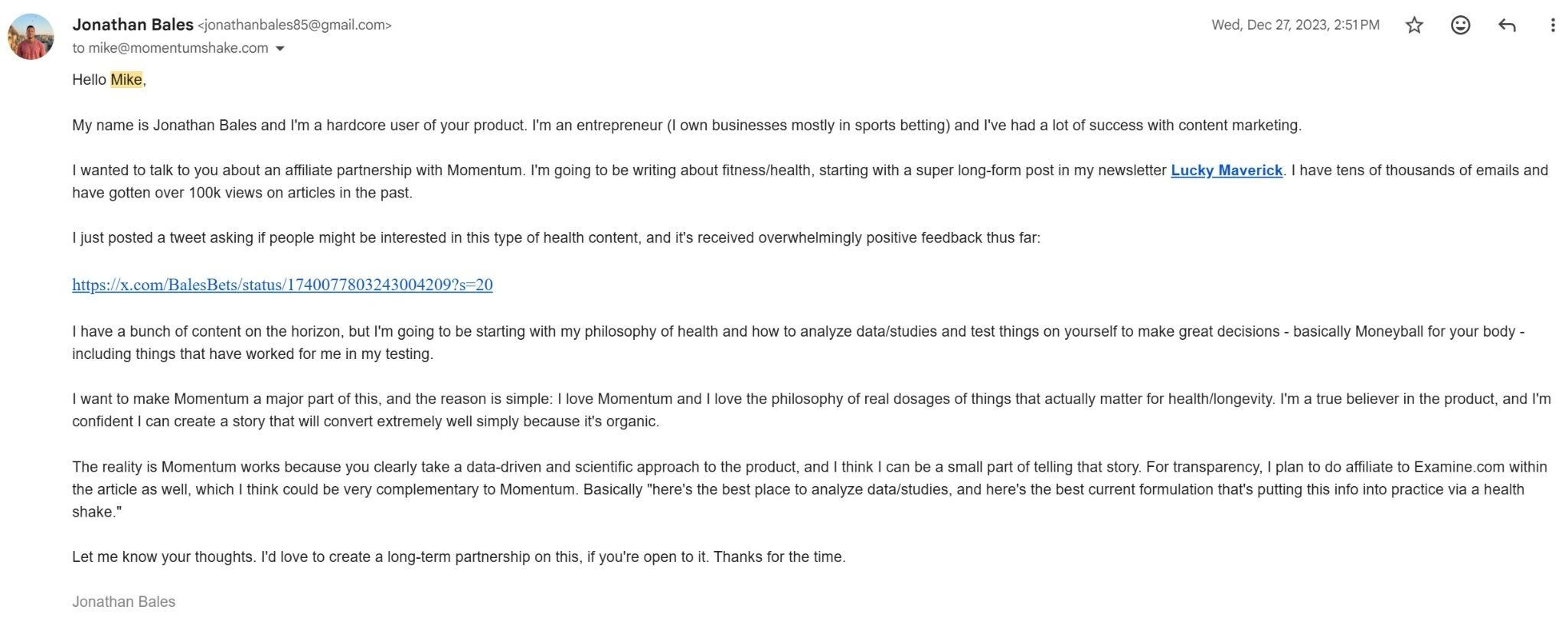
Disregarding the fact it’s been over two years since I sent this and I’m just now publishing the article (I got busy okay?), you can see how much I believe in the product.
Let me start by noting Momentum is expensive. It’s $80 per bag of 15 servings, meaning you’re paying $160 per month if you use it daily. Now, I’d argue that it’s actually very cheap for what you’re getting; in fact, I know it’s cheap, because Michael told me he’s breaking even on the product.
Before I started my current company, I actually thought about getting into this space. One reason I didn’t–in addition to knowing absolutely nothing about creating products in the real world–is because Momentum already existed and it’s effectively what I would create if building the world’s best overall health and longevity shake.
To show how I go about analyzing a supplement, let’s take a look at Momentum through each of our lenses.
Do people with real judgment trust it?
Figuring out who you can trust in various areas of life is an incredibly underrated skill.
I first looked into Momentum via a recommendation from someone I trust in the health space. They began taking it and vouched for it as the crème de la crème of nutritional shakes.
Michael had clearly built a brand that was obsessive from the perspective of actual quality, which instantly built trust as someone knowing what to look for. It’s clear nearly all other brands optimize for profit and marketability. Momentum looks like Michael built it for himself.
Everyone I know who I’d consider a believable person in the health/wellness/longevity space emphasizes the importance of the traits you see in Momentum: the most impactful ingredients with real evidence of efficacy, high bioavailability, transparent labeling, real doses, third-party testing, etc.
Do the ingredients, forms, and doses make mechanistic sense?
Science is arguably the most important filter when analyzing which supplements are worth taking. When I looked at Momentum’s ingredient list and dosages, it was completely in line with research on health/longevity I had been doing; every component has mountains of evidence supporting it.
I created this list of ingredients using images from the site:
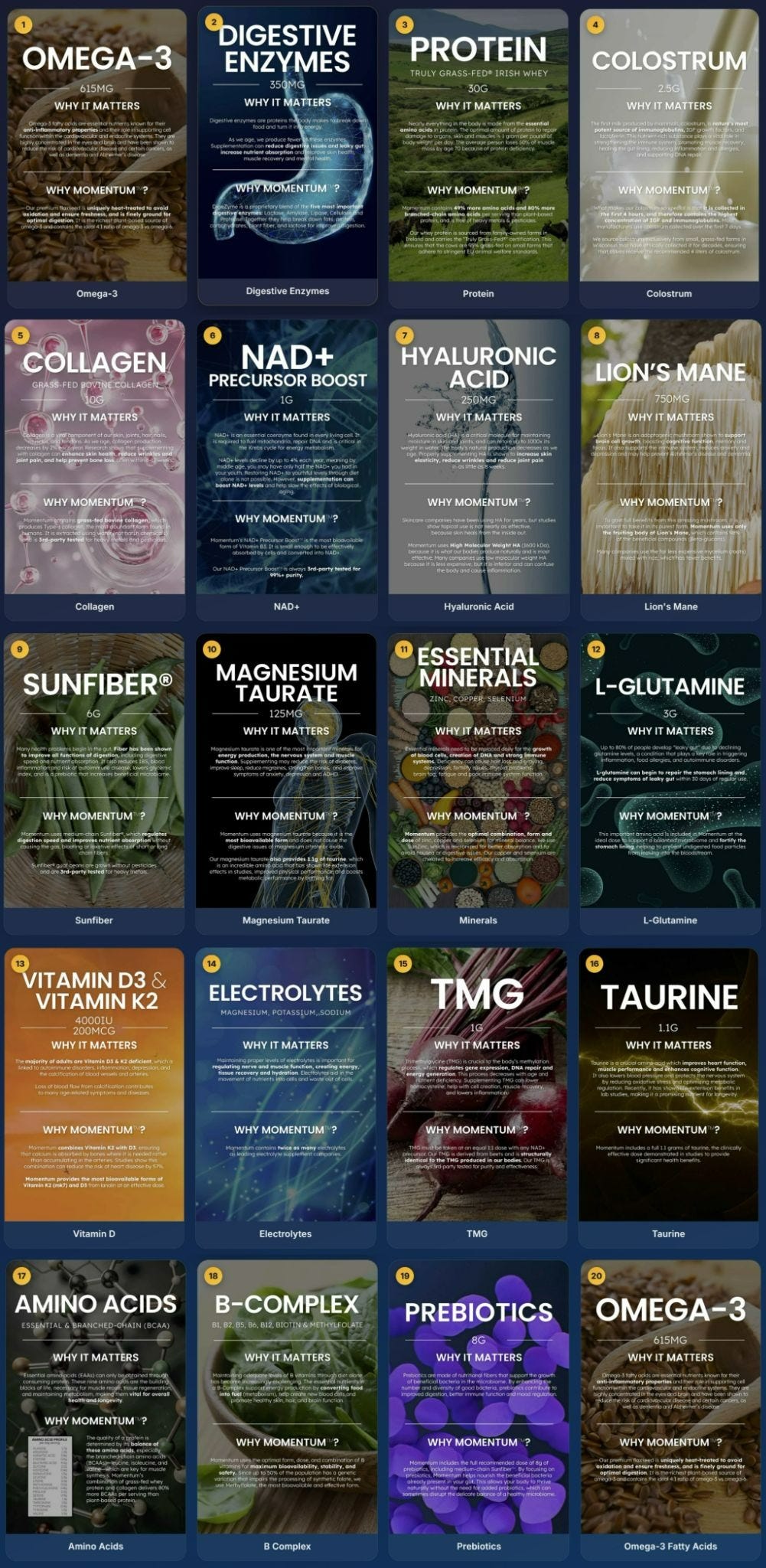
Some highlights:
The whey is sourced from family-owned farms in Ireland where the cows are more than 95% grass-fed.
Momentum contains 2.5g of colostrum. If you’re not familiar with colostrum, it’s the first milk produced by mammals after giving birth. It’s not only the most potent source of immunoglobulins, IGF growth factors, and lactoferrin on the planet, but it’s also expensive as shit. I’m actually shocked Michael was able to get this into Momentum; I have to imagine it’s the most expensive individual ingredient in the bag per gram. Most colostrum you buy is collected in the first seven days after birth; Momentum’s is in the first four hours.
The NAD+ precursor–widely linked to anti-aging and longevity–is the most bioavailable form of B3.
The hyaluronic acid in Momentum is 1600 kDa. Most companies use a lower molecular weight because it’s cheaper, but it’s not well absorbed.
The Lion’s Mane comes via the fruiting body, which contains nearly all of the beneficial compounds, whereas many mushroom supplements use the cheaper roots.
Magnesium taurate is the most bioavailable form of magnesium and the one I take during the day (and magnesium biglycinate at night).
The vitamin D3/K2 comes in the most bioavailable forms (mk7 and D3 from lanolin).
The Omega-3s come via flaxseed that is heat-treated to avoid oxidation and provide max absorption.
All ingredients are third-party tested for heavy metals and purity. They’re also dosed properly and transparently, without any proprietary blends that nearly always hide under-dosing. It’s real doses of the highest quality stuff on earth that makes an actual difference.
I could go on. Science isn’t about whether an ingredient sounds impressive in isolation. It’s about dose, form, absorption, and whether the final product is built in a way that gives your body a real chance to use what’s in it.
Momentum clears that bar unbelievably well.
Do the incentives and economics point in the right direction?
When we consider the merits of something from a math or logic perspective, we’re trying to think in terms of expected value, incentives, and first principles.
Momentum is expensive relative to other shakes, but it’s cheap when considering the ingredients; if you were to buy each of them separately in comparable forms and doses, it would be much more expensive, quite a pain in the ass, and far less likely you’d take them consistently. Seriously, start to calculate the cost of buying things like high-quality colostrum, NAD+/TMG, magnesium taurate, etc. individually.
Most supplement companies have an obvious incentive to underdose expensive ingredients and hide behind proprietary blends. Momentum does the opposite.
The presence of expensive ingredients in meaningful amounts is a giant signal of quality over hype because it’s economically inconsistent with what the majority of supplement brands are: marketing scams.
From a pure incentive perspective, if a company is choosing the costly form repeatedly across many ingredients, that is evidence about priorities.
The fact that Michael is breaking even on the product is another massive signal that the goal is quality above all else.
The important point here is even if I could theoretically optimize a stack better than Momentum, it would be more expensive and I’d be far less likely to use it consistently compared to the ease of making a single shake a day.
Does it solve actual problems in practice, not just theory?
The point of science is to question and predict what will work. It’s forward-looking. But what works in theory can sometimes diverge from what works in practice.
The best products are not just theoretically sound; they get used by serious people for long enough to survive real-world testing. Momentum has reached that point.
The product solves an actual problem: most people do not consistently eat and supplement at a truly elite level.
As discussed, a product that makes doing the right thing easier is often more effective than a perfect-but-cumbersome protocol. Momentum works on two levels: biochemically and behaviorally. It compresses what would otherwise be many +EV decisions into just one.
I’ve recommended the product to dozens of people, all of whom have loved it and become repeat users because it works.
Does it give off the aroma of the real deal or a pig with lipstick?
Pattern recognition is the skill of cultivating your instincts/common sense over repeated exposure to something.
When you analyze enough supplement brands, you see the same scammy tactics. Momentum shows the opposite pattern.
It “looks like” a product made by someone who knows quality. If it were a scam, it’d be one hell of an expensive and unprofitable scam!
Just from a common-sense perspective, we know the quality of inputs matter. And when they’re completely transparent, it’s a giant green flag.
On a personal level, I’ve spoken to many entrepreneurs over the years, and it was clear to me Michael’s priorities are in the right place; his primary goal–maybe his only goal–is to create the actual best possible product he wants for himself.
Does my own use reinforce the other lenses?
When it comes to supplements, the other lenses help you determine when it might be worth experimenting. Ultimately, the most important filter is personal experience–whether something works for you and if you should continue using it.
First, I enjoy taking Momentum. That’s a subjective feeling but it’s more important than people might admit. It creates consistency.
Momentum makes it incredibly easy to be a supplement guy without being a supplement guy. It lowers the required energy to be healthy.
I feel more nourished when I take it.
My experience doesn’t guarantee my belief in Momentum’s effectiveness is correct–the placebo effect is real–but it reinforces a view that’s also supported by every other lens.
Ultimately, there’s stacked evidence in favor of Momentum. It works for me. It’s worked for others I know, including people I trust in the space. There are common-sense reasons it should work. It shows the signs of real quality over the appearance of quality. The math suggests it’s cheap compared to buying everything individually. The science on what’s in the bag is overwhelmingly positive, and the ingredients have withstood the test of time.
Momentum is the epitome of what we should be looking for in a supplement brand.
By the way, peanut butter, berry, and matcha are the best flavors. Michael talked about them in a recent email (this gives a little look into the thought process behind sourcing):
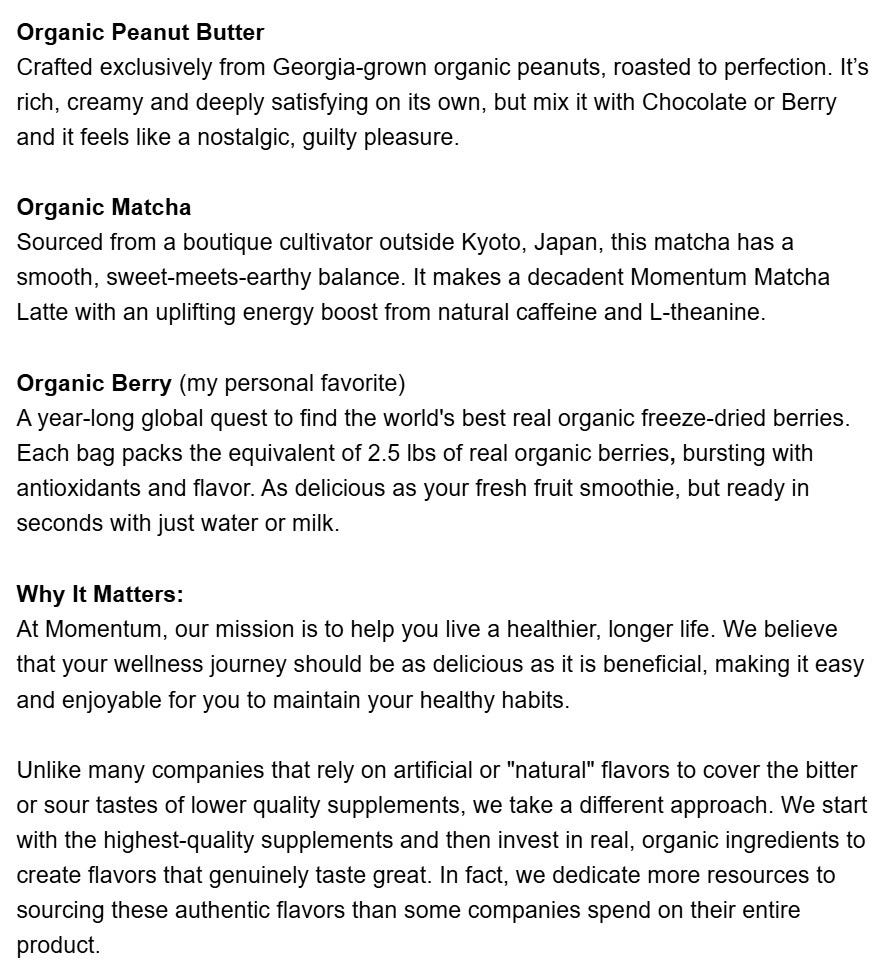
***Use this link to get a welcome kit, free travel packets, and free shipping over $100.
The goal of this section is to not just supply information, but more specifically, to supply scarce, actionable information. And if it’s something that goes against conventional wisdom, even better.
Anyone can tell you to prioritize sleep.
No fucking shit.
But if I tell you I’ve found success using this exact sleep support which contains real, third-party-tested dosages of magnesium byglycinate, theanine, tart cherry extract, and inositol–all of which have been widely studied and proven effective for relaxation and sleep quality–then we are getting somewhere useful. And if I tell you I sometimes add GABA, which has conflicting reports on crossing the blood-brain barrier but a plethora of anecdotal reports and studies suggesting it promotes relaxation, that could be useful as well.
You’re lazy and busy and don’t want to think about this too much, so what should you actually do?
This list is a word vomit of some stuff I think is probably true and not highly obvious to everyone. Please DYOR.
Sleep quality
VO2 max
Base metabolic rate relative to mass
The sleep thing is cliche, but outside of all the evidence of the importance of sleep for overall health, it’s a useful metric because it’s a proxy for many other activities. For example, rising early and getting morning sun, exercising, and avoiding alcohol are all things you should be doing anyway that will absolutely influence your sleep quality.
Your resting heart rate before bed–relative to your baseline–is an incredible predictor of sleep quality. This is why I’ve found that my sleep gets wrecked if I work out too late in the evening. It’s also why sleeping in cold temperatures is associated with overall sleep quality, and why many hypothesize things like glycine help sleep by indirectly reducing heart rate. The only thing I’ve found that increases evening heart rate that actually helps sleep quality is the sauna, likely due to a rebound effect.
VO2 max measures how much oxygen you use while exercising and is a useful proxy for overall cardiovascular fitness. Yes, it’s just a proxy, but if your VO2 max is high, you likely have good cardiovascular fitness.
My most non-consensus view here is that, after accounting for VO2 max, you should raise your base metabolic rate relative to your mass as much as you can; that is, you should aim to burn as many calories as possible from doing nothing, adjusted for weight.
Let me explain this a bit more. Your body does an absolutely amazing job maintaining homeostasis, so it works kind of like a thermostat does in getting near a neutral net caloric burn. Think of how difficult it would be if your body didn’t do that–if you had to track calories and eat within a narrow range to survive.
Instead, if you go absolutely apeshit and eat 4,000 calories in one sitting, your body will burn more calories than normal just processing the food, and you’ll likely move around more, which burns more calories, and the surplus gets stored for future use, which often results in you being less hungry later.
The point isn’t that eating 4,000 calories at once is good, but rather, if you were looking to burn as many calories in a day as humanly possible, you’d actually want to gain a ton of weight and eat a massive amount of food; and on the flipside, the way to burn as few calories as possible would be to lose weight and eat nothing.
What we really want is:
First, a high percentage of muscle weight; lean muscle requires more calories to maintain than fat.
And second, high thyroid signaling; thyroid hormone is one of the biggest drivers of energy expenditure, and one of the main things drives it down is being in a prolonged caloric deficit, which can lead to a lack of proper nutrients.
How much of the things my body needs can a food provide per calorie? This makes it more obvious that some foods that are marketed as healthy really aren’t all that good for you, containing few nutrients per calorie: most protein bars, granola, sweetened plant milks, veggie chips, some nuts, flavored yogurt, Lean Cuisine frozen meals. And some things that are higher in calories and claimed to be unhealthy are maybe better than first thought: potatoes, dark chocolate, eggs, full-fat milk, honey, and even some types of ice cream (this is my favorite).
By the way, the most nutrient-dense food I’ve found is beef liver.
There is simply nothing close; beef liver is the absolute crème de la crème in terms of micronutrient-dense foods.
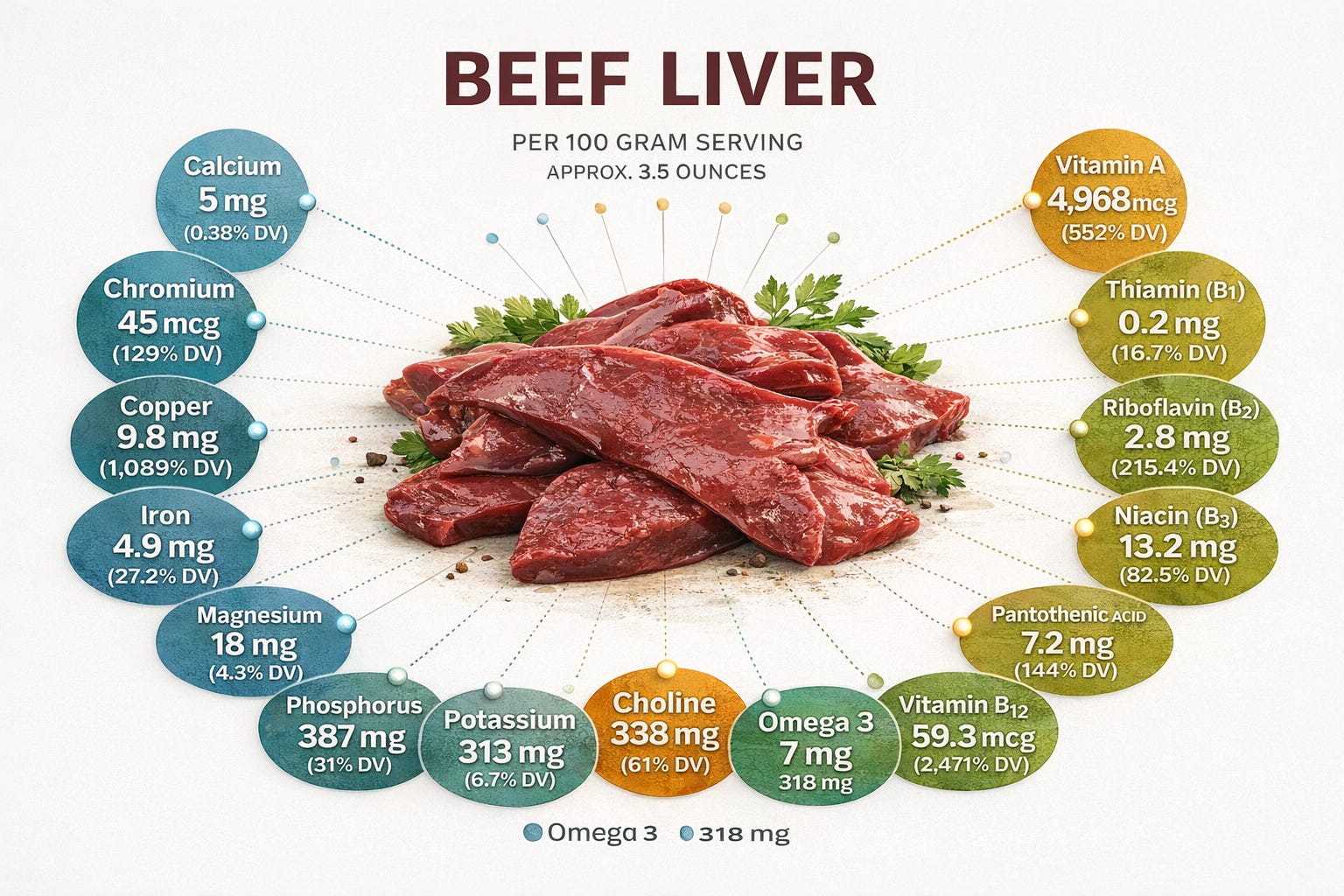
These numbers are pretty wild.
Despite enjoying nearly all foods, I personally don’t love the taste of liver, as is the case with many people. So instead of consuming as is, I buy lean burgers that have liver mixed into the meat, which more or less disguises the taste.
Some of the other most nutrient-dense foods:
Shellfish (oysters, mussels, clams)
Small oily fish (sardines, anchovies)
Wild-caught fatty fish (salmon, mackerel, trout)
Eggs
Leafy greens (spinach, chard, kale)
Ultimately, we want to be high in the following: quality sleep, VO2 max, lean muscle mass, and nutrients (the latter two of which directly contribute to a high base metabolic rate relative to your mass).
In short, stop trying to consume as few calories as possible and start becoming a person whose body naturally burns a lot of calories for its size.
You should try to consume grass-fed meats, wild-caught seafood, pasture-raised poultry/eggs, and organic produce.
I used to obsess over macronutrients–getting enough protein per pound of body weight, for example–without much concern for the quality. But the idea that “protein is protein, healthy fats are healthy fats, carbs are carbs” is simply wrong. There are differing levels of quality for each of these–different quality, micronutrient profiles, bioavailability, and so on.
The way that the animals you eat were raised–what they ate, how they moved around–matters a lot in terms of how consuming them ultimately affects your body. Grass-fed/grass-finished meats and wild-caught seafood have superior fatty acid profiles to those that are grain-finished and farm-raised, for example.
Eating superior ingredients is more expensive, no doubt, but there are some ways to consume the healthiest ingredients without completely breaking the bank.
In terms of seafood, which is where I think the biggest differences in quality-per-dollar lie, canned wild-caught oily fish like sardines are unbelievably nutritious for a relatively cheap price. Canned oysters are similar. Large quantities of frozen fish, including wild salmon, are much cheaper than fresh.
Pasture-raised eggs can be purchased in bulk at big-box stores like Costco, and grass-fed meats don’t need to be the fanciest cuts; ribeye is expensive, but grass-fed ground beef is just as good. And of course no one wants to eat liver, so it’s quite cheap despite being the easiest way to acquire so many high-quality nutrients with just a couple servings a week.
In terms of organic, I don’t think you really need to buy everything organic at all. Bananas, oranges, avocados, etc. are all naturally protected from pesticides, for example, and probably a waste to pay extra. I eat a massive amount of berries, though, and they’re more difficult to effectively wash, so buying organic makes more sense there.
Also, frozen fruits/veggies are said to actually be slightly more nutritious than fresh because they’re at their most beneficial when picked, at which time they’re immediately frozen. If cost is an issue, buying frozen items saves a lot.
When it comes to calories, our concern should be the net caloric effect a food supplies, which is affected by its nutrient-density, how it affects your metabolism, how it pairs with other foods in your diet, its effect on your hunger, and so on.
A lollipop has relatively few calories, for example, but provides no nutrients and won’t do much to quell your hunger. Diet sodas have no calories but have been proven to increase hunger. A small amount of wine might not seem like a huge deal, but it can be a disaster if it affects your sleep, and thus your future energy levels.
On the flip side, extra-virgin olive oil, avocado, and sardines are all quite high in calories, but provide all kinds of nutrients and typically have a positive overall net effect on your body.
The reality is that, while knowing how many calories are in something is generally useful, trying to calculate what actually matters–your net caloric intake and expenditure–is very difficult, if not impossible, especially with your body continually adjusting things behind the scenes to maintain homeostasis.
And, if I may say so, it’s boring as shit.
Not because there’s no risk, but because the downsides of being overweight are greater. This is one of the moderate-to-high risk choices I think is worth it for many because the benefits are plentiful and proven, while the risk that accompanies being overweight is probably underappreciated.
For cardiovascular health, the evidence is incredibly strong. It’s kind of a way to “cheat” your way to better heart health. Being in an extremely hot sauna for 15-20 minutes isn’t a walk in the park, but it sure beats doing actual cardio. You should do both, of course, but the sauna is one of the better combinations of efficacy and low total “suckage.”
For longevity, the evidence is fairly strong–namely via the release of heat-shock proteins and improved immunity (the benefits of which seem to come with longer use at the higher end of the sauna temperature spectrum).
I typically have a really big dinner, but early in the evening, such that I don’t get uncomfortably hungry at night. If I’m hungry, I’m going to eat; the key is maximizing how long I can go during key periods without being hungry.
An added benefit of eating a very large (but very early) dinner is that I do natural intermittent fasting without much effort. It’s kind of a “reverse” intermittent fasting, as most people begin the day by not eating. I find the opposite to be psychologically easier while also improving sleep.
Walking after eating reduces glucose spikes.
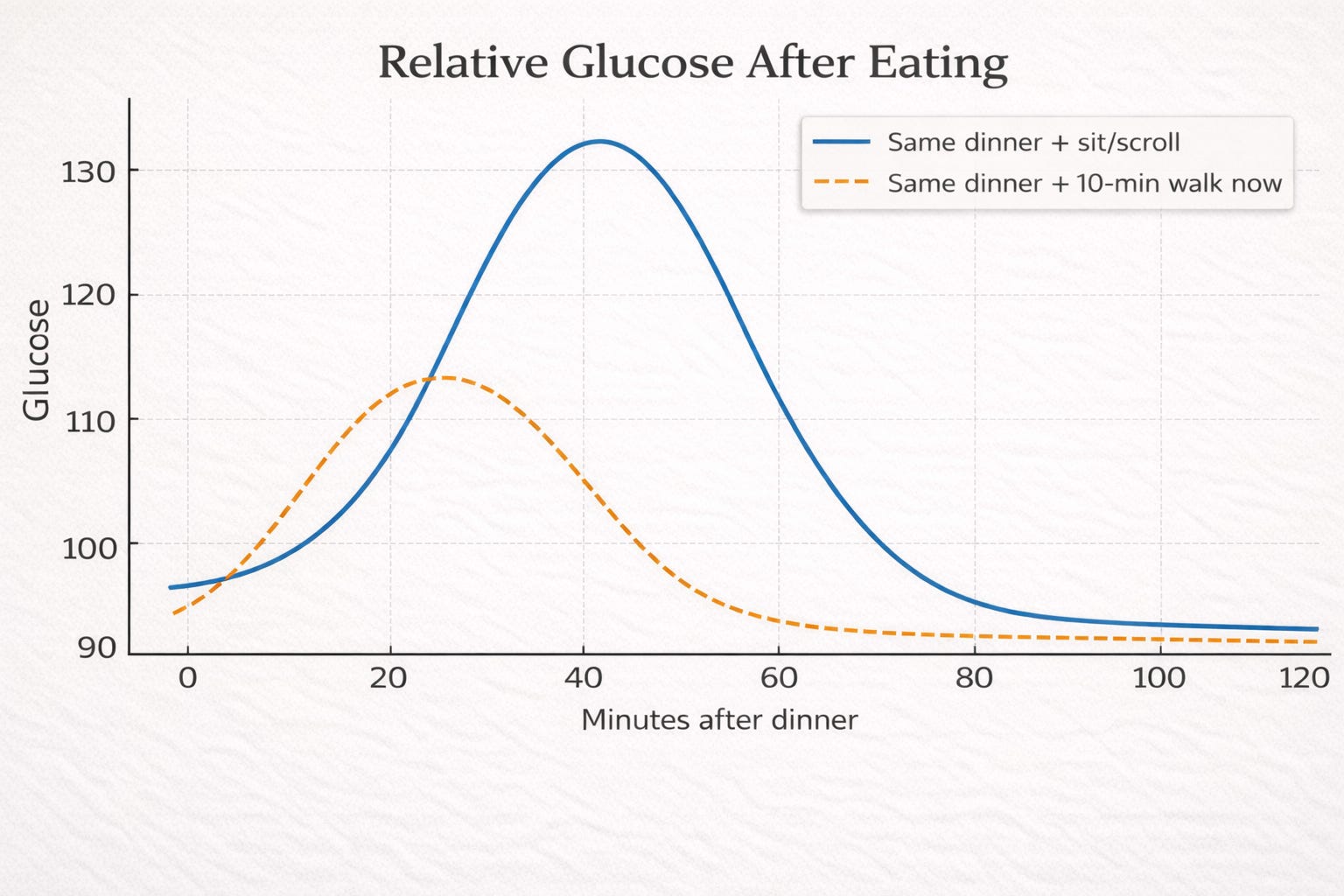
Also, walking in nature is great and you should aim to do it as much as you can; whereas that’s quite relaxing, going for a walk on a treadmill or in an urban environment solely to get steps can be quite boring or stressful.
If you work online like me, you’ve likely transitioned from phone meetings to Zoom/Google meets since Covid. If you’re able to turn off your video, turn these meetings into walking sessions. If I do a one-hour meeting while walking in my backyard, I easily take 5,000 steps and don’t even notice it; walking back and forth like a caged animal would be miserable if my mind were focused on the steps instead of the call.
I’ve talked about creatine a lot because it’s arguably the most well-researched supplement ever; it’s been widely proven effective for enhancing exercise/workout performance, but what’s most interesting to me is the more recent research on cognitive performance and mental health. There’s growing evidence that creatine improves memory, especially in older adults, and reduces symptoms of depression.
There’s also evidence that creatine greatly enhances symptoms of fatigue/sleep deprivation, and this is one of those things I can say is 100% true for me. On days on which I didn’t sleep well but still need to be productive, a larger-than-normal dose of creatine consistently and significantly improves my subjective feelings of fatigue.
This is one of those situations where I combined various lenses to find something effective for me. I already knew about the benefits of creatine, but saw one particular study on its benefits for sleep-deprived individuals. Knowing how creatine works–by regenerating ATP, particular in times of high demand–it made logical sense as to why it would help when tired. I then saw someone I believe to be a highly believable person discuss this exact benefit. With multiple filters leaning one direction and knowing the risks were minimal, I was in position to perform an experiment on really the only lens that ultimately matters: personal experience, or what works for me. I only do it occasionally, but I find it highly effective to take a mega-dose of creatine for cognitive aid when necessary.
tl;dr I have my grandma on creatine and you should too.
Also, just a note that if you’re vegan, your incentive to use creatine is even greater since it’s naturally only found in animal tissue (but vegan as a supplement).
What matters more: training to near failure. I’ve anecdotally found this to be true, but there’s plenty of scientific evidence for it.
If you don’t know if you’re training hard enough, you’re not. I’ll adapt one of my favorite sayings from bodybuilder Ronnie Coleman: “everyone wanna be a bodybuilder, but don’t nobody wanna lift no heavy ass weight!…(or a moderate weight for more reps but to near failure, or even a weight that’s quite light relative to your overall strength, but for lots of reps, or preferably as part of a superset or drop-set after achieving muscular failure with heavier weights.”
An example of how I might do this for back: weighted pullups, followed within 30 seconds by bent-over row, followed within 30 seconds by weighted back extensions–all taken to just before failure.
I’ve found there are four things that determine the quality of a workout: the weight you lift, your form, the number of reps, and the time between sets–but none of them matter in isolation. If you’re doing heavy weight, you’ll do fewer reps. If you’re taking less time between sets, you won’t be able to lift as much for most muscles. And while this might be controversial, I’d argue that even semi-poor form (when done properly without injury risk) is okay at the end of sets to squeeze in more half-reps.
My argument is that the specifics of the workout don’t matter in isolation–only in relation to other variables–and the most important thing is that you train to near failure on every set.
That means you should be on just a completely outrageous amount of steroids.
Psych.
But I do think there’s a ton to learn from bodybuilders without taking it to such an extreme level, in the same way you can learn entrepreneurship traits from Elon Musk without working 100 hours a week.
Looking back to our lenses, bodybuilders are the epitome of “what works.” They are literally the men in the arena. Although professional bodybuilders must possess unreal genetics and can’t possibly compete without steroids, I’d label those traits as necessary-but-not-sufficient, i.e. they’re doing many other things right.
Although most of what’s considered “bro science” today is actual garbage science, those at the highest level of bodybuilding have also historically been ahead of the curve on many things exercise- and nutrition-related that we consider true today, including the importance of protein, creatine, rest days, proper sleep, and so on.
I also want to note that most people’s actions reflect a goal of becoming smaller, even if that’s not their intention. For the most part, your actions should reflect a goal of trying to become more robust and harder to break, and adding muscle is like armor for your metabolism. A slightly beefy but muscular body can become a lean one at will, whereas the skinny-fat prototype doesn’t have such optionality.
Bodybuilders have mastered the art of gaining muscle and losing fat, which is relevant to everyone looking to make any change in their body composition.
I believe anyone can become highly disciplined in the right situations.
At various points in my life, I’ve been incredibly focused, motivated, and productive. At just as many others, I’ve been the laziest piece of shit you’ve ever seen for extended periods of time.
I didn’t change as a person, but my environment–including those with whom I surrounded myself–did change. This creates a situation that can snowball and become very challenging to reverse.
Discipline is an effect: the context of how you design your surroundings plus the momentum you generate in one direction or the other.
Your entry point into fitness doesn’t need to be elegant. I live in Miami and when people ask why I can’t speak Spanish, I have to tell them it’s because a long time ago I took 16 heaping tablespoons of creatine at once. A lot of people don’t know this, but the word creatine actually stems from ‘creatina’–the Latin word for “torso farts.”
Despite what you might hear on social media, you don’t need perfect information to get healthy. Usually, you don’t even need more information.
You also don’t need to be a monk. Discipline is necessary, but it’s just as much an effect of smart behavior as it is a cause.
You can be (relatively) lazy and still look and feel great. But you need a smart plan of attack to implement the right systems to make discipline an inevitable outcome.
We first need to treat health as a game. What’s the end-state we’re trying to reach, what are the implied rules, and how do we go about solving it?
Start with the highest-conviction items. Lift weights. Sleep more. Eat mostly real food. Stop doing obviously self-destructive shit. Remove downside first and foremost. Build from the bottom up. Test things one at a time. Use logic, science, incentives, experience, and pattern recognition in the right proportions. Make asymmetrical bets.
That’s really it.
The point of this article was never to propose some grand unified theory of fitness. Rather, it was to provide the foundation for you to build a better health operating system–one that helps you separate signal from bullshit, make +EV bets, and build a life where being healthy doesn’t require Napoleon-level motivation.
That’s what most people miss: winners in any field aren’t necessarily those with the most internal disciple. They’re those whose environments facilitate behaviors that naturally lead to the desired outcome.
Use lenses to determine what’s likely to be true, figure out which decisions will lead down the right path, then make those decisions easier to repeat.
The goal is to build a system that even your lowest-energy future self can follow.
Health is a long game, which means it’s mostly a compounding game.
One perfect day does almost nothing for you. One terrible day also does almost nothing to you. That’s why it’s so easy to do the wrong things; realistically, each choice matters an imperceptible amount. Like, it really is kind of annoying because your short-term incentive is basically always to do what feels best right now.
The solution isn’t to somehow muster more self-control; it’s to not even let yourself make choices in the first place. Design your environment–your operating system–so your actions are simply an outcome of the default settings you’ve employed.
This makes it much easier–inevitable–for smart decisions to compound. If your system keeps spitting out slightly better decisions, over and over, for years, you can look up one day and realize you accidentally became one of the healthiest people you know.
What’s crazy is this will happen without you even being aware of it.
So no, don’t be a hero. Be a normal, even lazy guy or gal who simply racks up enough high-conviction, low-risk bets that the math eventually has no choice but to work in your favor.
No posts
Comments
Nothing yet. Say the first thing.
Sign in to join the conversation.