Your AVX-512 GCD Isn't Slow. Your Benchmark Is.
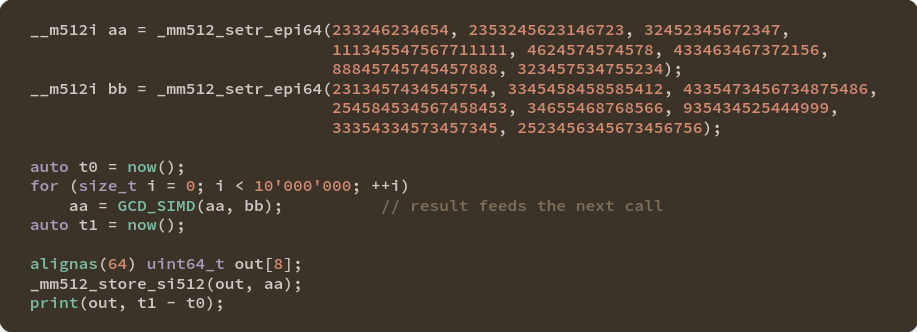
A reader sent me a small experiment.

Fresh insights on low latency and high frequency trading. Mostly new relevant technology, C++, FPGA, Verilog, tutorials, short notes and of course, rants. Problem subscribing? Try https://lucisqr.lemonsqueezy.com/buy/c78e2dd6-81c0-44cd-bfa3-13db7158a050
Live Last read · last published · next check
Saves to your Listen queue, to pick up on another day or another device.
A reader sent me a small experiment.
Lay the three side by side: unique_ptr is eight bytes and cannot share.
A few years ago I was looking at some performance graphs and I got surprised to see that I got a huge performance hit when replaced my homegrown smart pointer with the STL std::shared_ptr and kept wondering why since these should be mostly equivalent.
Many C++ developers have a pretty good idea about measuring micro-events - but if they don’t, we wrote another article just about that a few months ago: Microbenchmarking is tricky!
If you liked it, here is another one!
Compile time is one of the bottlenecks HFT engineers notice every day.
In Part 1 we covered why shared L3 cache is the silent performance killer in multi-workload systems, and how Intel's Cache Allocation Technology (CAT) and AMD's Platform QoS let you carve up the LLC into isolated partitions using Classes of Service (CLOS) and Capacity Bitmasks (CBM).
Someone on the desk asks whether we should be putting concepts on the hot path.
LLVM is one of the most performance-obsessed C++ codebases on the planet.
I put every struct-size rule C++ engineers memorize on five machines and eleven toolchains.
The Version You Can Copy Is Not.
Internally a hive is a linked list of blocks with geometrically growing capacities.
Map the same block of memory twice, right next to itself, and a ring buffer’s wrap-around just… vanishes.
A paper that went up on arXiv two days ago reports that inserting 500,000 keys into a deliberately overloaded C hash table takes 271.5 seconds with linked-list buckets and 121.2 seconds with “hybrid-batch” buckets.
AMD formally launches Zen 6 on Tuesday, July 22, leading with the server part, and by Wednesday the coverage will have mixed the keynote numbers, the leaks, and two-year-old news into one undifferentiated pile.