
Imagine being called Charles Dickens Junior, and trying to live up to that name, all while being stifled by the shade of your unbelievably famous father. Charles Culliford Boz Dickens, suffered from that comparison all his life. He was the eldest child of Charles and Catherine Dickens, born on 6 January 1837, at his parents’ first marital home, in Furnival’s Inn, London.
The new baby was known affectionately to his parents by his middle name of ‘Boz’, the pen-name chosen by Dickens when he was a young journalist breaking into fiction writing. Some years later, as Dickens gave all his children strange nicknames, he became known as Flaster Floby. To the family, he was Charley, to distinguish him from his father. Charley’s birthday, 6 January, was an important date in the 19th century, as it marked Twelfth Night, the final celebration of the 12 days of Christmas. Every year, Charley’s birthday would be marked with great excitement, as a double celebration.
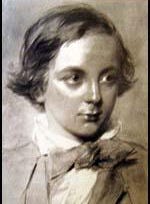
In January 1842, just a couple of days before his fifth birthday, Charley’s parents left him and his three younger siblings in the care of their uncle Fred Dickens and the family’s servants, with daily trips to the house of William[1] and Catherine Macready, who had offered to stand in loco parentis.
Before they left London, Catherine Dickens was presented with a beautiful, circular sketch of their four children – and Dickens’s pet raven Grip – by their friend Daniel Maclise[2]. Catherine was to keep it with her all around America and Canada. The picture now hangs in the Charles Dickens Museum in London. The children, all so young but so perfectly dressed like mini-adults, sit upon tasselled cushions in contented harmony, with an enormous book in between them. Four-year-old Charley is distinguishable purely by dint of being the oldest of the four, as he is wearing an off-the-shoulder dress that makes him – to modern eyes – look like a female child. It is an enticing picture that draws the viewer into the children’s world and their personalities shine through (with the exception of Walter, who is still a small baby, albeit a baby in a magnificent hat). Charley appears confident and is the only one looking out at the viewer; Mamie looks good and pensive; and Katey seems to be cheeky and pretty.
The children did not see their parents again for six months, because they had left for a tour of the USA and Canada. When they arrived home, unannounced so they could surprise the children, Charley was so overcome with emotion that he fell into frightening convulsions.
After their return home, Charles and Catherine were visited by a friend they had made in the USA, the poet Henry Wadsworth Longfellow. Following his stay, Charles Dickens wrote to his friend with amusement: “After you left us, Charley invented and rehearsed with his sisters a dramatic scene in your honor [sic], which is still occasionally enacted. It commences with expressive pantomime, and begins immediately after the ceremony of drinking healths. The three small glasses are all raised together, and they look at each other very hard. Then Charley cries ‘Mr. Longfellow! Hoo–ra–a–a–a–a–a–e!’ Two other shrill voices repeat the sentiment, and the little glasses are drained to the bottom.”
Although his fifth birthday had been celebrated without his parents, Charley’s sixth birthday was one that would be remembered in the family for years to come, because one of his presents was a magic lantern. Some months later, the family spent the summer months at Broadstairs in Kent, where Charley fell in love with being out at sea. His father wrote to his friend Angela Burdett-Coutts[3], “Charley is so popular with the boatmen, that I begin to think of Robinson Crusoe, and the propriety of living in-land. I saw him yesterday through a telescope, miles out at sea, steering an enormous fishing-smack, to the unspeakable delight of seven gigantic companions, clad in oilskin….”
In common with all the Dickens children, Charley travelled more widely than most Victorian children. When he was seven, the family moved to Italy for a year. Charley did, however, miss out on living in Switzerland and Paris with his family, as by that date he had started attending King’s College School in London. This was paid for by his godmother, Angela Burdett-Coutts, who also paid when he went on to Eton – the only one of the Dickens children to do so.
Charley’s childhood was affected and influenced by the regular births of younger siblings (including the death of his baby sister, Dora), his own dramatic brush with death, when he contracted scarlet fever, and long summer months spent with his family on the beach at Broadstairs, in Brighton, on the Isle of Wight, and in France, where they all learned the language. He also spent several of his school terms feverishly learning lines for the next ‘family theatrical’. These were always performed in the school holidays and were elaborate occasions, with wigs and costumes rented from professional theatrical costumiers, actors including Dickens’s friends, and an audience selected by special invitation.
Comments
Nothing yet. Say the first thing.
Sign in to join the conversation.