
I wrote this book for Thames & Hudson, in association with the National Archives at Kew, London. It was a fascinating subject to research, and involved visiting the collection of historic wallpapers at the National Archives – and, yes, we did have to wear gloves when handling them, to protect our skin from arsenical dust.
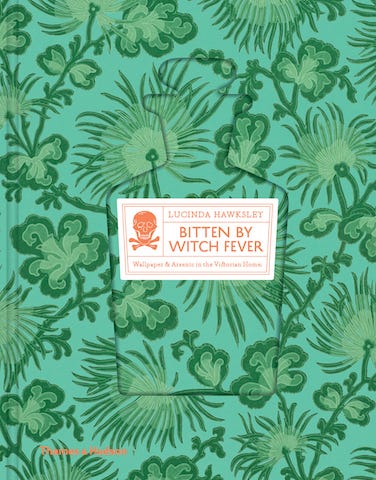
The archives’ scientists tested the wallpapers in their collection for this book, and I think it surprised all of them, as well as me and the publisher, to discover that it was not only the expected greens and blues that were laced with arsenic, but almost every single colour. The design of Bitten By Witch Fever was absolutely beautiful, and the book won accolades quite rightly. It states that the wallpapers in the book were reproductions of those in the National Archives’ collection. Astoundingly, some people seemed to believe this meant the book also contained arsenic! (Yes, they are faithful reproductions, but not that authentic…]
Extract begins:
Throughout the 19th century, arsenic was big news. It was written about constantly in magazines and newspapers – and it was also dangerously ubiquitous in Victorian homes. It would take many decades before people were willing to accept that the arsenic found in their cleaning cupboards and papered onto their walls was just as dangerous as that being cited in numerous murder enquiries.
By the end of the 19th century, the idea of poison being “a woman’s weapon” had become a journalistic cliché. Of all the poisons, arsenic was the most easily available and the most useful for a would-be poisoner, being tasteless and highly effective. Until the nineteenth century, the majority of murders had been attributed to men, but with the realisation that arsenic could permit even a frail, elderly woman to become a murderer, a strange interest was excited in the public consciousness, and arsenic murders began to gain something of a cult following in the newspapers. Stories abounded of arsenic being served in something as seemingly innocuous as a cup of tea. Until the law changed in 1851, it was possible to buy arsenic without restrictions from a variety of shops and business; it could even be purchased by post. The most common reason given for buying arsenic was to kill vermin.
Thanks for reading! This post is public so feel free to share it.
As the nineteenth century progressed, increasing numbers of doctors began dabbling in forensic science and those who were called upon as expert witnesses in court cases became celebrities, especially at murder trials. They would be called upon to offer their opinion on whether someone had been deliberately murdered or had ingested arsenic by mistake and the court illustrators would make the doctor’s face famous in the newspapers the following morning. The reason for confusion over whether arsenic poisoning was murder or an accident was because a number of foods naturally contain arsenic, and the amount of arsenic increased dramatically for those foods grown around certain types of mines.
As those murderers who successfully dispatched their victims with arsenic understood, it was an exact science to manage to carry out a successful homicide: too little arsenic would make someone ill, but would not necessarily kill them, and of course it could make doctors suspicious; too much arsenic usually had the effect of making the victim vomit so violently that they would expel the poison out of their system before it could take full effect. As early as 1844, the French writer Alexandre Dumas commented on this in The Count of Monte Cristo:
“Amongst us a simpleton, possessed by the demon of hate or cupidity, who has an enemy to destroy, or some near relation to dispose of, goes straight to the grocer’s or druggist’s, gives a false name, which leads more easily to his detection than his real one, and under the pretext that the rats prevent him from sleeping, purchases five or six grammes of arsenic—if he is really a cunning fellow, he goes to five or six different druggists or grocers, and thereby becomes only five or six times more easily traced;—then, when he has acquired his specific, he administers duly to his enemy, or near kinsman, a dose of arsenic which would make a mammoth or mastodon burst, and which, without rhyme or reason, makes his victim utter groans which alarm the entire neighbourhood. Then arrive a crowd of policemen and constables. They fetch a doctor, who opens the dead body, and collects from the entrails and stomach a quantity of arsenic in a spoon. Next day a hundred newspapers relate the fact, with the names of the victim and the murderer. The same evening the grocer or grocers, druggist or druggists, come and say, ‘It was I who sold the arsenic to the gentleman;’ and rather than not recognize the guilty purchaser, they will recognize twenty. Then the foolish criminal is taken, imprisoned, interrogated, confronted, confounded, condemned, and cut off by hemp or steel; or if she be a woman of any consideration, they lock her up for life.”
Of the number of deaths by arsenic which filled the 19th-century newspaper columns, there were several which not only captured the public attention at the time, but have remained notorious ever since.
Extract ends.
I will be writing about these murder cases in upcoming Substack articles. Find out more about the book itself here: https://www.lucindahawksley.com/books/bitten-by-witch-fever/
No posts
Comments
Nothing yet. Say the first thing.
Sign in to join the conversation.